 | DrumBeat: January 18, 2009 | The Oil Drum | Do you agree that President Obama should significantly raise US gasoline taxes during his term in office? |  |
A Trip to Todd's
Posted by nate hagens on January 18, 2009 - 12:36pm in The Oil Drum: Campfire
Below the fold is a 'Campfire' submission from Todd Detzel, posting for many years on TOD as 'Todd -a Realist'. Todd has a BS in chemistry but moved into mostly process development and chemical engineering including starting-up new facilities. He was a chemical plant manager before moving to the country in 1974. Since that time he has been everything from a small-scale certified organic grower to home designer and builder. He is now retired.
Though not precisely what I had in mind for the Campfire series, Todd's story about being (reasonably) self-reliant might be a good starting point for discussions about what is/isn't possible about individuals becoming less dependent on fossil fuels even if society is slow to do so. From my perspective it is about wide boundary thinking, and an acceleration of timing (before retirement) of trading financial capital (and time) into real capital (in this case, equipment and human knowledge necessary for renewable procurement of basic needs). As someone who still has a foot in both the old and new paradigms, I'm not even sure what skills will be needed in the next generation, but declining net energy suggests more physical labor, and declining per capita wealth suggests increased focus on basic necessities. Ultimately there is a spectrum between a high-rise city dweller and Todd's story below. We can't all live the way he does, but I suspect there will be a shift in that direction in the years ahead, as more built capital created by fossil fuels is aggregated in the private sector without intent for financial profit, but reliance. How big a shift, and for how many is an open question.
A Trip to Todd’s
Background
My wife and I have lived in this area since 1974 and at our current place since 1979. We’ve been married 48 years and chose not to have children at a time when children were an expected part of marriage. We live on 57 acres at an elevation of 3,060’ in the Coast Range Mountains of northern California. Our climate is more mid-western than Californian. We usually get snowed in for a week or more every winter – often more than once – even though we are only about 20 miles inland from the Pacific Ocean.
Getting Here
Pam and Joe Jones will be visiting us today (who are a composite of many visitors including ones we’ve had at open house’s.). Here are the directions I gave them:
You turn right off the two lane state highway as you are heading north onto a narrow dirt and gravel county road. Be prepared to stop at a wide spot if you see a pick-up truck coming down the road. A few miles up, take a turn to the left onto our private road and keep going up. It’s a mile to our house and you will have climbed about 1,500 feet in elevation from the state highway by the time you get here.
About a half a mile up the road you’ll see an acre pond on your left and a few hundred feet further on, a house on the right and a cabin of the left. The house is a rental of ours. The people who own the cabin come up once a month or so and are good friends. The level of the pond is really worrying because it is so extremely low for this time of year.
Todd’s View of the Future
Pam: Gawd, you really are in the middle of nowhere.
Todd: Well, from a country perspective we are in suburbia. We have friends only five miles away who have to ski or snowshoe a mile just to get to their truck a month or more during the winter.
Joe: We want you see everything but first I’d like to know how you see the future.
Todd: I am very negative about the future. First, there is population overshoot. Second, there is peak energy; peak resources really. Third, the financial sector and debt in general will preclude many needed actions. Fourth, the media and politicians are withholding the truth. Whether it is intentional or not doesn’t matter. Only a minority of people has considered how all this might play out and the changes that are necessary. Finally, the federal government blew two chances to prove that it could respond appropriately to crises when it totally blew off Katrina (a non-pun) and approved the financial industry bailout. I believe there will be a rapid collapse, although I prefer the term “devolution” or “cascading defaults”, within the next few years. Probably, in 2-5 years.
Joe: Fast crash? Boy, are you in the minority.
Todd: That’s the way it goes. I don’t live my life based upon what other people think. Further, because of a plant disaster that killed 15 men and some other incidents I personally experienced in the chemical industry, I do not take risk lightly. People who think that what is coming is a joke may starve and lose all they have. The good times are not coming back. It’s going to be the permanent depression. If you don’t have it right now, you probably will never have it.
Joe: But what about mitigation? I’ve read about biofuels and other ideas to conserve fuel and energy.
Todd: The mitigation ideas that people have proposed are too little, too late. All of these ideas, financial, energy, whatever, are an effort to maintain some form of business as usual when what is needed is a radical change in how people live and work and how governments govern – or not govern. And, this is not going to happen in time. It’s going to be up to individuals and families, maybe neighbors, and, perhaps, communities to take action and responsibility; although I don’t hold much hope for community solutions except for very small communities.
Self-sufficiency versus Self-reliance
Joe: Well, from what I can see, it looks like you’re pretty self-sufficient.
Todd: I hate the term “self-sufficient.” Damn, I sound like a grumpy old man don’t I… but you know better. Anyway, it implies that I can supply all of our needs at our present standard of living. Anyone who takes the time to think about it will quickly realize that there are a number of things that we are not going to provide for ourselves. The term I prefer is “self-reliant.” To me, it’s like the old mountain men: They could do just about anything and could survive on very little but they still had to rely on the outside world for things like gunpowder, metal objects such as traps and knives and flour. But, if necessary, they could make do for extended periods and that’s my goal.
My intent is to buy time by having a variety of alternatives; Plans B, C and D, if you will, with each one at a lower living standard, requiring more labor and more survival skills.
Alternative Energy
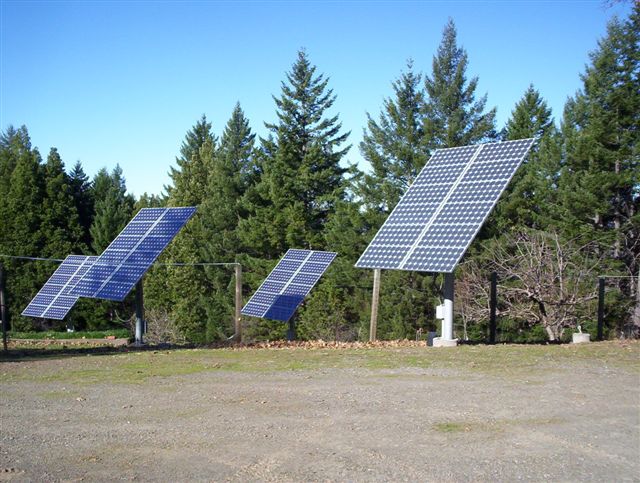
Joe: Well, on that happy note, since we’re standing by a PV rack, I’d love to hear about your power systems.
Todd: We are on the grid. In fact, we’re the last people on the grid in this area. One of my concerns is that the power company will abandon this area in the future after a major storm breaks the lines because it simply won’t be economical to repair them for the few customers they have in this area especially given the cost of fuel, parts and the distance the repair trucks have to travel to get here.
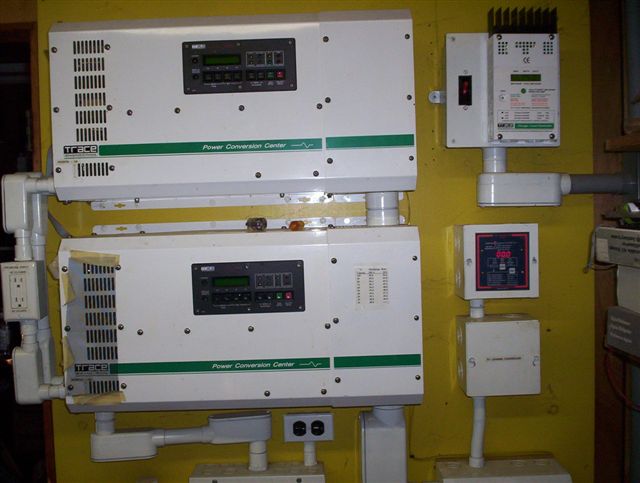
Because our power has always been flaky, I installed this 3.6kW PV system and a large battery bank in 1999. We used the California buy-down program to pay for a little bit of the system PV system. But, the cost was still close to $30k including the batteries. The battery bank has desulfonators to extend its life. There are 32, L-16, 6 volt batteries wired for 48volts DC in four banks. We have dual Trace (now Xantrex) 5548 inverters so we can have 220volts for the well pump, stove and water heater. They each can each handle 5,000watts at 110volts or 10kwatts at 220volts. We are not grid tied since we would have to give up our time of use electric meter. To date, we’ve actually used 2megawatt hours.We also have two back-up generators, an 8kW continuous output gas one and a 23kW three-phase diesel generator. If little gasoline or diesel were available, I would convert one of the generators to wood gas. I should add we’d do the same thing for at least our 4x4 pick-up.
I also used to have a 1.5kW Whisperwatt wind generator but finally sold it. It was only on a 40 foot mast and I chose the wrong location. I would have had to move it about 500 feet and gone to an 80 foot mast. The trenching alone would have been a pain since it would have crossed a number of existing underground power lines, phone lines and water lines.
Joe: Let’s get down to power usage. I had assumed most people up here used propane for hot water.
Todd: I guess it is surprising that we have a 40gallon electric hot water heater. We either use the grid or the PV system to run it. When I replaced our old water heater years ago, I debated between a propane, tankless one or to continue to use electricity. I chose juice because I can make juice but not propane.
Joe: I’m curious, you say your PV system is 3.6kW, right? Ok, then how do you run a 40 gallon electric hot water heater which I know can draw up to 4,500watts? Doesn’t it suck your batteries dry?
Todd: Well, there’s a trick. I decided to try running it while I watched the battery voltage so it didn’t drop too low. I’d run back and forth from the shop where the inverters are, into the house to turn the juice off. I found that there was a rough time interval between on and off. Then I had an idea, why not just put a cycling timer on the water heater. Success! Right now it’s set for 10 seconds on and 13 seconds off. The timer (Omron HC3R) sends a signal to a 220volt relay to turn the power on and off. Incidentally, we don’t keep the water heater on all the time. I installed a standard duplex 220volt switch on the wall outside where the heater is and I also installed a thermometer on the outlet of the tank. When we want hot water we look at the thermometer and then turn it on if necessary. I also included a pilot light by the switch to remind us to turn it off.
I do have a back-up water heater in storage. It’s only seven gallons but that’s plenty to get by with.
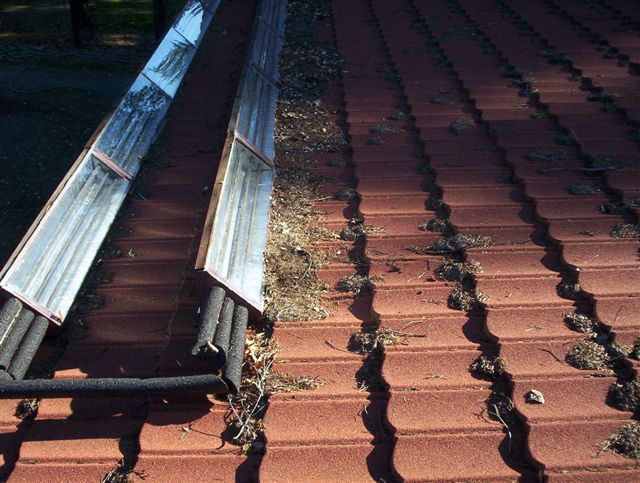
There is also a solar hot water system. The commercial units that are 4x8’ or so would really have looked terrible sticking up so I designed my own. They are semi-concentrating. They are each 8” high by 24’ long and rest directly on the roof. My two just about equal a standard panel in area. We get a 50 degree F rise in early spring and late fall which brings the temperature up to around 100-110 degrees and a 90degree rise in the summer that brings the temperature up to 140-160 degrees. This system runs off a standard timer but is also set up to use a differential temperature controller.
The differential temperature controller is really used by the heat exchanger in our wood heater. If we have a lot of fires, we often have to dump hot water. I blow down the solar collectors for the winter so they don’t freeze since they don’t self-drain.
Household Heating and Cooling
Pam: It seems like you have your electric power covered but what about heat? No one wants to be cold.
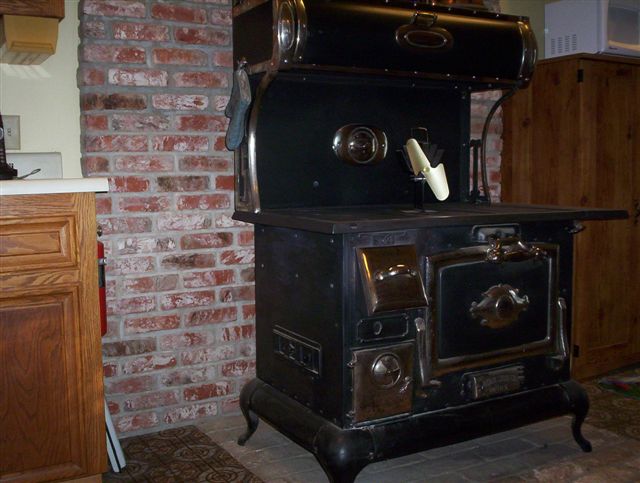
Todd: Wood is our main source of heat. We have a wood heater in our living room and we use the 6 burner wood cook stove in the kitchen if we just want to take the nip off the air in the morning. But, as you’ll see, we also have a standard electric range. – but, I’ve even cooked a turkey on the PV alone!
I cut the wood on our property. We burn 2-3 cords of wood a year. We do use a couple of small electric resistance heaters in our home offices and one in the bedroom if it’s really cold. Normally we get by with a down comforter in the bedroom.
Incidentally, we have a small wall AC unit that we run off the PV system during the day in the summer. It’s 8,000BTU and does a good job. I do have to admit though that we run it on the grid a few nights during the summer when it’s really, really hot.
Joe: What kinds of saws do you have to cut firewood?
Todd: Well, on gas chainsaws I have a 32”, a 24” and 2-16” ones. Then I have 2-16” and a 6” electric chainsaws that I could run off the PV system or the gas generator. And, if push comes to shove, 2-two-man 7’ misery whips, a couple one-man saws and bow saws for small stuff
And, naturally, I also have an assortment of wedges and splitting mauls but my primary splitting tool is a 30ton hydraulic, gas-powered splitter.
Water
Joe: By the way, looking at your garden and orchard, I assume you have a well. Hell, you’re on the top of a mountain in the middle of nowhere. What else would you have? How deep is it and how much does it put out?
Todd: Actually, I know a number of people who pump water from springs far below their houses. But, we do have a well. Ours is 450 feet deep with a 2 hp submersible pump and we get about 12 gallons per minute. We can run it on the PV system to fill the pressure tank but not for irrigation where it runs continuously. It’s not unusual to run it for 8-10 hours straight when I irrigate the orchard. We also have 4,700 gallons of water storage tanks; 1,000, 1,200 and 2,500 gallons. These are useful when there is a power outage since we have a 1/3hp pump that is fed from the largest storage tank and can be run on the grid, batteries or generator so we have household water. In the beginning, we hauled water in buckets if the power went out. These tanks also serve our rental and our neighbor’s cabin down the hill. By the way, I still have the 12volt DC water pump we used to use with our first, little, PV system. It’s a back up now.
You know, I did a workaround on the well pump too. Ok, it can’t pump continuously on the PV system but it will run through a pressure cycle if the batteries are full. What I did was to feed a solenoid via the pressure switch. The way it works is that when the pump is running, the solenoid closes an adjustable flow rate solenoid valve that leads to the storage tanks. When the pressure switch turns off the pump and the pressure tank is full, the solenoid opens the valve to the tank. By adjusting the flow rate, it allows time for the batteries to recharge and then the cycle repeats without over discharging the batteries. It isn’t fast but it can fill the storage tanks. I try to never discharge the batteries more than 20% of full charge.
Incidentally, I have a back-up well pump in storage too. But, it’s only 1 hp. It’s virtue was that I got it really cheap.
The Garden and Orchard
Pam: Going back to the garden, can you sort of give us an overview?
Todd: There are about 2 acres that are fenced and we use about 1½ acres. A lot of it is devoted to tree and vine crops. On tree crops, we have 4 varieties of pears, 4 varieties of plums, 2 varieties of peaches, 16 varieties of apples, 6 varieties and species of nuts and 2 varieties of persimmons. I guess there are about 50 trees in all. Then we have 6 varieties of grapes. And, finally, there are 15 varieties and species of berry and cane crops.
On the veggie front, we have about 2,000 square feet. About half of it is wood-framed raised beds and half are terraced into the hillside. I began converting the raised beds to terra preta three years ago. Since we heat with wood, I always have small branches with which I can make charcoal. I add charcoal each year.
Although I was once a certified organic grower, I now sort of split the difference between chemical and organic practices. At 70, I’m into doing things as easily as possible and making compost isn’t one of them. I use a combination of mulch growing (alfalfa hay-which I buy- and shredded paper), terra preta and fertigation (injecting soluble fertilizer into the irrigation water) using standard, soluble 20-20-20 fertilizer with trace minerals. I do add things like rock phosphate, greensand, glacial rock dust and oyster shell flour or gypsum depending upon the crop. I try to keep a 2-5 year supply of these things on hand plus things like oil and copper sprays for the orchard.
I turn the mulch under in the raised beds by hand using a long-handled spading fork in the raised beds and then I till everything in using a mini-tiller to break up the old mulch and new charcoal. I use a rear tine tiller for the terraced beds. I also use the mini-tiller as sort of a seed drill. I broadcast the seed (winter wheat or cover crop) and then run the mini-tiller over it really fast to work the seed into the soil.
As I said, I don’t use cover crops on the raised beds any more because they are a pain and don’t work well for me. Our soils stay too cold in spring for them to breakdown before crops are planted. However, I do use cover crops on the terraced beds because the soil isn’t great and I plant crops later when the soil is warm. I used to use a mix of fava beans, hairy vetch, cowpeas and oats from Peaceful Valley Farm Supply (Groworganic.com). Unfortunately it began to cost too much; over $2 a pound by the time it got here. I’m now using Montazuma oats that I can get cheap at our farm supply. I have about a four-year supply on hand.
But, here’s a neat trick if you ever plant large quantities of legume cover crops. Wet the seed with milk in a pail or a portable cement mixer, then add the inoculant to coat the seed, dump it on a tarp, let it dry enough to be able to handle it and get it planted. This way you can be sure that every seed is coated and you don’t waste an expensive product.
I’m also revisiting hydroponics. We grew organic hydroponics years ago using 5 gallon grow bags and a major overhead support system for a number of 6 foot long grow bags for strawberries suspended from the overhead. This time I’m using inverted 3 liter bottles with the bottoms cut out attached to a “T” post. I did bush beans this year as a test and will set a bunch of new ones up for strawberries this spring. The idea is to mimic a commercial unit called a HydroStacker.
I have to admit that I don’t grow what I would grow if we were on a survival footing – much less on the scale necessary. A survival garden would be corn, beans, squash, potatoes, tomatoes, some quinoa and winter wheat along with greens, some peas and I might include some “edible” soybeans I grew years ago. Oil would come from sunflowers. Although I do grow some of these crops every year, I also take space for things like watermelons and cantaloupes that are fun to have. Most of the veggies are open pollinated so I can save the seed from year to year but corn would be another matter. I usually grow hybrid sweet corn because it’s so much better. But, I also grow a little bit of open pollinated corn just to keep the seed viable. I have everything from field corn and popcorn to flour and meal corns. The flour corn is a pink Hopi variety and the meal corn is a blue Navajo one.
Food Preservation
Pam: I suppose you preserve a lot of the food you grow.
Todd: For sure. And, actually, I do most of the preserving, not my wife, because she has shoulder trouble. We, I, hot water bath/steam can, pressure can, dehydrate, juice, freeze and simply store things like Hubbard squash and potatoes in a cool area. We also can or freeze some things we buy at the store. For example, we never have had good luck with broccoli and can buy it cheaper at COSTCO. So, we get a big bag, blanch it and freeze it a few times a year. A good thing to remember is that people need about one quart of fruits and one quart of vegetables a day…that’s a lot of canning jars or freezer bags.
We also buy things in bulk like wheat berries, bread and AP flour, oatmeal, popcorn, olive oil, salt and sugar. We store these in 50 gallon used olive barrels. These are great since they are food grade and have a screw-on top with a gasket so nothing gets in. We have six barrels. By the way, I always put the grains and flours in the chest freezer for a month or so to kill any Indian Meal Moth eggs.
We buy meat “in bulk” too, either from COSTCO or when a chain store has it on sale. We have an 8 cubic foot chest freezer, a 25 cubic foot upright and 7 cubic feet in our refrigerator/freezer. And, I try to keep them packed full. By the way, I vacuum pack all of the meat using a Food Saver. The meat keeps well for several years. But I also pressure can things like chicken breasts and browned ground meat.
Finally, we have a 6x10 foot pantry for canned goods. We don’t eat much processed or canned food but we do need some things like molasses that I use in the bread I bake and a place to store things we’ve canned.
Joe: (With a wink) You putting TP into those olive barrels too?
Todd: (Laughing) Actually, the hole is too small for the big packages I buy. The TP is in a huge, square plastic trashcan with wheels. You never know when time will be of the essence and those wheels will come in handy.
The House
Pam: Wow, those are the highest sliding glass doors I’ve seen.
Todd: Yes, you don’t see many 8’ high sliding glass doors in houses (the wall at that point is 12 feet high) but they fit into my design for a house that was partly solar heated and didn’t impact the wisteria overhead above the patio to block the summer sun. In fact as you’ll see from the front, almost half of the south wall is 8’high sliding glass doors plus another 45 square feet of windows in the kitchen. By the way, the house is 82’ long and, essentially, one room deep. It has 2,200 square feet plus another 200 square feet of what looks like a porch in back but is actually a covered firewood storage area. It’s sort of interesting that the garage/shop is about 1,800 square feet. My only come back for its size is that only 600 square feet has a concrete floor – much to my wife’s displeasure.
Here’s the deal on the house; I’ve been interested in alternative energy and energy efficiency since the late 1960’s. One of the things I did after leaving the chemical industry was home design and construction. Our current house is the last one I did.
Our climate precluded a fully passive heating system and an active system would have had to be huge and expensive. Instead I settled upon what we could afford which was about 30% passive heating, the rest of the heat coming from wood. Although it may not sound impressive now, the house has R-47 roof insulation, R-20 walls and an insulated slab. But, it was cutting edge twenty-seven years ago. There were lots of other energy saving things I wish I could have done but this was really a budget design. However, we did have enough money for a funky solar water heating system (coils of NSF poly-pipe laid on the roof) and the heat exchanger in the wood heater. I also put in a little PV system; all of 77 watts, a couple of truck batteries and a 500 watt modified sinewave inverter. Not bad for that long ago.
It’s Not Always Wonderful in Paradise
Pam and Joe: Ok, we’ve seen what you’re doing and have done. What does it take to duplicate what you have been doing for more than 30 years?
Todd: I wish I could give a simple answer. But, the truth is far, far more complex. Maybe it’s like people going through rehab; you have to reset your reality. Our city friends come up here and see this and the physical stuff first and say, “Oh, Wow!” What they don’t see are the psychological adjustments and skill-sets that made this possible. And it’s one of the reasons I don’t hold out much hope for the future; many people won’t be able to pull off this kind of thing even in a more developed area.
This isn’t suburbia with large lots or even exurbia. This life of ours is really a different reality. One of the things we often hear is, “What do you do for fun?” Meaning how do we spend our leisure time. There is no leisure time. At the same time it is all leisure time because we are doing what we want to do. Does that make sense? To give you an idea of what I mean, I’ve been to exactly two movies in the last 30 years. I hadn’t even been in a multiplex until we saw An Inconvenient Truth. And, we stopped getting TV years ago.
Then there are real life threats; perhaps not every day but often enough that they live in the back of your consciousness. A number of years ago we had several mountain lions around. I used to drop my wife off at our gate a mile down our road when I went to work and she would walk back up for exercise but she eventually became uncomfortable and somewhat frightened, like someone was watching her. Not too long after this I tracked a lioness and her cubs on a lower Jeep trail, up the main road where she walked and around our house. And, I have lots and lots of rattlesnake, bear, wild pig and rabid skunk stories.
In some ways, the real killer for non-rural people who move to a rural area is the necessity, the absolute necessity, to be self-reliant. This is where relationships begin to fall apart since there is no one on whom a failure can be affixed except the person who did the work (or said they could) and there usually isn’t the money to hire someone who knows how to do it. This also gets into sexism where one person or the other feels an area should be theirs exclusively because of their gender even if they aren’t good at it. Sometimes, it’s a perceived inequality in the amount of work done between men and women.
Here is a quick list of the various skill-sets needed: carpentry, plumbing, electrical (AC/DC), roofing, glazing, masonry, welding, engine mechanics, timber felling, soil science, pomology/viticulture, seed saving, compost making, animal husbandry, pest and predator control, canning, freezing, dehydrating and so on. Now, no one is a journeyman in all these things but they at least have to be able to determine when they are getting in over their heads.
Then there are inconveniences such as shopping. The nearest city with a few big box stores is 60 miles one way. The closest city with a wide selection of stores is 90 miles away. Hell, our post office box is a 15 mile drive each way. Or, if you have a kid, you may spend 1-2 hours a day hauling them to and from the school bus stop and the time it takes hauling them into town for some kind of special event or practice. And, doing it in rain or snow is stressful. Plus, it isn’t cheap.
There are other psychological stresses. For men, this is often the loss of their former status. No one gives a damn if you have a PhD or were once a company president. You are now just one of the good old boys in jeans and work boots and that is the standard to which you will be held. Up here, a person’s actions and word is who they are.
For women, it is the loss of their social circle and trying to rebuild one in an area where there isn’t much contact with other women on a social basis unless you have kids going to school or work in town.
Finally, to be comfy and to be able to do what is necessary to survive requires a very significant capital outlay for “stuff.” And, I don’t mean a few grand.
My experience is that most city people last five to seven years before the new wears off and they, or one of them, can’t stand the hardships anymore. And, old folks get caught by the reality that the medical system they may need just isn’t here.
It is a hard life but the rewards are more than worth it for those that make it.
Tell you what, let’s have lunch and then go out and enjoy the views before you go home. You can see a little bit of the ocean to the west if you get tired of mountains and valleys. I can go into a lot more detail the next time you come to visit.
Pam: I’d love to spend some time looking through your books (looking at one wall of the living room as we are going outside after lunch).
Todd: That’s only part of them. Both of our offices are full, too. I guess we have several thousand.
Joe: Yea, but I want to see your shop.
Todd: Next time, Joe. Next time. Plus, I never got around to some of the energy saving and prepping things we do.
Contact
- campfire at theoildrum dot com
Personnel
Archives
- November 2010 (4)
- October 2010 (4)
- September 2010 (4)
- August 2010 (6)
- July 2010 (6)
- June 2010 (8)
- May 2010 (9)
- April 2010 (9)
- March 2010 (8)
- February 2010 (8)
- January 2010 (9)
- December 2009 (8)
- November 2009 (7)
- October 2009 (7)
- September 2009 (9)
- August 2009 (9)
- July 2009 (9)
- June 2009 (8)
- May 2009 (9)
- April 2009 (9)
- March 2009 (9)
- February 2009 (9)
- January 2009 (9)
- December 2008 (4)
The Oil Drum: Local archives
- November 2008 (1)
- August 2008 (1)
- July 2008 (4)
- June 2008 (4)
- May 2008 (3)
- April 2008 (1)
- March 2008 (1)
- February 2008 (2)
- January 2008 (2)
- December 2007 (4)
- November 2007 (4)
- October 2007 (6)
The Oil Drum: New York City archives
- September 2007 (3)
- August 2007 (2)
- July 2007 (3)
- June 2007 (8)
- May 2007 (1)
- April 2007 (8)
- March 2007 (2)
- February 2007 (3)
- January 2007 (5)
- December 2006 (5)
- November 2006 (12)
- October 2006 (10)
- September 2006 (9)
- August 2006 (14)
- July 2006 (15)
- June 2006 (11)
- May 2006 (18)
- April 2006 (35)
- March 2006 (14)
- February 2006 (13)
- January 2006 (12)
- December 2005 (17)
- November 2005 (13)
- October 2005 (25)
- September 2005 (36)
License

This work is licensed under a Creative Commons Attribution-Share Alike 3.0 United States License.
wonderful ideas & yes inspiring; from just a quick scan. gotta run, i look forward to digesting later!
great to see Todd featured!
A very interesting read and I hasten to add my informed view is Joe is very accurate in where he thinks it is going- the minority is growing. We are still in the process of setting up in a similar way in Southern Tasmania, Australia and have many friends who have moved from mainland Australia for the same reasons compounded by climate change. South Australia is turning into a dust bowl and many new arrivals from the mainland come seeking cooler climes and steady rains.
We don't have it so cold as Joe but do have a farm with cattle, orchards, solar powered green houses [partly submerged with underfloor heating] and veggie patches in raised beds.
The house is heated by evacuated tube solar hot water combined with a a wetback wood stove. In summer the excess heat from the solar panels is dumped into the insulated storage tank in the roof to warm the summer evenings, which can still be cool via hydronic [water] radiators around the house. The system uses an experimental control box designed in conjunction with my plumber and his electronic engineer friend to monitor, control and reverse the water pumps as neccesary to optimise heat and reduce fuel use. But plan B involves turning dials ;)
In spring, autumn and winter the wood stove provides heat for the radiators and a boost for the solar hot water in the morning when needed.
So, I agree with Joe the hardest think you have to do to start the transition is to let go of the idea the status quo is going to be here forever, then making do or changing becomes easier.
Richard Heinberg has a nice phrase for it- "the consensus trance", just because everyone else is going along as if it is business as ususal does not mean that is the truth.
As is becoming more common to say, take the red pill and see how far the rabbit hole goes ;)
Just one little point - it's me, Todd, that's doing it not Joe.
My apologies Todd. Been up since 4 am working out in the paddocks so this was done over breakfast - before my caffeine fix ;) That is one thing I think I will miss so stocking up and weaning myself off the coffee.
Bingo! I'm from Adelaide now living in SW Tas. Contact me by via user profile if you want. BTW some new neighbours have the same backgound. I feel a bit guilty since I should be at the anti old growth logging protest 30 km up the road instead of reading TOD.
Hi, I would like to see some more pics if any are available?
-The passive solar house sounds cool -ties in with the current ongoing passive solar thread.
Regards, Nick.
Hi Nick,
I only sent Nate the four pics (and he only wanted 2-3 so I felt I was overdoing it already). Tell you what, perhaps you could email me detzel at mcn dot org what you're interested in. Be forewarned that it'll all go to my wife's computer, I don't know how to send pics, and she will be at a seminar all next week so it could be a while before you actually get anything.
On the other hand, if Nate says he'll post more, I'll run out tomorrow and have my wife send them to him.
Todd
Edit "Hick" to Nick. Oh, gee whiz. Sorry if you saw it.
Hi Todd,
Graeat article. I know that the TOD staff or Nate might disagree but this is exactly the type of submissions that Campfire really needs.
There is one big problem though and its shared by the current series on Passive Solar building.
No one has the time to do all this. To do the 'buildout' you would have to do would take lots of funds and enormous investment in time. So IMO and I think yours , most/many don't stand a chance because its far too late. The solar would be a show stopper for me. I can put up a small panel and run my ham rig or my laptop but getting sized up as you are...well I have to go around that. Lucky I have accessible water and enough woodlands. But I would real fast go into stock and chickens..hogs for sure. I haven't as yet but getting close to it.
If they were rich and could hire a lot done and find those with skillsets to construct and build what you have then perhaps but again
those skillsets are missing in many areas today.
For instance no one here in 1990 was able to build a loghouse from scratch. I couldn't even get someone to do the roof for it was 12 pitch. Laying logs? Forget it. Putting in 3 inches of pink foam on top of one layer of sheathing then another layer of sheating on top of the foam,,etc....no one.
Unless they started some time ago? It won't happen...but what can happen is a lot more scaled down sustainable method.
For housing? A house built into the ground. We call them dirt houses here and they are common. You just build and pour a basement and live in it. Easy to heat,easy to build. Then you start gardening. You go from there and just use wood for everything. No electricity. No Gas.
Pioneer style that would be.
Doable by many who have the strength, land and the desire. Yet there is much they would have to learn. Such as getting up wood, right types,water..etc.
Did I miss something on the pictures? I see none.
Airdale
Airdale,
Re. pictures - I friend called up to discuss what I wrote and he didn't see the pictures either. I don't know why. FWIW, they were of the PV racks, inverters, solar water collectors and wood cook stove.
Todd
They are now there.Just looked.
Airdale-looks like good engineering
I completely agree, airdale.
Absolutely. Few (us included) could even get out of the house they're in now to start anew somewhere. So we're stuck where we're at - and I think what would be most helpful is thinking through how to make the best of the current situation. For example, our house is oriented all wrong for passive solar and is one of those raised ranches (of which there are zillions in the Midwest) that are poorly designed for any other type of heating - like masonry stoves, for example.
We got quotes for solar electric last year, but what we mainly learned is that our money is best spent elsewhere - like more insulation and toward a couple of woodstoves. It did make me realize how little electricity we really "need" - absolute bare minimum - enough to power the freezer (loaded with locally raised beef, turkey and veggies from our own garden) and the blower for the furnace.
We do live on a bus line and could, if we had to, ride our bikes to just about anywhere we really need to go. And we live in a great neighborhood, where we and some others are helping each other improve the productivity of our gardens and learn to raise chickens. (Luckily our city allows that in backyards.)
Todd's example is interesting and instructive, but not very practical for the vast majority of us at this stage of the game...
lilith
There are reasons why I preach natural building, natural farming and community-based midro-energy programs. To parapharse, not many folks are an island.
Come together.
We can work it out.
He ain't heavy, he's my brother.
It takes a village to raise a child.
United we stand, divided we fall.
Neighbor, have you got a T-square?
If I had a hammer.
Kumbaya.
Cheers
Todd:
Thank you very much for sharing your viewpoints and the very special "house tour." There are a lot of "doomers" posting on peak oil sites, but I don't think I've ever seen such an honest discussion of the huge amount of work and preparation and effort that must be done to try to live off the grid. I thought your insights into the psychological aspects of such a decision were especially interesting. Good luck, sir.
--Plant.
My wife just noticed an error...the nearest place with a multiple selection of stores is actually 120 miles each way. I should have figured that one out since it takes 2 1/2+ hours to get there. (Todd whacks himself on the forehead.)
Do you actually need to go further than Willits (ca. 40 miles) or Ukiah (65 miles)? Is Santa Rosa really important for shopping options?
Jason,
You raise an interesting question? Now, I could buy almost all of our needs at our local market, Geiger's, and not go to Willits, Ukiah or SR at all. Why make the trip? I should add that we usually go to Costco in Eureka when possible. (This will mean nothing to people outside the area.)
First of all, I noted that I buy in bulk or on sale in my essay. Let me give you an example of cost: I bought a package of thick-cut pork chops at Costco for less than $3/pound. Geiger's, my local market, was $5/pound and it makes no sense to drive 30 miles each way to Willits for a few dollars...unless there are major savings on lots of stuff. And, I want to put my purchases into context - a typical Costco "run" is $300-900 and, in most cases, I'm saving over 50%. You have to remember I'm on SS plus a small state pension. I don't waste bucks.
Now, I've noted that I "stock up." I buy big quantities of stuff, especially at Costco or Trader Joes. I can or freeze it or put it in storage. The problem with chain stores is that their savings do not cover a broad enough area. So, I'll just keep doing what we are doing.
Good stuff, Todd. Thanks.
I'll try and hook up with you in a few weeks. Been tied up for a few months. (This is the first time I've been at the Drum since the election; must be cosmic). Started with my mom moving, and I've been going down to her place and bringing my father's hardware store up here. 60 years of collected nuts and bolts and nails and switches and everything one could desire. And all his tools. Cement mixer with 2 back-up electric motors fromo old washing machines. Etc.
Mike
Hi Mike,
Glad to hear you're back. Give me a call if you have a chance because I'd like to know if you'd be interested in our once a month lunch talk fest when the weather gets better.
Todd
For meat.
I envision a time when one will be able to 'open range' stock.
There was still some open stock in some areas when I was a youth.
My Gparents alwasy put chicken wire around the garden because we let chickens,ducks and geese free roam on the farm. They stayed close.
But with the demise of population it would be possible to ear cut your hogs and let them fend for themselves. Predators in your area may make that unfeasible but here it would work easily. For cattle you put a bell on the leader. The rest follow and you can 'call' the up of a morning and evening. Same with calling pigs and chickens and even horses. We always did that. They came for they knew they might get some feed.
We only had problems with chicken hawks and snakes. But not that bad.
I have already stockpiled some rolls of chicken wire for exactly this reason. I need more hi-tensile though. Can run it with a solar fence charger and its maintenance free for the most part. The hi-tensile I put up here 20 yrs ago is still in perfect condition. In-line strainers and good corner posts make it work and then I just put spreaders in most of the rest with an occassional post every 300 ft.
To my way of thinking its going to be hard to do full blown sustainable without animals. First for draft use ,milk ,fiber(leather) ,meat and manure for fertilizer.
Airdale
A fascinating piece, thank you Todd.
One little niggle. (I feel queasy talking about death, sorry)
Have you thought about inheritors?
It would be a shame to see a place like yours fall to ruin, because no one was there to run the place.
Lukitas,
Based upon my wife's family genes, it will be her decision. The longest any man on my dad's side has lived over the last 300 years is to 87. My wife's family typically lives close to 100 years.
Today I visited my first ancestors gravesite, still working on the indian heritage, and did some rubbings on the very eroded tombstone.
My GGGranfather lived to be 72 years old and fathered 11 children with his wife being 30 yrs younger than him. Died the same year.
I am 70 currently and I keep wondering if it is possible to keep this place up when I get to be 80? I really don't want to look and act like many oldtimers I see around town. I rather go out with some style but how I don't know.
So doing it with just yourself and maybe a wife? When you get really advanced in years? This is something I think of more and more...
As a result I tend to be extravagant in my daily lifestyle. If I want something I get it. Money is just going away soon so I am getting what I want right now while the getting is good. I do have good health but who knows what can happen. Today I fell off a log I was cutting in the brush. Lucky fall but the chainsaw could have taken my kneecap out easily if I hadn't landed just right.
I just purchases a $5xx rifle scope because I wanted something that would endure hardtimes and not something flimsly. Things like that. A 14 ft John Boat last year for fishing as a source of protein.
Airdale
This (and the economic collapse and likely loss of pensions, SS) is why I believe that the coming troubles will motivate people to have more rather than fewer children. Children are the social security and "retirement nest egg" for poor people the world over. And we're about to become much poorer here. I sometimes wish I'd had more than one. Luckily, he and his wife gave us three grandchildren - and we have close and warm relations with he and his entire family...
lilith
On Friday I was in a meeting and a woman asked this question to the group, "What is going to happen to all the old homestead properties? Will people start taking in younger families to act as caretakers?"
There was a wave of back to the landers in the 1970s here and now that generation is in their 60s mostly. Many have heirs that live far away now and are having more trouble or worries about living so far from services as they age. Interesting question and now ready answer. Perhaps a way to transfer wealth from the generation who could pay for stuff and build homesteads to a generation where the money system fails.
Thanks, Todd, and a couple of comments on this sub-topic,
1) Have you considered, if not inheritors, then something like - apprentices or "work/study" opportunities for students or other young persons? Even for a relatively short time? Or, do you believe this would interfere w. your privacy?
I've often thought there's a lot to be learned that can best be taught by tagging along w. someone like Todd. (And several other TOD posters.)
2) Just a FYI, in case this is helpful to someone: I happened to come across some legal information regarding CA property. (Disclaimer, I'm not a lawyer, etc. Just mentioning this in case someone wants to look it up.)
The CA Prop. 13 tax basis may be directly inherited, if one inherits a house (or other property to which the prop. applies) in CA. There's also another CA Prop. that allows a one-time transfer of this tax basis after the age of 55. It applies within one's county, and can be transferred to particular other CA counties, where applicable. This has a couple of implications. One is that a CA homeowner/resident after the age of 55 can sell, re-locate and (depending on location) take the old tax basis to the new property. Another implication is that someone can inherit and then, after 55, also move and take the tax basis w. him/her. Anyone, the numbers of these Props. are 55 and 60 (I forget which one is which). For long-time residents of CA property, the basis may be quite low, and passing it along may confer quite a large advantage. (This, of course, assumes that low property tax in order to facilitate ownership is a good thing.)
Hi Aniya,
I have considered having some short-termers but the reality is that there isn't enough stuff to keep anyone busy. Plus, I couldn't afford even a small stipend. The best I've been able to do is have an open house every few years.
Besides the above, a major consideration was liability. At the very least I'd have to have workers comp and I didn't want to get into that sort of stuff.
Todd
The way this worked in the past in the farm country here where I live is like this.
A single man without a farm would work for room and board. He actually lived with another family and worked as like a hired hand did but got just the living and food...later a small amount of money might go with it. But having nothing and needing something this worked well for all.
Later on you could go to a nearby town and those who wanted to work for the day would be sitting around the hardware store waiting. Some days they worked ,like building fence or putting up a barn, and some days they didn't and in this case had their own lodgings.
As a youth I might make a quarter a day chopping sprouts off in a pasture with a chopping axe. Or milking a guys cows how was sick.
Lots of this happened. Boys used to always earn some money hauling in hay. Or picking strawberry or housing tobacco or stripping it. The stripping like that still goes on today around here. Lots of women do it but slowly its going away.
So that was the olden ways. I saw it and lived it. Best if you raise your own children for its too much work for just a man and wife unless you got enough good land to bring in a hired hand.
Airdale
Todd's establishment seems remarkably well thought out and executed. I'm envious. Lots of hard work, skill (and money) required, things most of us lack. I'm wondering, though, come the hard times he anticipates what happens when stuff starts to break down, need replacing. What happens when a freezer line goes, say, and you have to drive 90 miles to get it replaced and then you can't get one? What happens when you run out of back-ups for this or that. Todd's homestead seems to have already a whole lot more technology embeded than most of us, all of which requires constant attention. Most of us get by farming out those technological inputs to a large number of other people. My point is that the more self reliant or self sufficient a household gets the lower the level of technology and comfort the household can support. Bottom line - we need each other.
Oldchuck,
Let's start with reality. I gave up several millions of dollars in income over the last 30+ years when I gave up the gravy train of the chemical industry. My estimate is $3-5 MILLION. Got that?
I didn't include a lot of stuff after moving to the boondocks in my bio but we made day wages. My wife worked in the lath shop of a lumber mill standing under a roof or walls with no heat while being blasted with sawdust and I was everything from being a custodian in a school to the foreman of our county grand jury and substitute teacher. We had no big bucks.
We prioritized our spending and gave up lots and lots of stuff that most people assume is a needed part of their life.
I am not mellow or laid back much less warm and fuzzy. We have this because we were willing to make do and if others don't, TS.
Todd
Todd, you mentioned that you are 70 years old. What do you plan for old age? Move to the city? Take apprentices?
Todd,
Thanks. Very interesting what you have done.
I see you as the complement to someone like myself. Everyone cannot do everything. For a set number of folks who are spending all their time growing as much food as possible (me) to sell/trade/barter with others there, will have to be one of you who trades their skills in self reliant power generation/refrigeration. This is the essence of the ELP concept. Another one of our neighbors will have to be the blacksmith (perhaps with a power assist from yourself?) and we will need a miller to grind the flour, a gunsmith, and so on.
Best of luck.
Wyo
Kudos Todd, a life to be proud of. Well done !!
Don in Maine
They way I figure is that we will be able to buy affordable small cans of chainsaw fuel and bar oil even when crude is gone. They can make it out of coal and still keep CO2 below 450 ppm provided everything else is carbon neutral. The hard part may be gathering cut wood from the forest without a ute/pickup.
Without replacing a resistive element electric water heater other tricks are to turn down the thermostat to 55C if possible, shield the heater from air flow, take 'navy showers', use cold water for other washing and use a timer to restrict current to a period within off-peak hours. However you don't want a catch-up current surge to flip the fuse (say 10 amp) on the timer.
Forget 1500w steam irons on clothes. After a quick shower and putting on a cold wash drip dry shirt you can almost look respectable.
I owned and Outdoor Power Equipment business after retirement. Took over from my father.
Its not the oil and gas. Those carbs have a limited life with the gaskets that are part of the fuel system...fuel pump and so forth. Also spark plugs. New chains. New bars. Bearings wear. Pistons seize up.
Hoses and gas filters in the tank become wornout. Air filter flocks lose their flocking. Clutch sprockets especially are prone to rapid wear. You can only use the bar and sprocket just so long. Even if you are very experienced in using a chainsaw and most definitely are not.
A worn chain soon produces a 'blued' bar which in turn wears the sprocket. Your looking at about $100 in parts and maybe more right there.
Airdale-ps it takes a large amount of fuel,mix and bar oil to seriously cut your winters firewood. Little cans might not get you there.
Very interesting story! Well done!
It seems to me that even with all of this work, if you were to lose grid electricity and gasoline/diesel, it would be very much harder for you. For example, tilling without a tiller, killing the insects without putting flour in the chest freezer, not being able to drive to town for various products you use in your garden.
The other thought is that an injury could put you out of commission pretty easily. It is easy to get a broken arm or leg. I doubt your wife could handle things by herself.
Gail,
Injuries aren't a joke! A friend of ours was cutting wood at a place where he is a co-owner. He screwed up. A branch or something came down, broke his arm and caused a concushion (sp) and required significant repair work. He remembers nothing.
I can understand this. Two years ago the snow brought down several trees. One of which knocked off the top of another trees but balanced on the stump - 20' in the air. I am hot to get that "free" firewood but I felt I might be killed if I did it wrong...so I did nothing.
Risk management on a personal level is a big deal.
Yes, these are problems. But there is a far worse one: suppose some level of gov't decides to tax you beyond what you can afford -- or attack you in even worse ways?
So while your experience is very interesing and valuable, I think it needs to applied by collectives to avoid Gail's points, and even more so in order that there can be collective political action to defend your right to exist. For it to be practical for the many, your way of life needs a movement behind it.
Like Todd I see a bleak future unfolding ahead and too many people just don't get it and refuse to see it. I am hopeful about the community I live in where there is a slightly higher than normal level of awareness, resiliency, resources both natural and human to tackle the down-slope problems coming our way with responsible/capable self-reliance and willingness to help one another. Still it will likely be touch and go and nothing will be assured.
In any event, I have come to similar conclusions about the need for different plans/preperations and being skilled in a variety of practical skills. Beyond that it helps to have a good home to start with.
My antique Cape (circa 1820) house has been fully renovated and insulated. It is a relatively small (1,700 s.f.) house, positioned to face south for good solar gain and out of the NW winter winds; plus the chimney runs thru the center of the house providing for a lot of thermal mass to hold and radiate the heat from the wood stove. With these three simple features it doesn't take a lot to heat and keep warm in my coastal New England location.
On the energy side it has long made sense to me (for different reasons at the time than I am now thinking of) to take advantage of solar system components available. My present solar configuration consists of the following:
1.5kW of PV (2 stationary pole mount arrays) + a Bergey 1500 windmill. 24V battery bank (also using pulse desulfator) with Trace 4024 inverter. Installed in 1996. This spring I will be installing a dual-axis track mounted array of 1440kW. I might also end up replacing my battery bank this year while I can do so.
Presently configured as off-grid/stand alone system -- powers 750 s.f. cottage office, not main house. Solar system will be grid interfaced after spring PV upgrade to benefit from excess solar credits generated while I can get them. Also plan to wire more solar dedicated outlets into main house and upgrade lights with LEDs where feasible.
Shallow well grid powered water pump is rigged to run off solar as needed in storm related grid outages. Can live with candles/oil lamps for night light, propane and/or wood stove for cooking and heating, but no water pump is a pain. Not for toilets as I am using compost toilet set-up, but water to cook & wash with. Should be able to conceivably run water pump off solar power for drip irrigation in main garden bed after solar upgrade during summer months.
A solar hot water system; interconnected 4x10 (24 yr old panel!) and 4x8 (5 yr old)collectors tied to 80 Gal. water tank with on demand elec. back-up. Solar gain works very well spring thru fall seasons but less so in winter. Should electric power fail I have a fall back masonry stove in cottage with water pipes in it to heat a 60 gal. water tank so could take an as needed shower there.
Wood stove primary heat source; ~2 to 3 cords winter use; presently supplemented with 1st floor radiant oil fired boiler; 250 gal. oil tank can last one heating season. Husbanding wood resource on own land -- fast growing black locust mostly. Have 4 to 5 cords of wood stashed beyond present winter need.
Have new fruit tree orchard planted, vaster garden potential than previously attempted which will be expanded over next 2 years. Garden produce is canned or otherwise preserved.
This is a broad outline of my present arrangements to try and comfortably survive the near term cascade of failures that may well beset us. Beyond these near term arrangements it's hard to know whether it will matter. Until then, Thanks, Todd, for sharing your campfire story which mirrors my own.
Godraz,
Man, I am truly impressed. In some ways you are better off than I am. I wish we were neighbors
In light of other comments made here I'd like to add the following about my arrangements:
I am well aware that my solar system is a choice that many can't afford. That I could and most can't is unfortunate. Ultimately I considered it sensible, not for any "survivalist" reasons, but many others -- most having to do with desiring to lesson my FF/nuke electric generation & carbon footprint; lending financial support to a hopefully better way/outcome personally and societally; self-education, diversification of ways and means, taking responsibility, role-modeling, etc.
By no means is it a perfect arrangement, nor one that I believe will protect me from the worst societal troubles that might occur. Yet for now and within the immediate foreseeable future it fulfills my needs and inclinations as I conceived them at the time.
God only knows what the future will bring. As Alan suggests, I could drop dead tomorrow, and will eventually. My choices have not at all been made out of fear for the worst, but rather what I conceive as at least one better way that I can do with my time and resources here and now, and pleased me.
Nor am I living in isolation, holed up from my community. I have no firearms stockpiled, although there are enough other tools and means to kill in a pinch. But I see no point to engaging much thought to such scenarios. I am fully engaged in my community, helping to spearhead municipal solar and wind projects that my community is trying to accomplish. Despite the difficulties I can envision overwhelming us, I am committed to helping my community avoid them if possible.
Still, my immediate family's welfare is my prime concern/responsibility. That my personal arrangements may provide an easier time of it -- depending on what happens in the future -- is useful and reassuring to me. (Storm related power outages are a regular occurrence where I live, and so my arrangements have already proven useful to get by those occasions with ease and comfort for me and my family.) Given such an ability to try and make easier some of the energy transitions ahead of us, who wouldn't or isn't trying to do so if that is what we sense lies ahead.
In the meantime Alakazaam below expresses well an understanding of this mindfulness that needn't be energy hair-shirt extreme, nor without enjoyment and quality of life, so long as it's still to be had -- even tho it carries a price of BAU to a certain and largely unavoidable degree. I'm doing what I can within reason -- and that suits me.
It seems to me Todd's done what he's done as seemed reasonable and useful to him and his circumstances. I am sure he is well aware of its imperfections as well as his own. If one doesn't care for his way, go make your own. Best wishes and hopes to each of you doing what you can to deal with whatever happens ahead of us. To each their own as they are capable, or luck and circumstance allows.
Todd,
I'm halfway between you and exurbia; it only takes me 40 minutes to get to a 'rural' mall.
Have you planted any nut trees?
How does your passive solar work out?
What food preservation techniques work the best for you?
Will,
It's almost 9:30 and is almost bedtime for me...yup, the boondocks are really where it's at for party-harty! I'll do something better tomorrow - Ok?
Todd-
Looks like I'm making the move to Mendo. Have been here before. I know It’s Not Always Wonderful in Paradise ( I'm a former Pt Arena resident).
Anyway, a good transition move----
That will be neat. Maybe we could get together some time. When we were looking for land out here we looked at the coast as well as inland. I like it cool but the fog drove us inland. I'd never make it in Pt. Arena!
Todd
Todd, see questions above. Here in the northern tip of Virginia, I've planted English Walnuts, Northern Pecans, hybrid Chinese/American Chestnuts, Hazelnuts, and Japanese Heartnut.
Will,
Sorry I missed replying yesterday.
Your questions:
Have you planted any nut trees? Yes. Filberts - not good yielders for us. Almond - also not good because of spring frosts. English walnuts - they do fine. Black walnuts - I just started putting some in a few years ago and they won't have a crop for at least five more years but they do fine in the valley so I assume they'll do OK here.
How does your passive solar work out? Well, it works in that I burn a lot less wood than a comparable house. As I noted in the body of the essay, my expectation was that it would provide about 30% of our heat. It does that.
What food preservation techniques work the best for you? They all work well and the one chosen is obviously the one that's best for the crop and end use.
Take apples for example: We freeze some for apple pies (vacuum packed). We juice some and these are canned and some are canned as apple sauce. I'll dehydrate some if we have a really big crop (not often).
In the case of meat: Some is vacuum packed and put in the freezer while some is pressure canned.
I hope this helps.
Todd
i agree with todds assement of the future and living out of the way is a good idea.Here in wyomings high desert we are aiming low,1840's ,horses,farm livestock,sawdust toilets,outhouse,garden,orchard,berry patch ,super-insolated passive solar earth bermed adobe buildings.30 years ago we did everything by the rule of three,flush toilet to septic tank ,composting toilet back-up ,outhouse as last resort.Same with all systems,third step has to be something that will not backfire.Over the years we have gone to step three with everything.Last year my daughter, son in law and kids moved down to join us-they brought a trailer to get by till we could add on to the adobe.After the trailer was set up my daughter opened the back door and out came the gass heater,then the water heater,then the garbage disposal,light fixtures,toilets--all thrown into a heep of worthless junk which we hauled to the county dumpand repaired to the bar to celebrate.
Computers and internet are 1840s ?
Alan
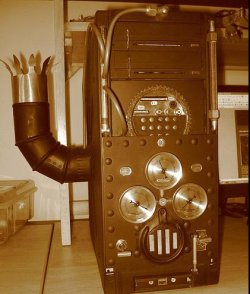
Behold the telecalculograph:
I find what you are doing to be very interesting, well thought out but very isolated. Having lived over the hills from you in Hyampom Ca., I know what it is like there. In my 65 years, the one thing I learned in going over the very same scenarios you have, is the the number one most important thing to do in a power down is to find a small community and lock in. Your situation is one that requires skills not reachable by very many people. You are mountain folks, isolated and on your own. In the coming years, and I do believe they will be in our lifetime, at our age we will need the help of others. I recently moved from our beautiful, off-grid, adobe home in the foothills of Colorado situated on a 5000 acre ranch. It was like living in Yellowstone park. But as we got older there came a time when the incessant rattle snakes, marauding cows, howling winds, lions eating chickens sent us reminders that 5 days trapped on a unplowed dirt road would ultimately prove to be just a touch more demanding than we wanted ---omantic as it was. It was about the endgame, as a friend reminded us.
While we have many of the same skills that you have, we now feel that small community is a place where we can still use what we have learned. Plus, here we have a multitude of friends, most of whom I would be happy to help and many who would help us. Everybody knows everybody. When times turn, we will not be left alone. I believe that to slug it out under even the first step down, your isolation would be far too over whelming for almost anyone. You have learned to be alone, to take care of yourselves but most folks could not last more than a week under your conditions even in the rich world of today. Here, I can take my fiddle down the street and find a half dozen musicians. I can still canoe the river. We secure most of our food here either in the garden, in the forest and rivers and local farms. I don't believe being alone cuts it.
In truth, I believe it is really too late for most folks to make many arrangements in a radical way. It appears that to me that relooking at ones present situation and making some sort of arrangements there might be the best choice. We all live in communities of one sort or another. Find it, improve it and dig in. If you live in a situation where you are surrounded by undesirables, vacate soon. Hard times will bring out untold amounts of bad behavior. There are many very undesirable areas and it takes little imagination to identify them. Take a map of the US and mark out areas of drought, Nascar popularity, religious fanaticism, and other peculiarities that disgust you and avoid them.
I like your idea of having a plan A, B, C and so on. I refer to them as say 1970, 1950, 1930, 1910, 1890 (basically Road Warrior days). Picture yourself going back to those times and remember how they lived. As energy declines we will, in a loose sense, go back to the living standards of those times—just with many more people. Or say, what is it like in Bulgaria today? It is not hard to see us stair-stepping down each drop occurring as we confront the down side of the Hubbard curve. Thanks. What you know is priceless. Be prepared to share it. D Wright
Wrighttracks,
I would like to be more community spirited and to that end I have preached to many about the future.
They just tune out. They listen politely but really don't listen, they just pretend to.
So there is a community here where I live. Many of them. Most church based or very small town based yet...almost none of them want to think of that future I speak of. Zero.
So they will be unprepared. They do know 'something' is going on but they pretend again,that it isn't.
They will die, many of them , like their city cousins. In fact they are more dependent on piped in energy. Electricity , natural gas and propane.
Most don't do "wood"...and I do appreciate that..Most have zero oldtimer skillsets. That left sometime ago. Some do raise gardens but with the store supplying plants sets and seeds and N,P,K they would be doomed.
So community will be what forms on its own once powerdown occurs.
Airdale
Well said. Human beings are social animals - most of us need other people. For companionship, to help one another, to share specialized skills, for fun. Sure, large populations in concentrated areas - like big cities - are going to be VERY problematic, dangerous even.
But if you have a good community of friends and family, the hard times ahead will be more bearable both practically and emotionally.
Aboslutely.
lilith
Meh. I'm going to be critical, just to make a contrast with all the other fawning comments.
Todd is old, and it shows. He is still part of the last generation, the Morning in America crowd, with the endless supply of manufactured toys and gizmos. On the one hand he spouts off about "peak energy" (I presume he means peak oil) and the need to prepare for it, but on the other hand he has all the trappings of the old way of life. Examples:
That's so much like my Dad's generation, such a contradictory situation to be in. If that's the best he can do after 30 years on his rural place, I'm not impressed. In fact, given that he's had 30 years to get it all sorted, it's pretty discouraging. But nice try, Pops, not bad for someone from your era. Now I'd like to hear from someone committed to living without extensive fossil fuel inputs. Someone under 60, say.
Rear tine tiller

Mini tiller

Such a person would unlikely be connected to the internet.
Okay - you correctly list the Todd's current ff and grid dependencies. (actually 2 gas and 2 electric chainsaws)
Did you miss the parts of the article where he talked about his PV setup? There was also a part in there about bio-gasoline. I think by and large the bases are covered here for when BAU ends.
It isn't likely that the end of the grid or the end of ff importation will spell the instantaneous end of electricity and ICE. More likely organizations like Todd's will be the norm among those who are prepared. A little of this (solar,PV, biogas) and a little of that (insulation, wood heat, small scale farming)
I like the fact that Todd and his wife have made decisions which give them relative independence from energy BAU right now as well as the ability to cope if and when things get bad. There is no need, however, for them to completely dispense with the advantages provided by ff and the grid until/unless they go down.
They also, BTW, do not have to meet your criteria for preparedness. When TSHTF, each individual/family will have to cope as best as they can, within a framework they can understand. Scoffing is not productive. Read and learn
Regards,
Al
Actually 4 gas and 2 electric.
When the Emperor has no clothes, a good scoff is what is needed.
kk - my bad - I counted wrong. I have never seen error, though, in having the right tool for the right job, and a backup. My POV
I still maintain that scoffing is unproductive. I believe it is more an expression of one's own feeling of superiority rather than any movement toward improvement or preparedness.
The Emperor's New Clothes is a parable about the collective delusions any society can find themselves within. Please consider many of our BAU paradigms for current examples and recall it wasn't just the emperor who was mislead.
Somehow, somewhere, as a society we have acquired the belief that it is okay to be rude and mean if one is right. I personally believe that this attitude is extremely unproductive. I can think of no instance where communication and cooperation is enhanced through denigrating the perspective or beliefs of others.
Again, my opinion
Al
Mamba,
He indicated that he was not totally sustainable. Neither am I for I am using what is NOW available to 'transition' to it.
You expect someone to just..bam one minute in the burbs and then next minute fully sustainable?
I am ready to jump full sustainable and getting closer every week but I am not going to where I may not have to go until that time does arrive and thats the reason I am here ...watching closely and timing it.
Thats why I am using a computer. Besides having worked on them for 30 yrs with IBM. In fact I have 8 or 9 of them. I work on others. This gives me money to buy say...canners. etc....
Todd I am sure could be full sustainable in one day. How long would it take Mamba? Never? Ok.
Airdale-as Mother Earth News put it "Let the men of wisdom speak"
never knew if that was sarcasm or not but I think I am applying it now to Mamba.Wise men. Huh...they are running the banks and our government then.
No, I expect someone with a belief in peak oil to have a much more sustainable lifestyle after 30 years on his farm.
Disagree with the tone - but the content - you make some good points. It occurs to me that one reason Todd needs all those machines is because he has no community or even family beyond his wife with a bad shoulder to help him. Kind of illustrates the problems of lone homesteading compared with having a community of some kind.
lilith
Prediction: if we were slammed into an oil crisis tomorrow, Todd would be in almost as much trouble as anyone else. In fact, with his vehicles sidelined, I'd say he'd be in much more trouble than most.
OK Mamba, tell us all how great your set-up is.
It is very easy to sneer at someone over the internet, but could you achieve as much as Todd and his wife have done?
Only a complete idiot would get rid of all available technology before it becomes inoperable. Any rational planner would do as much as possible to ensure that the tools, systems, facilities etc that are currently available are retained in working order for as long as possible.
Given that he has 57 acres on which to keep them, the addition of a couple of saddle horses and a team for a wagon would take care of his transportation needs (except for the 240 mi RT to Costco) fairly easily. There of course would be the added care and feeding of the animals, and you wouldn't make the 30mi RT to the PO box every day, but once a week for the mail and once a month for supplies with the wagon wouldn't be the worst experience in the world. And a good saddle horse is pretty much a go anywhere in any weather transportation tool.
I'm all for a return of the horse for traction power (currently subscribe to Small Farmer's Journal). In such a situation described, however, serious social unrest would be expected, and one would assume that a journey of such distance would require at least one (if not two) people riding 'shotgun", though with something with much longer range and accuracy. Even then, they could easily be picked off by someone hidden in a hill overlooking the road with a run-of-the-mill scoped deer rifle. Yes, bandits would proliferate under such a scenario; it might seem odd to think in those terms, but we also thought we had pretty much rid the world of pirates...
Working with several nearby neighbors to implement what would approach a collective self-sufficiency (configure a horse-powered well pump, add nourishing produce that can keep well over the winter [e.g., pumpkins, sweet potatoes, jujubes, etc]) might be a better long term approach.
A Word About Transportation...
I am amazed by the negativity and the assumption that we, and our neighbors, haven't considered transportation. We have.
Drastically less fuel - We'll have a neighborhood truck and do errands together. We already do some of this now when it snows where one person will either take someone along or do their errands for them.
No fuel - Well, actually we'll have fuel because we'll convert stuff to wood gas - and we have plenty of wood. Three of us have shops. Mine is small but the other two are really big. We all have welders, etc. so putting systems together is no big deal. Of greater concern would be engine oil and filters. But since we wouldn't be driving much, I don't see a problem.
Horse power - There's one riding horse and I suppose it could be trained to pull a cart.
So, all in all, we're going to be in better shape than 99% of people in urban and suburban areas regardless of how things play out.
Todd
Hello TODers,
http://www.enterprisenewspapers.com/article/20090117/NEWS01/701179768/0/...
-----------------------
People turn to homegrown food as a thriftier way to eat
..It's a sign of tough economic times, said Jeff Hume, president of Ed Hume Seeds in Puyallup, which sold about 300,000 more packets than usual in 2008.
"We are in a business that does pretty well during bad times or when there's worry in the community at large," Hume said.
He said the company's Plant a Row for the Hungry program also saw increased demand in 2008.
"People say, 'I'd love to plant a row for the hungry, but I am the hungry.' "
..Oregon-based Territorial Seed Co. experienced a double-digit increase in 2008 sales, with most of that growth in vegetables; 2009 promises to be an equally impressive year, said product development director Josh Kirschenbaum.
..Burpee, the largest seed seller in the United States, recently announced a cost-analysis study that showed gardeners can harvest $1,250 in vegetables for every $50 they spend on seeds, water and fertilizer.
-------------------
http://www.istockanalyst.com/article/viewiStockNews/articleid/2961857
--------------------
Decline in Rural Economy Continues
Job losses, falling farm equipment sales and declining farmland prices are harming the rural economy in 11 Midwestern states, according to a monthly survey of bankers.
The Rural Mainstreet Index fell to 24.6 in the recent survey from 25 in December. It was the 11th straight month below the neutral rating of 50, indicating decline.
Creighton economist Ernie Goss said the bankers reported that as farm commodity prices have dropped, so has farmland. At the same time, the recession and higher prices for fertilizer and other farm supplies are putting pressure on farmers.
The index for farmland prices has fallen from a peak of 81 in January 2008 to 36.6 in the latest survey, the lowest since the survey began in late 2005.
--------------------------
At some far future point, IMO: a rough equilibrium will arise between adjacent city/rural areas. But, in the meantime, the volativity will drive everyone nuts.
Bob Shaw in Phx,Az Are Humans Smarter than Yeast?
Here is a real sign of whats happening here.
I drove to a friend who does a huge amount of wood working,,say cabinetry and so forth,,stairs,etc.
He said all the saw mills were shutting down. The log trucks have stopped running for there is now no demand for wood products.
Three sawmills in my vicinity have shutdown..likely to not rise again.
The people who warehouse lumber are shutting down as well.
My friends woodworking shop is now idle. I planed some barnwood and came home. Knew it would happen sooner or later.
I am not taking bets on this upcoming crop year. I think it will be even more chaotic that the last couple.
All around the county I had to look very hard to find even one field of winter wheat. The prices spoke and the farmers complied. No winter wheat...and part of the reason is that wheat is taken off so late that you can only follow it with soybeans,,,for its too late to plant the biggie,corn.
Corn is now below $4...I-N,P,K is starting to rise once more. Lots of farm Co-op..ordering very large loads of expensive N,P,K last year. Now they are stuck with it and demand the farmers buy it from them but I think the farmers will get it where its cheapest.
Some run their own semis to the river and get it off barges.They get their own lime at the pit for I have hauled it myself from there.
Airdale-going to get very interesting out there
I agree with you mamba.Todd can see the future and he likes to live in the country but, like almost everyone,he doesnt want to give anything up.Todd, as he implies. has considered how all this might play out and has decided to keep things as much like they were as possible.I say we go 'commando'and live now the way we think we'll have to live to survive.forget about electricity except for solar- direct to pump water,skip the wood heat backup unless you live in a forest ,raise your own food as hard as you can to learn the art, now, before we're thrown,whining like school girls,into a low-energy environment.As far as making a stand in a community -are you prepared to place the lives of your children into the hands of the pampered and self-centered who never even saw this coming?How old am I?
My take on it is that we'd all be better off storing 2-3 years worth of food as a priority, and only then concentrate on getting on top of issues like growing food. The thing that'll kill us is the JIT supermarket supply chain, not peak oil. In a SHTF scenario, any garden will be stripped bare.
Since you mention it, I've ordered from these folks in the past and have been satisfied with the results: Ready Reserve Foods.
So what happens after the rations disappear? You inherit a depopulated planet? Yeah, sure.
Having skills, experience, good soil, water and links to a like-minded community will always be more important in the long run than a stash of supplies. However, a sudden crisis could interrupt the supply chain, and it is always wise to be prepared.
"In a SHTF scenario, any garden will be stripped bare."
I can't speak for my townie Todd, but my neighbors and I call these would-be thieves "Tonight's Barbeque". Our dawgs will enjoy them, too. Easier to catch than deer.
Put another leg on the barbie, kids.
Rat
Completely inappropriate.
But true.
True that you're a cannibal?
How old am I?
Mhhh...16?
Todd gave up millions in income he says.
What does 'going commando' imply?
Firepower? Stealing? Whining?
Why don't you tell us how old you are. Put some data in your Bio.
Like what your background is.
Airdale-I wouldn't press his buttons too hard twere I you. He has a bite I seem to remember. I'm sure he can protect his own turf. I protect mine for sure..but not commando-like.whatever that is.
I ment no offence Airdale.Maybe it's only the narrow circle I travel in,'going commando'is a kind of humorous reference to not wearing any underwear.You might have some fun with it if you have a sense of humor.
Ok...Myself I mostly wear army BDUs..camo since they are cheap and tough and have a lot of pockets so good for farm wear. Also in the woods so you can spot turkeys, etc.
I also have full army bivouac gear and a very big backpack for long hikes.
Thanks for clarification,
Airdale
Airdale,I put some bio.in there for you.Thanks for the tip.
Given that subsistence farmers have subsisted for 10,000 years (minus 200) without oil or electricity it can be done. Given that some are still doing that (or mostly so) we should discard our technology and learn in humility how they scratch a living out of the soil. Of course that course has some problems. One is that we have considerably more people on the planet to feed than for most of those 10,000 years and two is that we have not only depleted the ancient stored energy of oil and coal but also the stored energy of the soil and trees. Todd writes " The mitigation ideas that people have proposed are too little, too late." If one wants to extend their survival I suspect that they will have to simplify back to the lifestyle of the peasant farmers of yore. Otherwise they will have done too little to late as far as personal mitigation. But even the peasant of yore had an infrastructure - the blacksmith, the barrel maker, the cart builder etc., supply of domestic work animals. So with too many people, water, soil and forests depleted, truly ancient skills and infrastructure gone it is possible that "enough in time" is not possible.
This is what happened to the remains of the Western Roman Empire after the 490ties : trades such as pottery and metalwork were already highly specialized, and dependent on long-distance transport to remain viable.
As the good pottery broke over time, it was replaced by inferior local production; through roman times, people had grown to rely on well-made commercial pottery, produced in high quantity at specialized factories. Prehistoric skills had been lost. Kings in the 530ties have worse pottery than peasants in the 480ties.
50 years ago, young mechanics started school by learning how to smith, before going on to lathing, milling and plate work.
Now they don't even need to know how to use a file; they learn how to program computer driven precision lathes and mills. Most of these people haven't a clue about how to use fire and iron, a hammer and an anvil.
Considering the bewildering number and layering of specialized skills sustaining our society, most being highly vulnerable to the effects of lessening energy inputs, I am very scared.
I find myself increasingly dissatisfied with statements such as this one, while I understand what is meant, after all I do live and work in the US, I think this mindset is a very big part of our current problem.
This is the dictionary definition of "WEALTH":
What I find most telling of all in this definition is the origin of the word, and the fact that wealth being equated with happiness is considered an obsolete definition.
I would like to suggest that what we need to do, and fast, is work on reviving this obsolete definition and make it the currency of the land. I at least, can't imagine a more basic necessity than this.
Cheers
WE MUST ALL DIE !
An irrefutable fact.
The question is what do we do till then, and how long will that be ?
Todd has spent three decades doing what he has chosen to do, and hopefully enjoyed it. Absent medical care (see collapse), he is unlikely to live much more than a decade more (see Gail the Actuary for details).
Three plus decades (we have nor collapsed yet) of a lifestyle choice for less than a decade of longer life (dying of untreated disease instead of starvation or violence) involves a calculus of Quality of Life as well as quantity.
Life is the process of living, day to day, and not some distant goal. If such a lifestyle choice is not fulfilling to you, does not give you joy, then why strive for it ? So that you can spend a few extra years "hunkered down" in survival mode before untreated disease or a random accident (or systemic violence) takes you down and then out ?
You will spend your life in fear, and, in the end, die anyway.
IMO, "Survivalism" is only for those that truly enjoy it, that find it a fulfilling and joyful life.
Not for me,
Alan
You sound like my wife. She wants to end it all if things get too difficult. There are easy ways to die. You may want to save some of the material from that link onto your hard drive, before it disappears.
I was not advocating suicide, but LIVING today and tomorrow. Not if fear of an unknown and unknowable future, but in a fulfilling and joyful way.
Alan
Alan, I don't mean this unkindly, but that may be excellent advice for aging dudes with no or grown children, but some of us have people who kind of depend on us. I'm lucky - my life makes me happy and it puts me in a reasonable, if not perfect, situation for tougher times. But quite honestly, people in their 30s and 40s, many with dependent children, and many prepared people who are the primary resource for their families in tough times (which include everything from "zombies come" to "extended job loss" have people who depend on them - and their happiness depends on the survival of those people.) The casual "live your life for yourself" narrative is great, provided, of course, that the protection of your posterity or someone else's posterity isn't high on the agenda.
I live in a softer version of Todd's life, and we've been at it a lot shorter a period - we find that it is much less expensive to emphasize low cost, human powered than to try and replace hot water heaters with PV systems - we can't afford that. So we have a lovely solar heated shower system when it is warm, and solar shower bags that can be hung behind the woodstove to get nice and hot in the winter - and we're on grid, and enjoy some hot water the rest of the time. But then, we're in our thirties, and low cost and human powered are more feasible for us than they probably will be at 70.
Sharon
Exactly. Survival is not absolute but conditional. One does not survive, but may survive to a grand old age, longer than others, up to a certain event (birth of great grandchild for instance). But I hadn't thought of survivalism as a life style choice. Some may well enjoy it. Not my cup of tea. Even in the more ordered world we live in long term survival is not necessarily optimum. Go visit a nursing home if you don't understand that. Quality of life IMO trumps length.
I think Alan is mostly right about "survivalism" as a lifestyle choice. Somebody on another forum said it was a hobby they enjoyed "some people play golf, I prepare for the apocalypse".
I don't think this is an exercise in "survivalism". This is self-reliance.
Don in Maine
Well said! I would rather die sooner, working to survive with family and friends, rather than later at a homestead alone...
lilith
Brings to mind a quote from comedian Chris Rock, "I'd rather live 64 'Sammy Davis years' than 80 boring years."
Thank you Todd, that was quite enjoyable and I picked up one or two useful ideas. Hope to see a second installment.
FWIW, we're genx and 3+ decades short of you but with kids. A bit more crowded in the NE US at 45/sm. Continuing to make incremental progress towards a setup like yours. Last major investment was a 10-acre' pond with enough head to gravity irrigate veggie garden.
Beautiful stars at night . . .
few comments;
-Todd u'r skill level re solar electric is very impressive.
i have debated the issue of solar electric, & electric car similarly, & decided that security for solar panels -as i am in sight of a road & loss of BAU would not make these investments the best for me.
re the aging/health/physical ability & isolation issue i have experienced the need as Todd does for mechanization to grow food, heat with wood etc. the 'do it by hand' quit working for me about time i started 'living simply' as my back was worn[ i have lost over 2" in heigth ] & i couldn't do a lot of the needed functions. my back is immensely better but probably mostly because i respect my limits; mechanization-woodsplitter, etc.
hopefully if i live into the bottleneck i will have additional 'hands' with good backs etc.
i love nature. isolation however is ahuman in it's extreme forms. Todd & his wife seem to have found a balance that works for them. i'd like more nature & would be ok with more isolation; but this is not for now workable for my wife or grown kids [that are over in the city 25 mi. away]. sometimes the 'need' for the activity of the city seems like an addiction to me. I would prefer more isolation when crime/violence gets worse but know to some extent that is unpredictable, & will be local specific. i have come to appreciate leanan's position of being mobile- i think it will get that bad especially for my kids.
Creg,
One point I didn't make in my essay since it was already overly long was that I would certainly gather a lot of native food in a crisis situation regardless of what I grew. In fact, acorns would become a major food source as they were for the native peoples here. I have hundreds of black,live and tan oaks. I have made some acorn meal every year for years just to stay in "practice." People in Mendocino County, CA might want to get a copy of Plants Used By the Indians of Mendocino County California by V. K. Chestnut. It should be available at the Sun House or Grace Hudson Museum.
I also have a number of other books about native foods and cooking.
Todd
great to remember this. i have never leached them; great to practice any of this at least one time. i mentioned this- the acorns as food- while with 2 friends last weekend as we are possibly going to buy a 'fall back to property' & were looking at a piece with lots of oaks/acorns.
i have lots of black walnuts here & 2 neighbors that sometimes collect them- as i have in the past.
i like sassafras tea a lot & have planted several trees here- not FDA approved anymore.
Creg,
Here's how I make acorn meal: Crack the nuts. Put them into a food blender with water to cover them. Whiz until they are the size you want (mine are about like an eighth of a pea). Put it all into a sprout jar, the kind with a screen on top. Drain off the old water and put in new water. Put it into the refrigerator, it's food after all. Each day for the next five days, drain off the old water and add new water. Dump out and dry. That's it. I suppose a food processor could also be used.
Acorn meal/flour is really bland. It's not "oakey" at all.
Now, for those who were complaining about equipment and electricity, it can always be done the native way of grinding them on a rock and leaching them in a pond or stream.
Todd
thanks todd.
i'll try em; simple enough. a neighbor has a few trees.
he planted several gallons of them this fall along a fence; he's 80! that's planning for the future.
Will be difficult to get 2000 calories each day of the year ... it takes grain - legumes or meat - oil etc.
Look at your current calorie intake and where it comes from .... how would you get it ?
todd,
no mention of a dog. surely you have one or several. what role do they play beyond companionship?
Rube,
No animals at all. The only thing a dog would be good for is to scare away the bears, bobcats and deer. Bears are a major problem for us in the orchard and when I had bees. Although I like dogs, the expense to feed it/them really wouldn't have much of a payback.
Todd
Like a lot of people, I live in an apartment in a big city. The idea of living in a rural setting is interesting as a thought experiment, but I'm not sure I can go that far to complete independence. I'm thinking about moving to a small town in a couple of years, if business as usual is still getting by. And if I acquire enough savings.
It's an obvious fact that most people cannot move to the countryside or even the outer suburbs; there isn't space. What do TOD'ers expect will happen to these people? Disease/starvation/die-off?
There's little point making predictions of how many years before "collapse" if you don't have some sense of the sequence of events. 5 billion people aren't just going to keel over and make way for the Peak Oil believers.
Has anyone done a good future timeline of breakdown(s)? I'm not saying predictions, but just speculative scenarios. Something that helps highlight the interdependencies and the feedback loops in a concrete and digestible format. Some good peak oil novels? Kunstler's A World Made By Hand skips over the interesting bits, in my opinion.
I've helped answer my own question: post-oil novel.
i think we have too many bad things coming together not to have a serious societal dislocation in the next 3 yrs.
severe economic pbs global. 1-3 yrs.
increasing likely war in middle east; 1-5
oil/gas shortages; leading to increasing societal dislocation/collapse 1-3
all of above are in 50% + range of risk so 2 are likely & they have probable feedback increasing the problem.
crops not getting planted[ or to harvest] would be a serious concern any . food shortages trumps all but hopefully short term problem.
any of the problems could lead to panic emptying of stores & electric outages.
how we respond as a society will be the biggest factor for the next leg down.
A lot is being written (at last) on "solo survival".
Usually overlooked is the safest and easiest way to accomplish the whole thing. Get a 10 to 15 meter seaworthy sailboat. Get spares for everything. Get a half mile of anchor lines and a half dozen anchors. Make sure you can operate everything. Pick the low population warm spot you like. (There are many wonderful ones)
Go when you're ready, or when it becomes advisable. Don't leave it too late.
The tough part will be the miles between where you are and your vessel.
There's nowhere that you can't trade your fresh caught fish for whatever you need ashore. The smaller the village you pick to trade in, the safer and the better the trades for you.
Yes, there are folks doing this now and there will be more.
P.S. Get a ham radio on the boat. Don't worry about a licence. The bureaucrats and minders will all be gone... & Good riddance...
P.S. It's also FUN, not "work", and you will learn a lot after leaving N.A. or Europe (likely for good).
got a ham radio u recommend? i'm studying this now. thanks.
Icom 718 or 725..
Depends on what freq you wish to operate on.
Hf,vhf,uhf...I have a Yaesu FT-990 and a couple vhf and uhf transceivers.
I would suggest some modest proficiency with code. Better range. Works in an emergency too. Can even use far less power.
Antenna choices can make a lot of difference.Vert vs Horiz or multi-element vs longwire...etc.Yagis.....
HF is your goal if you want long range. VHF for local traffic and hometown nets. UHF is not that good. Too line of sight.
Packet used to be fun. Not sure now.
Airdale
While I'm quite certain this would be a 'lifestyle choice' most wouldn't opt for, if for no other reason than much of lifes rewards are linked to family and friends, which can't easily be stashed in a 10-15 metre boat, I would be interested in a guest post on such a topic, which I would assume have to include some images, demographics, pros-cons, and discussion of piracy. And, clearly, any 'solution' like this, in addition to being a lifestyle choice, is not a 'solution' at all other than for the one or two persons (per craft).
I suspect an unspoken theme in these campfire discussions is 'can we save the entire civilization during energy descent and if not, then how best increase both chances and enjoyment for those aware of and actively preparing for what's coming'. As usual I don't know the answer but do know it is a question...;-)
I spent some time living on a sailboat as a child. I liked it very much. My dad was and still is very into sailing. There is something really wonderful about the ocean but I married a landlubber who gets seasick easily so now I sometimes find myself missing the ocean!
I recently read that getting high quality nutritive food (seaweed, shellfish, fish) out of the sea is much more readily accomplished than raising crops or livestock on land. (I can't remember where I read this).
If you're not into boating (seasickness, fear of falling overboard, family won't go with you) why not try moving to a FISHING VILLAGE somewhere in the world??
A Word About Community...
There seems to be an assumption on some poster's parts that I live in total isolation. I can understand that since I am in the boondocks. However, there are three other families within a mile or so of my wife and I. We've known two of the families for close to 30 years, one for 15 years and one for seven years. We're all good friends.
Everyone shares a deep concern for the future. We started discussions several years ago as to how we would deal with everything, including food production and security, that might come down.
So, although this isn't a "real" community, it shares certain features that many associate with "community." I hope this clarifies the picture.
Todd
I also want to thank Nate for recognizing the worth of a topic like this and promoting it. I recognize that Todd does not live this way for "survival" but because he loves being self-reliant. I live sort of like Todd, but more primitively, with less technology, less everything, but not even close to being independent from the outer world. Several commentors have criticized Todd's lifestyle for one reason or another. Of course it's not for everyone these days. The only critical comment I might put forward from reading his story is the issue of "shopping locally". I actively support my local version of "Geiger's Market" over traveling out of the area to a Costco or Walmart or other big box store for obvious reasons--the local store will continue to be vital for my survival long after the big boxes are bankrupt, but only if we keep it alive until then by patronizing it. The local store has responded to my requests by stocking more organic products and covering most needs without charging more than necessary to stay in business. If we truly account for the costs of shopping far away, it's not less expensive at all. Looking forward to visiting Todd at his homestead one of these days.
You're always welcome to stop by. Give me a call and I'll give you specific directions.
Todd
I am glad to hear that and assumed as much. It is good that you mentioned this because there are all kinds of communities. I too have a similiar community that lives generally in the area, even though I live in a villiage of 1000 souls. Like minds in numbers is a very good start in the right direction. D Wright
Todd
Like preparedness, community does not have to meet some standard set of criteria to exist. I believe that we are all very entrenched in our perspective that a community requires several hundred (thousand?) people to justify the name. When I examine this belief I think a great deal of it derives from our current population density. Strip away numeric parameters and I believe you would find that community is a group of beings sharing a sense of support and belonging.
The boonies are not as heavily populated as elsewhere (hence the name - lol) So a community in the boonies couldn't comprise 5 hundred folks - no need to apologize for those facts. Your community of 5 families sounds just fine.
My opinion (seems I'm sharing that a lot lately)
Al
I agree. Had I the platform and weight of reputation, I would strongly encourage the intentional communities I have looked into to take a more open view of this. I think the closed, cliquish, let's-all-be-the-same-and-be-happy organizational model is no more natural than cities with millions of people in them. Then again, go your own way hasn't worked out too well, either.
Cheers
Hi Todd
Great post, thank you for your generous contribution. I will try that milk innoculation trick this spring.
I have sweet clover that was developed in the 70's from Saskatchewan called: 'coumadin' which was bred to get rid of sweet clovers propensity for accumulating coumadin (r?)in it. Which adverely affected animals that would graze it. As it is a blood thinner that is used in warfarin (rat poison).
Looking at your set up one thing that I thought that I would suggest would be to build a building possibly next to your pond
(or the house for -thermal mass)in order to provide some catchement and either use that to add to your pond supply or to be stored in a tank. I'm sure though that you have considered this.
There is (as some of us here know) a huge difference between living it and doing it and being an armchair quarterback.
Those of you who put their money and sweat equity into these types of endeavours have paved the way for others to follow.(And have some scars to prove it). It is the difference between experience versus theory and enthusiasm, and the school of hard knocks.
In 2004 my wife and I were living in Sacramento, California - a very dense metropolitan area. We're in the 45-55 age range with backgrounds in technology and business, were low in debt (owned one home, 1/2 paid on the second home) and knowledgeable about backyard-scale gardening. We started evaluating options for ways to weather the storm(s) (climate change, depletion, financial crisis) we saw coming, as follows:
1) buying acreage (a small farm) and running it (mostly) on our own.
The learning curve for us was pretty steep, given our backgrounds. We also felt that survival during tough times, even complete collapse, was made worse by social isolation. Simply, groups may survive, individuals won't. In a rural area we figured we would wind up driving more than we were living in downtown Sacramento, where we walked and bicycled. From a financial perspective, finding acreage including a suitable built environment at a price we could afford without going into debt was also an issue.
2) joining an intentional community located away from cities. We worked for a year with a group that planned to purchase acreage in Northern California and attract a wide range of skill sets. The group was too scattered in goals/capabilities, so we narrowed down to three couples with sufficient capital (financial and skills) to make a go, and some ideas about how to earn money. Driving remained an issue, as we determined that we could not all live entirely "off the land", and money was needed to pay taxes, etc. This project was also quite risky, after much interaction, research, and interviews with others, we found that the failure rate of intentional communities is quite high (~90%), with a significant turnover among those not invested in the property.
3) joining/creating a sustainability focused community in a small town or city. Other factors were: location in an environment with clean water, air, reasonable growing season; with walk/bike/bus/rail transport readily available; and affordable property.
This is the option we choose, and with a list of criteria did a search in the Northwest, and wound up in Eugene Oregon. We were able to purchase a property with 1/2 acre - a suitable match for our growing capabilities, within walking/bicycling/bus distance of everything essential. We've joined a community with a high degree of interest and skills in permaculture and culture change, and are located in an area with a lot of farmland close at hand. There are local farms actively soliciting help with work-trade programs, and we're learning not only backyard gardening but also to work in groups on a larger scale cultivation.
Our approach to community is a bit different. Rather than try to create an intentional community with the complexities of shared living arrangement and ideological compatibility tests (intentional communities are rather exclusive), we are creating an ecovillage (visit http://www.bethelecovillage.org/) of like-minded people living with a few blocks of each other. There aren't any rules per se, and we cooperate/coordinate at different levels, given the differing backgrounds of each household.
This is exactly what I have been advocating. I doubt I could afford land in Eugene, especially with no job there waiting for me. Seems most people need money to make the transition. It is this lack of money that might still lead me to creating a community from scratch, but with the loose affiliation and a land trust where people can buy in via hours worked. It would be a lot of hours.
Cheers
I'm on 35 acres at 9500 ft in CO. Off-the-grid. Single. My setup is very similar to Todd's except I don't grow any food. The local environment is very suitable for cow-calf/organic beef and I have a small investment with a local rancher that could be expanded. I don't try and earn money locally. I work on the internet and cell phone.
The biggest problem with being up here is making money. So make it first, and/or have a portable vocation.
The second biggest problem is social isolation. So find a suitable partner and bring her with you. Hard to do but easier than finding a partner locally.
Most of us have bodies that can do far more than we ask of them, and they'll quit on you if you stop using them. I built a 2200 sq. ft. home in my late 40's with 15k of contractor labor. It would get substantially harder each decade. I've got .8KW of solar capacity, an 11KW back-up diesel generator, a .6kw wind generator that just broke, 16 L6 batteries. At this point I've decided that wind generators are still too unreliable in these small sizes, and I will add .4kw of solar capacity this year, and may not fix the wind generator. Too bad, because about 1/2 the time the sun isn't shining, the wind is blowing. My total investment so far is around 20k, including 8k for the diesel generator and a shed to put it in.
My system differs in a couple of key ways from Todd's because I am off grid. I also have a 450 ft well, and my power production is cyclical, daily, with interruptions, unless of course I fire up the generator. So I have a 300 gal cistern in the utility room of the house, which I fill on sunny days, and it doesn't take too much electricity to get from there to the faucets. I also have a 6 gal 120V water heater with a 750W element that pre-heats water for a propane water heater. I use a solid state relay keyed off nearly-full battery voltage on my charge controller to turn it on. Essentially it converts electricity that would go for the last 2 or 3% of top-off on the batteries into enough hot water for one person for one day. Once that is accomplished, well then if there is still electricity available, it tops off the batteries.
I heat with wood, and cook on the wood stove 9 months of the year. I also have back-up propane wall heaters but they are only used if there are guests upstairs. The stove is propane. Be sure and get the old fashioned ones with pilot lights. The ones with electric igniters keep a 350W glow plug going in the oven the entire time the oven is on. Incidentally, the side benefit is the pilot heats the oven to just the right temp. for bread to rise.
I figure my cost of electricity at .50 $/kwh for solar and 1 $/kwh for diesel. So you conserv. The only thing which I've done which is truly innovative is I turned a chest freezer into a chest refrigerator, tripled the insulation on it, substituted the standard controller with a White-Rogers universal refrigeration control unit, and put a chest freezer in a shed outside, which means it doesn't hardly even have to run for 6 months of the year, which is good because its in the winter when solar electric is harder to come by and the ambient temperature downstairs in the kitchen near the wood stove is higher, so a freezer would have to run harder then too.
da_in_co,
I've been answering questions so maybe you can answer one for me about the freezer->refrigerator. Ok, freezers have the coils in the walls (at least mine do). How can the heat disapate with the added insulation? It would seem that the compressor would burn out. I did put an insulating blanket on the top of our chest but was afraid to put any on the walls.
Todd
I believe that most freezers.At least the chest type have smaller coils and a blower to push the heat out. Doesn't have to work as hard as a refrigerator then. My refrigerators have exposed coils in the back so one could insulate between that and the box.
For the freezer just leave the vent in the side near the bottom open.
I used to have a upright freezer and they are worthless IMO.
Now I have 2 refrigerators and a small chest freezer,which I can convert to a chest refrigerator and shut off the two refrigerators.
Best yet is my intent to go straight to a root cellar and forget cold storage. Start curing my pork. Just can everything or cellar it or ferment it.
Best,
Airdale
Some Final Thoughts...
It looks like this thread is heading to thread heaven so I'd like to close with a few comments.
First of all, I want to thank Nate for posting my essay. He wasn't a happy camper as is clear in his intro but he did it anyway. I promised him I'd toe the line if asked again. Please, please.
Second, there were so many well thought out replies. I appreciate those who took their time to add to what I was trying to say.
Third, I was mystified by some of the negative comments. It was as though they never read what I wrote. In retrospect, I should have nipped those in the bud with a clarification even if it took an ad hom to do it.
Fourth, I attempted to include useful information. I hope some it will be of help in the future. In fact, this was my primary impetus. In my mind, it wasn't about me but rather what people can accomplish and how to accomplish it along with some of the pitfalls.
So, to all of you who read or participated - thank you.
Todd
PS I do welcome visitors and my email is close to the first post. Now isn't the time to visit. We were snowed in off and on just a few weeks ago for two weeks and March is usually the big snow month. I'm not big on email discussions/conversations. I prefer the phone and a real person I can connect with. So, you can either send me your phone number or I'll send you mine or, sort of, well, forget it.
Very interesting account of your lifestyle of choice. I am sure it has brought you fulfillment and happiness. And you have taken a flexible approach based on circumstances.
My main comment is to the doomers. If you look up world income distribution websites, you will quickly see that anyone with access to a computer living in any developed country is in the top 1 percentile of people on the planet. One site says that 85% of the people on the planet live on $2200. per year. That's an average, so it gets quite small for those in the bottom 25%.
They only minimally experienced an energy ascent at all. So the descent is not going to be a big fall. Most of the people on the planet never got to come to the party, even if it was in the California woods.
And yet, as anyone who has lived and traveled in many areas of the 2nd and 3rd world, many of these people have quite good lives without all our gadgets and our wealth.
The happiest ones I've seen have well cultivated family and community.
That will still be important even if we get the Lovelock apocalypse and there are only 600,000 left living in animal skins on Arctic beaches.
JT,
I wouldn't have posted my "final" comment above if I knew a comment like yours would come along. I agree that native people's are happy with what many would consider the "pits."
But, the rationale that they will continue to live their contented lives as the climate changes is naive. I've lived on my property long enough to see serious ecological changes. I've watched avian species change over the years. I've witnessed changes in ripairian species viability change, specifically salmon, steelhead trout and lampry eels in our local waters.
I mentioned acorns up thread but their yields will crap out without minimal rains. So, what is your point?
I have to say that your post belongs some place else rather than here. Find another forum.
Todd
Todd-
Thanks for posting this. I take a break from TOD for a long weekend and I miss some good stuff.
The book you describe Plants Used by the Indians of Mendocino County, California is availible as a free 4.2mb .pdf download from Google books. I have already printed a copy and have it availible for offline use. Thought others on the forum might find it useful.
It can be found here:
http://books.google.com/books?id=vLkUAAAAYAAJ&printsec=frontcover&dq=Pla...
Hi Todd
Getting here a bit late, but could you describe your terra preta in more detail? Specifically, I'd like to know what method you're using to turn the small branches into charcoal, how you're crushing them and to what size, and how much you're applying per sq meter. I presume you're using small branches so you can crush the coals easily. Is that correct?
And of course, have you seen improved growth in the charcoal-enhanced beds?