 | My Year Without a Car - (Plus a Request) | The Oil Drum: Campfire | Energy, Transport and Sustainability Changes in The Puget Sound Area |  |
"I Don't Know"
Posted by nate hagens on March 22, 2009 - 8:38am in The Oil Drum: Campfire
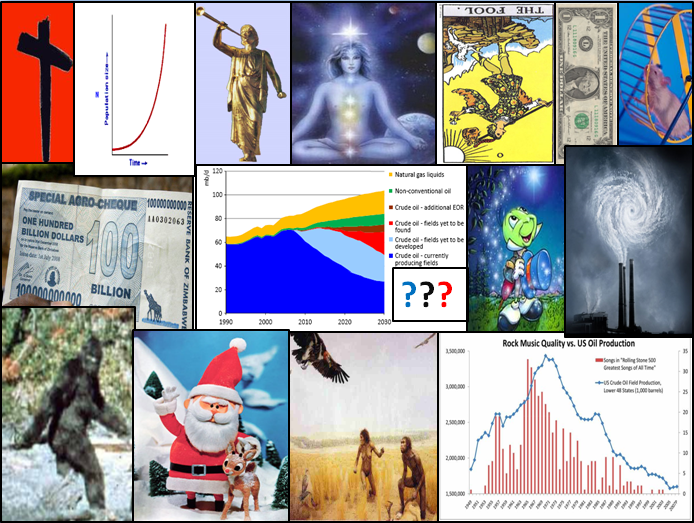
Click to Enlarge
Planck Problem - From Michael Shermer -How Thinking Goes Wrong
In day-to-day life, as in science, we all resist fundamental paradigm change. Social scientist Jay Stuart Snelson calls this resistance an ideological immune system: "educated, intelligent, and successful adults rarely change their most fundamental presuppositions" (1993, p. 54). According to Snelson, the more knowledge individuals have accumulated, and the more well-founded their theories have become (and remember, we all tend to look for and remember confirmatory evidence, not counterevidence), the greater the confidence in their ideologies. The consequence of this, however, is that we build up an "immunity" against new ideas that do not corroborate previous ones. Historians of science call this the Planck Problem, after physicist Max Planck, who made this observation on what must happen for innovation to occur in science: "An important scientific innovation rarely makes its way by gradually winning over and converting its opponents: it rarely happens that Saul becomes Paul. What does happen is that its opponents gradually die out and that the growing generation is familiarized with the idea from the beginning" (1936, p. 97).
Psychologist David Perkins conducted an interesting correlational study in which he found a strong positive correlation between intelligence (measured by a standard IQ test) and the ability to give reasons for taking a point of view and defending that position; he also found a strong negative correlation between intelligence and the ability to consider other alternatives. That is, the higher the IQ, the greater the potential for ideological immunity. Ideological immunity is built into the scientific enterprise, where it functions as a filter against potentially overwhelming novelty. As historian of science I. B. Cohen explained, "New and revolutionary systems of science tend to be resisted rather than welcomed with open arms, because every successful scientist has a vested intellectual, social, and even financial interest in maintaining the status quo. If every revolutionary new idea were welcomed with open arms, utter chaos would be the result" (1985, p. 35).
As cock-sure trainees (in 1992), fresh out of MBA school, our oft-times swaggering attitudes were held in check, and eventually dampened, by a cultural meme that existed in our division at Salomon Brothers (which I was to later understand, was not ubiquitous on Wall St.) We were often purposefully asked a series of questions - the first couple answerable if one had done their homework, but the third or fourth question being very difficult, and most times unanswerable. Our natural tendency was to look smart, speak with authority and confidently 'sell' an answer (or guess) to these tough questions. But our instructors (a rotating collection of senior people at the firm) came down on us HARD if we ever guessed, even if we guessed right. The correct answer, we were told was "I don't know, but I can research it and get back to you". Perhaps the thinking was that the richest clients on the planet could smell BS a mile away, and straight talk was not only ethical, but would lead to more business. This concept of humility was drilled into us to the point where even in social situations outside of work, we trainees were conditioned to say "I don't know" rather than BS our way through some smug, but wrong, response.
Fast forward 15+ years. Being right is still correlated with social respect and success. Being wrong drops us a notch socially, if not to others, at least to ourselves (some more than others). With the explosion of sub-disciplines in science, it seems that the more data we have on various aspects of our environment, our economy, and our energy situation, the more opportunity those with charisma, persuasive skills, money, connections, etc. can latch on to a particular datapoint or study or belief and leverage it into an attitude that becomes more widely held. I used to think that facts were incontrovertible, but "science" (and I have considerable personal anecdotes to this effect) has more interplay with belief systems and political power, than I once naively believed.
The internet has expanded our tribal numbers far in excess of our brains capacity to effectively process on an already full plate. Personally, I get about 1,000 non-spam emails per week. Since my own past crosses many demographic boundaries, I now get correspondence from rich conservatives, liberal environmentalists, risk-prone traders, philosophers, oil executives, tree-huggers, brain scientists, farmers, politicians, and old friends. (And let's not forget family). As such, I have been increasingly amazed at both the disparity and the strength of opinion/belief in what ails the modern world, if anything, and what these various 'circles' believe is our best path forward.
I am a global warming agnostic primarily because I haven't the necessary time or expertise to become adequately fluent in the complex issues involved in climate science. Given such a situation, one should rely on the consensus of modern science, which is that beyond the uncertainty in the mathematical models (in both directions), first principles suggest that adding stored carbon (quickly) to the global carbon budget will have (negative) impacts. And even if climate change is proven to be primarily non-anthropogenic, there are myriad other Liebigs limiters to scaling up the current conspicuous consumption/energy paradigm globally (i.e. anthropgenic planetary disruption is real beyond any doubt: ocean acidification, habitat destruction, pesticide impact, etc.). I know three IPCC scientists personally (one on my thesis committee). I also have several close friends who think global warming is a hoax - who continually send me data on Maunder Minimum, MWP, solar/sunspot cycles, Pacific Decadal Oscillation, and other things that look impressive but I don't fully understand. Occasionally, when I am emboldened, I cross pollinate 'new info' between these various tribes.
Two emails this Tuesday led to an 'aha' moment, and are the genesis for this post. First, I sent a one hour video presentation given by an astrophysicist on the natural drivers of climate change to an IPCC friend. Later that day we spoke. His reply "I watched 5 minutes of it and it mentioned Maunder Minimum so the rest was likely irrelevant too - I get 50 of these a week Nate I just don't have time for such crap - please stop sending it". Not being an expert, I didn't respond and we moved on to talk about a water/energy paper I am completing. That same night, I had sent a brand new pdf on methane hydrates to another scientist friend of mine (who thinks climate change is 90% natural in origin). He lashed out at me with an email 5 minutes later (pdf was 40 pages so he couldn't have read it) saying that "global warming has nothing to do with science - it is only science that is finally debunking the politicization of anthropogenic climate change". How could this be? Two VERY smart people, not willing (or not able) to incorporate new data into their belief systems.
I previously wrote an essay about some possible explanations surrounding resistance to belief change. One phenomenon was cognitive load - that we can only effectively handle seven chunks of information at once. This may play a bigger role than I thought - we live in the age of the internet, and larger tribes are taking up a subsequent larger % of our cognitive processing ability - our brain, by adhering to previous beliefs, stays in the moment and says 'no maas'. (Research suggests that people already holding 6 or 7 chunks of information in their heads, do poorly on math problems and choices involving delayed discounting - e.g. if your mind is maxed out, you care about the present more than the future compared to controls).
Conclusion
"“I think it's much more interesting to live not knowing than to have answers which might be wrong. I have approximate answers and possible beliefs and different degrees of uncertainty about different things, but I am not absolutely sure of anything and there are many things I don't know anything about, such as whether it means anything to ask why we're here. I don't have to know an answer. I don't feel frightened not knowing things, by being lost in a mysterious universe without any purpose, which is the way it really is as far as I can tell.” - Richard Feynman"
In a society assailed from all angles with social and environmental problems, and information (in addition to gambling, pornography, and shopping) available 24/7 on the internet to increasingly 'full' minds, we are moving further and further away from a cultural ability to say "I don't know". Such an answer implies weakness, rather than wisdom, and someone on TV, someone testifying to Congress, or someone publicly asked for answers to our financial or environmental problems replying "I don't know but I can find out and get back to you" would be quickly replaced by someone with a pithy, intelligent, or confident answer (with all three, they'd be branded an 'expert' and invited back). Only history will show that uncertainty could have played a much bigger cultural role than it has, and that the Precautionary Principle should perhaps have trumped the Planck Problem, instead of vice versa.
Campfire question:
How will the belief systems of scientists, politicians, civic leaders, average citizens, etc. converge on a 'best path' forward that integrates energy, economics, equity and the environment?
On the eve of the 4th anniversary of this website, whose mission is to provide a forum for logically and empirically discussing energy and our future, I'll admit that "I don't know".
Previously: Peak Oil, Believe it or Not
Contact
- campfire at theoildrum dot com
Personnel
Archives
- November 2010 (4)
- October 2010 (4)
- September 2010 (4)
- August 2010 (6)
- July 2010 (6)
- June 2010 (8)
- May 2010 (9)
- April 2010 (9)
- March 2010 (8)
- February 2010 (8)
- January 2010 (9)
- December 2009 (8)
- November 2009 (7)
- October 2009 (7)
- September 2009 (9)
- August 2009 (9)
- July 2009 (9)
- June 2009 (8)
- May 2009 (9)
- April 2009 (9)
- March 2009 (9)
- February 2009 (9)
- January 2009 (9)
- December 2008 (4)
The Oil Drum: Local archives
- November 2008 (1)
- August 2008 (1)
- July 2008 (4)
- June 2008 (4)
- May 2008 (3)
- April 2008 (1)
- March 2008 (1)
- February 2008 (2)
- January 2008 (2)
- December 2007 (4)
- November 2007 (4)
- October 2007 (6)
The Oil Drum: New York City archives
- September 2007 (3)
- August 2007 (2)
- July 2007 (3)
- June 2007 (8)
- May 2007 (1)
- April 2007 (8)
- March 2007 (2)
- February 2007 (3)
- January 2007 (5)
- December 2006 (5)
- November 2006 (12)
- October 2006 (10)
- September 2006 (9)
- August 2006 (14)
- July 2006 (15)
- June 2006 (11)
- May 2006 (18)
- April 2006 (35)
- March 2006 (14)
- February 2006 (13)
- January 2006 (12)
- December 2005 (17)
- November 2005 (13)
- October 2005 (25)
- September 2005 (36)
License

This work is licensed under a Creative Commons Attribution-Share Alike 3.0 United States License.
nice post, it reminded me generally of heuristics, and this paper, "Cognitive Biases Potentially Affecting the Judgement of Global Risks"
(PDF) http://www.singinst.org/upload/cognitive-biases.pdf
personally i've got no idea either about this, i'm just dealing with it on a personal level
Nate, great post and I like the graphic above too.
Frankly that is my experience with how humans behave. True open-minded people are as common as enlightened Zen masters. Scientist and engineers are the worst at parsing data and getting all upset if it doesn't match their reality filters.
Heaven help Obama, the poor man is already looking like he is way past overload. Someone becoming a "decider" or claiming "papal authority" starts looking understandable in light of human overload and people being in power. I do think Obama is our most intelligent president in ages, but the problems are SO big and seeing them clearly lie outside of MSM explanations that I expect MUCH LESS of leaders and other people. They're human, and unfortunately almost all of them are overwhelmed with life in general. It takes a truly crazy or determined person to being new ideas and concepts into practice.
"Frankly that is my experience with how humans behave. True open-minded people are as common as enlightened Zen masters. Scientist and engineers are the worst at parsing data and getting all upset if it doesn't match their reality filters."
Yep. We all have our cognitive biases.
Great topic, Nate. Thanks for bringing up a subject that should be covered and emphasised in all science-related courses. At the university I went to, The Philosophy of Science was an optional course for all disciplines, as far as I looked, but it was the best paper I ever took.
Our scientific knowledge seems to be a tiny island of what seems to describe some aspects of our experience.
This tiny island is always changing, and floats in an infinite, inscrutable ocean of mystery.
Wisdom is a way of staying aware of the nature of our supposed knowledge as well as the infinite mystery in which we exist.
We tell ourselves stories that can blind us if we mistake them for reality, but can help us if we do not.
The "pupil's metaphor" is dangerous because the student is apt to be too enthralled with it. The "teacher's metaphor" may be the very same model or image or story, but the teacher uses it carefully as one helpful tool, with an awareness that the metaphor is not the reality.
We wield godlike technology with a great deal of foolishness. (E.O. Wilson)
We commit atrocities because we believe absurdities. (Voltaire)
"I don't know" and "I am sorry" and "I love you" are phrases we use too little and perhaps abuse too often.
We are headed for the world of Cormac McCarthy's "The Road" soon enough. In the end, our close relationships will be what matters.
I will try to give the children I've adopted and am raising a chance to survive -- just as the father in McCarthy's "The Road" tried to give his child a chance to survive. I'm not sure that any children alive today will be glad to survive the Bottleneck, but I hope that some do and at some point will be glad of it.
Meanwhile, the high and mighty commit more atrocities each day, all in the name of whatever absurdities are thought to best justify rapacious violence. "And so it goes...." (Vonnegut)
Chris Mooney asks some of the right questions in today's Washington Post:
http://www.washingtonpost.com/wp-dyn/content/article/2009/03/20/AR200903...
"Can we ever know, on any contentious or politicized topic, how to recognize the real conclusions of science and how to distinguish them from scientific-sounding spin or misinformation?"
and finishes with:
"Readers and commentators must learn to share some practices with scientists -- following up on sources, taking scientific knowledge seriously rather than cherry-picking misleading bits of information, and applying critical thinking to the weighing of evidence. That, in the end, is all that good science really is. It's also what good journalism and commentary alike must strive to be -- now more than ever."
Good science is also something else. It's peer review, where peer review builds to wide consensus or alerts to faulty steps in reasoning or evidentiary procedure. What I look for when confronted by a controversy is evidence for scientific consensus. Yes, of course, "paradigm change" means overthrowing a current consensus; but until the scientific community's sense of ponderous anomaly and embrace of new theory (and evidence) breaks through, scientific consensus is the best we have.
"Scientific consensus" isn't just a product of the media, or the counter-media, saying it's so. If that were so, we could write it off casually and still claim intellectual sophistication. It appears when you can pull together umpteen studies starting from different premises, using different methods, all tending to the same result. A good review article will tell you whether there's a consensus or not. That's the sort of thing the IPCC has been doing now for years, and though there be dissenters out there, until they can come up with something better than scoffing to refute the mountains of evidence and confirmatory studies that support the IPCC consensus, I'm not giving them much, or any, credence.
No doubt, we have to be careful of "bad" science. From what I've seen, much of what passes for "science" in "nutritional science", "agricultural science," "social science" is junk: it doesn't meet elementary tests of sound research procedure, statistical inference, or sound reasoning. I'm speaking as an ex-social scientist who's spent a lot of time looking at the so-called "scientific consensuses" in nutrition and ag science.
So, yes, Nate's right. We need to do our homework before we can claim to know anything. But that admonition implies there's some way to find out who's right, or at least get comfortable with a point of view.
Hi Greenuprising,
This is exactly how I felt reading this essay.
I think Nate's essay is excellent and I’m sure he intended to be thought provoking – so here are a few thoughts that Nate provoked from me :-)
I think it is important to parse the opening phrase
The dictionary says that “know” is to be well informed about the facts. Further, a “fact” is that which is really true. And, truth is something agrees with reality and is not false. So, in Nate's case, I believe he intended to imply that “I don’t know the facts or truth about such and such”.
And then he mentioned:
This “research” brings us to the concept of discovering what is the reality or what is true about some question or the other.
And then the Campfire Question:
Or, I might submit, allow us to discover reality/truth. To which Nate dodged the bullet :-)
The “Scientific Method” http://en.wikipedia.org/wiki/Scientific_method is not perfect and it does not guarantee discovering ultimate “truth”. It is not even one single, indisputable procedure for discovering reality. However, it is completely separate and distinct from all “faith based” religions (despite the critics who like to call science “just another religion”). Science, by definition, is the opposite of “faith” because faith is defined as “unquestioning belief that does not require proof or evidence” and science is all about proof, evidence and questioning.
Science, and its Scientific Method (variations aside), is the very best way that humans have for discovering reality and arriving at the best approximation of “truth”. Actually, “convergence” is a good word, because that is just what the scientific method attempts to do – converge via experimentation and testing to arrive at a workable set of “facts”. The “knowing” as it might be said.
So, the answer to the campfire question is to educate young people in the scientific method as opposed to “belief systems” that have no rational basis – like all religious faiths. Scientists will always argue and debate (that is their mission) but the idea is to get irrational belief systems out of the mix so that over time some degree of convergence is even possible.
Some interesting variations on “I don’t know” are “I don’t know positively, but I would bet..”, “I don’t know, but I suspect..” and, “I don’t know and I don’t care”. And, of course, there are lots of things, about which, most of us are willing to say that “I do know”. Here are a few of my personal examples:
I don’t know (and probably never will):
• What occurred a billionth of a second before the big bang – but it sure is fun to read speculation about this.
• If string theory in quantum mechanics can ever be tested – again much fun.
• If the universe will start contracting at some time and how fast – scary idea.
I don’t know positively but I would bet:
• That climate change is a very real issue and is significantly affected by human behavior. The facts are clear and measurable: 385 ppm of GHG increasing by 2 or so every year. It is quite possible to reach a tipping point of temperature rise before we have exhausted all means of adding more GHG. It is foolish to avoid efforts to reduce GHG emissions by humans.
• That fossil fuel sources like oil, NG and coal will be depleted according to the basic tenets of Peak Oil theory. These sources are finite and non-renewable in human timeframes. It is a good bet that this depletion process will negatively impact most humans within 20 years or less – probably a lot less.
I don’t know, but I would suspect:
• That the human population on the planet will experience a reduction (after reaching a peak of about 8 billion) to somewhere around 4 billion within 100 years – maybe sooner. The measurable decline of other species and biosphere resources that we depend upon will most likely result in a “carrying capacity” that is insufficient for supporting any greater number of humans – maybe even less.
I don’t know and I don’t care:
• About any NASCAR statistics.
• About the personal lives of Hollywood stars
• About the “purpose” of humans on this planet beyond that which is simply explained by evolution and the drive of any species to propagate itself. Life, liberty and the pursuit of happiness is a pretty good explanation for what we should worry about – and Darwin had a better story than stories about a creator.
What I do know:
• When I die, my conscious existence will cease. There is no god overseeing events here on earth or administering the details of an afterlife.
• That most people, in the entire world, are operating under one or more mind crippling delusions. World religions, most of which served a purpose at some point in history, are now frequently just a tool for controlling power and wealth by TPTB.
• That religious indoctrination of young children is the worst form of child abuse. That instilling irrational myths in the impressionable minds of young children before they have the ability to reason critically is a huge reason why Nate’s question about “Belief Systems” is so important. In order to collectively solve the big problems facing mankind, and to find truth, we all need to move beyond reading holy books of faith. We need for our kids to start adult life without the baggage that plagues most current adult generations.
wonderful post, bikedave
Bicycle Dave,
Organized religion is dead and dying. It doesnt' work anymore.
Yet that does not mean that individuals no longer have life changing experiences. Something that can't be discounted so easily.
Read my post below then or not ,,as you wish. I am certain many will sneer and chuck spears. That's ok. It becoming rather universal anyway.
Airdale--BTW I did not post that comment below to enter a discussion about that subject. I did it ...well just for the hell of it. Its where I am and have been for years and where I am slowly disappearing into...me and my remaining right kidney...(and still no reoccurance of the cancer as of last weeks visit to my urologist). Science did save me at that..so I will cut it plenty of slack..but..well...there is another avenue as well ...a path we must all walk someday..me sooner rather than later.... and as Stephen King sez ''a clearing at the end of that path'...
I recently heard someone say that science started out as a branch of philosophy alone, and it only became objective after the religious philosophers sensed too much competition and tried to put distance between the two groups. Eventually science became totally distinct from a philosophy, and the only vestiges are in the title Ph.D. perhaps. But that means that everyone is a philosopher who gets an advanced degree. This gets confusing so it basically boils down to people who believe in the facts and those that don't ... I guess.
So I usually don't invoke science. Instead, one can try to use the word theory to explain something.
But then you realize that the word theory shares the same root as theology. When a scientist tenaciously hangs on to a theory well past its utility he has become theocrazed; hence the term theocracy to describe the self-delusional group-think that he and his followers may acquire.
It ends up being a viscious circle of people following other people who would encounter huge sunk-cost losses if they switched sides. Yet I don't really know either because a lot of this involves spouting tautologies. People who believe in facts are in fact correct about being correct. Those that ignore facts, the religious types who believe in divine truth, are correct because it has been divinely stated. A pair of tautologies that can neither be proven or disproven.
That explains why I usually just try to work out the math :)
I think math is a great tool for helping ask the right questions but I think the often overlooked core of science is finding interesting questions that can be asked then determining if an answer can reasonably be found. To some extent is a game of questioning the questions but only if its a fruitful endeavor which to some extent differentiates math from philosophy but both end up surprisingly close because mathematics itself leaves a wide latitude in the questions that can be asked. Math in the sense of expanding mathematic knowledge itself can and often does pass the realm of anything remotely useful in the scientific sense.
I'd argue that most of the writers and I assume the readers of the oildrum have this sort of basis they care about the questions that are asked. I'd suggest today many Americans are simply asking when their home will start going up in value ? They don't care to ask the right questions about how we got here.
From what I can tell what division exists from contributors on the oildrum tends to boil down to the question of what are the right questions to ask ?
Should we ask if we are on the verge of a end of our growth civilization ?
Should we ask if we only need to make small changes to our transportation network i.e EV's ?
Should we ask questions the lie between these extremes ?
I actually asked myself the question of what is wrong with mankind ?
Why are we collectively dumb as a pile of bricks ?
So I think that its time to even look past the potential fall of our own civilization and begin to ask the hard question of what is wrong with our species why are we wrecking our planet ?
Related of course would be is math usable for this sort of question ? If not why not ?
Can we really use science in the reflexive sense and become dispassionate observers of our own selves ?
Science and math lay claim to this ability yet can science and math actually prove they have this capability ?
Ask to many questions and you end up being a stupid philosopher it seems :)
And I might add I believe I've found answers to some of these questions but the answer itself is unsettling humanity has managed to short circuit evolution for a host of reasons our species is no longer capable of evolution. One one had by triumphing over evolution we have become intelligent on the other I believe having asked and answered the question that humanity itself is a evolutionary dead end by its very nature. Realizing your own species is a very intelligent Dodo bird is not what I expected.
You're cool memmel, could you write book sometime please.
I think you're whole comment WAS mathematics.
I got a feeling that we are potentially capable as a species of managing things better..... yeah, what's the excuse?
The seat of our problem, as I look within, is some "strange ambition". Something that exists in our bodies and our desires, perhaps our souls, can you feel it. But we understand to a sufficient degree how all this occurs on a management level through behavioural neuroscience and related fields(see Nate). We should be able to train it out with education, eugenics if necessary.
My take on evolutionary dead end, though perhaps trivial.
Individuals don't make a species sure we have our Mozarts but overwhelmingly we have our average joe and he has not gotten any smarter in the last million years. In fact its probably a very safe bet hat the average joe of today is a lot dumber by just about any measure vs the past. Maybe I should be politically correct and say more ignorant but to hell with that we are becoming progressively more stupid on average.
As far as genetics goes eventually maybe thousands of years or even millions of years in the future we need to deal with our collective genetic heritage. But we can't isolate human populations basically we are all capable of walking,swimming or sailing any where in the world and having sex. Any attempt to guide our genetics now esp given our mental process is misguided at best.
I may get flamed for this one but if your a smart person then you probably should have 10-12 kids and teach them to think. Instead where we have the highest education levels the population growth rate is the lowest. The educated people are being successfully out bred.
This does not mean of course that the poor are not capable its just that the average ignorance level is probably far higher today then it was in the past. Many of the poor have lost the knowledge required to be self sufficient and have not gained a high tech education thus they exist without the old knowledge base of how to survive and without the new knowledge base of how to build.
In the wealthier countries the same situation exists albeit with a much higher average standard of living but again few people have a cohesive knowledge set or the ability to learn.
Politically this means groups of fairly intelligent and educated people like the oildrum are impotent in our modern world. The masses are incapable of understanding our problem and our leaders are far more interested in extracting wealth out of the toil of the masses to pay attention to where our society is esp vs the environment.
Anyone that spends any time on the board at all came here to find out about something they did not know about before arriving on one on the oil depletion sites they realized they did not know and they filled in a gap in there knowledge. The number of people willing to do this today that have what you call this "strange ambition" is I'd argue one of the proto branches of humanity that has suffered the most over the last 100 years. Even a cursory reading of history should make you realize that far more people used their knowledge base in the past certainly they lacked education and understanding but people with strange ambitions where a larger part of our society. Many of these of course fell into exploiting both people and resources but being intelligent has nothing to do with being moral or good.
Thats a whole second can of worms that morality and intelligence are not linked. I find it amazing that its true how can some one be intelligent without developing morality. Or worse what circumstance turn intelligent men and women into immoral people ? Your typical master criminal esp a politician or swindler is generally fairly intelligent.
Even discussing this subject trying to understand it opens up massive areas subject to "moral" debate and potentially stepping on someone else's morals. Particularity my example of the smart generally successful person thats chosen not to have children. Your probably doing our species a disservice. Better to have as many kids as you can and teach them to think for themselves and use less resources.
And to reverse myself on that one obviously playing a game of out breeding is not the right solution but then we have to look deep into ourselves and really ask why we are having children whats the goal obviously not having them ensures that a person intelligent enough to understand our problems has chosen not to pass on both his/her genetic heritage and learning to even understand the problem. But yet your in and impasse.
My point is even with what I think I understand I cannot come up with any reasonable way to solve our population problem that sensible for the world. Even a retreat to enclaves probably followed by a massive die off just kicks our basic problem down the road a bit. We grew and declined exploiting renewable resources beyond capacity until they where exhausted before we found oil we can and probably will do it again.
I can see that I'm a member of a species thats collectively screwed but seeing this does not seem to alter the problem. Just like the fact that some small precentage of the current people in the world grok the severity of our overall problems they are helpless now to do anything to alter the outcome. Sure we might somewhat bypass the peak oil bullet but plenty of other constraints will then hit us eventually one will take out our civilization just like its done to every other human civilization since antiquity.
Maybe a few hundred thousand years from now when we have mined the garbage pits of our ancestors great civilization for the ten thousandth time we might just might finally decide to solve our core population problem. Then and only then do I think we can develop a civilization that could create the long term stability required to really look at our intrinsic genetic wiring and maybe at that point we can restart evolution somehow.
Right now anything I could come up with could be warped and distorted and turned into a tool to create people with wealth and power and those without. No noble plan not even one of my favorites ELP solves this. ELP is a step in the right direction but its a baby step its all we have for now and if we just practices Economize Localize Produce for a few thousand years the I suspect we would be able to take the collective next step and the one after that.
Obviously the first thing we must do is start taking a multi decade view then a multi-generational view then eventually we need to be able to collectively work on problems that could take 1,000 years to solve. If we can look beyond the now and the short term then we have the basis to work on our problems. ELP by stabilizing the short term sets the stage for long term thinking to grow. You could look at fusion as and example of the utter failure of our current species. We where forced to make short term promises on a long term problem when those promises did not work out we repeatedly pulled back from fusion. If we had instead recognized it was potentially a 50-100 year problem and stayed at it consistently and realistically we probably would have had functional fusion reactors available today or really in a few years time.
Although I won't be around to see it I'd be surprised if very many of the structures built in the second half of the 20'th century will be around in 500 years and outside of the vagaries of war I suspect many of the ancient cathedrals or say the great wall in china will still be there looking much like they look today.
So I guess the first step is to recognize that somehow we lost a lot of even what our limited species was capable of we have to get that back and then and only then can we as a species start truly looking into a brighter future. Will we dunno but I'm pretty damned certain that once we do collectively either die out our get our act together we will long be dust along with our AIG's and mortgages and Maddofs and probably most of our records. Thats how far we have strayed from why I think evolution created a species that was and evolutionary dead end and eventually had enough intelligence to realize it.
What I find really funny is it looks like natural selection and random mutation created a species almost capable of intelligent design just it seems to have forgotten to put in enough intelligence. We are collectively on the verge of just being smart enough to realize we are the dumbest kid in the room.
"I think evolution created a species that was an evolutionary dead end and eventually had enough intelligence to realize it."
Strikes me as a perfect summation.
Uber post If I had you're facility with language. Hammered. Thank you.
Don in Maine
Are the Eloi busily defining themselves among the bankster elite? How long before the Morlocks tire of the servant role and quietly turn the tables once again?
FAITH AND USELESS DESIRES: WHAT LITTLE I KNOW
Earnest Lux said,
"The seat of our problem, as I look within, is some "strange ambition"."
Let me tackle that one, being qualified here at this moment on the subject not because of a great education, but because of my background of being poorer than average for longer than average, but being reflective and questioning enough to wonder why (you would be surprised how many poor people never bother to ask themselves, "why am I and almost everyone I know poor?")
The strange ambition that Lux refers to is EXPERIENCE. It is caused by having a developed brain that knows experiences beyond our prior ones are possible. A cow never yearns to fly an airplane, ride an Italian motorcycle, Listen to the Metropolitan Opera perform Verdi, or write something that could potentially best Beethoven's 5th Symphony or rival "War and Peace", or build a house as beautiful as Frank Lloyd Wright's "Fallingwater".
Humans, on the other hand, will NEVER stop yearning for more experience. We want more so we can do more, or be more, or see more. We want to achieve SOMETHING. Unlike the cow, we know our life on Earth is short, and as Emerson once said "We are like the stream that knows not it's source or to where it is flowing", and remember, Emerson was as religious as the best of them, but still was open minded enough to sense the cause of human restlessness and striving, always striving.
I have heard and read that this is a Western trait, that the oriental philosophies do not suffer from this. Balderdash. For centuries they have been prevented from striving by overlords who taught a caste system, and the masses knew that striving was hopeless. Now that Eastern peoples have the opportunity to strive, they do, and with zeal that would make the founders of capitalist free enterprise proud. The youngest Asians now want MORE. They want the cars, the houses, the motorcycles, the clothes, the WORKS. Young Asian women can outdo even our Western women in their drive, determination and desire for more, and in their flare for consuming it.
Because wherever there is desire for experience, there is consumption. The two come together. Humans, as an animal, are relatively small and do not really consume all that much. Somebody do the math, what is the total weight, the biomass, of human beings in comparison to all the other living animals on Earth? I am willing to bet the insects alone outweigh us! There must be billions of tons of birds! Mammals are a minority, and humans only a sliver of those!
Humans as a living animal should be relatively low impact on the Earth, virtually not noticed. It is HUMANS AS HUMANS that are high impact, because humans as humans want MORE. We want experience, we want to do things, and build things and see things, we want to go to space, we want to go over 100 miles per hour on land, and then over 200, and then over 300 miles per hour...and we want to go from 0 to 100mph in 10 seconds, and then to 200 mph in 10 seconds! We want to go faster, than get to faster faster! We want to go higher! Can anyone explain the biological need for the human animal to build skyscrapers as tall as the Sears Tower, or the World Trade Center? Can anyone explain the biological need for the human animal to blow them down?
Of course not, because these are not biological needs. But they are HUMAN NEEDS.
Robert Rapier, just the other day in a reply to his post on living car free, seemed to be going through a bit of soul searching. Nate, in the post we are commenting on now, seems to be going through a bit of the same. I know I am. Robert the other days asked "what is it we trying to accomplish here?" Nate is asking the question at least as old as Montaigne, "What can I really know?"
I am asking "Can we ever succeed at telling humans the only way they can survive as a species is by finding a way to stop being human?"
And honestly, that has over the last year or so seemed to be what TOD is more and more about. But of course it is a tautological solution, like the old "we had to destroy the village to save it." If humans are to succeed in "sustainability" as humans by stopping being human, how is that success? We may succeed at being an animal that walks upright, but my goal, from poor childhood to my now rapidly advancing old age, has been to succeed at the experience of being human, not upright animal. If living to seek only a crumb to put in my mouth, and enough warmth to maintain my core tempeture and nothing else is to be my goal until old age breaks me down for the last time, then the question "what am I living for" haunts larger and larger in my HUMAN soul. Even at 50 years old, I still must DREAM of doing more. And doing more will consume more. It may not consume much in comparison to the wealthy overlords, but it will definitely consume more than I have in my poorer years. But it is what I must do, or attempt to do, to feel human.
Humans are unique. No one knows of a documented case of a well fed cow hurling itself down a well because of existential angst. It just don't happen. But there are many documented cases of well fed and warm humans killing themselves every year.
What is in your head can kill you. It is at least as important as food or warmth, and surely as important as oil.
Science can answer many questions: What is that made of? If we combine this and that, what will happen? Why does an apple fall down instead of up, and how can we break up light and make a rainbow?
But science was not designed to and cannot answer the question that matters most: WHAT DO YOU REALLY WANT?
The BIG questions are aesthetic, philosophical, and in the end, and I know how this word is hated here but there are no other easy substitutes, SPIRITUAL.
So back to Earnest Lux's question of the "strange ambition" and I note that Earnest says he found this "seat of our problem" by "looking within". Fascinating isn't it? The telescopes and microscopes can only do so much looking at the outside, but the real core of our issues are found by "looking within". WHAT DO WE REALLY WANT? WHAT SHOULD WE REALLY WANT? Albert Schweitzer once said that "the problem of the West is essentially an ethical problem."
He also said "Man has lost the capacity to foresee and to forestall. He will end by destroying the earth."
Schweitzer also said "A man is ethical only when life, as such, is sacred to him, that of plants and animals as that of his fellow men, and when he devotes himself helpfully to all life that is in need of help."
Of course Schweitzer would be dismissed here on TOD as an imbecile believer in fairy tales, his whole being driven as it was by religious faith. How easy it is sit in a comfortable living room banging on keys, to dismiss lives spent in service to humans and minds that reach to the edge of the heavens by defeatists who really are no smarter than yeast. Rapiar is right to ask what we are trying to accomplish here.
It is the great minds and great HUMANS who cause me to ask myself "WHAT DO I REALLY WANT?" "SHOULD I REALLY WANT IT?" "WHY?", those who have proven by example such as Schweitzer and by courage such as the Hindu holy man Gandhi, by thought and meditation such as The Trappist monk Thomas Merton who said "What can we gain by sailing to the moon if we are not able to cross the abyss that separates us from ourselves? This is the most important of all voyages of discovery, and without it, all the rest are not only useless, but disastrous" or the great Buddhist leader the Dalai Lama who said "The purpose of our lives is to be happy." and "Happiness is not something ready made. It comes from your own actions." and "I find hope in the darkest of days, and focus in the brightest. I do not judge the universe." My goodness, how tragic it is that faith has destroyed the mind of these men who pursue FAITH!
So my soul searching continues: What do I really want? Why? Which of my wants are what the great songwriter Patti Griffin calls so poetically "Useless Desires?", and why do I still want them? What should I want?
As has been said, we can know so little, and as Nate Hagens points out, "I don't know" is often the wisest answer we can give and accept. If someone were to ask me what I "know" it probably would not even exceed a few sentences, but I am developing a new one, and my friends and fellow students at The Oil Drum are the first to be privy to it, so THIS I KNOW:
Those who work diligently at destroying hope should not be surprised when they find themselves hopeless.
And remember, what is in your mind can kill you.
Thank you. Roger Conner Jr.
Good points on the size of humanity as compared to other biomass within the earth's biosphere. Here are some data points from Vaclav Smil's, "The Earth's Biosphere:"
Fungi 3,000 - 6,000 MtC
Invertebrates (Land) 400 - 1,000 MtC
Domesticated vertebrates 100 -200 MtC
Ocean Fish <40 MtC
Invertebrates (Ocean) 300 - 500 MtC
Oceanic viruses <300 MtC
Humans 40 MtC
Total biomass (broad definition) 2,200 - 4000 Giga tC
It is comforting to know that at least humans represent more biomass than ocean fish.
Ummm... actually I find it a lot more frightening rather than comforting that the humans outweigh the fish when we consider that the fraction of those fish that are fished commercially provide 40 per cent of the protein consumed by nearly two-thirds of the world's population.
good point. Guess I am not eating fish tonight.
Jim,
No offense, but considering what we are doing to the ocean biomass through overfishing, environmental, and habitat destruction, I'm not sure that this still holds true.
If it does, I wonder for how long, unless you have a real taste for jellyfish.
This http://www.esi.utexas.edu/outreach/ols/lectures/Jackson/ppt/41_files/fra... shook me.
It has been posted recently, but I would like to reiterate, everyone should watch it.
Excellent, Roger. Thank you.
ThatsItMount. I have some questions / thoughts.
EXPERIENCE, striving for "inner" experience does not necessarily consume resources like 0 - 500 in 10 seconds does. I wonders how much craving for worldly experience is really just an excuse to get a fix of endogenous hormones (adrenalin in the 0 - 750 mph scenario)
Maybe that is our evolutionary path, to transcend ourselves. You appear to find that unwholesome though I am short of time right now to think through your words carefully (will have more time in about 4 hours - got to get these raised garden beds finished)
I'm not sure how this conclusion ties in with the paragraph that preceedes it.
Why is MIND so important? Is thought and mentation really the apex of human possibility?
I don't think the "strange ambition" I observed within is deisre for experience, it feels more like "a need to dominate and control, a ruthless passion to be free from the constraints of Life and Creation", but I might rescind that assertion later.
Earnest,
In my heart of hearts, I truly understand your plight.
If the sky were not blue, but some other colour, whatever would we do? If up became down we would truly be in a pickle.
Why is my trip to the store uphill when a flat path would be so much more convenient?
Why do you pose vague, open ended questions with little invitation to true discourse and little insight or alternative thought?
What if I were to ask you a hypothetical question?
I will lay awake at night answering these deep issues.
/sarcanol
On this occasion I wished to draw out further comment from memmel.
I was successful. I also drew out T.I.M, and then requested some clarification of that poster's thinking.
I don't use sarcasm wich is the lowest form of communication.
Pragma, I suggest you re-read the guidlines for Campfire posts, you're beginning to appear intellectually challenged.
First a disclaimer, I'm not a biologist and certainly not an evolutionary biologist. However, while I think I can agree in spirit with what I believe is the gist of your point, (note the lack of certainty)
I will state with absolute certainty that your statement is fundamentally incorrect by definition.
The basic definition of evolution is:
From Wikipedia:
The population of human organisms has most certainly not stopped evolving by any stretch of the imagination, may I suggest you post this statement over at pharyngula.org or pandasthumb.org to get an expert's response.
My point is that when talking about a specific field of science one should at least examine the fundamental underlying premise and be very careful with regards the language and words that one uses to discuss it. As for realizing your own species is a very intelligent Dodo bird is not what you expected. Sorry but to use an expression posted above, "tough nougies", cuz nature doesn't give a rodent's rear end about us it just "is" and so are we, maybe just for a short while.
You should at least read darwin. One of the key aspects of evolution is isolation a population has to become physically isolated from another one that it can interbreed with humans esp homo sapiens have never had enough physical isolation to develop species.
The other speciation drive is a collapse of the ecological niches leading to a single species isolating itself while still maintaining physical overlap this generally is caused by physilogical isolation i.e new beaks claws etc that specialize one species into several.
Again humans as tool users have sidestepped this other evolutionary force.
I stand by my statements and I suggest you read my other post about experts.
In this case I believe that most of the "experts" are wrong. Very few bioligists study actual evolution itself much less in the higher species. You you to suggest that most have a clue about real evolution is nonsense.
Consider other species that that has achieved globalization if you will.
http://en.wikipedia.org/wiki/Gull
I question if you understand what your talking about.
And again sorry to be rude but this thread is about critical thinking. You just exhibited the classic example of and idiot quoting experts.
Think about it in fact you need only a decent understanding of information flow as long as routes exist that allow a certain amount of hybridization and it takes place then real speciation is prevented by continued re-hybridization. Also understand that I define a species as bounded by its ability to form viable offspring. Once the flow of information is broken then you have a true species.
Gulls are a great underlying example since the exhibit one of the reasons that speciation can be short circuited they have flight and a basically continuous overlapping range.
Its not perfect but they exhibit with only one of the conditions that I'm asserting prevent speciation in humans the retention of the ability to hybridize.
Am I right probably would I need to get a PhD in evolutionary biology and a tenured position at Havard before anyone would take me seriously are even look at the problem.
Probably.
Who is "more" wrong a society that rejects critical thinking without the right credentials or one that allows critical thinking to highlight what I argue is probably a serious problem for our species.
By slicing and dicing our collective wisdom in a number of bins with high barriers to entry we have collectively made a pretty serious mistake. Science itself has become so distorted by the trapping of knowledge that overall its lost the power to ask the right questions.
Why on earth is something as simple and obvious as the exhaustion of a obviously critical and non renewable resource left to a band of amatures on the internet ? Where are the scientists ? I hesitate to go here but our scientific establishment is just as corrupt and misguided at the rest of our society they as a group are just as responsible for our current mess as the most corrupt politician and banker. They literally sold their soul to the devil in exchange for grant money and being told what questions to ask.
Needless to say I double our current scientific community is willing to stand up to the problem of genetic diversity look at what they have allowed with our food crops. We are one disease away from losing a substantial amount of our food supply because scientist have no backbone or political will. Ceertainly some individual scientist are not corrupt and are free thinkers but the overall situation is the same as with the rest of humanity.
Critical thinking has become so diluted at all levels even in the realm of scientist that its been effectively broken and destroyed rational thinkers are now on the sidelines and incapable of turning the masses of humanity from its headlong rush to disaster.
Why becuase to turn each and all of use would have to sacrifice something. Sacrifice is no longer possible. Name a scientist that turns down grant money because he does not agree with the underlying research topic. Name a scientist that can really determine his own direction of research and recieves money with no strings attached. Sure they exist but they are a minority even in our scientific communities.
I actually have, while studying biology at the University of Sao Paulo Institute of BioSciences, I didn't finish that degree because I went on to other things but I have a pretty good idea that you are fractally wrong when you say that humans have stopped evolving.
I'm neither offended nor am I going to descend to your level with my response. Wikipedia is not an expert source but the definition that I quoted for evolution stands.
Excuse me? I believe that most of the "experts" are wrong. Based on what?
You may want to read this article from Scientific American, it is a really good example of a scientific study proving recent evolution in a population of Homo sapiens.
December 11, 2006 in Biology
African Adaptation to Digesting Milk Is "Strongest Signal of Selection Ever"
East African cattle herding communities rapidly and independently evolved ability to digest lactose
By Nikhil Swaminathan
You need to go back to the drawing board as far as lactose goes.
We already have the gene for lactase its just a regulatory change to select for higher lactose levels. Same for that matter for pigmentation changes in humans.
No new genes involved. In fact any human population that adapts a high milk diet develops greater expression of lactose. In fact a certain precentage of the human population has higher lactose expression than others we could go on because of course many genetic disorders are related to variance in gene expression. Its a huge leap to take the underlying fact that we are not all perfect copies and expand it to assume we are still capable of evolving.
Left unmixed long enough humans could eventually evolve into truly different species incapable of interbreeding. But I'd argue that for many species not just humans the planet earth simply is not large enough to allow highly mobile species to become isolated long enough to diverge.
You completely missed my point and assumed you understood what I was talking about I suspect on purpose. I never made the claim that our fundamental dna was incapable under the right circumstance of speciation I said because of our nature or the type of species we are that natural genetic drift will never result in us undergoing further evolution.
Its a geography problem coupled with species mobility. Other species suffer this problem generally to a lesser extent.
I offer without proof that the genetic variation of Locusta migratoria migratorios is far lower than other locust species. Here you have closely related species that only differ by their migration patterns.
Underlying all of this of course is the simple fact that genetic drift suitable to cause speciation has a certain rate if the gene pools are remixed faster than they can drift then speciation becomes difficult.
Using wikipedia again :)
http://en.wikipedia.org/wiki/Speciation
Again you simply don't know what your talking about your making assumptions.
However your posts are providing a perfect example of the incorrect use of science.
And I do have and extensive background in biochem before I moved to theoretical chemistry.
I've worked on liver physiology, trace mineral toxicology, tetrogenisis and briefly pheremone isolation. I'd argue that biologist vastly underestimate the role enviromental toxins play in complex animal speciation. But thats yet another place where me and the "experts" differ. My experience has been that chemical toxins and diseases play a huge role in a rapid filtering of the underlying genome under immense stress regardless of the complexity of the species. New species are often born of duress. Going from changes in gene expression to creation of new proteins via successful genome rearrangement is at its heart a chemical problem and I'd argue that its generally in response to a chemical change in the environment. Plants are different despite the claim of organics are good plants are nasty chemical factories to begin with producing toxins in abundance. We are fortunate that these factories of death have found it advantageous to allow animals to eat a few parts. Plants have retained a effectively complete set of synthetic pathways capable of producing almost any organic or organometallic compound. I mention them since they act as the source of toxins that cause the various non-plant species problems. Basically the repeatedly and routinely drug the crap out of us. At a biochemical level they have us beaten.
My point is simple the ideas I've brought up are actually found in the literature I'm not the only one that suggests these are important behind what I'm saying are actually works from true experts published in peer reviewed journals. Because I presented them as a non-expert you assume I'm wrong. Well I'm not and I'd argue that if anything the expert literature is in general coming around into agreement with the exact points I've made.
And yes I don't always link wikipedia but wikipedia has links back into the expert body of literature from those papers you can find alternative paper and after about ten years right a review of the literature of interest to workers in the field but only of course if your and expert in that field in the first place.
Science does not have to work this way and indeed the best science rarely uses these routes.
Maybe I'm not a scientist I don't know but more important I don't care. If I'm right about our species then we face some serious problems as a species.
And I might as well present my conclusion. First and foremost we must learn to live within our means which means live in harmony with our planet and prove we can do it for thousands of years but next if I'm right this is not good enough. We have to leave we have to scatter beyond this planet and most importantly we have to do it in such away that we cannot be followed. This is the only way to restart the isolation I claim is so important for species to continue to evolve and create new branches. We are only a dead end on this planet but evolution has almost given us enough collective intelligence and understanding that we may someday collectively realize we must leave.
Makes you wonder why evolution creates intelligent dead end species in the first place. At this point I have no answer maybe one day we will maybe at some point in the far future we could prove that evolution on a single planet results in species that has to leave or die.
I personally have no problem making these leaps of insight maybe in a few thousand years the experts will "prove" it.
But one argument at a time.
WHT
Theory and Theology have the same root?
Nice theory but not true :)
Theory from Greek "theorein" to look at
Theology from Greek "theos" god and "logos" word
Probably right. Back before fundamentalists got a hold of religion, the ancient Greek philosophers actually practiced speculation, and likely asked the questions "Who is god?"
Sometime later, dogmatism crept in.
Bicycle Dave,
"Organized religion is dead and dying. It doesnt' work anymore." Pope Benedict (Arnold?) still seems to pull a crowd in Africa. Now that is ironic. The continent in the most need of reality is hosting the Vatican puppet show. LOL.
airdale!
Good to see you back.
I would love to agree, but I can't. Yes, it doesn't work anymore, but as Samuel Clemens said, "reports of my death are greatly exaggerated". It may be ebbing right now, but WTSHTF, there will be a resurgence in organized religion and there will be a host of new scams disguised as religions (assuming most religions are not scams to begin with). A thirsty man will see a mirage and drink the sand.
IMO, the term "Organized Religion" is redundant. The tenets or beliefs are structured, and most beliefs are intolerant of any deviation. Religions are corporations that pay no taxes.
Spirituality is another thing entirely, but perhaps a topic for another post.
Cheers
Great to see you back,Airdale.
bikedave: I'm with you all the way (and thanks for all that) until you get to "What I do know." Whoa! Really? How? Not that I know any different. But science will not get us there.
Hi GreenUprising,
Well, once I get on a roll...
And, I think you make great comments also.
Seriously, I think science does help us NOT believe in something like an afterlife because there is no proof, it cannot be tested, it is not falsifiable, etc. I suppose I could take the wimpy position of being agnostic - but, why should I even accept the idea that an afterlife might be "true" when there is zero reason to believe that?
My second point about delusions, simply follows from the first point - If there is no valid evidence or proof then why would billions of people "believe" all kinds of nonsense.
And my third point is an answer to my second point - people believe this stuff because they have been indoctrinated before at an extremely impressionable age by the people they trust the most.
The book "God: The Failed Hypothesis. How Science Shows That God Does Not Exist" is an interesting read if you want to pursue this thought.
http://www.amazon.com/God-Failed-Hypothesis-Science-Shows/dp/1591026520/...
As you can probably tell, I am convinced that religious beliefs, at this point in human history, cause far more harm than good. Good human behavior can easily be taught without resorting to supernatural beings for enforcement.
I don't expect many people to agree with me on these points - 30 years ago I would have been fairly upset to even hear this kind of reasoning. I just hope that a few people might begin the process of examining why they hold such passonate beliefs about things for which there is no proof.
I'm currently rereading "The End of Faith" by Sam Harris, and recommend it. The first chapter stands alone as an essay. I wish I could post it here.
I'm afraid that it's a fact that mythological dogma will have greater fitness than the scientific method in occupying human brainspace as things get tougher, except perhaps in predominantly atheist countries. (if there are any). Religion has evolved fitness in viral competition and adaptation over millennia, while "science" is simply a method of sorting knowledge.
I keep extra copies of that book so I can give one to any friend that is interested.
hmm... I wonder if you really believe that? Nuclear power or DNA mapping did not just fall out of some sorting process.
I've been reading "Making of the Fittest" - perhaps would give an insight to your fitness thoughts.
http://www.amazon.com/Making-Fittest-Ultimate-Forensic-Evolution/dp/0393...
Also, Richard Dawkins, evolutionary biologist, discusses the evolution of religion at length - again this might shed some light on your position,
http://www.amazon.com/God-Delusion-Richard-Dawkins/dp/0618918248/ref=sr_...
I'm not seeking to diminish science, I'm a scientist by any reasonable definition of the term, even a slightly newsworthy scientist now and then when I don't keep my head down. Science is incredibly powerful as a method of figuring out how the world works, sorting from among hypotheses. And Nuclear power and DNA mapping did fall out from that process.
My point was that despite being a powerful method, it has not evolved virally to reward all including the lowest-common-denominator human brains by quashing dissonance and directly providing reward. Thus, science and religion are qualitatively different in terms of vigor in times of stress. It takes discipline and training to stick to the scientific method, and only enthusiasm to burn a witch who has cast a spell on your crops.
I enjoy your comments, feel free to click my user name and drop me a note offlist any time.
Greenish,
Point conceded - very hard to argue with that observation. It is the witch burners that bother me.
BTW, I am working something that I'd like to run past you offlist to get your opinion - probably in a week or so. Thanks.
You might enjoy reading "The Closing of the Western Mind, the Rise of Faith and the Fall of Reason" by Charles Freeman.
Hi Jim,
I read the Amazon reviews and added the book to my wishlist. I've always been most interested in history before the 10th century or so, and then going back tens of thousands of years. Your recommedation fits nicely.
I recently finished a fun history book that is a very light read and not really intended for serious history scholars - but I enjoyed the book. It also covers the time after the fall of Rome.
"How the Barbarian Invasions Shaped the Modern world"
http://www.amazon.com/Barbarian-Invasions-Shaped-Modern-World/dp/1592333...
Dave I find myself wondering what you will do when (if) you discover you are wrong about no life after death. Do you have a backup plan?
Hi Other Jim,
And what will you do if you find the movie Matrix was not fiction :-)
I guess we could explore every supernatual theory and have a backup plan. Let's see:
the Hindu or Buddhist doctrine that a person may be reborn successively into one of five classes of living beings (god or human or animal or hungry ghost or denizen of Hell) depending on the person's own actions --- I would ask to be reborn as a god so I can teach the Republicans a few new tricks.
Mormons believe in heaven, which is defined as "the place where God lives and the future home of those who follow Him." Faithful Mormons and their families will live in the presence of God and be rewarded in accordance with what they have done during their lives. ---- I don't know if I really want to spend eternity with some of my relatives.
Ancient Egypt - Arriving at one's reward in afterlife was a demanding ordeal, requiring a sin-free heart and the ability to recite the spells, passwords, and formulae of the Book of the Dead. In the Hall of Two Truths, the deceased's heart was weighed against the Shu feather of truth and justice taken from the headdress of the goddess Ma'at.[4] If the heart was lighter than the feather, they could pass on, but if it were heavier they would be devoured by the demon Ammit. --- I think I would be in trouble here because I just don't have the time to learn this stuff.
Zoroaster, who lived in Iran around 1000 BC, teaches that the dead will be swallowed by terror and purified to live in a perfected material world at the end of time. --- sounds like I don't need any special plan.
Norse religion - Valhalla: This heavenly abode, somewhat analogous to the Greek Elysium, is reserved for those brave warriors who die heroically in battle. --- hmm... I was drafted into the US Army, but did not die in battle - but, maybe I get some points for serving.
Judaism - The Talmud offers a number of thoughts relating to the afterlife. After death, the soul is brought for judgment. Those who have lead pristine lives enter immediately into the "World to Come." Most do not enter the World to Come immediately, but now experience a period of review of their earthly actions and they are made aware of what they have done wrong. Some view this period as being a "re-schooling", with the soul gaining wisdom as one's errors are reviewed. Others view this period to include punishment for past wrongs. At the end of this period, approximately one year, the soul then takes its place in the World to Come. Although punishments are made part of certain Jewish conceptions of the afterlife, the concept of "eternal damnation," so prevalent in other religions, is not a central tenet of the Jewish afterlife. According to the Talmud, eternal punishment is reserved for a much smaller group of malicious and evil leaders, either whose deeds go way beyond norms. --- I guess my plan would be to tough it out for a year. But George Bush might have some worries.
Christianity - Jesus compared the kingdom of heaven, over which He rules, to a net which was thrown into the sea and gathered fish of every kind. When it was full, men drew it ashore and sat down and sorted the good into vessels but threw away the bad. So it will be at the close of the age also known as the Last Day. The angels will separate the evil from the righteous and throw them into the furnace of fire. Then the righteous will shine like the sun in the kingdom of their Father. --- This one is a little hard for which to make a plan B. The key would be to understand the angels that are doing the separating and appeal to their bias. So, I have been pretty nice to the angels I have met.
Christian Science teaches that the after-death state consists of a form of "probation" and spiritual development / progress whereby the experience of the deceased is in proportion to their ability to avail of the unlimited love of God. Consequently, a person dying in a state of sin would experience God's love as suffering (like a person used to darkness whose eyes are hurt by the light) while someone who passed on in a state of spiritualized consciousness would experience a corresponding level of happiness. There is no concept of eternal punishment in Christian Science: hell and heaven are both states of thought that correspond to the presence, or absence, of self-centredness that characterise the individual undergoing the experience of death. A person who seems to die does not "go" anywhere: he/she simply adjusts to another level of consciousness which is inaccessible to those they have left behind. The ultimate, and inevitable, goal of all of us is the experience of divine Love (heaven, harmony). Death is not necessary for the experience of heaven: it can be experienced here and now to the extent that one's thought is elevated to a spiritual level. Indeed, Christian Science teaches that death itself is an illusion, and that it can, and will, be ultimately conquered through the conquest of sin, as taught by Christ Jesus and exemplified in his life. --- so, not much to worry about here
Personally, I think the afterlife thing is the ultimate con job: you give me your support (and usually some money) and I'll make sure that you never really die. Of course, I have a few rules that you must obey or I'll make sure your contract is cancelled (usually in an unplesant way).
"Christian Science teaches that the after-death state consists of a form of "probation" and spiritual development"
What's your source for this?
I googled Wikipedia Afterlife. But, if you are trying to have a debate about the exact doctrine of each belief system, you missed the point of my comment. I really don't care if Wikipedia satisfies your understanding of Christian Science. Almost every one of these belief systems has internal debates about all kinds of articles of faith. The point is that trying to have a plan B for an afterlife is a silly exercise given all the different concepts about what it is, how to get there, and how to secure a better deal.
" if you are trying to have a debate about the exact doctrine "
No, I was just curious - this did indeed not fit my understanding, and I wondered if I'd missed something.
Sorry Nick, Didn't mean to sound grumpy - I do try hard to always be civil.
We seem to have gone from oil flow stats to musings about God on this website. I guess we have to find something to keep us nattering while there's dirt cheap gas at the station, eh?
Ok, so what about "higher things", as Huxley asked of Hemingway's work? I'll be brief: absorb everything Joseph Campbell wrote, then move on to Alan Watts.
All your questions are thusly answered, and those not answered no longer seem important.

Because there are so many religions that have a different concept of the afterlife, even if one assumes that there is one true truth and there is an afterlife, then probably the majority of so-called believers will need a backup plan along with the non-believers. That sounds like a pretty big group. Why did (or will) so many people get it wrong? Did us heathens choose the wrong metaphysical ISP?
Many associated sects will be chagrined that they picked the wrong team, assuming that they still get a pass, the rest will just suffer in the pit of eternal fire.
Before you ask, yes I am in the camp of Richard Dawkins, but I have issues with his delivery.
Cheers
Hi Pragma,
I really like that! I expect to quote you often when my religious friends ask where I went wrong in my life and fell from grace.
Thanks Dave,
I chuckled to myself when it popped into my head, but then again, I am likely my biggest fan. :-)
Your posts have been great, but right now my brain is mush from reading this intense thread, so further comments would be unworthy.
Cheers
bicycle dave - I find it a little bit frightening that I agree with pretty much everything you have to say here. Rarely does someone else's world view match mine. Anyway, I have been accused that science is my religion, but as you stated, the two have very little in common.
-Crunchy (who survived 10 years of Catholic school, complete with the plaid skirt uniform and a giant helping of Guilt n' Baggage)
I disagree. The Scholastic "consensus" was that the Earth was the center of the universe, blah, blah, blah. One or two lone individuals challenged the entire consensus--and they were right and the entire consensus was wrong. Having "peers" review their works had those peers forcing them, some on pain of being burnt at the stake, of renouncing their views.
Regardless of the field involved, "peer review" is nothing but mob psychology--and has nothing to do with science. It matters not if the entire world holds that 2+2=5--they're all wrong.
Yet peer review can find a mistake in the math and prevent you from suffering further public humiliation.
And it can root out the complete frauds, like your incompetents Martin Fleischmann and Jan-Henrik Schon.
"Peer review" comes along as part and parcel of the empirical scientific method, which is observe-hypothesise-test-adjust-repeat.
The Scholastic method was deduction, where,
general principles --> specific examples
That is, by applying the general principles someone had come up with long ago, they interpreted specific examples. The scientific method added induction, that is,
specific examples --> general principles
or from looking at facts, try to induce the general principles which give rise to those facts. After a while, the general principle is well-established, and so you can move on to discovering the others while taking that one as given; in this way, the scientific method uses both deduction and induction.
Peer review is the process by which people look at the facts gathered, question whether the method of gathering them was good, and if the inductions from those facts are good.
While climate change denialists and the like are fond of comparing themselves to Galileo, even if they were correct in their denialism the comparison would be wrong. Galileo was establishing the scientific method against Scholasticism and the like. For example, it'd long been assumed that heavier objects fall faster: Galileo said, "Well, let's see if they do or not," thus his famous experiment of dropping cannon balls off the Pisa Tower.
Climate change denialists are merely challenging the scientific consensus. In this respect, a better comparison would be with Bohr and the others involved in subatomic physics, or with the Blondlot who thought he'd discovered N-rays.
So there's a difference between scientific consensus and Scholastic consensus. Scholastic consensus can't be changed, because it's based on old texts. Scientific consensus can be changed, because it's based on facts and general principles drawn from those facts.
Proof that 2 + 2 = 5
* Start with the identity
− 20 = − 20
* Express both sides in slightly different, yet equivalent ways
25 − 45 = 16 − 36
* Factor both sides
5^2 - 5 \times 9 = 4^2 - 4 \times 9
* Add the same thing to both sides
5^2 - 5 \times 9 + \frac{81}{4} = 4^2 - 4 \times 9 + \frac{81}{4}
* Now factor both sides again
\left(5 - \frac{9}{2}\right)^2 = \left(4 - \frac{9}{2}\right)^2
* Take the square root of both sides
5 - \frac{9}{2} = 4 - \frac{9}{2}
* Cancel the common term
5 = 4
*Proof
2+2=5
Source(s):
wikipedia
I am unclear whether you support or reject the previous post. Are you presenting a specious (and flawed) argument to be clever or silly?
The concept of zero is perhaps (arguably) the biggest development in fundamental mathematics ever.
Having read your posts before, I suspect you forgot the /sarcanol tag.
Cheers
My post is intended in jest. I thought that because it was so far out there it might not need the /sarcanol
Cheers
I've seen some pretty "out there" stuff posted here in earnest, so I just needed to check.
Nice "proof" BTW.
Cheers
I agree. Two areas where I suspect paradigm shifts in the near future are in nutrition, overturning the 'high fiber, low fat' paradigm; and in evolutionary science demonstrating a more flexible genome than allowed by current neo-darwinist theory.
Memmel's admonition to 'smart' people to have 10 kids may easily be based on erroneous assumptions about how evolution takes place.
Won't be debating these as i have a disabling tremor, besides I generally find debate a waste of time.
That is something that I am realy good at for a large number technical and other systems.
And I have done enough usefull stuff to prove that I got a reasonable ammount of intelligence.
Anybody want to hire me?
I don't know, but I expect that this negative correlation of IQ to openness to other alternatives very much depends on what IQ tests are used. Most, especially more modern ones, tend to reward guessing (and hence "I know" behaviour), for instance by not giving negative scores to wrong answers. I myself consider this inability to unthink ideas to be the most dominating flaw in human intellect and one that psychologists have grossly failed to investigate or even recognise.... probably because academics themselves would score particularly abysmally on it.
(see http://cogprints.org/5207 for just one alternative being religiously ignored by the "distinguished experts".)
Nate -
This is a fascinating subject, and one which gets at why I am not overly impressed with the concept of 'peer review' when it comes to scientific research.
While peer review of scientific papers is of course necessary to weed out clearly incompetent research and erroneous conclusions, the downside of it is that it can also serve to suppress inconvenient anomalous evidence, reinforce prevailing dogma, and to discourage exploration into areas outside the current scientific mainstream. The scientific establishment is like a big flywheel and does not change its position easily, which is perhaps as it should be.
However, there is a somewhat unwholesome feedback mechanism at work here: areas of research that get favorable peer review tend to more easily receive further funding, thus generating more published research in that area and so on. Areas of research running counter to such, tend to become orphans. I think nowhere is this more apparent than in the area of medical research, particularly those areas involving the efficacy of pharmaceuticals.
On the subject of not wanting to accept what is right before one's very nose, I got a good taste of that several years ago at Christmastime. We were visiting some friends, and our host was wearing a nice new sweater he got as a Christmas gift. The fireplace was going, Christmas candles were lit on the coffee table, and everything was nice and cozy. Then I suddenly observe a dull blue flame dancing up and down the arm of our host's sweater as he's serving drinks and pleasantly chatting, totally oblivious to what is going on. For an uncomfortable few seconds no one, including myself, seemed to be capable processing the information that this guy's sweater is actually on fire, even though our eyes are clearly receiving the raw data. It was totally out of context with the situation, particularly since everything was so pleasant. Finally, the unavoidable fact that our host's clothes were on fire sank in, and he quickly brushed it out with no injury whatsoever. I guess the lesson here for me was that physically seeing something and actually perceiving it are two very different things.
Hi Nate
This is a great provocative post. I have always wondered why people who I know have a very high IQ and a strong ability to argue are the most difficult to convince of things in the light of new data.
In my last place of work, asking clarifying questions and admitting that you don't know the details of a subject were seen as a sigh of weakness. It's a regressive cultural habit at the moment and one which is holding us back from assessing new ways of dealing with the problems we have.
I have just finished an old book on thinking laterally by Edward De Bono called "I am right, you are wrong" which, while being a little bit didactic, shows some techniques for testing arguments to see if important possibilities have been discounted by the thinker's existing bias and assumptions.
Carbon - Coventry UK
Great essay, Nate. More and more, I find myself wondering about how we react to the world around us. And more and more I think that our hardwired and acquired systems for processing information will lead us away from any kind of convergence in the belief systems of scientists, politicians, civic leaders, etc. Solutions that require cooperation and agreement seem more and more like fantasies--and those where agreement or some degree of consensus is achievable (e.g. we can all agree on "hope" or that yes, we in fact "can") seem increasingly meaningless. I think that, for precisely the reasons you highlight about our belief systems, and because those people who can admit "I don't know" are (generally) prevented from attaining positions of power through structural vetting, efforts that depend on achieving consensus are a bit like world peace--something we "can" achieve tomorrow if we just all agree to stop fighting, but that we will quite likely never, in fact, achieve.
So where does that leave us? What the hell are we doing here if we accept that we won't be able to convince everyone (let alone those in power) that 1) there's a problem, 2) what that problem is, and 3) what specifically to do about it?
If we accept, for the sake of argument, that we will NEVER achieve a workable consensus on energy, or on climate change, or on the basic structure of our civilization, does that mean that we cannot do anything of value? Does it demand either fatalism or selfish action? I don't necessarily think so, but this troubles me. Maybe the most relevant question to ask ourselves right now is this: what is our most effective course of action if we accept that the large majority of people will never agree with us or cooperate with our efforts?
Is any action under that assumption either 1) fundamentally selfishly motivated or 2) doomed to failure? Is there some set of actions that we can take that will propagate among those who disagree with us and lead to coordinated action by default? Or can we have the greatest altruistic effect by pioneering a path that is both self-interested and in the greater-good and thereby demonstrate to others how they can do the same? I tend to think the latter is our best path, but I'm not convinced--for example, showing that we can be happier, healthier, and more secure by reducing total consumption, increasing localized self-sufficiency, and building a network of interaction that is more closely aligned with our ontogeny?
I think we should each do what we think is necessary for our own long term good. It's becoming increasingly obvious that the vast majority of people with either not be given enough information to make their own decisions, or will be led by those who refuse to consider alternatives to their long held beliefs (i.e. those "we" elect). So we can only have a limited impact and, hopefully, it will give us a head start and provide some needed experience for our local communities.
In the case of an individual, their "long term good" period is somewhat under 100 years; the effects of elevated temperatures from climate change, even if we went to zero carbon emissions today, would last for over a thousand years.
Some native Americans had the concept of considering 7 generations; we need to consider 70+.
Oh, I agree, in spades. In fact, I think 7 generations must have seemed like forever when those native Americans came up with the notion. So we should be looking to live sustainably with no time limit.
What I meant, in my previous post, was that it is probably no good waiting for the majority to figure out that we need to live sustainably, and certainly no good waiting for governments to figure it out; the frantic attempts to resurrect national and global economies is clear evidence of that. So we really have to do what we can for ourselves and our families and hope some of that attitude lives on through our descendants and spreads slowly throughout our communities and beyond.
Not at all.
Significant social change, both good and bad, never occurs because a majority wants it, but because a small group of annoying people want it.
A majority of women did not starve themselves with the Suffragettes. A majority of Indians did not march with Gandhi to make salt. A majority of Germans (at least in the beginning) did not support the Nazis. A majority of blacks did not march with MLK, still less a majority of whites support the Civil Rights laws. A majority of Iranians did not support the Ayatollah. And so on.
Social change, both good and bad, is brought about by small groups of angry and annoying people.
Excellent. If that's an original, I'll attribute you when I quote it... though I'd add "angry and annoying individuals".
I think that the empowerment of a few individuals to extraordinary action may have a lot more potential than general enlightenment. I may expand on this here in the future, or encourage others to...
Something like the phrase comes from Sharon Astyk. I couldn't tell you which article, they're not very well-catalogued at her site.
I've heard, don't know if it's apocryphal or factual, that the United States came into existence even though only 1/3 was pro, 1/3 was con and 1/3 didn't give a rat's ass.
fwiw
Cheers
Yes but the 1/3 pro had muskets, that really helps your argument :)
Annoying and concerned, perhaps, but not angry. Anger and negative emotions do not build anything of lasting value, though they can be instrumental in starting (or destroying in order to start) something.
Such words always remind me of MLK's Letter from Birmingham Jail.
This is true of all socially progressive movements. Always there are those saying, "wait, don't be angry, be patient, don't rock the boat". But it is only by rocking the boat that we get a little refreshing water in, and get the passengers to ask the crew exactly where are we going, anyway?
There's a big difference between taking action, and promoting anger.
MLK was pushing action, not anger. His whole approach was designed to maximize action and minimize fear and anger.
Nonviolence - that's the point.
Your point that change is brought about by a few annoying people, though, is just a way of saying that a workable consensus IS reached by enough loud, influential people taking up an issue to force broad action. This was true in India, in Nazi Germany, in the civil rights movement, etc. It took a long time (in some of these examples), but a consensus was eventually achieved.
My question--and this is more directed at the belief that we can achieve perpetual growth than at a more narrow understanding of peak oil--is what happens if we CANNOT acheive a workable consensus. IF you accept that as an assumption, for the purpose of this thought experiment (it is campfire, after all), can our individual or small group actions amount to anything more than 1) ultimatly meaningless self-sacrifice or 2) selfishness? What are the "best practices" for such action, if possible? I feel intuitively that this is possible--perhaps along the lines of emergence (yet another key phenomena that we simply don't understand), but I'm having a difficult time articulating why this is so, and how it is best approached.
Call me a pessimist, but something tells me that this question will be critical because we will (again, still) not be able to convince others of the near-axiom that infinite growth on a finite sphere is a poor premise for lasting civilization.
Well, "consensus" is generally understood to mean the compromise position agreed to by every member of a group, after contributions by all of the members.
Which is a bit different to people just saying, "oh alright then, if it'll make you buggers shutup and leave us alone." To make people agree with you can be pretty hard, to make them put up with you is a lot easier.
As to this question of what if not everyone follows, the basic response is what Pat Meadows and Sharon Astyk called "the Theory of Anyway." That is, the things we do to reduce our impact on climate change, fossil fuel depletion and the like, these are good things to do anyway.
Some examples:
- using less electricity saves you money
- getting rid of your car and using public transport saves you money, lessens stress from traffic, and gives you extra time each day to read or study
- walking and cycling makes you physically healthier, which is inherently good, and particularly useful in countries without socialised medicine
- eating less meat, more fresh fruit and vegetables and less or no refined foods, likewise saves you money and makes you healthier
- borrowing consumer goods rather than buying, buying secondhand rather than new, this saves you money and reduces clutter around the house
and so on. These are things which we must do if climate change and fossil fuel depletion are real. But even if burning coal gave us vitamin C and the Earth had a creamy nougat center of oil, still these would be good things to do anyway.
My last observation is that while genuine change seems impossible, we may be surprised. Good change always seems painfully slow, and bad change terrifyingly fast.
But genuine change is often gradual, or not so much gradual as sinking into you like a sponge. Rebecca Solnit writes,
[definitely worth reading in full]
Now, I don't think productive change is likely by itself. It takes a deliberate effort. I think that if nobody tries to be annoying and effect change, then the natural drift of things is to severe climate change, turning the middle third of the world into desert, with the EU, Japan and parts of the US develop ecotopian gated cities surrounded by slums of effectively slave labourers, mostly migrants from desert zones.
But the same trends which may make the world so bleak could be turned by annoying people into something better and more equitable. And when it's changed, those changes will seem as flat and ordinary to us as "Bob and his boyfriend", "Madame Speaker" and so on.
Good thoughts.
Some thoughts about being annoying: here's a big difference between pushing for change and being willing to annoy people, and making annoyance your goal.
King and Gandhi used non-violence, respect and communication, combined with a willingness to passively accept violence until their opponents could no longer look themselves in the mirror. They raised the level of the debate, and appealed to their opponents better selves (or their pre-frontal cortex, if you like the materialist approach).
The Nazis used fear, scapegoating, manipulation and violence to reduce everyone to thinking with their lizard brains - a completely different approach.
The freedom riders would have been delighted if they had been allowed to sit at the lunch counter, but they were willing to provoke controversy to make progress. Similarly, if no one had objected to sitting at the front of the bus, that would have been great.
King and Gandhi would have been delighted to make progress without annoying anyone - they simply accepted annoyance (to the point of violence) as a price of making progress. But, it's worth pointing out that they wanted to minimize hurt feelings as much as possible. They didn't want to scare anyone - that was the whole point of non-violence.
Being annoying was not a goal, and minimizing "annoyance" (while still making progress) was an important goal.
Nick, I agree with you and those up the thread, but if one is angry and annoying, I question whether that has any relevance to democracy.
Don't get me wrong, I am a huge proponent of democracy but I could argue that Fox News is also angry and annoying. I suspect that they are pandering to a perhaps (and hopefully) limited base which guarantees Fox a certain advertising revenue.
Maybe this is democracy by proxy, but I have always believed in direct democracy regardless of income, beliefs etc.
So, if change occurs by propaganda, whether it be Ghandi or Hitler, does democracy truly exist?
{cynical}
WTF am I saying? Most people don't give a fat rat's ass about the big picture until they can't get fed or laid or they are threatened with death, IOW there are those that want to maintain a status quo annd those that want to improve their status. It's all propaganda. We pick and choose which propaganda fits our belief system. Some listeners are more discerning than others. That said, survival trumps ideology every time. As Nate has said, our time discount is our doom (No, Nate didn't say that directly but...)
(/cynical}
And Fox News, I would say, has created social change.
Which reinforces what I said, that small groups of annoying and angry people create social change - both good and bad.
This is neither inherently democratic nor undemocratic. Small groups of annoying people can have undemocratic aims (extremist political parties, religious write-in groups, corporate lobbyists, Fox News) or democratic aims (Gandhi and MLK and followers, the Suffragettes, etc).
In his Birmingham letter, MLK talked about how others were saying that all the things he wanted would come with the passage of time. He replied that there is nothing inherent in the passage of time that makes good or ill come, only that people make these things happen. And so, he concluded, those of good intent must ensure they use time more effectively than those of ill intent. "The time," he said, "is always ripe to do right."
"Fox News, I would say, has created social change."
No, they've impeded it. They spread disinformation, and create fear and anger which impedes progress.
"This is neither inherently democratic nor undemocratic."
No, fear and anger cause people to defend themselves - this is the opposite of progress. Democracy requires communication and cooperation, both of which are impeded by fear and anger.
We may need to tolerate others fear and anger when we push for change, but fear and anger are very rarely helpful or productive. Oh sure, cathartic anger can be therapeutic during consciousness-raising, and may accompany one's own move into action, but one shouldn't confuse one's own private therapy with something that can be a productive tool for progress "out in the world".
Nick:
I agree, but I think we are both talking about democracy in its ideal form. If the people are fed a steady diet of destructive propaganda and then vote accordingly, one could argue that the process is democratic.
In fact, we have seen just that for the past two years and the US is heralded as "The Great Democracy".
That's not very comforting.
Yeah, you can fool everybody part the time, and some people all of the time (gosh, where have I heard that before...).
OTOH, sometimes we do better - this last Presidential election was somewhat reassuring.
We get impatient, those of us who've been lucky enough to have the time and resources to learn about these things. We don't understand why everyone else isn't with us, yet.
We're muddling our way through. If we're too slow (as is almost certain with AGW), then we'll hit crises that make it clear, and then I think we'll act faster than seems believable now. It won't be pretty, but we'll make it one way or another.
I tentatively agree, depending on the definition of "it".
More and more, I am convinced that we are so far into overshoot on so many levels that "it" will be the fight to make it through the bottleneck to a population level appropriate to the earth's carrying capacity. Reading between your lines, it appears you are more optimistic.
To say it won't be pretty, IMO, is an überunderstatement. (Is that an oxymoron? :-) )
Yes, I'm more optimistic than that.
This is a very large discussion - you could take a look at my site if you want.
Here are a few posts:
Peak Oil
Climate Change
Malthus
I had a recent conversation about this:
Nick, our disagreement about Peak Oil boils down to a question of capital replacement. While I do not foresee the collapse of civilization I do think that the costs and lead times on capital replacement and lead times in organizing new industries around new ways of doing things will cause a long deep recession as Peak Oil's decline hits full force.
I've become more pessimistic about Peak Oil due to the financial crisis. Imagine how bad the next financial crisis will get when the amount of oil available is declining 3%-10% per year.
I answered:
"Our disagreement about Peak Oil"
I don't think we differ that much - I think we have a real challenge ahead, that certainly could hurt us economically. That said, I'm somewhat more optimistic. Below I'll comment on each of your points in detail.
"a question of capital replacement"
Peak Oil (PO) is mainly a liquid fuel problem, and cars turn over fairly quickly, even now (9M per year is still not bad). We have substantial idle production currently, and putting it to use making extended range EV's (EREVs) is a social problem which I am reasonably hopeful we'll solve. EREVs are currently ready for production - I recently saw a fully finished production-ready prototype of the Chevy Volt. It's just a matter of ramping them up.
Hybrids are a transition to plug-in's (PHEVs) and EREVs, and Honda Insight and Prius production could be ramped up fairly quickly (Toyota has a second plant waiting in Texas for expansion of Prius production).
"costs and lead times on capital replacement"
The Volt R&D is pretty much done. Production will start in 18 months - that's not bad.
"organizing new industries around new ways of doing things will cause a long deep recession as Peak Oil's decline hits full force"
Well, GDP measures activity, and PO could keep us mighty busy. GDP gets a bump up after natural disasters.
High oil prices hurts the US's GDP mainly because of the income transfer to oil exporting countries. If OEC's can be persuaded to take T-bills, then GDP will be ok (at the cost of a large long-term wealth transfer). After their current reminder that oil prices can also go down, leaving them to live off investments, I think OEC's will be more receptive to that.
The current crisis is largely a failure of petrodollar (and Asian exporter dollar) recycling: low income households were borrowing directly from oil-exporting (and Asian) countries through CDO's, but it turned out they didn't have good collateral, and we're returning to financing our trade deficit with national debt, rather than personal debt. That's much more workable for the long-term.
I'm a bit more pessimistic about Climate Change, and a bit more optimistic about PO, because of their differing dynamics. Take Y2K: it was a problem with a purely man-made system, and so it's cure was relatively straightforward. PO has a geological element, but ultimately it's mostly a problem with human systems - heck, with the right national consensus we could reduce oil consumption by 10% overnight, 25% in 3 months, and 50% in 5 years. CC, on the other hand, has enormous natural lag times, and dynamics which we understand only poorly.
Well, history suggests you're wrong. Fear and anger are often but not always productive. They're more productive than being patient and reasoned. I mean, blacks in the US were patient and reasoned for a century after the end of slavery, and they got more and more segregation and oppression. A decade of being impatient and angry, and scaring whites, and voila, the end of segregation.
The examples of social change, both good and bad, created by small groups of annoying and angry people are legion. Usually those most against that kind of action are those with something to lose. Those who are most upset about people rocking the boat are the passengers in first class.
"Fear and anger are often but not always productive. They're more productive than being patient and reasoned"
That's a false choice. The less scared you are, the more action you can take.
"blacks in the US were patient and reasoned for a century after the end of slavery"
No, they were scared, of lynchings, etc.
"A decade of being impatient and angry, and scaring whites"
Is that how you would describe King's tactics? Seriously??
No, what created change was patient assertiveness in the face of fear and anger. It was the sight, on national television, of harmless children and students being wattercannoned and herded by snarling dogs. It was the Federal Government that did it, because they were embarrassed by the sight of calm, harmless protesters being hit with batons. It wasn't fear, it was shame and compassion.
"The examples of social change, both good and bad, created by small groups of annoying and angry people are legion."
Well, King and Gandhi aren't among them, not if you're looking for groups whose tactics were to be deliberately annoying and provocative of anger. King and Gandhi may have been angry, but that wasn't their tactic. They may have been willing to face anger, but they weren't trying to create it.
"Usually those most against that kind of action are those with something to lose."
Your MLK quote is about people who didn't take action because they were scared.
I'm not talking about action vs inaction, and I'm not talking about whether people were willing to face angry opposition, I'm talking about tactics. MLK and Ghandi never used fear or anger as a tactic. They inspired change, in both their followers and in their opponents.
The British could have suppressed Gandhi. They had the military power, if they were willing to kill enough people. The British people simply no longer had the stomach to kill people they began to realize were human too. That was Gandhi's genius - to connect on a human level.
I think you both are overlooking an important element in this discussion. Anger is a motive force when focused/re-focused.
This idea that anger has no place in civil action, public debate, etc., is bogus and ignores basic psychology. Anger focused and expressed as assertive action is healthy. Anger expressed as violence, you might be able to build a strong case against.
It is inaccurate to say neither Ghandi nor King used anger, nor that they didn't intend to rouse anger, both in their followers and their opposition. It is equally inaccurate to say did.
In both cases, their own anger - and King's was obvious, in my opinion - and that of their followers was harnessed and focused on internal change and external change. Just because people are not violent does not mean they are not angry. Otherwise, why were they protesting at all? Joy?
The anger aroused in their opposition was evident, also, and intended: else, how else to get them to make mistakes? How else to get them to grow tired of the whole affair? If the protesters' actions had not engendered anger and frustration, their oppressors could simply have ignored the marches and let the marchers wear themselves out.
Cheers
All IMHO, of course.
Well, I believe emotions like anger, fear, sadness are an oddly under-researched area, perhaps because of the influence of behaviorism (that terrible wrong turn in human psychology). Their interplay with liberation movements, not surprisingly, gets even less attention. So, the following is also my humble opinion from my observations. OTOH, if you've seen research, I'd love to see it.
"Anger is a motive force when focused/re-focused."
Not really. It gets you started, but will burn you out in the longterm. It also tends to create unproductive schisms in movements, and alienates potential allies.
"that anger has no place in civil action...ignores basic psychology. "
Have you seen research on this? I'd love to.
"Anger focused and expressed as assertive action is healthy. "
Again, not really. Continued focus on anger is very stressful. Acting in anger keeps you in your lizard brain, and out of your pre-frontal cortex. You're just not as smart when you're angry. I'm struck by the fact that you've seen that, when you say "anger...get[s] them to make mistakes ...[and] grow tired of the whole affair". You're talking about the oppressors, but this applies to the oppressees as well.
"t is inaccurate to say neither Ghandi nor King used anger, nor that they didn't intend to rouse anger, both in their followers and their opposition. "
Could you show me an example or two?
"Just because people are not violent does not mean they are not angry. Otherwise, why were they protesting at all? Joy?"
Anger isn't a good long-term motivator. Hope and determination to build a better life, love of compatriots and children, are better.
"The anger aroused in their opposition was evident, also, and intended: else, how else to get them to make mistakes? How else to get them to grow tired of the whole affair?"
Please re-read what I said earlier. King and Gandhi depended on reaching what's human in their opponents, not tiring them out. The history of oppression is full of oppressors outlasting their oppressees.
"If the protesters' actions had not engendered anger and frustration, their oppressors could simply have ignored the marches and let the marchers wear themselves out."
Then the protestors would have won. They were marching (in part) for the right to be in those places. They were sitting at lunch counters because they wanted to be served. If they had been quietly and peacefully served lunch - they would have won.
You are referring to the "consensus" model of decision making, which is based on unanimous agreement. But as used in phrases like 'scientific consensus,' no such unanimity is assumed or implied. The two senses of that term are rather different.
I think we should continue to try and help people become better informed. It takes time for new concepts to sink in and if people are exposed to the concepts of ecological economics they may internalize these realities quicker as the negative impacts to our environment become even clearer. The light bulb may come on sooner once we have helped people to become more sensitized. This can be done by holding small meetings with your collegues and friends, community meetings, speaking to business leaders, testifying before your legislators or local planning commission, holding conferences, etc. etc. The transition towns concept is a good example of this. I invited our management team to view the DVD "A Crude Awakening" last spring and we spent some time afterward discussing its implications. We also hosted a Conference on Michigan's Future: Energy, Economy and Environment last year and put the word out to 200 attendees. www.futuremichigan.com This is like eating an elephant, one step at a time and there is no shortcut.
As far as I am concerned, the more people who know about these issues the more likely we will reach a tipping point of larger scale behavioral changes. For a good example of this go to a "Bioneers" conference and talk with the young attendees. Most are pretty aware of these issues already and are living a different less consumptive lifestyle than the previous generation.
Of course, if you look at the facts our situation is very daunting. One of my friends calls it the 80% powerdown. But, I would rather work toward making some positive progress because any success will help to reduce the hardships that are an inevitable part of our transition.
Good post, and good question.
Ans: They won't.
At least by any reasonable definition of a "best path". We've become spoiled, since huge amounts of free "net energy" have not only put off the immediate consequences of boneheaded decisions and belief systems, but spared us the effort of reconciling one with another. The cold equations of the physical world will ultimately bend our path away from this disconnect.
Paths are interesting thing. In hiking, rather a zen question whether one makes a path or whether it makes itself, whether the intersection of the landscape and the organism create an optimum path that in a sense pre-existed. Path-dependency establishes the subset of remaining options, and we have each foreclosed options this morning. I recommend the nice little book Ubiquity by Buchanan for a wide-ranging discussion of the interconnection of different kinds of systems, but I digress...
There will, in retrospect have been a path forged of attrition and default, but our ways of thinking don't really allow us to get outside the system and optimize it very well in advance for ourselves, as an intelligent alien advisor might. And if that intelligent alien showed up with logical advice, we'd nail her to a tree as our only point of majority agreement.
Still, I'd say there are some paths that are much better and some that are much worse. I expect that our individual senses of entitlement, of egalitarian ideals, may doom us to ignore the best paths while assuring ourselves of the fairness of the process of achieving the worst ones through compromise.
Guess we'll see.
I just got back from a talk by head of UMaine climate change institute. In the presentation he was well able to distinguish between natural and human caused climate change. Not a problem there. These are various volcanos and it's easy to correlate magnitudes and rates. But his conclusions? Release corporations from liability - they are afraid of being sued like tobacco companies if they admit to climate change. The Obama stimulus package is on the right track because of all the green energy. Windmills off Maine will provide us more energy; it's only a couple of trillion dollars. Write your legislators. Change your lightbulbs. And this is the same person talking about climate flipping in as little as a year or two - 11 months of winter in Maine.
On the way out I stopped at the coffee shop for a pickerupper. "How's it going today?" the 20 something barrista asks. "I'll recover; I was at this climate change talk." She had done posters for the institute off and on it turns out. "They don't understand their own work and what it means," she said.
Gradual, eh? Everything is happening faster than anyone could have predicted. There is not much "gradual" about a discontinuity. I've been joking that we should issue AKs to everyone under 21 on the promise they not shoot anyone under 21. Maybe Gandhi would suggest everyone over 30 walk into the sea. Sadly, as the talk pointed out, the rates and lags are such that even mass suicide wouldn't have much effect in the short term. And the "opponents" are not only those who won't accept a human component to climate change, but those who refuse to accept limits and those who prosper from the system as it is even if they do understand limits.
The last thing the planet and life on it needs - human and otherwise - is an economic recovery.
cfm in Gray, ME
If by "recovery" you mean a return to the status quo ante, the way it was up until 2007, then you are surely right. But recovery can also mean a process of getting over an illness, and surely recovering from the illness of despotic capitalism (or debt-based consumerism, if you prefer) would be a good thing?
The last the the earth needs, is for us not to speedily get to some sort of economic recovery. Otherwise, the push for a greener way of making a living dies, and the old dirty ways are desperately continued until the fuel runs out. We are already seeing quite a bit of retrenchment in "clean" energy business. Our progress towards better sources of energy -and also more efficient usage is threatened by the financial panic. Of course a return to pre crisis BAU won't do, and in fact resource constraints would put a stop to it before a year or two have gone by.
Re. climate science not knowing the implications of its work.
This is so true. Read the IPCC.
The first part is about our global future of unrelenting economic growth, lifting the poor out of poverty, etc.
The second part is about how the climate system goes wacko as a consequence of the economic growth.
The third part is about how the ecosystems of the planet and the human managed systems we rely on food food, water, fibers, etc. get clobbered.
Nobody seems to look at #3 and say: How can #1 occur given #3? Isn't this kind of "growth" uneconomic since it causes even greater problems than it "solves?"
There are two points about economic growth.
The first is that it takes relatively little energy and money to give people tolerable lives. For example, Human Development Index (education, longevity and GDP per capita) reaches above 0.8 ("highly developed") with 2,000kWh per person annually; more electricity than that doesn't improve things much at all. By comparison, the USA and Australia have around 12,000kWh, Germany and Denmark 8,000kWh, Iceland and Norway 25,000kWh, and so on - with countries like Ethopia stuck on 300kWh.
So "economic growth" doesn't necessarily have to mean wasteful and destructive growth. Obviously there's a big difference in environmental impact between Ethiopia getting six times as much electricity as today, and Australia even just doubling it.
It takes relatively little income and energy to make for decent lives. It takes enormous amounts to satisfy Westerners. Or as Gandhi put it, there's enough for everyone's need, but not for everyone's greed. So we can talk sensibly about economic growth in the impoverished parts of the world, without contradicting our desire to minimise environmental impacts.
The second thing is that there's growth and then there's growth. If there's an oil spill and it costs $50 million to fix up, or if we spend $50 million on a prison, or $50 million cooling an indoor skifield in Dubai for a week, well $50 million just got added to the GDP. Whereas if we spent $50 million on a school or a hospital or wind turbines, again $50 million was added to the GDP. In all cases there was "economic growth", So when we say "economic growth" what we really mean is "spending money", and money can be spent on both good and bad things, spent usefully and spent wastefully.
Thus when the IPCC and similar organisations speak of economic growth in the Third World, generally they're speaking about the more positive kind of growth. About money being well-spent.
This is a very thought provoking thread, and one that resonates in various ways with my aptitudes (basic analytics related to systems engineering) and recent motivations (being a little less smart and a little more wise).
Two posts above reconcile -- the one above on consensus and another on belief system change. The one on major belief system change notes that paradigm shifts are accepted when the primary defenders of the old system die of old age. Consensus is easier to build when you kill (or otherwise dispose of) detractors.
Elsewhere I have heard that the human mind self-reinforces pathways that are traversed repeatedly. This can be good as when learning a new language or other skill, inherently destructive as when brain seizures strengthen over time, or learned destruction when dopamine pathway stimulation results in drug dependence.
As noted previously, the human mind is also wonderfully adept at filtering and categorizing data, probably through a process of continual prediction and correlation. I'm not sure how this plays into the pathway reinforcement, but it seems to incorporate a heavy hysteresis and a bias toward existing "knowns".
In other TOD posts I have also heard the viewpoint that "man is a rationalizing creature, not a rational one". The human mind seems perfectly capable of quickly and effortlessly matching up observed data to a preferred existing world-view (discarding "outliers" that don't fit will), and then cleverly and inventively justifying the conclusion and exclusions.
I wonder if these all point to a meta-stable multi-variant belief system where each of us quickly self-sorts data to form initial opinions (landing in some semi-stable local minima in a vast and complex universe of possible beliefs), and then once settled for a moment each of us immediately begins to dig with a vengeance, entrenching ourselves permanently in our little spot.
I see this tendency at every turn -- in picking significant others, in choosing religions, picking college majors and careers, selecting autos, buying houses, etc. In many cases where we start is more chance than anything (who you bump into as potential mates, the household church you grow up in, what you pick on college sign-up day, the dealerships in your area, and the first "good" neighborhood in town you were exposed to, respectively), yet once selected by a semi-random mechanism it takes very little time before you've convinced yourself you've met your one and only soul-mate, you're part of the one true religion, you have a good major at a great school, you're driving the best deal on the best model from the best manufacturer, and you're living in an appreciating house in an upwardly-mobile community in a good school district.
In fact we hold this ability to stay firm in face of duress in high esteem, "if you don't stand for something you'll fall for anything", "stand by your man", "vote the party-line", or "bloom where you're planted". Marketing and sales people understand bits and pieces of this too, as does Gail the Actuary with her "herd mentality" commentary. We all know the power of making your boss think your bright idea is his, or of socializing the benefits of a plan long before a decision discussion is warranted. I think it doesn't take much to bias an individual into a relative small range of relatively shallow local minima, while safely ignoring much more profound and more stable zones elsewhere.
In my personal and professional life I try to betray my conclusion-jumping brain and trick it into considering additional paths. If a decision is needed, I make matrices of features and attributes, assign relative weights, and tally up totals only after some research and perhaps some give-and-take with a disinterested party. I strive to revisit base assumptions with each new decision or project, at least in a cursory manner. If an assumption is "I'll always make more money this year than last", a lot of my decisions made sense from 1990 to 2002, but not afterward (so I revisited, researched, and ended up here!). I endeavor to spin scenarios forward to extremes, and then see what the (often ridiculous) conclusions reveal about the present and its scalability. I step-back and draw a quick picture of how the problem/decision/project fits in a larger world-view, and see if mega-trends or large-scale issues play havoc with desirable paths.
Command and control. The best way. The one truth.
or
Laissez-faire. Let people choose their own truth and way.
The best form of command and control is by making people believe they have choices, but either is acceptable to the controller, and the controlled remains blissfully unaware of other options.
Say hello to Republicans and Democrats, in a free voting society.
The human pattern which appears unbroken in history is the need to maintain large, paradigmatic beliefs. (Early 20th C Existentialism will probably go down as a brief experiment in non-meaning that simply couldn't last.) In addition, there is also a crisis cycle in human civilization in which peaceful complacency devolves into conflicts and scarcities--thus reviving the need for belief systems. As one modern psychologist put it "life lacks any obvious meaning" thus we're propelled into an inescapable quest for meaning. Oh sure, we may travel through a number of these in a single lifetime. Belief in Love, then belief in Art, then belief in Capital, then back to Love. Then a 2-3 year nihlist period, before resumption of the belief trend. "I believe in my garden." "I believe in the redemptive experience of having and raising children." And so on.
The current Crisis (which I have started calling the Comprehensive Crisis for its brilliant fusion of so many problems into a single, monolithic jack-hammer) will no doubt trigger a starburst of new beliefs. Of course, it has to dislocate a ton of belief in the process. And that's surely underway.
I could give a different answer on a different day, but the dislocation that interests me the most right now is how this crisis will eventually tear down the pathways in which we created and maintained Experts and Expertise. This will come a little later - after the crisis chews its way further through the material world, dislocating wealth, ownership, and denominators of such. (my take is that a crisis in the material world is generally the most effective way to get society to change its paradigms)
G
In my last mgmt job before retirement we taught "critical thinking" as well as both de Bono's "lateral thinking" and Joel Barker's "paradigm paralysis", and took people through exercises in all 3. This was in the microelectronics business where you tend to find highly intelligent and opinionated engineers and scientists. When people were made inescapably aware of their own "paralysis", often through peer pressure and/or management reenforcement, they usually became quite open-minded and able to consider conflicting inputs openly and critically. My experience is that resistance to new thinking and blind clinging to cherished paradigms can be largely overcome with effective training. It is quite gratifying how much less contentious and more productive "knowledge" work becomes when this kind of success is achieved. Unfortunately, I have never experienced any such success on the internet.
I believe time and inescapable evidence will be the only way to get convergence, and that probably only through crisis. Peak oil and NG will become inescapable quite soon, and global cooling not too long thereafter. Murray
Global cooling? Jeez, you need to read up on hysteresis effects and time lags...
If temperature is a matter of perception, lack of fuel could cause a semi-global shivering. ;)
An ongoing leader in the microelectronics business, IBM, used to have a simple mantra, "Think".
I still have some pencils and stationary with the word.
But now IBM has gone loopy. They have a television commercial currently playing during the NCAA:
- “Math can do anything … it can fix the economy.”
A question and a comment:
Q: What is your IQ?
Comment: Geologists are nearly always wrong, but know so.
€
PS - u need to get a new thesis supervisor
Yoon, my IQ is high, but probably just in the interquartile among TOD staff.
I suspect your intent was to ask 'because I have a high IQ, isn't this post itself, subject to the Planck Problem'? Insightful. I am aware that in my life I 'like' to be right, but not overly so. I readily admit when I err, and am aware that I err probably more than I know.
But the purpose to me of this discussion, and even this website is not to point out the answers, but to ask better questions. We have not changed policy much if at all in the 4 years of this sites existence, but I know that people spending time here have a better understanding of the constraints we face. It is reasonably accepted now that oil is finite and that flow rates and cost are important. Other beliefs are going to be much tougher to change.
You and I share a different view of the world, though the common intersection of our beliefs is large. By definition, if I thought your view of world was better than mine, then it would be mine. I have learned from you over the years, both from your posts and private emails, and my viewpoints have changed accordingly. TOD has allowed me to 'trade up' in the people I listen to and learn from. But I continue to wonder: at what point do we have enough knowledge? At what point do we stop learning and start doing? And are those 'doing' using arrows from the right knowledge quiver?
A common delayer tactic is to proclaim that we don't know enough or have enough certainty, and that we should wait until we do.
I think that's a false dichotomy.
Every inaction is still an action. Every non-choice is still a choice.
We act according to our beliefs (and to a lesser extent, our knowledge).
There's no commandment carved in stone saying that our choices be similarly inscribed and followed for eternity.
So, we iterate a sequence like this:
act on our beliefs; observe; (hopefully) gain more knowledge; modify our beliefs;
"Plus ca change; plus c'est la meme chose" "The more that things change, the more they stay the same"
"If you choose not to decide, you still have made a choice"
-- Canadian rock group Rush
Nææt, You don't know. I know I am wrong. And another good quote from Colin Campbell "all numbers are wrong". Its a miracle that The Oil Drum has made it this far.
The Planck problem is of course a generalisation, to which there may be exceptions. In your case, you worked in an area that involved taking risks within a multi-dimensional and dynamic system. In order to succeed you had to understand what the risks were and to do what you could to reduce them. Geologists are working in a similar environment, in both exploration or reservoir characterisation. Hundreds of poorly constrained variables upon which multi-million $ decisions have to be based.
I heard a story about a Norwegian company that wanted to drill a well on a field because the reservoir model showed a large fluvial channel system - that may be full of oil - that had not yet been drilled. It was pointed out to them that the nearest well control points showed that the channel did not in fact exist - this was only a model which in this case was clearly wrong. But the young geologists still wanted to drill it. The model had disconnected them from the real world and they were struggling to relate to the fact that the real world was very different to the model upon which all their views had been based.
I don't know what my IQ is - but I'm guessing its below 100;-)
€
That joke just isn't fair.
If Colin Campbell really said "all numbers are wrong" my opinion of him just went up a notch.
As for saying "I don't know.", it may be honest, false modesty, a delaying tactic or good salesmanship. But in the end we can never have perfect information about anything IMO. But we have to make some sense of the world in order to function.
That is what religion does. It makes sense of the world to believers. To atheists like myself it makes no sense. But even atheists have to at some point make the jump that while the available evidence and reasoning says there can not be a god, to come out and state that there is no god is a leap in a country where about 90 percent say there is. It would easier to say "I don't know." like the agnostic. But to me that is just avoiding making the conclusion necessitated by evidence and reasoning.
As for changing belief systems and perceptions, I like the cynic who said "Progress is made funeral by funeral". It is insightful in that it is the way evolution has brought nature and us to this point. Change is gradual but over time those things that do not work are slowly dropped and replaced with things that do work.
The outcome is never clear ahead of time since the changes affect each other and the environment as they go. Those who think they can predict the future implications of climate change or peak oil are delusional IMO. They should say "I don't know." We can not know the future except that aging occurs as time passes, that we will die and that change never stops. That is it.
This is all good perceptive stuff and I agree with most of what you say. One way to tackle this is to break the problems down into smaller, more manageable sized chunks, and then it may be possible to draw more certain conclusions from this smaller data base.
In the UK, an energy gap was forecast, and it was forecast that this would have negative consequences for trade balance and value of £. The energy gap began to appear in 2004, and is getting bigger each year, our trade balance is getting worse and the £ has been heading S. At this level I think we can be more certain about cause and effect and what should be done to mitigate the consequences of energy decline in the UK.
Trying to model the whole system is fraught with difficulty and massive uncertainties.
"Progress is made funeral by funeral".
Oh god, that's the funniest thing I've read in a very long time.
Indelibly implanted!
"Knowing" carries such heavy binary connotations that it can drive analysis paralysis on the one had (for those who require certainty) and it can carry much faith on the part of those who do not. Coming to grips with probabilities and statistics is necessary to make clear decisions in the face of uncertainty, IMHO. This of course flies in the face of emotional arguments, cherry-picked testimonials, and scenario weighting. Some people drive cars despite a very good chance of dying in a crash over the course of their life yet hesitate to fly despite a much lower chance. Many buy lottery tickets but can't justify flue shots.
In my line of work there is strong mantra of "if it's your decision to make, make it" and "if it's not necessary to make a decision, then it's necessary not to make a decision". Anyone who has done cost-benefit analysis or project scheduling knows that all numbers are inaccurate, but projection must be made. For short-term business needs simply striving to limit the scope of estimated items and then aggregating based on historical trends generally works well for an "incremental" world, but it fails in a "sigularity" world, such as Taleb's Black Swan event. Some combination of the two, via scenario gaming or weighted options, will often enable "good enough" decisions while raising awareness of potential issues.
A recent trend I have seen in business is the notion that risk identification serves only to drive risk mitigation, and that mitigated risks are no risk at all. This is obviously a logical fallacy, yet it seems to have stricken and infected the financial world, as well as other industries. The corollary is that many people when facing a black swan will say it does not exist, because in their carefully constructed world-view it CANNOT exist, and if it MUST NOT exist for key tenets to hold then it cannot be recognized, no matter how obvious it may be. I think this is exactly the sort of discontinuity we see in the Geitner/Bernanke plans of late -- it is obvious the system is broken and the underpinnings are flawed, yet those who most need to have clarity of vision cannot or will not or choose not to admit it.
I'm sure we're all guilty of dismissing, without consideration, ideas that conflict with our own, especially if our opinion has be painfully arrived at, in an apparently rational manner. It's probably even more likely, if our current opinion has actually reversed a previously held position.
I try to cut through the conflicting arguments (climate change is a classic example of the kinds of arguments that go round and round with both sides feeling, and believing, that they have thoroughly countered, or debunked, the other) and focus on realities.
All species affect their environment, in some way. This leads to new local, or even wider, balances and a new mix of species or relative proportions of species. So it's highly unlikely that humans (a science mag article, a couple of years ago, reported on some analysis suggesting that there is very little of the earth that humans have not left their mark on) don't affect the environment. Also, it's highly unlikely that the earth has infinite resources or that renewable resources can be harnessed at whatever rate we would like (either because that rate is beyond the renewal rate or the harnessing and use is having a detrimental impact on our habitat).
So, for me, it comes down to the fact (surely incontrovertible) that the earth is finite and that we rely on the biosphere for our survival. Our ability to expand our reach for resources beyond earth is open to question and, so, a matter of belief. Am I confident that the society I live in can survive, more or less intact, for the rest of my life? No. But, if I were, would that be enough for me? No. I have kids and may later have grandchildren; will some limit bite them after I'm gone? That is very possible. If I was confident that any grandchildren I may have would see out their lives without too much disruption to what has become regarded as normal functioning for their society, would that be enough? It might, but I'm not sure I would be happy feeling that the current generations had known about limits but either decided to lump the problem on a future generation (possibly including descendants of mine) or to cling to the belief that "someone will think of something" that will push the problem so far out (let's say a thousand years) that it is not worth doing something about now.
I would love it if those who analyse to death possible solutions to isolated problems (like how do we generate our existing power requirements from some long term energy source) looked at the bigger picture and considered what we know to be true - that the earth, and it's biosphere, is finite. What should be our strategy for dealing with limits, or should we just act like any other species and let nature take its course for ensuring a long term stable population size?
I hit one of those "I don't know" things the other day.
I read an article in the local newspaper about building a(nother) interchange on US Hwy 14 going through North Mankato MN. See:
http://www.mankatofreepress.com/archivesearch/local_story_077221320.html
After reading the full article I found myself asking:"What about all the other bridges in North Mankato (3 more over Hwy 14) and in Nicollet County? How many of them are already listed a deficient or worse? Are any of the 3 other bridges over US 14 listed as deficient or worse? How the hell can we keep building more bridges when we can not maintain those we already have?
So I called the newspaper and asked about this. The writer of the story admitted he had not thought about that.
How do you start to get newspaper people interested in doing investigative reporting instead of just publishing quotes from someone. How do you get them to come up with the "I don't know" so I will dig into it and find out mode?
Or are they so financially stressed that they will never have/be given the time for such deep reporting?
Great posting as always, Nate.
Recently I had a thought that goes in line with your conclusion:
Most people prefer "popular" statements, which are catchy and simple - even if they are wrong. (Otherwise intellectuals like Al Gore should have been much more successfull than guys like the Bushs).
But I have also the impression that this mindeset is changing as soon as people realize that they have run into a crisis - and that these populists were responsible for it.
Take for example the 180° U-turn of Germany in 1945. Before it was a "perfect" totalitarian state. And I also have the impression that in the overall mainstream mentality among the people (BTW: also in large parts of the world) ideas like nationalism, racism etc. were socially very acceptable. However with the desastrous outcome of WWII and the exchange of the major leaders this mindset changed completely: People strived for a completely different world, which lead, among other things, to a constitution that puts equality and human rights at a paramount position. I am hoping that with this crisis people again will strive for some new sorts of fundamental change.
Another thing I am rather optimistic meanwhise refers to the cognitive bias issue:
More and more I am reading about this or similar topics (empirical finance, the black swan...). So I do have some hope that these new ideas won't stay limited to a small bunch of intellectuals but that it will eventually become mainstream. In fact I hope that one day even our kids will learn to become aware of the limits of their brain at school.
Maybe right now we are experiencing an intellectual revolution similar to what happened in 1968. When the protests of students spread over the world many people of all sorts lost their respect of the old establishment, no matter if these had a PhD, were university professors or whatever - so even much of the university personnel got a thorough overhaul.
Recently I heard Taleb complain about the masses of overrated PhDs on Wall Street. Just the same thing - but now in 2009.
"In our society, those who have the best knowledge of what is happening are also those who are furthest from seeing the world as it is. In general, the greater the understanding, the greater the delusion; the more intelligent, the less sane."
~George Orwell, Ignorance is Strength
These so called smart people are just like the rest of us but have more at stake. They erect around themselves some sort of self maintaining delusion to give their life meaning and direction. The more time and energy spent building the illusion the more one has to lose so it is crucial that it never be exposed for what it is. These "VERY smart people" have to erect very thick walls of denial so their life's work isn't exposed as meaningless. Could you imagine spending the majority of your life laboring to prove something like anthropogenic global warming only to wake up and find out one day everything you did was worthless and has been proven wrong by some nobody with internet access and a laptop? That would yank the rug right out from under the little world one created to ward off the existential dread that rumbles beneath the surface of us self conscious creatures.
A great example of this was in the movie "Good Will Hunting". They took Will to some professor that had spent most of his adult life laboring over the solution of some mathematical theorem. Will walked up to the blackboard and worked out the solution in five minutes. The professor just slouched and began to weep. His entire life was exposed right in front of him for what it was, a fraud. He spent so much time and energy building his illusion that after it was exposed all that was left for him is to find somewhere quite to lay down and wait for sickness death and decay to return him to nothingness.
Freud clearly felt this when he confessed to the Reverend Oskar Pfister:
"I can imagine that several million years ago in the Triassic age all the great -odons and -therias were very proud of the development of the Saurian race and looked forward to heaven knows what magnificent future for themselves. And then, with the exception of the wretched crocodile, they all died out. You will object that...man is equipped with mind, which gives him the right to think about and believe in his future. Now there is certainly something special about mind, so little is known about it and its relation to nature. I personally have a vast respect for mind, but has nature? Mind is only a little bit of nature, the rest of which seems to be able to get along very well without it. Will it really allow itself to be influenced to any great extent by regard for mind?
Enviable he who can feel more confident about that than I."
Ernest Becker commented on Freud's confession:
"It is hard for a man to work steadfastly when his work can mean no more than the digestive noises, wind-breakings, and cries of dinosaurs—noises now silenced forever. Or perhaps one works all the harder to defy the callous unconcern of nature; in that way one might even compel her to defer to the products of mysterious mind, by making words and thoughts an unshakable monument to man's honesty about his condition. This is what makes man strong and true—that he defies the illusory comforts of religion. Human illusions prove that men do not deserve any better than oblivion."
There is much at stake for these "VERY smart people". We deserve better than oblivion....
==AC
I wish I didn't know now what I didn't know then.
Perfect, and I knew I should know it, but an attribution would have saved a geezer who thinks Bach is god the trouble of looking it up.
Good post. Whether things are worse now than earlier is not clear. We continue to give credence, clout and high positions to those that ignored all the signals of the coming debacle, Summers, Bernanke etc, and continue to ignore those that predicted it... Roubini, case-schiller, maybe Krugman, Mish , etc. BUt, much the same happened back in the thirties, maybe even worse then (we hope.) Could be just herd behavior in the absence of those older and wiser that died off.
"How will the belief systems of scientists, politicians, civic leaders, average citizens, etc. converge on a 'best path' forward that integrates energy, economics, equity and the environment?"
I don't know, but I will get back to you in about ten years and tell you how it is going so far IMHO.
Sometimes I think I am a goose and wake up in a new world each morning (maybe I am a black swan). One thing I have figured out over the years is that the typical impression of IQ has nothing to do with wisdom or much of anything else.
One time I took an IQ test at Squadron Officer's School. I scored 99 percentile (for those into testing, this is high beyond belief). Now if you want someone who can turn a complex multi-colored figure inside out and tell you what it will look like, I'm your man.
Another part of the test was about what I knew of AF regulations and I scored very low. My instructor who was from one of the academes was excited and said, "You are just the kind of student we want because you will be able to learn so much quicker than the other students." What he didn't know or even think about is that I just wanted to fly airplanes and didn't give a good Goddamn about AF regulations, paperwork or making four-star rank. I was just at Squadron Officer’s School because the Colonel said I couldn’t make Major without it.
So I believe that often people will overlay their own goals to other people’s actions or lack thereof. This is in addition to rationalizing actions of people based on their beauty, wealth or possessions.
I’m working on wisdom. Some of the wisest people I have found to date believe reality is only here and now. My new motto: “Hope for the best … prepare for the worst … love when you can.” Is that wise … I don’t know.
I am right there with you. I used to be intelligent and as a young man I strove always to learn more. Now I strive to be wiser, and upon setting this path I quickly learned that it is not that important to be smart.
Motivation, tenacity, and luck count for a lot too. Smart people often work for people with other gifts and higher motivations!
Nate, by the information you supplied, the proximate problem was cognitive load due to time constraints, and the underlying problem was lack of knowledge due to time constraints. In both cases the time constraints are effects of complexity.
Over the last four years myself, I've spent at least two hours a day reading up on the interrelated material and reviewing forgotten subjects. Systems theory, physics, complexity, the history of law, fluid dynamics, psychology ... but who besides freaks like me have the time to acquire that level of understanding?
If I break this down from my own experience, intelligence is only one component. I have a high IQ.
There is also a time component. I have ample free time for research, reflection, and experiments.
There is an existing infrastructure component. I have computer expertise, access to the Internet, access to a library, and a reasonable education.
There is an available energy component. I have electricity and food.
There is a motivation component, driven (or impeded) by emotional components. After having exited denial, which took some time and during which I accomplished very little learning, I found that fear can be a motivator if used properly. And I also find this material interesting. And I'm also no longer afraid to say to myself, "I don't know, but I'll go figure it out." Even more powerful, but much harder to do at the beginning, was saying, "I was wrong with what I thought before, now I'll go find a better way or more accurate model."
The trick lies in being able to ask yourself the hard questions and being able answer them yourself, before someone else asks you.
In the end, though, your campfire question can be re-phrased as, "What does Utopia look like?" Because if we are capable of addressing and reconciling the difference in belief systems, why would we waste time with scientists and politicians without first reconciling faith-based systems?
As far as the methodologies and ideas concerned, though, dynamical systems theory, chaos theory, and complexity theory are inherently cross-disciplinary. They could be the framework. How would it be implemented given the actual humans and resources we have to work with? I don't know. If I have the time, resources, and inclination to figure it out, I'll bring back a solution.
Time indeed is the rarest of commodities, which is likely a good % of why we generally have positively sloped discount rates. I too have spent a great deal of time reading on similar subjects and noticed there ARE definitely decreasing returns to complexity, both in the world and with myself. Believe it or not, I recently re-read that belief essay I linked to above and I was like 'Wow! I didn't know that - great!, interesting!, etc.' when I was the one who wrote it just two short years ago! The human brain was not designed to handle/integrate and retain the sheer volume of data and topics we are now synthesizing. We need specialists. We need generalists, and maybe even a higher level above that - like new generalists every 5-10 years as the others forget and become outdated.
I don't know...;-)
I am reminded of Alvin Toffler's book, "Future Shock," written in 1970. Apparently, he coined the term "Information Overload."
Future Shock (1970)
by Alvin Toffler (Author) "In the three short decades between now and the twenty-first century, millions of ordinary, psychologically normal people will face an abrupt collision with the future..."
Amazon Customer Review:
http://www.amazon.com/review/R34DP245546Y4U/ref=cm_cr_rdp_perm
Barron Laycock "Labradorman"
I don't think humans are truly synthesizing all the information.
With the increase of easily accessible information and "knowledge," people, especially younger ones, have become good at filtering information that suits their needs. It doesn't mean they are filtering "good" information to make "good" decisions, but it is a way to screen out the onslaught of information. Websites are getting pretty good a picking up on individual filtering patterns and presenting specific advertising to the user that the user might like to see.
I agree with you.
But exactly this is the problem: If you are the gatekeeper who pre-selects the information you want to notice then you will ignore all the information you don't want to reach you. This may easily lead to an information lock-in effect (or bandwagon effect, groupthink): If there is any unexpected "black swan" out there you won't notice it. This effect would be avoided if also people with a completely different state of mind could inform you. This could be for example a very broad-minded newspaper with a mixed team of editors.
At present I am trying to build up a better information feed for me, which currently consists of several rss-newsfeed. But I am seing how hard this is: Sometimes I subscribed to neewsfeed from editors that had quite opposing standpoints, but I unsubscibed them very soon again because I simply didn't like their writing style and found their news a waste of time.
I fear there is still a long way to go to overcome this information lock-in issue.
CBS Sunday Morning just had an interesting segment on the mistakes that humans make and how we process information. One of the people interviewed said that the implementation of a simple checklist had significantly cut surgical mortality rates, which reminds me of an airplane crash that a friend of mine was in years ago (he survived). The pilots apparently skipped the checklist and took off without the flaps deployed. They stalled and crashed at the end of the runway.
Not following the checklist(s) have been the downfall of many aviators. Checklists can be a great tool for producing standardized, repeated outcomes if: 1) They are accurate, 2) the intended audience uses the checklist as intended, and 3) the user has the knowledge and experience to know the context when to use the checklist and to have the judgment to make decisions outside of the checklist boundaries when required. Overconfidence in one's memory when accomplishing complex tasks is a set-up to fail.
Even a checklist can fail when it's so well rehearsed that checking-off becomes automatic. It's like a kid who gets his eyes checked but while waiting on the doc inadvertently memorizes the eye chart.
Complacency is a dangerous enemy.
you raise an intersting point. And it brings to mind an interesting thought!
Do unto others as you would have them do unto you. The golden rule that transcends all religeons and belief structures.
The Platinum Rule (from Eric Allenbaugh) is "do unto others as they would have you do unto them."
If you want to see almost every issue we discuss on TOD discussed in 1980, get Toffler's great book "The Third Wave". It is the book that introduced me to almost every issue we now discuss here in early adulthood....so I had a 20 year head start! For me it could be called (with apologies to Kubrick) "How I learned to stop worrying and love the peak!" :-)
RC
Hey hey Nate,
I think I may have a solution to this problem, it's a little out there though.
You correctly identified the root of the problem here:
When a person is confronted with new arguments, theories, philosophies, etc there are only two responses: 1) To spend the time to get to the bottom of it. 2) To defer to either your preconceived notions or an outside authority. This is an inescapable problem as spending time to look at one problem necessarily prevents you from spending time on other problems. Consequently, one must defer to another who does have the time, an authority or expert, which seems reasonable except that it introduces a further problem. How to pick the expert? If you pick an astrophysicist and I pick a meteorologist then we could end up in a situation where we both have it 'on good authority' that the other is wrong.
To state it concisely how do you choose the authority to appeal to without biasing the decision? There exists in our present society a mechanism for addressing just such a problem that many of us participate in and believe strongly. In fact we consider it to be a fundamental principle upon which a free country depends: Trial by jury.
A pool of jurors is randomly selected. Some are disqualified for preexisting bias and some for conflicts of interest. The remaining jurors are relieved of their present time constraints and commissioned to get to the bottom of it. They listen to the arguments then sit down to talk it over until they reach a consensus. There is an appeals process to allow for errors and oversights and a retrial can be held if new evidence comes to light.
There are of course problems with this arrangement and it would need to be modified from it's present form to be suitable for scientific problems. Innocent until proven guilty obviously fails for peak oil and climate change because definitive proof won't be available until after the point is moot, some other standard will need to be developed. In fact innocent and guilty are unsuitable terms for such trials and a spectrum of outcomes from conclusive to erroneous would need to be crafted.
I believe that even though 'trials' of 'science' by jury feels unpalatable it's benefits are great enough to merit consideration as a viable method for dealing with otherwise intractable disagreements in a society. First, unlike a committee it settles a dispute in a binding fashion; the results are conclusive and actionable. Second, it frees the debate from powerful influences and political meddling; no lobbyists, campaign contributions, PR campaigns or backroom dealings. Lastly, the exact same trial would be conducted in numerous different countries giving a broad sampling of the state of the issue at hand; if there is a great divergence of conclusions exists between nations then more research is needed if there is substantial agreement then it is clearly time to forge international policies.
I wrote this up as a persuasive argument. It makes sense to me and seems like a rational solution, but to be honest it doesn't quite feel right. Aditionally, the boundaries of what topics are acceptable and unacceptable for trial would need to be clearly defined, religion for example is a bad candidate for trial whereas climate change is a good candidate.
What do you think?
-Tim
O.J. Simpson?
Hey hey Lynford,
First, If two dozen different nations held a trial for OJ, each with their own varying rules for evidence and procedures, would they all reach the same conclusion? If they differed what would happen? What would the result of the OJ trial have been if the standard was something other than 'proven guilty beyond a reasonable doubt?'
More importantly, the OJ trial is an infamous case of the system failing, but is it by itself the best case to judge the system by. It seems equivalent to judging nuclear power by Three Mile Island or NASA by the Challenger.
But, I do have to admit there would be mistakes. Some of them are bound to be horrendous and costly, but we are making horrendous and costly mistakes right now. The question is would binding trial by jury be an improvement or not?
I was on a jury once. Myself and a couple others argued it out and decided the case-everybody else basically slept through the trial and picked one side or the other (I prevailed eventually). God help you if your fate is ever in the hands of a jury.
If you were in the hot seat how would you like your fate to be determined? Would you prefer some other system?
I think "perceived fairness of process" is erroneously conflated with validity. This is a deeply held human conviction. Even the brightest humans embrace the fallacy as fervently as rhesus monkeys do.
There are alternate ways of weighing issues which one may not have time to become an expert about. Precautionary principles - walking along the edge of a tall building is physically the same as walking along a sidewalk, but any sane person will lean away from the abyss, and this may be usefully applied to situations in which a significant number of intelligent analysts see the possibility of catastrophic results. Probabilistic considerations are valid as well: coincidences should be highly suspect. And even a simple soul should be able to understand on which side of a question lies the scientific burden of proof. Then, one can apply a corrective factor for human optimism and rationalization to maintain whatever feels good. Even without knowing a thing about the subject matter, this would probably give a good first cut.
Hey hey Greenish,
Perceived fairness is required for a system to gain public support because we embrace it so tightly.
I believe these things would come up in the course of the case and the 'simple souls' on the jury would on average reach a conclusion consistent with the simple prudence that our society presently seems to lack when taken as a whole. Whats more, the outcome would be binding, forcing action on problems that we would be happier to ignore.
heydee hey, ttt.
Yes. And my point is that this may not be a good thing. Trials are a mechanism for socially accepted resolution rather than useful prescriptive decision-making. Just as the salem witch trials served a social function, but majority mythological belief systems like that are a poor match for navigating the real world. Sometimes fair process and popular agreement are useless. More often than not, in the big picture.
They would come up with a decision. This would be based on the opinions and relative personality strength of the temporary tribe. Again, there's a big difference between social resolution and validity. Galileo mumbling "Eppur si muove" after having his life threatened by the majority. Really, if you get past "fairness" there are few realworld problems which actually cry out for a committee of ignoramuses.
Or, more likely, preventing action on problems that struck the jury members as a bummer.
But I give you points for thinking outside the box, thanks.
Hey hey Greenish,
First, thank you for your thoughtful replies. I am basically thinking out loud here and I expected some level of outright dismissal to come of it before any meaningful discussion was reached. So I appreciate you considering this at all.
I agree that social resolution and validity are very different beasts, but I disagree that that there are few real world problems that cry out for a committee of ignoramuses. Galileo is in fact a perfect example: "And yet it moves" the words he is reported to have uttered after leaving his trial in which he publicly proclaimed that the Earth was the stationary center of the universe. The reason this is the perfect example is that he was tried by the church, not a jury of his peers. A committee of ignoramuses would be far more likely to see things his way after careful explanation than a group of intelligent experts with preformed opinions and convictions.
The problem that trial by jury solves is the selection of decision makers. It removes undesirable interference from the equation. It doesn't give you the best and the brightest, what it gives you is the least biased and in a heated debate with ideologically driven opponents and far reaching consequences to politically powerful groups. I see the lack of bias as outweighing the lack of expertise. If the oil industry gets to pick the experts in the climate change debate then the out come is every bit as certain as Galileo's trial conducted by the church.
That is the primary benefit of trial by jury, but it doesn't address your important point about social resolution and validity.
You are absolutely right about this and there would be negative consequences of employing a jury to determine the veracity of scientific arguments like peak oil and climate change. But employing any system has pros and cons. The question is whether trial by jury is a better system than the one we are currently using.
I encourage you to stop and think about peak oil and climate change for just a second. How is it being settled in our present system? Just what exactly is our present system anyways? When is the debate settled? Who has the final say that compels congress to act?
I'm not wedded to the idea. I'm not sure that it would offer superior performance to our present hodgepodge of news networks, voters and politicians playing out in fair and balanced interviews between experts that disagree, but I think that it is intriguing enough to merit consideration. Ultimately I think the deciding factors would be success rate, expediency and damage control. That is:
1) Would trials reach the same conclusions that the scientific community eventually settled on with an acceptable frequency?
2) Would trials result in meaningful action sooner then our present system?
3) Would the damage done from mistakes be greater than the damage presently done by in action?
Nate asked what is the "best path forward?" I believe by that he meant "what system can we use to address the 'I don't know' problem?" That is, if we are to implement a best way forward what would the mechanics of it look like and though he framed it in in the context of individuals I believe the question is more pertinent to our fate at the societal level.
Thanks again,
Tim
On a lighter note, did you know that the ancient Athenians, upon which our democracy is ostensibly modeled, practiced appointment by lottery more than election by vote? Allotment in Athens
*I didn't mean for the jury to determine the "prescriptive decision-making" only for them to settle the debate in much the same way that a jury renders a verdict and a judge decides on the sentence.
You're essentially proposing "resolution by electorate in a vote", which is what we have now in the end, regardless of what internet debaters would like to believe. Personally, I'm not sure it's the best system, but likely better than most.
In many situations an acceptable end may be to assign probabilities to two or more scenarios, while potentially leaving options open for further future work.
Once a probability becomes high enough to be actionable based on the probability-severity product, then a different mechanism is needed. Deciding what to "try by jury" and what to do with the results will likely require a different approach and simply determining "fact". Some problems are simple enough to say "if X is true then the solution is to do Y". Most thorny issues are more like "some fraction of A, B, C, and D are true to varying degrees, and we can at least do X, Y, and Z in some combination".
I am sure there are experts in decision theory that could help with both parts of the equation. The real problem is that there is no consensus that we need a better way to define fact and develop consensus. We're already stuck in a status quo that excels at preserving the status quo. What will cause us to believe "we don't know" in enough depth to make a new process a driving change?
I think I'd rather sell peak oil than a new decision process!
An important issue is the extent to which a question actually "matters". Whether Jupiter's moons were all formed out of leftover debris from the planet's formation, or whether some were actually captured asteroids, is an example of a question that doesn't really "matter". An interesting question to speculate upon, but it makes no practical difference to one's everyday life which answer proves to be the correct one. One can also simply be content to say "I don't know" (which is probably the honest and correct answer, at present), and that won't matter either.
Global Climate Change, on the other hand, does "matter". How that all plays out, and what we do or don't do about it, will directly impact each of our lives in some way. The younger one is, the more substantial that impact might be. The honest truth is that we probably do not know with absolute certainty, even now, exactly to what extent GCC is anthropogenic vs. natural in causation; nor do we know the full extent to which GCC will play out given each assumption of relative responsibility for causation (for 0% natural/100% anthropogenic through to 100% natural/0% anthropogenic); nor do we know with certainty to what extent GCC can actually be moderated or even reversed, even if strategies to attempt such were even possible (and we don't know that either). However, while we may not know any of the above with certainty, it does indeed matter very much that we try to know as much as we possibly can. Many of us might also have to take personal action based upon that less-than-certain knowledge. For example, those living in very low-lying coastal areas will sooner or later have to make a decision whether to stay put or relocate to higher ground. Those living in the arid southwest will have to make a decision sooner or later whether to stay put or to relocate to areas which are more likely to be better endowed with precipitation. When faced with such decisions, "I don't know" is not at all helpful. Given the need to make such very significant, possibly life-or-death decisions, in the face of uncertainty, a better approach is to try to acquire as much reliable and relevant information as one can, and then to try to weigh the pros and cons of each course as carefully as one can.
Thirty years ago I found a book called the 'Encyclopaedia of Ignorance'. Each chapter was written by someone emminent in their field, it was British and most authors had FRS after their name, they each wrote about the profoundest mysteries in their field, everything from cosmology to diet and blood transfusion, and postulated what might lie just over the horizon of their ignorance.
The introduction was by an American philosopher on the nature of knowledge.
In a nutshell what he said was 'One should never totally believe or totally disbelieve anything'.
He said that one should imagine a short wire rod in one's skull that ran from zero, represesenting total disbelief, to one, representing total belief. One's integrity and credibility are represented by a bead that slides along this wire. Should it ever get all the way to either end it will fall off into the pit of pride and prejudice from which it can never be retrieved!
One should always maintain some shred of disbelief in one's most cherished ideas and some shred of belief in those of one's arch enemy.
There are a lot of people around whose beads are totally off the wire.
I try to keep my bead on the wire by thinking lots of little thoughts rather than just a few big ones, I get just a much thinking done but it keeps me flexible.
Excellent suggestion.
One way to implement this is to make it a point to read people (or websites) of vastly different persuasions every day. Currently, we face a small set of fundamentally divergent assumptions and conclusions in the social/political/economic field, ranging from (1) Everything will soon be back to normal, (2) Maybe it'll take a while, to (3) We're all in decline and are headed for serious dislocation like (a) depression, (b) tribal systems, (c) stone age existence, (d) extinction, and even (e) total universal annihilation.
Considering this variety on a daily basis is a good way to retain perspective and sanity.
One aspect of this problem is specialist vs. generalists. The trend and bias in our society has been toward increasing specialization. That is where the job opportunities are, and society seems to attach more prestige and respect to those who are more specialized than the average person, in all fields and at all levels.
Everyone pretty much knows - consciously or unconsciously - that it is impossible to know everything. Thus, the implicit assumption is that it is better to know everything that there is to be known about some small specialized subset of knowledge - or at least to think that you do, and appear to do so. The problem with this assumption is that the world and our lives in it do not fit as nice and neatly into our specialized cubbyhole mental constructs as we think that they do. Everything is connected to everything else, which means that there are no real hard boundaries defining knowledge. At the artificial boundaries that we construct around our specialist fields, we cultivate a practice of deliberately ignoring the interconnections and interactions between that which resides within our specialized realm and that which resides outside of it.
What this means is that specialists -- ALL specialists -- inevitably end up knowing less about their subject than they think they do.
Generalists tend to be more immune to this problem. For those very few of us who have deliberately turned our back on the specialist career pathway and have taken the hard road of being generalists, we KNOW that we DO NOT know it all. But we do tend to be very much more aware and sensitive to the interconnections between distinct fields of intellectual specialization; we are much more likely to see or at least be open minded to things to which specialists are blind or closed minded. Unfortunately, society usually pays us very little attention. Interestingly, though, in times of crisis, turmoil, and drastic transition, being a generalist rather than a specialist can be much more advantageous; generalists have less invested in BAU and the status quo, and are thus better equipped to adapt to a changing world. This pattern mimics what we see in the natural world; highly adapted specialist species thrive as long as an ecosystem is undisturbed, but when an ecosystem is greatly disturbed, opportunistic generalist species tend to be the ones that survive and thrive.
One final, and somewhat related thought, is wrt Kuhn's "Strucutre of Scientific Revolutions" and the idea of "Paradigm Shift". I'm not a very "ideological" person, but this is one of the very few things that constitutes something close to a basic, unalterable ideology for me. I operate on the assumption that knowledge isn't complete, that we don't know it all, that theories are subject to revision as new data becomes available. As a generalist, it is very easy to see the truth of Kuhn's thesis; I am aware that it has played out over and over again in the past, and will certainly do so again in the future. One of the things that Kuhn points out is that the older specialists have a lifetime investment in the old paradigm; it is very difficult and "costly" in many different ways to abandon the old paradigm, or even to countenance its being questioned. It is the younger ones coming up the ranks that have less investment in the old paradigm, and who also have the opportunity to make a name for themselves by pioneering the new paradigm, that thus usually end up being its champions. I would just add to this that generalists also have less invested in old paradigms, and thus are naturally more open minded toward new paradigms early on.
Once you have this all figured out could you write something whether nuclear power is a good thing or not?
Nuclear power is definitely a good thing or not.
Is fire good or bad? Fission is like fire.
I am also agnostic on global warming. Either way we need to move beyond fossil fuel.
Hi Nate,
Knowing that I was just 1 of your 1000 emails this week to process...are we "on" for the Wednesday 3/25 Campfire slot (Pacific NW update?). Thanks :-)
Thanks for the interesting article.
I've often thought it would save a lot of argument and time if there was some easier way of determining clashing presuppositions for an argument. I often find myself at odds with somebody, and after a good deal of rational debate, we manage to pinpoint where we differ on some axiomatic principle. I think the gradual formation of these axioms over time predispose us to other axioms and memes, and thus our very development is guided down what often proves a one-way route.
(I'm referring to subjective axioms here, if they can be said to exist)
In this process, some people seem to develop in a depth first way, capable of learning quickly and specialising in an area of expertise (and typically being socioeconomically successful), and some develop in more of a breadth first way, taking longer to overcome doubts but acquiring knowledge over a broader horizon (and generally meeting with less socioeconomic success).
(The last bit isn't a fully formed thought, but there may be something to it)
Love your work Nate - always thought provoking and worth the time to read. I think you hit a lot of nails on the head by drawing on an unusually wide range of professional and personal experience, even if it makes your brain hurt at times.
You are not alone musing about the force of prior beliefs. Here is a recent article from the Sydney Morning Herald by Ross Gittins, one of the few popular economists I bother with because he has a great way with words and actually understands the big issues at play.
http://business.smh.com.au/business/clashing-ideologies-behind-the-globa...
Cheers, Mark
And let us not forget that what we do know is first an imperfect abstraction of reality, filtered through incomplete perceptions.
We perceive a sliver of the electromagnetic spectrum, have limited tolerances to pressure, temperature, and environmental content, and thus most of the Universe is physically imperceptible to us without immediate death. Without aid and understanding, we can't experience the microscopic or the galactic. And while these things are all around us and affecting us on a constant basis, our awareness of them is in bits and pieces.
The knowledge that results from these perceptions of bits and pieces of reality is encoded in our memory, another abstraction, and then abstracted again through communication in gestures, language, and pictures.
And the foundations of how our limited experiences are processed in our brains, they are laid down without our input or choice during the first few years of life.
It's almost a wonder any of us "knows" his or her own name. Maybe nobody really knows anything at all.
It's interesting how loosely formed and tenuous all of our knowledge is. Even the things that we hold up as "Truth" can only be tied to reality through our incomplete perceptions. Yet, subjectively these "Truths" feel absolute. Everyone has been on the wrong side of a heated argument. Whenever I KNOW that I'm right, I think about all the those times I KNEW I was right. What can be done to foster an atmosphere where uncertainty is favored over false-knowing?
It seems to me that the hardest thing to see is reality itself.
I recently read of a brain experiment where introduction of drug (IIRC) to a specific area of the brain led to a sense of sureness, a "knowing" feeling, even though a premise was obviously false -- once you realize your own brain is a machine which is miraculously complex and capable yet surprisingly fallible you can help mitigate your own weaknesses.
"It isn't what we don't know that gives us trouble, it's what we know that ain't so." Will Rogers
I happen to be re-reading Diamond's Collapse. Frankly, there is too much psycho-theory here and not enough historicisity (no such word but it sounds nice - or else I don't know how to spell it). Coupling Diamond and Tainter, few simple societies could pull it off survival, much less complex ones like today. There are simply too many issues for people to grasp what needs to be done to cope with them all simultaneously. I also would like to add that people today have few real-life, useful skill-sets.
So, Todd's view of the future is that most countries devolve into areas of shared interest/resources and any central government ispretty impotent.
The IQ thing is funny to me. I didn't know until years later that I was suppose to have an IQ of 160. It sure as hell didn't help me in college when I took calculus without even having advanced algebra in HS. :-). I did get a high D however.
Todd
Hi Todd,
It's been awhile since I read Collapse (thought it was a great work), but I recall how many cases were characterized by the way the masses were distracted by irrelevant activities while the essential problems were being ignored.
Perhaps maintaining a massive military machine to fight Terror in non-Christian countries is that type of preoccupation. Maybe worring about socialism (which is close to godless communism) that might deny us the "right to choose our own doctor" is another distraction. Or the horror of embryonic stem cell research and abortion is one of those ways to avoid talking about PO, GW and 10 billion people.
A common thread which I saw running through Diamond's examples was the non-adaptability and responsiveness of CULTURES in the face of environmental/situational change and crisis. For example, the Greenlanders were surrounded by edible seafood, but their culture was not based on seafood, so when the climate became too cold for cereals, they simply died out.
Civilization and its institutions, including governments, rests upon a foundation of culture. Peoples have cultures even when they don't have civilizations. It is culture that is more basic, and it is that which needs to change and adapt. And that is exactly what is hardest to do.
If I understand Holmgren and his Permaculture concepts correctly (and I am still studying), he tends to place more emphasis and hope on a bottom-up, person-by-person cultural transformation; top-down transformation dictated from on high has a very poor track record of success - even if the people at the top can somehow be convinced to attempt it, and to attempt the right thing. This is very hard and unlikely to happen, because the elites at the top of an existing culture have gotten where they have gotten because of that culture being the way it is; massive cultural change is the LAST thing they would want to promote.
The fact that neither these discussion on the reality of knowledge or the topic of peak oil are discussed on a blog ending in mensa.org should be enough to illustrate the tenuous value of IQ.
A high IQ doesn't prevent lubricating differential equations with beer in order to produce a personally acceptable but scholastically non-viable result either.
That's a trick question and the correct answer is: I don't know and neither does anybody else ;-)
For complex problems an optimum solution is not often required. If you can first define the threshold for "good enough" a plethora of more reasonable solutions may well exist.
Empirical evidence is that "good enough" is usually not very good, and nowhere near as good as most people intuitively believe to be necessary.
Rephrased question: how can a working majority of these belief systems be managed to non-orthoganal paths such that the resulting overall direction does not completely destroy the environment or decimate humanity?
The admission that "we don't know" and that the universe contains a "maybe" might perhaps be the best option we have for finding a way through this mess.
Is there a problem with language?
Quantum Psychology: E and E-Prime
Interesting. I have almost finished a long tome (+400 pages) and I purposely got rid of every passive construction I could find (except for quotations and formulas). I did this because it forced me to credit every statement I made to someone, either as a source or target. Then when I reread it I search for any ambiguities. With the active voice, I usually don't find many. People will go nuts reading it because it does not sound normal. I say tough nougies.
I didn't know that much about E-Prime, so I will try to research the concept. I go by the classic advice of Strunk&White: "Omit needless words"
Oh yeah. If you read my blog, you will rarely find any passive voice constructs either. I have posted there only rarely recently while I work on the book. I find writing this way takes a lot of work. I say tough nougies to me.
BTW, I found two passive constructs in the two sentences you posted. You have batted o for 2. Congrats :)
I looked at the E-Prime site, and yes indeed I try to write E-Prime when it counts (although not on TOD comments usually). I have quibbles with some of their examples.
5. The car involved in the hit-and-run accident was a blue Ford.
5. In memory, I think I recall the car involved in the hit-and-run accident as a blue Ford.
The second active phrasing sounds awkward, as it would rather state:
5. In memory, I think I recall the person involved in the hit-and-run accident drove a blue Ford.
Note that their active substitution created the ambiguity that the car may have driven itself, or you don't know if the victim or the criminal had that car.
As a logic programmer, hierarchy constructs always confound me:
9. Grass is green.
9. Grass registers as green to most human eyes.
Instead, I would say
9. The color of grass is green
because it fits into the hierarchy of "things" classified as "green".
So when I write something like that, I would usually use some formal logic.
The other weird one:
10. The first man stabbed the second man with a knife.
10. I think I saw the first man stab the second man with a knife.
The first one sounds perfectly alright to me. Like, if it happened, it happened, you know?
Otherwise, you might have to preface everything you say with, "In my non-dreaming state, I think..."
Quotes from the referenced article
Note that their active substitution created the ambiguity that the car may have driven itself, or you don't know if the victim or the criminal had that car.
Instead, I would say
9. The color of grass is green
The first one sounds perfectly alright to me. Like, if it happened, it happened, you know?
You have to know when to stop parsing a sentence. If you keep going and begin invoking existentialism, writing that way will drive you crazy.
Short comment:
I find it saddening that the more complex sentence sounds akward to you. So you prefer simplicity to reality?
@5: You cannot state someting as a fact as long as it is not perfectly sure if this statement is true. For example the Ford owner may state he wasn't involved - now which one is true statement? For example the media are not allowed to simplify that a person is guilty for a crime as long as this hasn't been acknowledged by a legal court. So they have to use the more complex statement.
@ 9. Grass is green. This statement is often not true, for example after very dry weather. So one can only say things like it is mostly green (this is true even if some people cannot discern colours).
@ 10. same as 5.
First off, I usually don't write in legalese, as I don't have any interests to protect.
@5
I merely invoked readability concerns. Adding an anonymous driver makes the sentence more active. Arguing with Beldar the Conehead, I find "Go, Man, Go" better for readability than "Proceed, Human, Proceed".
@9 "It is mostly green"
Not if you look between the little bits of chlorophyll. You may find it mostly non-green. You have to know when to stop parsing and make a pragmatic decision. Besides, you just used a "is'm", which basically torpedoes your argument. :) :) :)
@10
Time to give it a rest.
1. The first man stabbed the second man with a knife.
Put that in the context of trying to educate someone about some fact
1. The one country imported oil from the other country.
vs
1. I think the one country imported oil from the other country.
So if WestTexas tried to establish the Export Land Model, he wouldn't say
"I think the one country imported oil from the other country."
Instead, he would assert that as a premise and build his model from that. You just want to make the phrase active to engage the reader.
Please stop messing with my head.
I agree. At some point a pragmatic decision has to be made as to what the sentence means, and whether it meets the intention. It's almost like a quantum Wave Function Collapse.
To preserve the doubt through each stage of argumentation, would defeat the object of readability, and therefore communication of the meme. Taken to it's logical extreme, this approach leads to a solipsistic dead end, where nothing can be trusted or taken for what it seems.
Words are about rhetoric, and forwarding memes and emotions to their next host. In a strict logical sense, I don't see how they can ever be trusted for conveying an objective reality, since words and sentences mean different things to different people.
I worked especially hard on the second sentence :)
Nate's campfire question:
is too broad. Sure scientists suffer from the Planck Problem like everyone else, but under different parameters than politicians and the general public. Scientists have to subject their actual work to scientific review through the peer process. Every article submission is another thesis exercise, where a committee works over your logic, your evidence, your theories, your spelling, whatever. Then, if published, your work gets attacked or imitated by other scientists, subject to the same process. The result is "science," a process of discovery we can often rely upon, at least when we're talking about the "hard" sciencies -- physics, chemistry, biology, etc.
The Planck Problem is much more severe for those of us not subject to such rigorous challenges. It is worst of all, in my experience, for the inside-the-beltway crowd and the politicians they depend upon. Here the smart response is carefully nurtured and shaped, not in a process of scientific discovery, but through varieties of "groupthink" enforced by sarcasm, arrogance, and shutting out (and ocassionally shutting up) contrary voices. So it is assumed that Iran is a threat, though the intelligence agencies keep saying it ain't. It is assumed that single-payer health care is a non-starter, even though sizable majorities in poll after poll say they would prefer it. You can't mention the name Chomsky without evoking a sneer, or an angry response. And you can't criticize Israel, no matter how much dissent appears in Israel's own press. This is Washington. Some social settings are just as bad, none more influential. It's an entirely different world from the scientific world, which has it's own burdens; and it requires radically different solutions.
Hi GreenUprising,
Once again, I think you have made a good point. What I worry about is how did it become so easy for this "groupthink" to take hold? And, once they have crafted a message (as you describe) why don't the masses of citizens pick up pitch forks and come after these guys?
Least I sound like a broken record, I'll just quickly submit that religious indoctrination of young children to accept so called "truth" based upon "faith" is a process that seriously degrades the resulting adult person's ability to decide what is true and what is false.
In Washington's case, it ain't religious indoctrination. OK, you pointed to the soft spot in that post. I didn't suggest how you get that sort of consensus (as opposed to scientific consensus). In Washington it's a combination of culture and money. The money's pretty clear. Washington's bought, lock, stock and barrel by Wall Street, big insurance, big pharma, big you name it. The money defines what Congresscritters are willing to hear, hence what the pundits and think tanks are willing to risk saying, even what the advocacy groups, the so-called "mainstream" ones, are willing to risk saying (think big enviro).
Culture, as usual, is harder to grasp. My reading is that the culture of Washington on foreign policy issues has been shaped by political competition and the military. Political competition in that politicians played the "red card" for fifty years, ensuring that each party was (and still is) intent on proving its mettle by taking almost any "threat" seriously and spending lavishly on what has been euphemistically call "defense" since, what? 1952? The military, and the industries it pampers, has enjoyed this game and used it to expand, service by service, weapons system by weapons system, foreign base by foreign base. "Smart people" in the business of thinking about foreign policy take these realities for granted and build their careers on catering to them. It's also the case that since before World War II, Wall Street has seen it's interests in open world markets, and the political figures it has groomed, starting with Dean Acheson, saw to it that Wall Street's interest became "national interest."
So, to generalize, "groupthink" takes hold in all sorts of settings (the term was coined to describe the behavior of decision making teams around successive American presidents), but one clear condition is that you have to think that taking your cues from those around you is the only path to advancement, and for people in authority to reward such behavior, something the guys at Salomon Bros. apparently avoided like the plague, at least while Nate was there.
As for the pitchforks, it's a troubling question, though lately we've seen some evidence that even Americans might finally rise up. I won't tackle it, having to admit that, though I can speculate (and the above is what for me is advanced speculation), I don't know. But I'm working on it.
Hi GreenUprising,
I don't want to belabor the point because I agree with 99% of your comment.
In other comments, I've suggested that there are two sides to this coin. There are people who are susceptible to being manipulated and those who are good at doing the manipulation. You are talking mostly about TPTB who take advantage of the general citizenry for the reasons you suggest.
So, for example, you mention the "red card" and I recall very vividly all the references to "godless communism" and how the "atheists" wanted to take over the world. It is these underlying elements that in the general psyche on a nation that I suspect make fertile ground for the abuses you describe. Even today, a convicted child molester would be more likely to get elected to public office than a self described atheist.
Even the groupthink element may be supported by a culture of not questioning certain "sacred values" - and guess where that comes from.
In any event, I think you are right-on about corruption and the whole business of having a military budget that is bigger than all other military budgets in the world combined.
I think there's a difference between someone saying, "I've seen this before, and don't have time to deal with it again," and someone saying, "it's all politics! I won't look at it!"
That is, there's a difference between someone who's already contended with a particular point of view, treated it seriously and after consideration rejected it, and someone who never treats it seriously or considers it in the first place.
As for people testifying before Congress, it's actually quite common for them to say, "I don't know, but I'll get back to you on that." But these sorts of people are not the sort who bombard your email inbox with strong opinions. Those with doubt are silent, those without doubt are noisy. So you get the impression no-one has any doubt.
Now we come to Planck. His perception came from a revolution within physics - quantum uncertainty and the like, which gave us the atomic bomb. Most science is not so revolutionary, and so it's easier for old scientists to accept. For example, when Meitner found atoms splitting, people doubted her; but when Crick discovered DNA, no-one doubted him. That is, when the new discovery turns everything else on its head, people doubt it, and we get the Planck Problem. But if the new discovery simply adds to the existing understanding, there's no such problem.
Lastly, sometimes the dissonance comes not from the science itself, but from the conclusions it leads to. Darwin and evolution are a good example: if creatures evolve, then it's not necessary for the world to have been created in one go six thousand years ago, it could happen over millions or even billions of years. So people's problems with Darwin's work weren't really with the science itself, but with the conclusions it lead to.
Likewise with your example of global warming and whether humans have caused it, the dissonance comes not from the science itself. The President's National Science Committee predicted global warming becoming a serious problem by 2000... in 1965. The science is complex, but not really controversial.
The dissonance comes from the lifestyle changes - use public transport, eat less meat, generally burn less stuff - which would be needed to avoid the problem. We see a similar resistance to people believing in peak fossil fuels, and for the same reasons. The basic science is not in any doubt: fossil fuels are finite, and must run out some day, and long before they run out, they must run short. This would apply even if the entire planet were made of coal, oil and gas. But the conclusions is leads to - "we need to burn less stuff" - are shocking to Westerners.
Before you can analyse people's defence of something, you have to realise what they're defending. The climate change and peak fossil fuels deniers are not really defending "natural processes" or "abiotic oil" or whatever; they're defending our wasteful Western lifestyles. Once you realise that it becomes easier to talk to them.
While I think that is true of probably 99 percent of AGW skeptics, I see a substantial number in this comment section, who I would classify more as scientific agnostics on the question. I doubt any of them have decided, they don't like the lifestyle -or political implications of a true answer to the question, but rather they aren't convinced by their understanding of the science. Now, I suspect, this may be more a result of being influenced by associates who are influenced by the cultural issues, than of having made a major effort to understand the issues. But, nevertheless I think they are all sincere, and would be amenable to convincing science.
Now, I would claim, that they need to look into radiative transport, and the effect of changing the opacity of the medium on heat transfer. That gives one the first order warming effect. The rest is simply, how a complicated system responds to an incremental increase in heating.
In the case of TOD commenters, and I believe a couple of the editors, there's a financial interest in believing in peak fossil fuels, but not in climate change.
If peak fossil fuels are real, but human-caused climate change isn't, then as fossil fuels become scarce, demand will stay high, their price will rise; so that investing in them is a wise financial decision.
If peak fossil fuels are real, and human-caused climate change is, then as fossil fuels become scarce, well even if they don't we ought to use less of them, demand drops, and their price drops; so that investing in them is a bad idea.
This is possibly why so many fossil fuel geologists show up in lists of climate change "sceptics" (and engineers, for that matter). If nobody wants to burn the stuff anymore, they'll be out of a job. Expecting a fossil fuel geologist, or one with investments in such companies, to believe in human-caused climate change is like expecting a hedge fund manager to believe in regulation.
Of course, it's also that it's hard to even imagine a different world. Frankly, I don't blame them. I mean, I hate cars, but when I look around at all our roads and traffic jams and cheap stuff from overseas, I just can't really imagine its being any different. It's such a different world we're going to, I can't really feel it in my guts. It seems so alien, so impossible that all this could just be gone someday.
I suppose it was much the same in the USSR in the 1970s or 1980s. They couldn't imagine a different world, and so a different world was forced upon them. And those who found it most difficult to imagine a different world were those who were benefitting the most from the current one.
Nobody in the Politburo or in the immense bureaucracy thought the Soviet state would simply collapse one day. The peasantry and factory workers were a bit more sceptical about it all. He who benefits from the system, believes in the system. This is why we we don't find fossil fuel peak or climate change denialists in the Third World, but heaps in the West.
http://www.nytimes.com/2009/03/10/science/10quant.html?_r=1&em
You have it 100% absolutely right. Whatever makes money becomes the truth. Gulp.
Thomas Hobbes from The Leviathan:
The key, of course, is to eliminate dominion.
Kiashu, Excellent point among many excellent points by other posters. Nates questions and many of the responses are important but when it comes to humans I find that often it isn't that complex. I think you hit on a very important point that a great deal of the denial and in action is based on protection. Protection of self image, self esteem and wealth which for most is very much threatened by acknowledging PO &/or GW. As individuals, corporations and a society the west has the most to lose and to gain in this process. It is bound to create massive cognitive dissonance. Is it really surprising that we haven't been able to overcome the denial or inaction when you consider this? I would like to pose the question to the community of whether we, as an annoying minority on a short time frame, should be trying to reach consensus with the greater community or acknowledge that for the time being that it is a losing battle? If it is a losing battle should we be simply looking to implement solutions as part of that annoying minority?
http://www.uctv.tv/search-details.asp?showID=13459
As noted in the presentation above, and not explicitly stated in any of the comments I've read thus far, there absolutely is an ideological, thus also economic, agenda involved in AGW denialism. Of course, this should be common knowledge as ExxonSecrets , the UoCS and others have clearly demonstrated this, but people want to be comfortable. Acknowledging that lies are pretty much the sole reason for what you believe - or don't believe - on a topic is pretty hard to swallow. It may mean you are not very bright. It might mean you are naive. It might mean you are highly suggestible. It might mean you are lazy. It might mean lots of things. What it doesn't mean, and I have disagreed on this contention with many her at TOD, is that you don't know.
Here's what I know: To say "I don't know" often means "I can't be certain." That too often extends to:
I can't be certain and don't want to look the fool.
I can't be certain and don't want to appear to be arrogant.
I can't be certain and don't want to stick my neck out.
I can't be certain and I don't give a damn, anyway.
I can't be certain and I have something to gain from my ignorance.
And many more. The problem with this is we often don't need to know. When you don't know you do a risk assessment, then you know. This is the best risk assessment for AGW I've ever seen:
How It All Ends
Despite having posted this on TOD a number of times, I'm fairly sure few, if any, have watched it. Why? ZERO responses. If people were sincere in their opposition or interested in getting past their agnosticism - one direction or the other - wouldn't they spare the ten minutes?
So, what is there supporting Nate's agnosticism and others' denial? Nothing. Literally. The supposed science doesn't exist. There was a recent paper posted that looked pretty good if you're a sceptic. Where was it published? In a rubber stamp denialist journal. Who was it written by? One of the two authors had already published using similar arguments at least two times. Each time real climate scientists critiqued the work as being highly flawed.
And this is best the agnostics and denialists have to offer. In the literature, the number of papers on climate that support AGW vs. those that don't run in the thousands to one. This isn't hyperbole.
I read somewhere, and I don't know where, but it was recently, a quote from one of the majors at the Heartland Institute's denialist jamboree that their gathering wasn't about the science so much as gathering for moral support.
Wow.
So, when someone says we can't know, and I am speaking generically here, I say you are not grounded in reality. We can know. We do know. We just don't know everything. And we don't need to. I see this position as nothing more than a collective way out of dealing with reality and/or avoiding responsibility because the claim is patently false.
I like to point out my little successes:
I knew Bush would invade Iraq.
I knew methane would be increasing as early as last August with the first report of thermokarst lakes.
I knew sea level change was way ahead of the IPCC statements back in Feb. '07.
I knew climate change was coming far faster than most thought years before the IPCC IV report.
I knew my baby was a boy.
Now, that last was pure intuition and had, of course, better than 50% chance of being right, so let's set that aside. The rest? That's analysis. It's observations. It's subconscious calculation masquerading as intuition - or arrogance if you think I am full of crap.
The mind knows far more than our conscious awareness would indicate. This we all know. The curious thing is, why is it not mentioned? This is the danger of relying on science. Science cannot begin to account for what our minds/brains can do. Is it too much like mystery for most people, so much so that they can't trust their own brain functions?
But let'sthrow all that out and look at a question raised above: how do we choose the experts to listen to if we really don't know and are not able to do the work ourselves to answer the question? Again, no mystery.
Query: How do you know when someone is lying, beyond the physical tells and such?
Answer: Do their actions match their words?
Query: How do you know which experts to listen to?
Answer: Does their research/observations/recommendations match what you see happening?
Let us test our test:
Washington: Free market. Socialism is evil.
Observation: Bankruptcy reduced for public, corporations bailed out. With public money. Socialism.
AGW denialism is based in science: Temps are falling globally.
Observation: '08 temps one of warmest years on record, moving the overall trend higher. Virtually all proxy data, i.e. real observations of the natural world, indicate warming.
Of course you can know thins without being able to prove them. More importantly, sometimes you have no choice but to act because the risks are simply too great to not act.
To answer Nate's question, it's an issue of risk. The risks of inaction and the benefits of action have to be made clear. Unambiguously so. The only answer to dealing with not only AGW, but every other major risk, is action. Inaction brings a risk of societal death that is actually quite high. It's not as if there is a 1% chance. It is significant. The scientific community, as per reports out of the recent Copenhagen conference, sees virtually no chance of staying below 2C. How much more risk can you have than that? 2C is now the minimum warming we will see. What is that? 3F? 3.5?
Peak Oil? The same. I refer everyone to Hirsch, et al.
Fisheries? God, they're virtually gone already, but since there's still mahimahi on the store shelves...
Food? GM seeds are moving us toward a world where Monsanto owns everyone's food.
Politics? Bush and Cheney are free. Obama is socializing the economy. The people talk about parties and personalities, not issues. The people talk about what the government is doing and is going to do while ignoring completely they ARE the body politic.
Etc.?
So, where will the real change come from? Not the governments. There are too many deal breakers the government will not, and cannot, address. But we can. We can just change. We can stop buying and start growing. We can have one or two children. We can decide that politics equals talking about problems and solutions with our neighbors and telling our reps to do what they are told, or be removed from office, if not jailed.
Do we really have a choice?
Humility? Sure. Honesty when you really don't know? Sure. Hey, I've been called arrogant on more than one occasion. But there are things I don't know.
I don't know when collapse will happen, or to what extent. I'm not certain there must be a depression. There could be a positive Black Swan. I don't know if my petition for my wife's residency will be approved. I don't know how to model climate. I don't know how to assess world oil supplies or figure out decline rates.
So what? I still have insight. I still have the ability to analyze. I can still look at the evidence and make a decision. And I can make mistakes and then adjust to deal with that.
And I can compromise if truly necessary.
But I can't do nothing.
You *can* know. Don't accept that you can't prove it so you can't speak and act.
Cheers
That is totally incorrect as the fuel geologists that have posted on this site in the past were met by the religious dogma of the climate changers. The climate changers never quite admit that the earth was much "warmer" and CO2 was much higher PRIOR to man being on the Earth and was a necessary precursor to the formation of the algal mats that formed the vast oil deposits found in the traps.
The "dogmatic" shouting of the climate changers drove off one of the best posters on this site MUDLOGGER in the same manner that Preachers drove enlightened people out of the church. Go look up his posts. Great writer, great humor and great at providing insight, unlike others. I can see the benefits of the MUDLOGGER and Airdale, but most of climate change nuts are not focused on the correct things or things that matter.
Climate change or not MUDLOGGER knew the same thing that the CIA knew in Three Days of Condor. They are going to burn the stuff, no matter what you say, but we may affect the "way it gets burned" and that is the goal. Keep the Amazon rainforest, but burn the oil, beneficially of course. :)
It's not religion if it's backed by science.
Show us the science that humans aren't causing climate change. Write that article for Nature. When you turn modern science on its head you're sure to get a Nobel Prize, it's the better part of a million bucks even if you don't care about the prestige.
Go on. We're waiting.
If people who ignore evidence presented to them, presenting none of their own in return - "it's just religion!" - were driven off by those who do present it, then I say good riddance.
It's still science if climate change is proved to be anthropogenic. It's still pointless if that will result in no meaningful action.
Before undertaking any proof, it is worth asking "What will be the action taken if the proof is validated?"
For CC, or AGW, or whatever it's called this week, I think the answer is "nothing". Therefore, I'm not spending too much time researching the details or forming a strong opinion.
If you convince be that the world population could and would make a change, then I might pay more attention.
I do think energy shortages and economic crisis will force change soon, while CC will force changes later.....so I'll spend more time on the former rather than the latter. There's that nasty human-centric time-discount at work again.
Well, you've got it backwards.
You're saying "nothing will be done, so there's no sense having an opinion."
Whereas the truth is that if nobody has strong opinions, nothing will be done. Ignorance leads to indifference, which leads to inaction.
Also, don't blame your own indifference on the world's indifference. You're responsible for what you do, don't blame the world for it.
God Grant Me The Serenity To Accept The Things I Cannot Change, Courage To Change The Things I Can, And Wisdom To Know The Difference... (The AA Grapevine, Vol. 26, No. 11 April 1970)
I can change my own behaviors, and that'll be challenge enough for me. Convergence of approaches for mitigating CC, peak oil/energy, environmental damage, petro-farming, nat'l security, world economy, world starvation, and population growth would be helpful -- we should first do those which most broadly offer value.
Ignorance leads to indifference? Don't know, don't care. :)
I don't blame the world, and to do so would be pointless since it won't even notice. My personal assessment of US bureaucracy and sociology is that the effort for intentional proactive change was a luxury which will not be sustained, and from here on we're mostly going to react to continuing emergencies.
JD does not post here any more. All the dogmatic shouting of the peak oilists drove off one of the great posters on this site.
He still posts here. And he always threatens to quit. And he never does. And, plus, he usually spouts secondary gibberish, essentially mitigating and marginalizing all the claims he made in the past. Like this "Look, it's not that I don't believe in peak oil, I just said it would be a smooth landing, if we do everything correctly".
But of course!
Your right, I was being glib. The funny thing is that the course of events that follow the anti peak oil post is almost exactly the same as an anti AGW post. It is difficult in the AGW denialist world as there is not much in the way of scientific evidence to back them up.
Why is this issue so black and white? I'm absolutely convinced we're enduring anthropogenic climate change today. What I'm entirely unsure of is our ability to make quantitative cost benifit analysis of any mitigation strategy. ie, how much will x cap and trade regime cost and what costly consequences will it prevent? I'm entirely skeptical that the science is definitave enough to say anything except avoiding excess CO2 emissions where its very inexpensive is probably a good idea.
It is relatively straightforward-the public (taxpayer) pays up to a TRILLION dollars a year out of their pocket-Wall Street insiders have a new source of scam revenue as old ones aren't as popular. If anyone has a logical argument connecting the necessity of a cap and trade futures exchange to the prevention of climate change I would love to see it. If an activity is taxable then tax it and put the tax revenue toward guv expenses-this idea that you can run everything through "private sector" powers that take a huge slice without a cost is absurd IMO.
Cap-and-Trade for CO2 mitigation is simply a scam to further enrich the gamblers on Wall st. etc. A straightforward carbon tax on source production / imports would do a better job, at lowwer cost, with greater stability. The only factual argument the Traders are posing against a carbon tax is "the revenue will accrue to the government", which is utterly farcical since their LAST great set of scams have put the government so far into debt that it absolutely must have a lot of new revenues simply to survive. Of course the traders are also muttering something about "let the market rather than the regulators set the price", which is just farcical having watched the market for oil, (or shares for that matter) over the past few years. Markets work better than any alternative ONLY if tightly regulated. Markets for CO2 emissions are totally pointless and un-needed, as volume fluctuations for CO2 emissions (supply / demand) are very stable overall, with hopefully an easily forseeable gradual decline which in no way needs to be anticipated.
"Cap-and-Trade for CO2 mitigation is simply a scam to further enrich the gamblers on Wall st. etc" agree completely, I have lobbied for this much simpler tax at source. Unfortunately IMHO this is unlikely to be adopted since the tax would be obvious to the "voteriat" and thus unpopular whereas "Cap-and-Trade" can be fudged and is of course a new source of income for our gambler/dealer friends (who do not have to actually make anything beneficial) and thus to more contributions for the corrupt politicians.
Could I communicate with someone who gets 1,000 emails a week? Could I answer 1,000 emails a week? Could I even read 1,000 emails a week. I don't think I could survive 1,000 emails a week. Maybe this is why people are so scatter brained these days.
This is where filters come in for email, just set your email client to send the mail to certain folders based on sender & content then read the ones that end up in the most important folder first and work your way down from there when you can.
Super thread folks, all you clever folks can(not) think after all. Cool.
Nate, re catching fish or cutting bait. I'm wondering where you will be most usefull and self fulfilled, you are most certainly appreciated here.
Ever thought of punching your thesis supervisors on the nose. If not perhaps learning about Hypnotherapy or Neurolinguistic Programming may give you a few more tools to successfully navigate your way to eternity (the grave).
Sorry, we won't find best path. All entities in this universe are born, exist and then die (and perhaps reborn cyclically).
And the entity known as "Piscean Humanity" is getting very geriatric. So the question becomes one of palliative care.
It should all be over very soon, RIP.
Another vector:
"With our thoughts we make the world", a buddhist thing. Often interpreted as "How we experience the world is dictated by our perceptions and cogitations about the world".
I would suggest that is an incorrect interpretation and would give the following;
"By the carefull construction of thought models of what we desire in the world and the exercise of spiritual will we create the physical universe".
My wife's observation; "(Laughing) Oh my I'm so naughty. I was looking at that lady crossing the road and wondering whether those silly shoes are safe to walk in, and just at that exact moment she tripped and smacked her face on the pavement. I must guard my thoughts more carefully in future"
Fortunately, I DON'T KNOW ANYTHING: true liberation.
Why do you believe this?
Because that's how I get stuff done.
I don't know...
I've been pondering things like these for some time.
Obviously, if you are a sincere seeker after truth, you must not fool yourself... and, as Feynman famously noted, you are the easiest person to fool.
Science - in Feynmans' sense, and as opposed to 'Cargo Cult science' - is a set of behavioral rules for overcoming these biases, selective perception, overconfidence, etc. It developed by trial and error, before pschycologists could explain why these precautions were necessary; and it works.
It works - as long as all the requirements are met.
Which, sadly, often isn't the case.
Which again has fostered the (IMNSHO) dangerous conviction of many intellectuals that there is no possibility of true understanding of anything... even so far as to believe that even physics is just another postmodernistic plot to advance the physicists' personal careers... Einstein said everything is relative, didn't he???
Anyway, at least in intellectual/social science circles here in Norway, doubt is something of a religion... and I can't help thinking about Daniel Dennett's words about the "belief in belief" that's common among intellectuals.
(And of course, that's my "fundamental paradigm" that'll not change until I die: There is such a thing as truth. I don't think we'll ever know all truth... By Gödel: there are true but unprovable proposals, and there are unfalsifiable false ones... but that does NOT entail that there are no provable true proposals).
I think there is a polarization process going on. In mainstream culture, doubt and its cousin reflection are increasingly unknowns, I agree... but there are subcultures, intellectuals, scientists, truthseekers... and these subcultures, I think, in many respects are larger and more prosperous than ever. But maybe also increasingly cut off from the mainstream...
I am currently not posting on the DBs. Partly due to the reason you state here. Most will dispute and totally dismiss something that doesn't fit in their mental framework.
One told me on a DB "this is not a place for your 'beliefs' , this is a place for verifiable 'facts'".
So goes the constant drone on the DBs. Reason why I just quit in disgust. The level of ridicule and actual threats there was just too much too stomach.
So then to the question and answer of "I don't know".
Neither do I know but I do know this..it really doesn't matter to me.
I seek not the "scientific" solutions to our dilemma. I care not too awful much just what does destroy this country.
I just hope it occurs before the whole landscape of this nation is completely destroyed by man's total and utter stupidity. I see the trees here are all about gone. What nature didn't destroy recently now man is cutting them all down with a passion. Huge trucks have been moving over the roads for weeks now cutting way back all the trees that line the roads. Cutting them off at the stumps. Live one. Ones not even damaged. Farmers are cutting all around the fields and money is given them to do such by the gummint. To continue the wreckage upon nature. To ensure perhaps that most animal life will suffer tremendously just so more acres can be planted.To completely denude our landscape. Each huge grandfather tree I see destroyed is like a dagger thrust between my ribs. Each ride down the once tree lined roads is damaging to my soul and reverence for the land that once was.
Its a pity. A sad ugly stupid occurrence. Men don't care. They just simply do not care. We are doomed and I really really do not give one shit either. With destruction everywhere I really don't care. Burn it all down. Kill it off. Saw them down....Then man ,,scream as you die your miserable lives. Wasted stupid lives. Good.
So what do I then do and think of as it all falls to pieces?
I look outside the box. I seek spiritual peace. I look to the time when I can leave this dead and dying planet.
I read lately Adam Frank 'The Constant Fire'. I read that as an astrophysicist he believes in the 'believers' encounter with the unknown and the sacred. I have found someone in the realm of science who has finally agreed with my views and what I have been expressing for some years to those around me.
Dogmatic religion is dead and dying. The believer who has an individual experience with 'something' is the only real mark of spirituality.
This then is the path I tread. The only one that makes sense to me, and even more so of late.
But on all sides no one really listens when I speak of this and no one here will listen or care either. Thats perhaps the way it should be.
So 'I don't care' except for what I personally experience and how by that I am lead.
There is no doubt that our 'science' has allowed us to rise up to great heights and also has allowed us to burn through millions of years of stored energy in this earth in just a very very short number of years. Perhaps less than 100 years.
So as someone else puts it:"So what else do we know?" This is where I try to pierce the spirituality phenomenon. Something that has been with us for eons yet does not yield a definite answer other perhaps than "I have showed you the way and the truth is within you, go that way and do no harm. Do not destroy what I have created for you."
In closing I will leave here a few quotes from the material I spoke of.The follow.
William James was not interested in a person who has "his religion made for him by others, communicated to him by tradition,determined to him by fixed forms by imitation and retained by habit"..
Its only the personal one-on-one experience that some have and alters the rest of their life's, can be spoken of but can never be defined and does not yield to scientific endeavors to understand it. You take it for what it is and go with it or not. It usually does not occur unless sought.
So what is Airdale doing now? Still searching but in between regressing to the past. Means trading my Harley for a good horse right now. Going back to my past and how I was once that young boy living on my grandfathers farm. Just 2 miles down the road from where I am typing this on my ThinkPad. Back to the past. My wife is gone for good. My children never call. Most of my farm is gone. The loghouse is not mine anymore. Its just me and two Jack Russels and soon to be my horse as well. Note: I have most always owned horses and motorcycles and kept a 'constant fire' in my heart as well but sometimes on a very low flame.
Here is a URL of some of what I spoke of. If your interested that is in what a few scientists think in this area.
http://blogs.discovermagazine.com/realitybase/
http://www.constantfire.com/about.html
As for me. I am not sure of anything except what works for me. Otherwise I too 'don't know'.
Airdale-I posted this as perhaps my last ever post on TOD,,unless I once more see something that speaks to me personally. Such as this Essay Post did. Thanks Nate. Peace.
PS. I will surely no longer post on the DBs. Too much debris.Too much of too much. ..and hello Don in Maine and some of you others who think about all this as us olden geezers are prone to do.
Class of '57 rules! and to those who are silent yet know the score. Out there working in your gardens,same as me to get some food put by for what is surely coming down.
airdale,
I remember that interchange, I also remember another commenter coming to your side and pointing out the positive benefits that you bring to the discussion.
In a very non-gay way: Screw the arseholes.
Ground is still frozen and snow covered up here Airdale, but the sun is warm. I'll get my hands into the earth soon. Do miss your posts but so it goes.
Tip of this evenings Jim Beam to you, and be well.
Don in Maine
Hi Airdale,
Although we probably look at some aspects of life a bit differently, I can certainly relate to your comments about "stupid human tricks" that are destroying the planet. I just finished reading "The Dominant Animal" - the rate of extinction of other species is really frightening. We just can't seem to understand how we are just one piece of the ecosphere and how we depend upon the health of other species. I grew up in the wilds of Northern Minnesota many, many years ago - when I think back about the growth of human population and their impact on the planet - compared to my childhood, it is quite shocking.
It seems that we both graduated in '57 (that is high school for me) and like Terriers - we have an Irish Terrier. I went thru 3 motorcycles (including a '57 650cc Triumph) before I decided that bicycles were much more to my liking.
I still live in an area that is pretty leafy - probably more trees being planted than being cut down. But, that is little compensation for the huge amount of urban sprawl, SUVs everywhere, and McMansions springing up like weeds in the former farm fields.
Please do take care of those Terriers and smell whatever roses are left to delight the nose!
I will miss your posts, if it really comes to that. I do agree about the recent degeneration of the DB comments. It used to be a good place to discuss energy interests, about which I am usually fascinated. But, lately it seems to be more conspiracies regarding the economy. Hopefully it will change back. I won't gove up on it that easily -but it is certainly lower down my list of priorities -and I've taken to skipping large sections of comment threads, bacause I find them to be little more than tiresome bickering.
Airdale, Dogs, horse, and motorcycles...dammit, I think you have found the key way more than the rest of us!
I have been looking at a Royal Enfield myself...an old grey haired guy can putter alone on damm little on an old one cylinder bike...I used to to dream fo the Italian crotch rockets, but I am too old to sit on one without real pain nowadays...
Your trust in the down to earth spirituality, you know that's an American thing from way back...my two favorite great religious quotes come from Henry David Thoreau when he was on his deathbed...
When a minister asked Thoreau if he had made his peace with God, Thoreau said, "I never had no quarrel with him..."
And when friends began asking Thoreau about his thoughts on the afterlife, Thoreau held up his hand and said "please gentlemen, one world at a time." Now that's an AMERICAN, rugged individual, he built his own way of thinking...
take care man, and hey, you'll have to post at least once more to describe that horse when you get it, how about a fine Paso Fino,
http://www.gaitedhorses.net/BreedArticles/Majestuoso.jpg
you know, if I could find and afford one that pretty, I think I could give up this car thing! :-)
P.S., the ice storms in Kentucky should be over, now it's time for the thunderstorm season...I'm thinking of building me an underground bunker, we don't have to worry about peak oil around here, the weather will get us first!
RC
RC,
While living near Lexington I owned a small horse farm. I lived near one of the oldest Saddlebred stables in Kentucky. David Mountjoy of Mountjoy Stables from whom I purchased at one time 5 saddlebreds at about 1 1/2 to 2 years of age. All registered and of highly respected blood lines. One a granddaughter of Wing Commander. , the supreme horse of that linage. Another of Midnight Rambler and my favorite was a son of Standing Room Only.
So I still have my gaited horse tack and Fox Lane tree saddle of pigskin and such and will hope to put it back on a true Kentucky Saddler(as they were called early on)..known as an American Five Gaited Saddlebred.
That horse was the best I ever owned. I later sold all my horses and this one to a car salesman...he got rid of it later and I suspect to a killer, but he wouldn't say. The horse I think was just too much for him. I still worship that horse and its immense spirit. Trained him myself and none but I could shoe him. He loved to be mounted and ridden over my farm. Racking along over the fields or at a slow lope.
Closeness to animals has always been part of my life when I could have it. The saying is that: "The outside of a good horse is good for the inside of a man."
The storm cleanup is winding down. We are left mostly with bare sticks of trunks pointing to the sky. Very little foliage. My peach tree is just big stubs. Not a single leaf. My populars in the yard are totalled. Some of the big pasture oaks nearby kept their latterals. Most all trees here in the Purchase Area lost all their laterals. The devastation is still awesome and extreme. I fear the timber cutters will cut what is left and haul to the pulp and paper mills. Its very difficult to even walk thru the woods. I fear much animal life will disappear.
We are now forgotten and the news is back to normal. All the stumps will sprout weak watersprouts from whats left. Not productive. Not good.
I am now planting my garden. To me this is theraputic. Along with a good supply of Amberbock and righteous Kentucky bourbon.I await the future and ....the rest "I don't know either."
Best to you,
Airdale
American Five Gaited...I worked for a guy, my first employer actually, when I was in my teens that had several of those, trained his daughter, a big boned but very beautiful natural redhead girl to ride them in shows...damn, that's some fine memories! :-)
RC
Hello Airdale,
I live in Dayton, Ohio and when I return from Romania in June I would be willing to give you hand anytime you need it as I am sure I would learn a great deal of things. Let me know as we have conversed about Religion and Life in the Past.
ghunter at mannus dot com
Airdale I gotta say I'm gonna miss your posts. Been reading the drum now for over 3 years and I always enjoyed reading your experiences and outlook on life. My father told me before how when he was growing up in NM he really enjoyed listening to the older folks about their life experiences. Unfortunately he found that as he got older more and more of the ol'folks became just like everyone else. Its a rarity it seems now days for the older generations to stay active in mind, body, and spirit. Even rarer than that is having a real conversation with those a few generations older than mine. A real disconnect that is probably part of the reason that the youth of today no longer understand the past and therefore not able to conceive what the future holds for us.
I'm still in my 20's and sometimes I wish that had been born to a previous generation so I could experience nature and the real world as it used to be. Having said that I realize too that the pain of seeing civilization "exploit" (rape) our world would be greater than that which I feel now. Every time I walk in a forest for the first time I find my self trying to imagine how tall the largest trees were and how many deer, rabbits, foxes used to dwell in them. When I drive I too often think at nature was once the world and humans lived within it. All of it saddens and angers me. My friends often tell me how beautiful they think greece, the mediteranean, and europe is. When I look at the pictures I think how deforested and lost it seems. I guess I too think that spirituality is always a personal experience and most likely to be found in the natural world.
PO changed my perspective on many things. For the longest time before, I thought that civ would just keep expanding until nothing was left. Because of this PO is very much a good thing. Still I dread the reality of the collapse. Because it will also mean the collapse of whatever, albeit limited, enviro laws enforced today. There probably wont be much wildlife left around urban areas. That's why I hope we can find some success in mitigation even though I share your sentiments that we deserve what we have sown.
I hate to make a comment to only say's "Agreed", but you mirror my own thoughts so well that I am forced to.
I wonder if this is a common "feeling" within our generation. I see it often in the faces of my friends and classmates. Civilization is growing and consuming with out relent, and we are an unwilling part of it. We didn't make the rules or policy. We didn't choose any of this, but we are the one's who are going to be left when the reality of our situation becomes apparent. Unprecedented population growth, global warming, and peak oil are all staring us in the face, and we have no answer.
Of course most of our generation has only a fuzzy understanding of this, and have been lead to believe that there are experts in charge who are going to take care of all this. Don't worry, play your XBOX and stay out of trouble. This will all blow over...
Airdale ole' buddy,
First of all we all know the class of '56 rules (although I have to say I drove a black, convert '57 Ford with a white top in my senior year in college; even had rear fender skirts)...but seriously...
I've been posting stuff on forums for years and years as well as to an email list I used to maintain; long time consuming posts/essays to prepare. But, I always got shit on by a few people - witness some of the replies to my Campfire essay. I'd take time off and say, "Fuck it. Let um die. I tried my best to pass along knowledge." Still, I always came back.
Why? I honestly don't have an answer. My best guess is that how the old folks (I guess that's a joke since we're now the old folks) dealt with us as kids. That's how we finally learned.
So, don't give up. Take the crap and write it off.
Todd
PS - I believe in God but to me God is All There is. God is a gestalt that is made up of each grain of sand, each tree, the air we breath... Kind of crazy for a guy who considers himself a "Christian." Even my Indian friends don't go that far and stick to The Great Spirit.
PS - I believe in God but to me God is All There is. God is a gestalt that is made up of each grain of sand, each tree, the air we breath... Kind of crazy for a guy who considers himself a "Christian." Even my Indian friends don't go that far and stick to The Great Spirit.
Old guy post, Chuckle, I am so "one" with that Todd. Comes with living in the woods and mountains I think. See you there.
Don in Maine
Todd and Don..and some others,
I have great hope for the Campfire series. I demur on the DBs. I have not too much to pass on via the Key Energy posts and scientific gleanings.
I once posted this "so we know that things will get very very bad and so just exactly 'What Are You/We Going To Do About That'?"
Campfire seems to answer that question. Durandal offered to create a website for just such a reason some time back. Called it WTDWTSHTF. It had a brief lifespan.
We old geezers don't have much time left like the younger generation. We have to already be getting it together. I am fairly well along on my list of Things To Do yet I take a huge amount of time out to just to try and enjoy the remaining years of my life.
This is harder to do, find enjoyment, as all around me events are rapidly exploding into the shutdown but speeding up as to the destruction of our environment. It tends to make it harder to find time to enjoy what the earth and nature offers when you hear the constant sound of bulldozers,trackhoes and chainsaws in the distance.
When the wildlife is rapidly receding into oblivion.
When what you knew only 20 years ago has since disappeared.
When the lakes you fished are filled with imported escaped ugly Asian Carp. You hate to harvest a squirrel for their numbers are so thinned out. That you never saw but a few geese overhead this winter. No ducks anymore. No honeybees. Fewer possums. No foxes anymore.Snakes have even become more rare. They once bred in my barn and left their skins there.
I believe that habitat is being destroyed such that nothing will be able to maintain a meaningful balance anymore.
Things that once were plentiful are receding rapidly. We are taking down everything.
I drove thru a fog of chemicals yesterday as a spray coupe in a heavy wind was spraying a field right next to town. The clouds of spray were blowing over the state highway. No thought given to the effects. Just get the croplands ready.
GMO and other advances are changing everything. Science seems to be our enemy now.
What is happening here? Why is it happening? Who does it benefit?
I sometimes read the DBs. I read most of the Key posts. I follow the Campfire series very closely and will likely post there when I do have something to add to the dialogue and 'improve on the silence'. But its gardening time right now and I should be out and about and not pounding away on this IBM ThinkPad.
Best to you my friends,
Airdale-proud member Class of '57..when boyz loved girlz...our music was outstanding and we danced the nights away
Just a minor re-direct. Everyone blaming the (agreed) trashing of our local continent needs to think about things like situation of Elephants, Tigers, Rhinos, Gorillas, Leopards, etc. etc. etc. on other continents. And those blaming "modern" humanity need only consider the buffalo / bison in N America, the Right Whale and Sperm Whale of past era's.
It's a complex problem not easily assigned to any particular society or era. Are Africa's Elephants disappearing because of modern western society's stupidity? (I'll grant I just don't know, just asking.)
Pretty much wherever humans have gone for the last 11k or so years, it seems like large fauna has disappeared or been greatly lessened.
Though most of the endangered whale species were mostly knocked off since I was born in 1950.
A lot of the pressure to wipe out interesting fauna comes from Eastern belief systems such as Chinese medicine, which provides a financial mechanism to actually drive species into extinction intentionally. It isn't western society per se - although it has a lot to answer for. It's human delusionality and avarice. The different cultures seem to be more effective at wiping out everything than any one culture would be alone.
But for a further re-direct, this is not mainly a human tragedy. It's a tragedy for nearly all the other species which is well underway, some of which are self-aware, large-brained, and may have had as much future potential as humans. There are millions of dieoffs now underway, of species which were not overpopulated to begin with. Our heads are simply so far up our own asses that this seems an irrelevant perspective to most of us.
" Chinese medicine, which provides a financial mechanism"
Chinese medicine provides demand - superstitious customers are willing to pay others to hunt these things. It's the demand that's important, not the finances.
" to actually drive species into extinction intentionally"
Not intentionally. Just as a direct byproduct.
"It's human delusionality and avarice."
Mostly the delusionality - the poachers aren't the highest form of humanity, to be sure, but I'd focus on the customers as the root problem.
"this is not mainly a human tragedy"
Yeah, I don't know why people focus so much on whether we have massive economic effects from our impact on the environment - surely the staggering loss of life is extremely important in it's own right.
RE: mechanism and avarice, I'll try to clarify.
Those who deal in wildlife products - rhino horn, tiger penis, hummingbird tongue, river dolphin eyeballs, name it - hoard the stuff. The rarer the species gets, the greater the value of their hoard, and actual extinction makes the stuff nearly priceless unobtainium. This is a mechanism and it's intentional. Unfortunately I can speak as an expert on that.
Another mechanism, for species which aren't as far gone, is when the biological replacement rate is lower than the financial investment returns available to the exploiting entity. For instance, if a species has a 5% annual replacement rate, and invested money makes 6%, it is fiscally irrational to hunt sustainably and maintain hunting infrastructure indefinitely; it makes more sense to kill them at a rate which optimizes financial income and then move on to the next species.
There are all sorts of mechanisms like this, each "rational" in a financial sense. Seeing no reason not to drive species to oblivion to maximize cashflow is based on simple avarice.
The delusionality and ignorance of the consumer provides the context.
What a piece of work is man, eh?
"actual extinction makes the stuff nearly priceless "
words are inadequate.
"it makes more sense to kill them at a rate which optimizes financial income and then move on to the next species. "
Do people really analyze in this way?
I would have hoped that Viagra would have made some difference - have you observed that? Is the Chinese government at all interested in consumer education, or policing of poaching?
Unfortunately, yes. Individual mom-and-pop stores don't consider it in these terms of course, even if it amounts to the same thing. But the large dealers very much do analyze it this way, and they're the only ones who can acquire the "good" stuff since a single rare animal can be worth what a regular worker makes in a lifetime. How much would gold be worth if it was used up when sold and nobody could possibly ever get any more? And the more it costs, the more the legend grows. The mythology is powerful; even undercover agents I've had policing the trade have ended up believing that it must work magic or it wouldn't be worth this much, and these were dedicated conservationists risking their lives.
And there's big money involved, which means that one is up against organized crime, and the same people who are smuggling drugs, human sex slaves, weapons, name it. I never really expected to live to this age.
There are many more such sordid stories, and this topic probably isn't the place for them, but campfire maybe should have some leeway for following stories whichever way they go. One institutional example would be whaling post WWII. Whales reproduce slowly while invested money increased rapidly, so the mega-industries took one species after another to "commercial extinction" and then re-tooled the vessels to optimize for the next-largest whale species. This was mostly done keeping fake books while under the aegis of a putative conservation convention, the ICRW. The fake books only came to light after the USSR collapsed and they were made public by Russian citizens during Glasnost.
Getting asian peckers stiff is only one of many "magical" effects derived from token medicine, although it certainly is the most popular. Last time I checked, the entire cashflow from the Pribiloff seal kill in the USA was from selling their dicks to china, with the rest of the animal kind of a by-product. I had hoped to leverage viagra when it first came out, but that's one of the great ideas that didn't come to fruition.
Doing conservation work within China is one of the most depressing things you can imagine. They conduct VIP tours of some zoos where the VIPS's can point to cages of endangered critters to determine what will be cooked up that night. Really, it's nearly masochistic to try, but I have 30+ years of stories worse than this. Fortunately, some of them ended with significant change being made in various parts of the world, but the pervasive spiritual damage will never leave me. Damage in a good cause, I reckon.
Dieoff is no abstraction to me; I've been trying to steer it for most of my life.
I consider peak oil and the entire energy/resource clusterf*ck mainly in terms of the effects it will have on other species, which makes me an odd duck on this site, and in human society. But it's a niche worth inhabiting.
best.
Many heartfelt supports, greenish. Thank you for doing your share and my share as well. I owe you big time.
Airdale,
I'm a full generation younger than you, but I have for 25 years lamented the death of forests. It took only two backbacking trips in my teens for me to make an observation that I have never seen refuted: the stumps and deadfall are bigger than any standing trees, and there are no healthy trees as big as the dying ones.
I don't claim the wisdom of years yet, but I am at least wise enough now to recognize the pending loss of knowledge and wisdom of the elder generation(s). I know many retired people (engineers, mostly) who are a rare and dying breed (literally). Through the wealth of stored sunlight they conquered the world, and to a man they realize the downside of their actions. I truly believe this elder cadre has a better chance of showing us a path to the future than more recent generations, who have too much of sense of entitlement and growth and too little sense of wonder and risk.
Somehow I have feet in both worlds -- I feel both the call of the wild and the yearning to build stone heads. When I was young I blithely assumed the would would hand me both. Now I increasingly fear the world will have neither.
As for DB, I can take or leave any post or poster, and I filter quickly based on the topics and authors. I don't care for the personal attacks and prevalent herd-think, but I'm willing to put up with that for the nuggets of gold.
Don't go too far....there are many here who value your posts.
Paleocon,
Thanks. I keep my 'filters' in good shape.
I tend my soil and husband it as well I can. Its my very life's blood.
Today I sowed my potatoes using Steve Solomon's COF.
I have already planted onions of three types. Lettuce and radishes.
Spinach and arugula.
I now hear the hoot owls starting up in the holler. Almost bedtime.
I will mostly be active henceforth on the Campfire series. God willing and the devil don't care.
Airdale-I think you are on the Good Medicine path.
Richard Nisbett's The Geography of Thought has some observations that are relevant to this post. Though I do not agree with him on certain generalizations, one of his claims is that the entire Western edifice of thought has been founded on the idea that there "is" an answer to everything and this answer can be delineated on the basis of axioms or principles, and that from the Greeks we all developed the idea that we can and must take a stand and defend it against all comers, and either be defeated (in debate) or "win" on the basis of the law of excluded middle--that either I am right and you are wrong and vice versa.
In the Eastern (specifically Chinese) paradigm, on the other hand, the "ALL" is not susceptible to axiomatic treatment, but is, in the words of William James, "a buzzing, blooming confusion." As a result, in the East there is a rejection of the law of excluded middle in favor of a dialectical mechanism of trivalent logic, where anyone can see that yes, you are right, but so is he, and so partial truths are possible, and a goal in social situations is the maintenance of "harmony" (hence harmonious society as President Hu's goal in China) between opposing forces.
This is just a sketch of the argument, but from it I would infer that your own views and your paradigms (fundamental epistemological presuppositions) are strictly Western and not global, and that your conclusion that there is just too much knowledge and too many facts and we're all just stuck in our ideological prisons, while it has some merit, misses the point, which is that our models of thought, our logics determine the formulation of our problems and the solutions we develop.
A dyadic or bivalent logic, like the excluded middle, is bound to result in antagonism, polarity, and the search to destroy the "other." A trivalent or polyvalent logic is going to accept and seek reconciliation and harmony and synthesis.
If we were to reformulate the so-called global warming controversy in polyvalent terms, I am positive that we would be able to reconcile the views of many people who in the Western paradigm appear antagonistic. Surely we can all admit to climate change over long periods of time. Surely we can all admit that climate has changed numerous times prior to and without any input from humans, though other life forms may have had a lot to do with it. Surely we can admit that there are many "causes," both natural and human--and the point is not the cause, but the extent of the cause. And surely we can admit that trying to mitigate assumed anthropogenic warming is a waste of time if the warming is not primarily anthropogenic. And surely we can admit that if mitigation does not succeed, then we're all going to have to adapt anyway. And surely we can all admit that whether or not human activities cause GW, the oil-based economy has created a gigantic cesspool on Earth, has poisoned our entire environment, and that we should, regardless of GW, make every effort to move to a non-carbon-based economy.
I like the idea that there is a single objective reality.
I don't know why we can't combine that with polyvalent logic with regard to our imperfect understanding of reality, to accept and seek reconciliation and harmony and synthesis.
I wonder where the "the law of excluded middle" came from?
Reading you from the first "Surely we can all admit that " onward, you're apparently demanding a total capitulation to an AGW denialist + PO view. Then in the last sentence, you confuse. Appears you are not very clear.
Nate, interesting post. And interesting comments. We (not just Nate and I) are probably birds of a feather. I liked bicycleDave's comments the best.
I think one of the problems is our very real need for cognitive efficiency. One of the components of good problem solving is the ability to filer out the irrelevant. We also need the ability to estimate some very losely defined error bars, on the various sources of information, opinion, thought, and theory that we are presented with. We all have our crank detectors on. For instance your first example, once he percieved yet another "it's the sun (only) crank" the intellectual exchange was over, he chucks out the rest of the report. He can't waste limited mental time and energy on cranks. Of course the filtering process is imperfect, we all throw out some relevant data/opinion, because we too quickly percieve signs that the source is untrustworthy. But, without this filtering function, we would be unable to make any progress, we would simply be overwhelmed with data, much of it of low or zero value.
Then, we have a similar secondary problem. Each of us only has the time, knowledge, or motivation to seriously research most subjects. We have to pick a small group of "experts" whose reputation and thinking processes we think give them the best odds of being right. So, if we are going to be able to discuss the subjects that we are not formal experts in (not just say I don't know), we have no choice but to place (provisional) confidence in their results.
But how do you know the experts asked the right questions. I read a link in the last drumbeat and it was a very good paper on VMT on the outside it looked fine. I've spent enough time studying the problem to realize that traffic congestion is also a huge issue and if congestion had been included most of the results would have changed some to the reverse conclusion.
I happen to know about congestion so I have that in my filter. But without spending the time to at least understand the basics of a problem you can't "trust" the experts even implicitly.
You don't know if they have asked the right questions.
This points out to something big that might have been missed by our current version of science we don't weight the opinion of the self taught interested party at all. These people may not be experts but they probably have developed a decent grasp of the basics have a novel viewpoint and the ability to detect when and expert drops the ball.
Indeed one can easily argue that the strength of the oildrum rests in this unique collection of both experts and interested educated parties working together.
Whats happened on this blog is something that science as practiced today has lost.
People with good filters but not experts are rarely involved and if they are involved their opinions are quickly discounted. Science did not start out this way and maybe having lost the interested generalist or amature contribution from most fields we have lost a lot more than we realize.
Nail meet hammer as this is how I would describe myself on jobs. I am not the expert, but I hold them in high regard and I am not a laborer, but I also hold them in high regard. I am a translator between the laborer and the ivory tower. My role is to "weigh" or "filter" what is important for the project and what can "be field adjusted" to make it work within the constraints of the on the ground activity. I have been able to do this work whether it be software development or construction projects and the role is the same. Understand the design concept and convince the users or builders to construct it according to design. I have been blessed to work with great designers.
I am a translator. Memmel has the ability to write what I think, but I cannot write it. I believe what Airdale, MUDLOGGER, West Texas as well as others.
Salomon, wow, I had almost completely forgotten that they existed.
Whenever I hear Salomon now I think about the ski equipment, roller blades, and trail shoes. To most folks, I don't think they considered "Salomon Brothers" a brand. So when they got eaten up, there was really nothing to miss. Is that the problem? That these guys really never made a product, and neither do all the people like Madoff and the financial skimmers. The path forward surely won't include those people again....maybe.
Interesting collage. I assume the profundity is intentional.
O. K., let's see if I can B. S. my way through this . . . : - )
I read Thomas Kuhn's The Structure of Scientific Revolutions about 40 years ago and was very impressed. However, I do not think that Planck's problem applies to our situation here in the way that this question implies. The reason is that "peak oil" is not merely a scientific issue. It is a social and political issue. A political crisis is not like a scientific crisis. A political crisis is forced by external events.
If we had to wait until neoclassical economics was transplanted by ecological economics, then yes indeed, Planck's problem would apply. But this crisis extends across multiple disciplines and will manifest in a social and cultural breakdown. At some point it will be transparent to a critical mass in one or another country in the world that we face a real crisis and have to rethink our assumptions. This is actually a fairly stable pattern in U. S. history: Americans go through long periods of not much change at all (e. g. 1800 - 1860, 1870 - 1925, 1950 - 2000) and short periods of convulsive change (the American Revolution, the Civil War, the Great Depression / Second World War). I think you could easily argue that other modern countries have the same general pattern. So, we're entering a period of short, convulsive change.
The problem of peak oil will become palpable at some point -- the Pearl Harbor moment. When it comes, there will be no holding back some sort of revolutionary change, for better or worse, any more than people could argue on Dec. 8, 1941, that we did not need any sort of fundamental change in our foreign policy, or on April 14, 1861, that we could work out some sort of compromise on slavery.
We probably cannot force this moment -- we'd probably like to speed it up, but won't be able to. So the literal answer to your question is "I don't know," because "you do not know the hour or the day," but you do know that it's coming and that we need a plan. One of the key problems in getting people to recognize "peak oil" is that there is no plan to deal with it. To make an analogy with Kuhn, it is not the mere presence of anomalies that creates a scientific crisis (you always have those), but a plausible explanation of those anomalies. Analogously, it is not the presence of social issues that creates a social crisis, but a plausible way of dealing with them. If there had been no anti-slavery agitators in 1860, or internationalists in 1941, history would have taken a very different turn. My suggestion for a plan: ecological economics.
I would stop worrying quite so much about how to raise awareness (though we do need to pay attention to this), and instead worry more about what to say when the country is in chaos, when everything is being swept aside, and the microphone is handed to us.
Keith
That's a tricky business. The microphone won't be handed to any of us if we're just doing what we're doing now. Indeed, at that point most of us may want to keep our heads down. If I take a microphone at that point, it'll be in full knowledge that I may not survive the attention.
Ecological economics is a good grounding, but it might have to be sold cloaked in a mythology. If we want the microphone then, we need to plan for it now in specific ways and not wait for society to evolve in our direction.
Most of us here understand the overall situation sufficiently well to take action. Action just seems socially incongruous. Yet whatever we're gonna do, we probably should get to it. We're privileged to exist at a time when we have relative freedom of action, and the inherent individual leverage of few others bestirring themselves. At stake is the fate of the human race and the course of life on earth.
A lot of great comments here. I wish more posters had an email contact in their profiles.
cheers
The "Pearl Harbor moment" may indeed come too late. But I am hopeful it won't. Yes, it can be dangerous to take the microphone, but at that point it will be dangerous for ANYONE to take the microphone -- for our ideological "opponents" (peak oil deniers, BAU advocates) probably even more so than for us. Courage.
Agreed. There are several possibilities here that I'd mention.
(a) Three books from my youth that made a big impression on a lot of young people: The Environmental Handbook ("1970's -- the last chance for a future that makes environmental sense"), Diet for a Small Planet("meat is a protein factory in reverse"), and The Limits to Growth ("within as little as 70 years, our social and economic system will collapse unless drastic changes are made very soon"). We can retrospectively portray the environmental movement (and everyone's an environmentalist, right?) as being embodied by these three classics, all urging less consumption.
(b) Religion (yes, that's right, religion). Uh, Jesus said, sell everything you have and give it to the poor. Also early Christians owned everything in common. There is a big emphasis on "simple living" and "nonviolence," essentially urging less consumption. This is the side of Christianity that is blatant in the New Testament but overlooked by the megachurches. Other religions (especially Buddhism) have a similar message. You want mythology? You've got mythology.
Just some thoughts.
Keith
You've missed building in any easy paths for th elites to exploit the masses, ergo no acceptance.
Old guy, geezer comment, scroll down. Keith all well and good, but the microphone assumes an infrastructure to power it. You will be able to talk to the people close to you and that will be it. You'll be lucky if you know anything that happens 50 miles away.
Just off on Airdales post, I see a huge amount of Linguistic Masturbation here. Trot out the degree, and the large words. The crap about IQ, Oh yeah set myself apart. I have degrees myself, but I have some real world perspective on them. Endlessly debating is like watching the turd as it circles around before it's gone. You have accomplished nothing, your words mean nothing. All you have done is use energy to create them and stroke your ego. I've run 3 global companies and I have gained and lost more money than most of you here will ever imagine. It means nothing. Your time, each second, means everything.
Us geezer types, that ones that are here, are the folks that made things work. Like Airdale I can still pound iron to make a useful tool, can you? I like old leaf springs to work with. Do your words heat your home? Do your words feed your family? Most of you ought to stop posting and use the time to read Sharon's blog.
Head stuff can be fun, ego stuff sucks. Now there's a filter to define. Maybe that comes with age.
There are some things I suspect Airdale and I would disagree on, but put us in the woods together, and you would see the definition of teamwork. Watching each others back, not stroking our egos. Ego means nothing to me now. What I do, and I mean actually do, means everything. It's how my family stays warm, and how my family eats.
What I get, and it is very special, is the wind in the trees and the stars at night, if they don't speak to you, you are not listening, and I have no time for you. Yup it's quite primitive, but so are we as animals.
We are the kind of people who will be fine.
Again tip of the Jim Beam to Airdale tonite, and if he goes I guess I'm gone as well.
Some days the thing you do is pet the cat, hug the ones you love.
Peace to you all
Don in Maine
I respectfully disagree. Sure, it might happen that way, just as you say, back to the 14th century, mass die-off, etc. But in the meantime, it is not helpful to dismiss those trying to sort all of this out as "linguistic masturbation" or heap scorn on those trying, however ineffectively, to do something about it.
Keith
I think these are good to keep in mind. By contributing thoughts about PO, and how to mitigate the coming crisis, we hope to at least seed the body politic with the needed paradigms for dealing with it. We may not be able to get meaningful mitigation pre-PO crisis. But, with any luck, we can prepare the intellectual ground before hand.
Imagine you are flying a really, really good Helicopter simulation.
You fly and fly and then you are over the Ocean.
It turns out to be a trick used by programmers to stop you flying right out of the program.
Next you become curious about the detail on the screen. It looks real enough but as you zoom in you see it is made out of pixels.
The same can be said of "real life". Apparently there is a limit to how far out we can look because light has travelled a finite distance since the Big Bang.
At the plank length space-time becomes frothy. Another limit to what we can know.
I read that the universe does not have enough information storage capacity to know everything about itself.
I will bet that there are lots of these limits. All designed to keep you in the game.
This is where my God lives. My God is the God of the yawning chasms.
Still.. Not knowing the truth is not an excuse. You have to go with the evidence. Roll the Dice Sam.
This whole post is a complete COP-OUT!
It's your duty to do the work and figure 'it' out.
You can't abstain.
Saying your 'agnostic' on a scientific fact like GW or even Peak Oil, which is real isn't the same as saying your agnostic on whether God exists which is a metaphysical, unprovable assertion.
If TOD is about proving things and presenting facts, 'no opinion' makes no sense.
Evidence is stronger than proof.
Proof is either inductive "All swans are white, because we have never seen any other colour".
or Deductive, Men build Airships, I am a man therefore I build airships." (Not true).
In real life I use evidence.
Evidence and Opinion are both scientific tools. Evidence must be questionable and verifiable even if it is currently unexplainable and contradicts. Opinion is part of the meandering tug of war that eventually leads to the consensus explanation. TOD serves both purposes.
Interesting question: Is TOD about "proving things?"
RC
Joe,
1)No one that remains anonymous in this forum should demean those who write under their real names for 'copping out'.
2)I would rather abstain than say we should be seeking to minimize EROI. The above essay was a perspective not a fact. That was the point.
Nate,
It does you credit that you wrote the post and signed your own name. Personally, I wish to remain
anonymous as I mentioned in the post I submitted.
However the perspecitive that endorses suspending judgement is not what I expect from a forum that seeks to 'facilitate civil, evidence-based discussions about energy'.
http://www.theoildrum.com/special/mission
You consider that my statement that we need to minimize EROI to be either absurd or irresponsible.
I think it is simply common sense.
If the EROI of energy sources is falling then the way to maintain
energy levels is to increase the efficiency with which we use energy.
If your policy is to use only high EROI energy sources you are going to run out of energy quickly.
If you develop only high EROI sources you lose the
incentive to energy efficiency(nuclear power plants producing electricity 'to cheap to meter' or Gulf oil sheikhs or Americans driving 7 mpg SUVs).
Jevon's paradox is that technology reduces costs(prices) and lower costs raises consumption. Lower EROI sources themselves raise costs(prices) and reduce consumption. This is the big driver of raising
energy efficiency.
It is impossible IMO for humans as a whole to survive
without a certain level of energy--a break-even point
and the final energy efficiency(~eroi x efficiency of use) determines where that point is.
The 'evidence' is that human sub-groups don't process 'evidence' equally. Furthermore most implicitly assume that new data and facts, via some scientific credentialed osmosis, are added to their internal pattern recognition bank and some sort of logical self-organization then occurs spontaneously. This is just not so. Would you rather take advice from someone who has 9 pieces of a puzzle and believes there are 10 or someone who has 26 pieces of the same puzzle but is aware there are 100? Basically, a big part of knowing the truth is understanding our predispositions to, and limits of, processing new information. Eventually this will all be quantifiable.
I will respect your request for anonymity, but please realize how frustrating it is at times to chaperone these discussions when 90% of people are anonymous and are not risking their credibility - they therefore have an advantage and can play dirty.
Perhaps you will downrate my input also, being posted anonymously, but majorian's comment does have value, I believe.
Put simply, there is a lack of utility in agnosticism ("I don't know"). Yes, anyone who has lived long enough comes to realize they don't have all the answers (to life's questions), and if one is scientifically trained one also realizes the limitations of the knowledge gathering process. There are more questions than can be answered because time and resources do not permit full exploration, and the human brain may be so limited in memory or the ability to abstract sufficiently that some attributes of the universe may be beyond us.
However, that does not diminish the value of what we do know. Indeed, it makes what we have come to discover about the universe all the more precious. Otherwise, you might as well send us to AnswersInGenesis for solutions to biology questions, or to the Raelian site for historical study.
Encourage you to not de-value the advances of the hard sciences, in particular, just because the social sciences are still wrestling with fundamental issues of methods or self-definition.
******
Onward -
Your conclusion:
... is something about which I must instinctively say.... "I am not sure". It seems to me that people, males especially, have always had the problem of saying "I don't know"; do you have any reason (or evidence) to suggest that this is increasing?
My own observation (and this is a clear example of anecdotal evidence, not the conclusion of any scientific investigation) from roaming around the internet is that those individuals participating in online discussions are a bit freer in offering negative opinion, but no more sure of their ideas, from when I used to discuss topics with friends face-to-face pre-internet age.
Back in the Iraq invasion in 2003 a friend of mine trying to be frugal didn't have cable or satellite tv. He splurged and bought a subscription to satellite radio. I was trying to be frugal too and only had broadcast tv and radio so I thought I would hit him up for updates on the situation. His radio had batteries which enabled him to keep it with him most of the day, unfortunately. He listened to it non-stop but could tell me nothing. He claimed information overload and retained little of what he listened to though he listened attentively.
How will the belief systems converge? Not without spiritual progress - for that is what you're discussing. I wrote about this in my 'The Holiness of Stuart Staniford' article about 18 months ago: http://www.energybulletin.net/node/35355
"The spiritual tradition moves forward by the development of virtues, ie particular habits which form a specific attitude of mind and heart, which then bears fruit in right conduct. This is why the cultivation of virtues is what religious traditions tend to look like on the outside, ie lots of emphasis upon obedience and discipline, and lots of what might look like utterly boring and pointless exercises - like zazen. What is at stake is quietening down and eventual submission of the will, ie the seat of desires of our ego - and the fruit of that quietening is the right understanding of the world. One of the foremost virtues in the Christian sphere is that of humility, and it's worth spending a moment considering what humility actually means. It's often misinterpreted to mean self-abasement, which often ends up being intensely self-destructive, but really it is about being properly earthed in the truth (ie in the humus). So it is about having a correct appreciation of one's own merits and faults; a settled assessment of one's true station in life. Humility is really about ego-abasement, where the ego is understood as that craving for celebrity and social recognition or affirmation; it is the ego that cannot admit to mistakes, and which is therefore heavily embedded in the games of certainty that so often get played out in internet fora..."
At least since the advent of agriculture we have operated under the assumption that more is better. More land, more production, more energy have always served the community or individual well as we have attempted to escape the problem of scarcity. We have been so successful with the advent of our use of fossil fuels that we have been able to expand the level of social complexity to an extent unimaginable just a couple of generations ago.
The task before us is to scale back the presumption that more and bigger are better in the direction of sustainable is better; even if it means a short-term (perhaps measured in years, decades or centuries) disadvantage. I don't know that we, as a species, are well equipped for such changes.
A community with a dogmatic cultural commitment, perhaps combined with a nice fundamentalist religion, that requires actions which are otherwise a short-term (decades or centuries) disadvantage but insure long-term survival of the culture.
I'd say it does not have to be dogmatic the heart of Christianity is the ten commandments and the addition of Jesus's main tenet to give to the poor. Which is really just saying the wealthy better recycle their wealth back to the lowest rungs directly for the good of all.
Now with our concern about resources common sense about renewable resources and sustainable population would need to be added.
I guess I just don't see the need for much more then a good book filled with some very sensible views of the world. We have plenty of great quotes Mark Twain himself you readily be a treasure trove.
I think you have two problems that need to be solved first and foremost is sensible living.
And second if we are not going to grow by amassing great fortunes and big houses what are people going to do ?
I'm quite happy at my age to hang out and grow tomatoes but I can't see my kids taking on my views early in life. Later they could but the point is we still need a dream to chase.
To some extent and I'm probably the worst we focus on just staying alive. Others look for the next silver bullet thats going to save us. Few consider the dream our kids will chase and should chase our of course turned out to be a nightmare but our children our their children will eventually get past our current problems and they need something to chase that does not destroy our planet.
Once you get past staying alive which is a very solvable problem at least for a precentage of our current population then what ?
Or another way to put it that the "wealthy better recycle their wealth back to the lowest rungs directly for the good of all." is that the wealthy should be the leaders and behave accordingly as good and strong leaders. As a leader, you are in a symbiotic relationship even with the lowest rungs. If you don't take care of your people then the entire system becomes sick and fails if not actively biting you in the rear. I believe that we are seeing this play out in spades around the world and will only get better the further we go down this path. Still the supposed leaders haven’t learnt their lesson yet.
Perhaps part of the answer to your question is that at any age we should be happy to hang out and grow tomatoes. As someone that has been living the dream of amassing the fortune and living in the big house on the hill (by association with my husband rather than my priorities and yes, his head is deeply stuck in the corporate quicksand of denial), I can definitely say it neither works nor is it worth it. The dream being fulfilled doesn’t exist or happen and worthless except to gain debt, stress, lose family connection and time. I am wondering if the dream shouldn't be about exactly what you are saying. Enjoying the simple things like growing tomatoes or watching a bird build a nest, taking a walk or playing with a child and making our loved ones and neighbours our priority. Getting back to the basics and enjoying it. I am insisting in our household that our lives change and that this change needs to happen regardless of PO or GW but because it is the right thing to do and a better way to live. I am hoping that at least for my sons that it will give them a more balanced, healthy, happy and fulfilling life than the excessive out of unbalanced madness that our society is about. I hope that their dream is of happiness, simplicity, service and connection rather than amassing fortunes, rungs on the status ladder or the symbols of status. PO and GW just make it smarter and more important to do. This is past just staying alive but doesn't comprise all the excess of today and their disadvantages.
I agree but we are old farts :)
My own children are young enough to enjoy the simple things in life. My two year old loves the moon. Its when they get to be teenagers that you have to do the real work or at least that seems to be the case.
I've always been something of a traveler and this proved in the long run to be a good thing.
Maybe if society is stable enough our children and grandchildren can burn out their need for change and being different by traveling between newly localized and unique cultures. Maybe the young will be the ambassadors of the future. They can sneak in change and cross fertilization of ideas without being threatening. Youth exchange programs always seem to be very fruitful to me. Also of course mobile experts Doctors without borders for example.
As long as you have the time you can readily travel the globe without using tremendous amounts of energy. A rich culture that keeps its local flavor but accepts outsiders is possible.
Maybe we will live to see it maybe not.
Once we survive we can choose between building big stone heads or hoarding big stone heads. I think up until the 60's we mostly built big heads of various sorts, including providing useful stone heads for future generations.
More recently I think we work to build them or buy them only to hoard them, and are willing to borrow to have more.
Artistic talent and learning used to be targets for their own sake -- stone heads still, but nice shiny ones! Today even those seem to be worthy only for collecting, or for their utility in acquiring other goods.
The essence of one of issues with the smart guys is here
You have a case where a BS detector can go off. In this case there is a push to have an uneducated public think that "It is the sun" even though that theory has been put in a coffin with so many nails in it that they can't find a place to put another one. I am sure he constantly gets tons of rehashed BS about the sun, hence the "Jeez, not this crap again" response. So if you want to give a "smart guy" some new information make sure it is up front rather that mixed in with a bunch of already debunked information, it is a question of packaging the information so the interesting stuff is noticed so as not to be ignored. If someone posted a Jerome Corsi video here about how oil was abiotic, and the earth had a smooth and creamy nuget center of oily goodness that the Illuminati was preventing us from getting how many of us would make it more than five minutes into that video. So I think you need to balance the I don't want more information, with the normal crap/not crap triage that people do when deciding how to spend their time.
Excellent point, thanks!
The difference, as we have seen many times with articles from Mearns and the like, is that this is TheOilDrum, with people experts in oil; so that denialism is simply not tolerated. It's like human-caused climate change over at the educational global climate model site, climate change denialism is stomped on thoroughly, but if you wanted to write about abiotic oil the worst that would happen is that they'd ignore you.
The paradox is that specialists in one area cannot understand why anyone would have doubts about their own area, but at the same time are full of doubt about an area outside that.
It also happens that advocates for some particular issue often imagine all the world's problems in terms of that issue. For the communist, everything is class; for the feminist, everything is gender; for the peak oilist, everything is energy; for the climate scientist, everything is climate. Other issues either aren't issues at all, just faked, or else are not so important.
So for example on peak oil sites they tell us that human-caused climate change doesn't exist, or that there probably isn't enough stuff to burn to cause a real catastrophe. On climate change sites, they tell us that fossil fuel supplies are "effectively infinite" and more than enough to toast us all.
Even just here, we see for example that peak oil is the focus of the site, there's relatively little talk of peak gas or coal. Part of this is because the oil peak comes first, but still it's strange that the others are so ignored, because their peaking is more deadly to us and our comfortable lifestyles, since we use coal to power us, natural gas to grow and cook our food, but oil just to transport stuff and make plastic junk.
If we have to choose just two of cars, electricity and food, I don't think most of us would hesitate. Yet here we speak almost exclusively of peak oil, ignoring coal and gas. Why? Because many of us can only handle one problem at a time.
It happens so often, this ignoring or minimising more than one problem, that I sometimes wonder if it's a human limit. I call it the problem exclusion principle.
I fully agree with this.
this is out of line. we have many many posts discussing peak gas and coal. this is an energy site but discusses most aspects of the broader system that impacts our future. It has more to do with our expertise and ability to write on topics other than oil than any lack of concern.
Not this site. Totally unfair statement. The three main editors (myself, Gail and Kyle) are not remotely experts in climate science, but we all recognize the fact that the human economy is part of the environment. AGW is an incredibly complicated subject - I have chosen to study net energy on supply side and cognitive/neural limitations/opportunities on demand side and let the experts debate climate. If you look at my work, you know I am seriously concerned about human impact on planet, and I would still be concerned if near term oil peak and climate change were both debunked (though considerably less stressed).
Your broader points are taken, but you are painting with a broad brush.
Certainly. But the overwhelming weight of articles is on oil.
No, it comes down to interest, since with enough interest you can develop the expertise.
So far as I can tell, TOD does not require that you have a degree or professional background on topic X to write on it. I know this is so for TOD-ANZ at least, since articles of mine have been published there, and I've no degree in energy or anything like that.
You just write about whatever you're interested in. And it's the nature of the internet that people of similar interests gather together. But this still leaves us the question of why we're interested in X, but not Y. Why the focus on oil?
Along with the focus on oil, why the doubt on the areas you're not that interested in?
How well received would it be for someone to say, "Mostly I'm interested in climate change, but I don't have the expertise to know if abiotic oil is real, so I'm a biotic/abiotic oil agnostic"?
Traditionally, if you're not interested in studying some area yourself, you just accept the consensus of those who do study it. I'm not interested in jet engines, but I accept the consensus of aeronautical engineers that they work, and so I have flown on occasion without expecting to fall out of the sky.
And in this I'm not alone. People trust scientists all the time. People believe in jet engines, electricity being there when we turn the switch on, forecasts for hurricanes, and so on. There are vast areas of life where we simply accept what scientists say on faith.
But then when scientists tell us that resources are limited or excess use of resources has bad effects on the world, suddenly we're all sceptics or say, "Well I'm no expert, so I'm an agnostic on this." Why is that?
Could it be that most of what science asks us to accept does not ask us to change our behaviour, but accepting resource use limits means that we'll have to change our behaviour?
I'm not singling you out. I'm talking about the overall weight of articles.
I'll just add that you may be speaking of TOD-EU, as distinct from TOD-USA or whatever. While the distinction is undoubtedly important to the editors at each sub-site, I don't get the impression any readers make the distinction, particularly since the articles are shared between the sites.
On TOD overall, a good number of articles express denial or scepticism about humans being the cause of climate change, or climate change itself, or at least downplay its importance relative to peak oil. See for example Mearns' recent article which said,
"The view presented by the IPCC and other organisations is that the rise in global average temperatures observed from 1980 to 1998 is largely caused by anthropogenic causes of green house gas (GHG) emissions and surface albedo changes caused by changing land use and loss of surface ice. I do not agree with this position."
He goes on to say, in essence, "global warming is partly natural, so we shouldn't do anything." He also tosses in his belief that, far from warming, we're likely to face a "Little Ice Age". It's denialism.
On the more reasoned side, there's Bardi's recent article which presents a more middle position about the relative threats of climate change and peak fossil fuels, saying that it's unclear which is more dangerous to us; though the general weight of his words seem to lean on the side of fossil fuel constraints preventing the worst of climate change.
Note also that many climate denialists when they get a lot of loud opposition tone it down to say, "well, I don't deny, I just have some questions, what do we really know?" You can see this in many of Mearns' comments on articles, as an example. Given that context, declaring yourself "a climate change agnostic" looks like closet denialism.
I realise that's not your actual personal position, I'm just saying that such words contribute to an overall feeling of "well, this is our main problem, this other problem either doesn't exist or isn't that important." That's because people don't read in a legalistic way, taking each word literally: they read and get the overall "feel" of a piece. This is especially true online, where people tend not to read at all, but just scan.
Scanning over TheOilDrum, we get the feeling that
- only peak oil is very important, peak coal and gas are relatively minor issues by comparison, and
- climate change isn't happening at all; or if it is happening, isn't caused by humans; or if it is happening and caused by humans, well fossil fuels will run short before we do any real damage.
If you think I'm wrong, run a poll on what readers believe the overall weight of opinion of TOD articles is on these issues. Because if it's not your (collective) intention to give that impression, then you need to change your (collective) writing.
Now you see the power of propaganda. The efforts by the major industries to spread disinformation are succeeding. Those normally would have acceptance of science instead take on contrarian viewpoints with little to know scientific reason why. The reason is that popular culture has been influenced to add fear, uncertainty and doubt about this issue via the mechanisms of policy influencing organizations such as the Heartland Institute.
Oh, I never doubted the power of propaganda. It causes even intelligent men to claim to be "agnostic" on things - to claim that the issue is essentially unknowable like God.
Which is all very comforting, because if we don't know anything we can just keep on truckin'. Cruisy! We must preserve our way of life! Nothing must come between a man and his burnouts.
Maybe not at TOD, but peak oil sites in general tend to have a large number of participants that work as part of the fossil fuel industry. As an offshoot of that I would say that a larger number than the average across the population ignore the science and pretend that AGW does not exist. Could be the culture and the sociology of the workplace influences their thoughts. As I said present company excluded. Although I would say that saying you are AGW agnostic when the world body of scientists have a high confidence it is occurring is a bit hard to understand. To say that "I am AGW agnostic" and "I am aboitic oil agnostic" are pretty close to equivalent statements.
Look, they're completely different issues.
In one case, the point of view is supported by hard data and the consensus of many experts, and doubted largely only by those with a financial interest in doubting it, or who have chosen not to look deeply into the matter.
Whereas in the other case, the point of view is supported by hard data and the consensus of many experts, and doubted largely only by those with a financial interest in doubting it, or who have chosen not to look deeply into the matter.
They're entirely different issues. You simply can't compare them.
You KNOW all of those three big things, Bikedave? Blimey, that's a lot more than Descartes was confident about knowing. Evidently (but not evidentially, clearly) you've outgone the great sceptic.
Nice to be compared to Descartes, but I've never laid claim to such importance. I just offered my personal examples of "knowing" or "not knowing". The three items that bother you are the conclusions that I've personally arrived at. They guide my life, what guides yours?
I don't worry about issues of heaven and hell, perhaps you do.
I see plenty of examples of abuse of power via major world religions. Perhaps you agree with the Pope going to Africa and admonishing against the use of condoms in the fight against AIDS.
I find it troubling that Christians indoctrinate their children with belief systems that will put them in direct conflict with Muslims who are doing the same thing. Perhaps you find this amusing.
bit glib but here goes
by accident...
are we going to get on the best path?
or a path that just survives the truncation of all the other options?
ideas on a more proactive method...?????????
If you want some designed future the problem here is getting some political package that represents this best path and sell it
step uno....
define the path
zwei....
package it in a manner that allows the broadest possible constituency to accept it into their belief systems... in other words talk a lot of BS like politicians do....
perhaps build different packages approaching the problem from different perspectives depending on the target audience..so if you want a program of conservation its sold to military as a strategic resource management lest we weaken our defenses" .. but the same program is sold to the youts from SF as save the polar bear....
we call this lying
YMMV but lying has a history of successful implementation. thou ultimately it tends to have unforeseen adverse effects
if you don't like that then hope for some mass epiphany that results from straight talking... somehow?
ie "i don't know"
"We were often purposefully asked a series of questions - the first couple answerable if one had done their homework, but the third or fourth question being very difficult, and most times unanswerable."
Hi Nate - These questions should not have hit you guys in your first job - it should be part of the school/educational curriculum from junior school up. If we were reminded of the limits of our own knowledge and understanding on so many points and taught to question for constructive gain then we'd have a much better chance of finding the "best path" you refer to. Might give a couple of generations of mums and dads and teachers a hard time till they get the idea though ...
From
On Being Certain: Believing You Are Right Even When You're Not by Robert Burton
"There is a problem basic to the science-religion controversy. Although the sense of purpose is a necessary and involuntary mental sensation, it isn’t easily comprehensible solely as a sensation. It doesn’t feel right to say “I have a sense of purpose but I don’t know what it is.” In order to think about purpose and meaning, we need labels. We attach words to spontaneously occurring feelings in order to incorporate them into a larger worldview. If we didn’t use such language, the expression of purpose would be difficult to impossible. If you doubt this, try to state your purpose or the meaning of life without expressing thanks, obligation, moral imperative, or a need for greater understanding of the unknown. Whatever the explanation there is an underlying implication of something beyond us that needs to be acknowledged or pursued – from an all-knowing God to the awe-inspiring physical laws of the universe. Religious purpose might be described as a movement toward the understanding or embracing of a higher power. Scientific purpose might be described as a movement toward understanding the nature of the mystery of the universe.
"Few believe that individual perceptions represent an exact correspondence to the outer world. We know better than to believe that observations arise out of a neutral dispassionate mind. We accept that the unconscious is loaded with unrecognized agendas, motivations, and complex ill-defines innate propositions. ….Good Science requires distinguishing between felt knowledge and knowledge arising from testable observations. “I am sure” is a mental sensation, not a testable conclusion."
I liked that book. Here is a partial bibliography (the one that I have) on the recent books related to the evolutionary roots of belief, self-deception and how we change our decisions -as you can see it is a popular and broadening topic.
Vital Lies, Simple Truths: The Psychology of Self-Deception Daniel Goleman
Why We Lie: The Evolutionary Roots of Deception and the Unconscious Mind David Livingstone Smith
On Being Certain: Believing You are Right Even When You Are Not Robert Burton
Why We Believe What We Believe: Uncovering our Biological Need for Meaning, Spirituality, and Truth Andrew Newberg, M.D.
Making Up the Mind: How the Brain Creates our Mental World Chris Frith
Lying and Deception in Everyday Life Michael Lewis
Gut Feelings - The Intelligence of the Unconscious Gerd Gigerenzer
Blink: The Power of Thinking Without Thinking Malcom Gladwell
Mirroring People: The New Science of How We Connect With OthersMarco Iacaboni
How God Changes Your Brain - Breakthrough Findings from a Leading Neuroscientist
Human: The Science on What Makes us Unique Michael Gazzaniga
Kluge: The Haphazard Construction of the Human Mind Dr. Gary Marcus.
Predictably Irrational: The Hidden Forces that Shape our Decisions Professor Dan Ariely (MIT)
The Happiness Hypothesis: Finding Truth in Ancient Wisdom Prof Jonathan Haidt
Why People Believe Weird Things: PseudoScience, Superstition and Other Confusions of our Time Michael Shermer
The Demon Haunted World: Science as a Candle in the Dark Carl Sagan and Ann Druyan
How We Know What Isn't So: The Fallibility of Human Reason in Everyday LifeThomas Gilovich
Don't Believe Everything You Think: The Six Basic Mistakes We Make in ThinkingThomas Kida
Religious Thought and Behavior As Byproducts of Brain FunctionPascal Boyer (pdf)
un-Spun - Finding Facts in a World of Disinformation Brooks Jackson
Once and Future Myths - The Power of Ancient Stories in Our Lives Phil Cousineau
A Mind of It's Own - How the Brain Distorts and Deceives Cordelia Fine
The Tenacity of Unreasonable Beliefs Solomon Schimmel
The Fundamentalist Mind: How Polarized Thinking Endangers Us All Stephen Larsen
(and no, I haven't had time to read them all)
Michael Sheremr runs the Skeptics web site. I always figure that if ever Shermer decides to run a peak oil debunking investigation, we have cause to worry. He has a good track record on BS detecting.
About 2/3 of oil producing countries are post Peak(below production peaks) while world demand is at the maximum. New discoveries are smaller and less frequent. Unconventional oil is being produced at small rates.
There is no way that PO can be 'debunked' without resorting to obvious quackery.
I am sure Shermer has looked at this closely and figured out which way the evidence is going. I always like to point this out to people that think the peak oilers are conspiracy minded.
Nate I appreciate your balance on issues and what appears to be leadership of this site now.
Here is a little "I DON"T KNOW" and perhaps the brains on here can tell me and many others what happened on Jan 21/21 2009.
Notice the little extension of very cold weather in Europe, the brief warm up in the US and then continued well into spring snowstorms and the very cold weather in Alaska that spills down to bring the snow and cold.
Answer: Stratospheric Warming Event. NADA in the US news, and only a brief statement by the Met office in Britain as to the reason for the first snowstorm in London that brought 12 inches. Those that live in Europe know that winter seems extended with snow in Devonshire on March 17, and an interesting story to go along with that ;). I checked the Alaskan temps a couple days ago and they were very very cold, more like Jan, than March.
NOW Stratospheric Warming Events are NOT uncommon. This last one for the North Pole was quite an impact, if I recall correctly the upper atmosphere warmed by 50 degrees C.
Our protective shield is well below norm and appears to be falling if not failing. We have been blasted regularly and today there is a good deal of energy hitting us.
NOW here is the question.
WHAT caused the event in Jan. If its the sun which is the culprit 99.9999999% of the time. What caused this event. Also note that since then the hits on our shield has happened several more times, but there are coronal holes to explain "some" of the strength, but some of the hits are off the scale and the coronal holes don't seem to be able to produce such events. Note Feb 4/5 of this year. Solar flares can also cause this, but AHEmmm.., we haven't been having any SUNSPOTS, and NASA has been very quite on this. Their last statement was they were sure by APRIL we would start to see the increase. And we are still seeing sunspots (of the very few that have formed) of the last cycle and their polarity.
Here is a link to a brief animation I found to illustrate the hits.
http://www.youtube.com/watch?v=LqWNNhsYrdI&
http://www.youtube.com/watch?v=FaaM64PVHmc
Please ignore the comments. The second one is very unusual, I haven't seen anything like this and the second link the upper left graph is very interesing. Is it the new neutron star just discovered by Nasa. And if so what does this mean for the planet, weather, and our shield.
And today we seem to be taking a pounding continuing from yesterday.
So my point is, what happens if Stratospheric warming events become more of a norm. Is this one of the reasons that ice ages happen quickly. Is this energy also causing the volcano's to become more active. If you haven't noticed, volcano's are all in the news lately. Even Yellowstone caused quite a stir a few months back.
Oh, and can you tell me. Do the models have the effects of these events in their projections.
Nate said "he didn't know" and asked me to provide some "wrong numbers".
The solar wind has lost 20% of its strength in the course of a decade:
http://science.nasa.gov/headlines/y2008/23sep_solarwind.htm
related to the deep solar minimum that continues. The fall in irradiance associated with this is small, but there will be a delay before the full thermal effect is felt on Earth. A delay of a few years to a couple of decades. This is due to thermal inertial effects.
One concept I've read about is a spectral shift in the energy leaving the Sun associated with this dimming - but have not read much concrete - I imagine that NASA will be accumulating data now on a solar event that is outside of the experience of the last 50 years - which was marked by hyperactive solar activity.
WRT links to volcanic activity, that would be highly speculative, and would invoke gravitational / tidal influences exerted on Earth by the solar system. That is beyond my ken.
If you want to read a bit more, two excellent peer reviewed papers describing hard geological evidence:
Bond, G. et al. 2001 Persistent solar influence on North Atlantic climate during the Holocene. Science 294, 2130–2136. (doi:10.1126/science.1065680)
Neff, U., Burns, S. J., Mangini, A., Mudelsee, M., Fleitmann, D. & Matter, A. 2001 Strong coherence between solar variability and the monsoon in Oman between 9 and 6 kyr ago. Nature 411, 290–293. (doi:10.1038/35077048)
Thanks Euan,
I understand the link is speculative in regard to volcano's. I have to point out the recent complete reversal on Mars and water. I also have studied Tom Van Flanderns work (recently passed). Or perhaps Web Hubble is familiar with his work, which I know is outside current thinking, but heck, from my experience, those are the people that help shine light on formerly dark knowledge.
I will also try and see if the papers are available without charge.
http://www.metaresearch.org/ is Tom's site. If you have time can you tell me if his "gravity" work and paper have been debunked (if you know).
Dr. Kaku http://www.youtube.com/watch?v=lPLjnqS8UeY&feature=related on the new holes in the shield.
And isn't just so FN strange that 2012 seems to be the year that even HE says is when it will happen. I personally don't know about that. I have studied with an Elder about some of this. Best way I can explain it is. "do you know the difference between a prophecy and a prediction"
AIRDALE,
Greetings, and if I may, if you're interested in more of your heritage, might I suggest that other elders may share with you other "stories" passed mouth to ear. There are customs to ask about such things. Perhaps some nice loose leaf tobacco as a gift to an elder and some patience to see if they ask if you perhaps you have a question or need some knowledge of the past. I don't know the Cherokee, but I understand from my teachings that most are similar from tribe to tribe. And I am sure Kentucky has some like nice long leave, perhaps to rival even the Shire. :) I think the old elders will welcome such, as they are not asked to share the old ways very much. And they desire to do so from what I have learned, for those that approach them with respect and sincerity.
Be careful of what you read on the internet, and especially a site called crystalinks. or such. Which google seems to like. hmmm. I have found many sites to be ummmm, not correct, or pushing an agenda to many that seems counter to the teachings I have been given.
Walk in peace.
Creator is Chief
YT.
YT,
When I lived in N. Carolina I saw quite a few Cherokee folks but was not aware of my heritage at that time.
I have spoken to some here who are mixed bloods. They are rather shutmouth and don't like to talk about it much.
The 'Trail of Tears' first trail came right thru near where I live yet there is no tribute or monument to that visible. This is how my some of my ancestors came to be here. They hid out.
Thanks for the advice.
Airdale-
**"Beyond my ken" is Scottish for 'I don't know'
;-)
And don't get me wrong. If you read my original post (linked above) on this topic, I am fully in favor of the scientific method, and we must adhere to science instead of believing in faeries. But 'science' works best when given years-decades to percolate, test, hypothesize, re-test, integrate etc. Especially given the pell-mell pace of modern society itself, and limits on our time and ability to reflect, science sometimes gives a shield of invincibility that doesn't exist, and slants facts and topics towards the greater socio-political system, even as real world events accelerate in a different direction. To give one example, papers I had (narrowly) rejected from SCIENCE in 2005-2006 would likely be accepted today - as the 'topics' are now acceptable and relevant.
Quote of the decade. I suggest understatement of the decade. The problem with modern science is it does not reveal the questions that where never asked or the answers that where never widely disseminated. Peer review now serves more as a strait jacket to science not its original purpose to dismiss outright incorrect papers. It was meant originally to ensure that obvious mistakes did not creep into the scientific literature not as a place to play games with papers that are even reasonably valid scientifically.
Obviously I'm not a big fan of science - the best thing I ever did was walk out of my PhD program my fifth year as I was working on my thesis. I'm convinced I managed to steal all that was valuable in science without giving in to the establishment. I'm quite happy to be the renegade quack pseudo-scientist. I will say that learning to know what I don't know means was invaluable and this only happened for me in grad school I don't see that teaching of critical thinking needs to be reserved till you reach that level. To some extent I'm angry that I was left ignorant for so long the ability to think has nothing to do with your knowledge level. Why did I have to go to grad school to find out how to say I don't know ?
My lack of critical thinking skill blocked my understanding of mathematics for example for a long time. Once I learned how to think then I could finally begin to understand Mathematics but at that point it was too late to redirect my focus. If I had been taught critical thinking skills earlier then I probably could have been a successful mathematician because the establishment chooses to not teach people critical thinking until late in the education cycle people lose opportunities in life.
The one thing that still baffles me is how can people capable of critical thinking create the mess we have today ?
My opinion is obvious that science as practiced today has failed humanity. I reject scientists and science that are incapable of taking collective blame for group failure.
The entire cold war for example should never have happened if science has stood up and drawn a line and refused to cross it. This is and extreme but it shows how science has allowed itself to be diverted and subverted for political means.
Like the rest of our culture no one wants to be the fall guy or take the blame or accept that they have made mistakes. I'm pretty certain that our society will crash without anyone ever accepting that it was their fault and they bear part of the guilt for the mess we are in today. And the generally spineless scientific establishment is revered ?
Where are the scientist marching on Washington en masse because of the political mess that been made addressing global warming ? They never will, they delivered their warning its not their fault that our politicians will mess up and never solve the problem.
Again sorry for ranting but people need to realize that we face serious problems across our society and problems in how our scientific communities function are important as our society becomes more stressed. We are going into our most trying time as a technological civilization with a collectively corrupt and incompetent scientific community with practically no ability to fight the political status quo.
As and outsider by choice I can see that I can be easily dismissed but you can't dismiss my decision to become and outsider. That decision was made while I was technically a good member of the scientific community my growth in knowledge happened after I left.
And the reason I left is actually funny I felt that we had to apply AI algorithms to the study of chaos. I did not feel like we would ever understand chaos without adaptive algorithms. I still to this day feel like it was a valid and useful research proposal.
It had no reason to be rejected. And this was the straw that broke the camels back so to speak I had seen enough at that point to leave.
Replying to my own post.
http://www.echeat.com/essay.php?t=32283
This link goes through and mentions the fields but does not try to link them together as a cohesive whole. It does not seek ways to integrate adaptive search into numerical chaotic solutions. And I'm not talking about simulated annealing or random search. Thats the most basic approach. I can see ways to bring all these areas into a overlapping unified complex problem investigator program if you will. And of course you notice that Wall Street itself seems to have played a large role in diverting this field to its own gains. Many people good at this sort of work have been sucked into the financial engineering field. And I think its obvious that they where not good enough. The combination of a morally corrupt scientific community and morally corrupt financial community has probably been lethal.
This is an excellent Essay Post(key post?) whatever.
It is one of the best I have ever read on TOD.
Looking back of late to my Native American ancestry that I recently discovered some months back and ran to ground, I was reading this last night as I studied their culture and ways. To me it speaks volumes and I wonder then what I did inherit from my old half-breed grandfather whom I lived with back in my youth that has slowly transformed me over the years and more of late.
This:
"In the old days, there was peace and harmony in the mountains where our people(the Cherokee) lived, struggled for survival, and raised the young ones. There was respect for the elders, and they were honored in our ceremonies. Don't get me wrong, we were not without our difficulties, 'cause there were plenty with just surviving a winter in the mountains.
We were a people who shared all things, and we did not own the land. It and we were free to be responsible,to care for others who also shared. We had everything in nature and Mother Earth gifted us with plants for food and for our ills.
We beat our drum,sang our songs,danced, and worked for survival of the family,clan, and tribe. We were one with each other and the Universal Circle of Life."
Oscar Rogers
Cherokee Elder
Eastern Band of Cherokee Indians
I noticed that Nate put the following figure in the thumbnail montage:
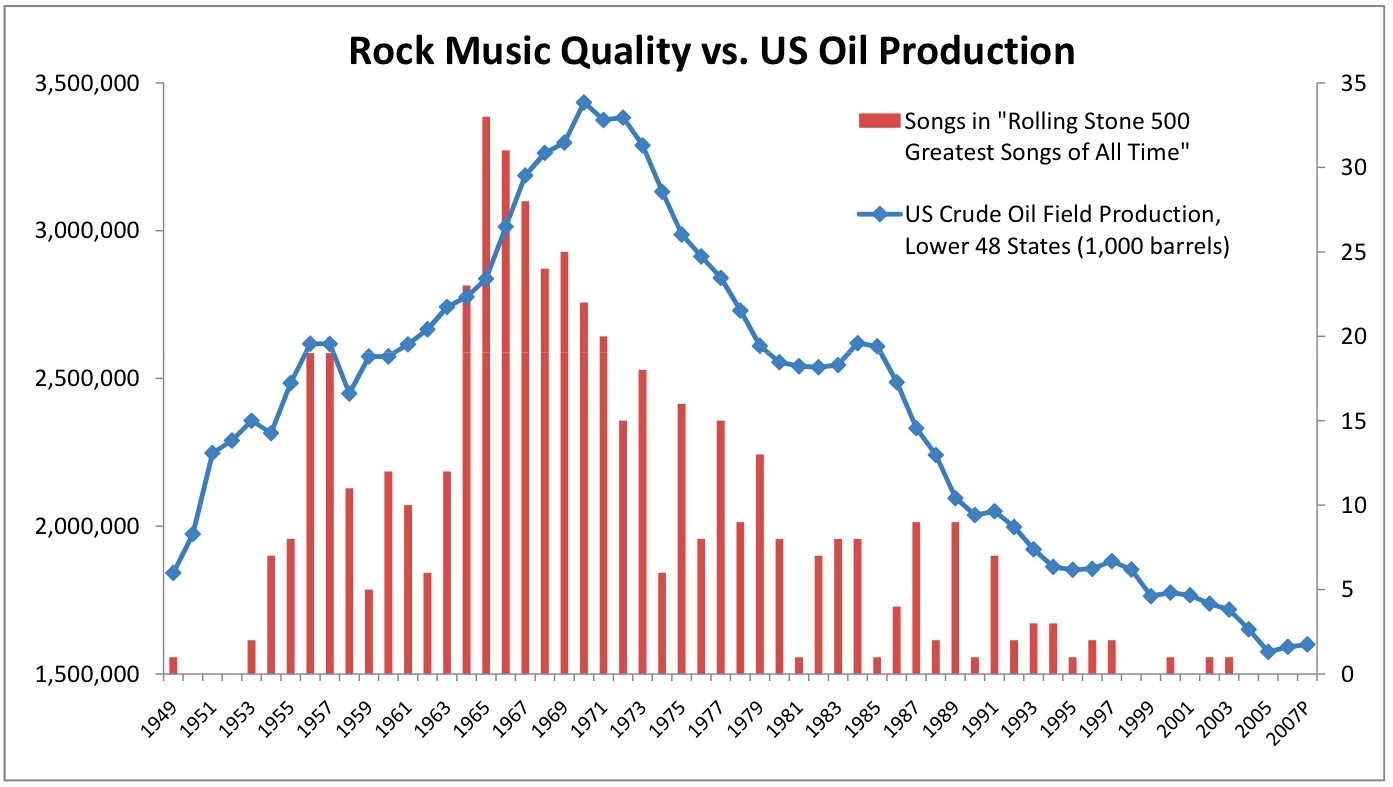
I know it is meant to ultimately be funny as it comes from a web site called "Overthinking It".
Yet what better way to educate people than to show something that uses some nasty statistical tricks including data censoring and scaling. And that does not even begin to touch on how utterly preposterous of someone to make causal connections between the two. I say this since it is clear that the best movies of all time (and not rock songs) coincide with USA peak oil production.
What is required here is a dispersive model linking cultural investment and its evolution and diversity to net energy (per capita) set in a system dynamics model for the Earth - that includes cultural developments outside of the USA.
Some people too proud of the progress they have made with their belief systems might be surpassed by those who can grow beyond their existing knowledge bases. Much of the science, math, and intellectual progress has been wrought in more Christian tolerant societies. Moral ethics that have provided healthy and peaceful enjoyment for many may not be abandoned for the emptiness of spiritual anarchy.
Rene Descartes, "Cogito, ergo sum." Certain truths are inevitable.
Some were content to be able to invest in fixed line phones for customers, but others took risks to
implement mobile wireless broadband services already going into planning for the fourth generation technology and hardware upgrades, the fastest growing segment of the telecom industry.
Those worried the world would quickly run out of oil and henceforth energy were challenged by innovations in drilling, completion, seismic exploration, and heavy oil upgrading technologies.
If I did not have the time to do my own, in depth research on a topic, the next best thing would be to read papers produced by scientists in the relevant field, doing current research on the topic.
The reason most people are confused about the causes of global warming is because they view scientific knowledge areas as interchangeable.
Would you go to a brain surgeon for a heart attack? No, probably not, yet no-one disputes that a brain surgeon is probably very smart when it comes to brains.
It is important to realize that all scientists are not alike - their expertise is not interchangeable. And the smarter, and better educated in one topic the particular scientist is, the less likely they are to know much outside their given area.
While an astrophysicist is very smart, and very specialized, and could probably pontificate at length on the correlation between sunspots and climate, they don't have credibility in the discussion about anthropogenic global warming, since they have not done their own, peer reviewed research on the topic.
Yet, every single day, we are bombarded with out-of-context "facts", second- and third-hand opinion and "belief" by psychologists, commentators, lapsed and retired geology professors funded by oil companies, religious and political pundits, even TV weather-persons claiming a position on climate change.
Me, I prefer to go to the source - Climatologist James Hansen.
"http://www.columbia.edu/~jeh1/"
or to the website http://www.realclimate.org. "Commentary on climate science news by working climate scientists for the interested public and journalists."
Once you read this material, there is no room for doubt about the current cause of global warming.
Michelle
SpringTides,
Time is the most valuable resource you have imo. I humbly suggest you use it wisely before you find out you have just run out of it.
Your reply and suggestion is nothing more than an appeal to authority, and nothing more than the same ol same ol with comments and charges which are out of context, misleading, unprovable, and are the techniques of trolls.
I have read, and still do the claims and sites you have mentioned. I find the peer review of the "inner circle" is nothing more than a "circle jerk" at this point. I prefer to expand and evolve, than worship those that have failed before, changed their tune, in their claims and pronouncements of superior knowledge. How I should follow their viewpoints because they know more than I do.
Follow them if you will, I prefer another way of life and study.
Point.
Lord Kelvin, flying machines, and people that believe that their knowledge is always right.
Lord Kelvin and many others of his Time stated that man could not build flying machines. Some even stated that this was a complete hoax well after the Wright Brothers had flown many Times.
At that Time I recall that Lord Kelvin was head of the most respected Scientific organization of its Time.
Wonder where he went wrong, and all those that believed his appeal to authority based on his faulty knowledge of the universe and how it works.
PrisonerX
I rather think you just made my point exactly - clearly Lord Kelvin was not the expert studying and practising, and learning the facts on the ground, so to speak, in the front line of aerodynamics, and therefore his opinion, no matter how smart or influential he was, was not credible - on the topic of aerodynamics.
spring_tides
But is that not the problem in a nutshell ?
We have no easy way to determine if someone has actually studied a field to the point of being credible. Intrinsically there is no reason to assume that Lord Kelvin did not understand aerodynamics he had certainly had the basic background required to readily grasp the field.
To my knowledge he never published a peer reviewed paper on the topic but left his comments to stand in the general press. But this does not mean they where not valid just because he did not spend the time to become an expert in the field does not intrinsically mean he was wrong.
And further more Lord Kelvin is now well known as the premier example of a prominent and influential scientist that got a lot of things wrong.
http://scienceworld.wolfram.com/biography/Kelvin.html
Not that I dislike extreme examples :)
But I'd argue that far more dangerous and insidious is the real expert who dismisses and idea not a man like Kelvin who obviously put his own view of himself and the world above science. He is to some extent easy enough to dismiss being on the extreme its the narrow decisions that leave certain paths unexplored which collectively hurt science far more then one extremist despite his position. Even on the side of the people that are wrong when it becomes a matter of the individual then its not so important to the collective.
For aeronautics for example efficient flight has long been neglected generally a field relegated again to the sidelines with ultralights in the headlong rush to large international transports. With almost every single field of science the road less traveled turns out to be the path we should have taken in retrospect. We should probably have built small fuel efficient people movers and with ingenuity these could well have been VTOL craft or capable of very short take off and landing. Technology to make flying fairly failsafe and doable with out extreme pilot training has been possible.
I'm not suggesting the personal flying car but at least cheap and probably overall more efficient flying taxis. Lighter than air craft of all sorts are and entire area that was prematurely abandoned. Solar powered rigid airships are just as viable at the engineering level as our electric train concepts and offer a far lower infrastructure footprint.
Thus our problem is not the Lord Kelvins of the world they become over time known more for their failure than their success. Its the smaller decisions that make the difference and these are made by "experts".
A hypotheses becomes a theory when there is sufficient data to support the hypothesis, with a high level of probability that the results are accurate. It would be pretty unfortunate to have to wait until sea levels rise 30 feet in order to determine who was right about climate change.
spring_tides
Not true most of the critical scientific advances are based on mathematical models based on rudimentary evidence. Maxwell's equations, Relativity etc. Even the laws of motion by Newton did not have a firm data set to support them. Once these theories where created each proved amply backed by the evidence ( until they where not ). In fact I don't know of a single physics theory that was not created by a combination of experimental evidence acting more as hints and fairly rare brilliant insight coupled with a firm understanding of mathematics.
Lasers etc.
That is the question being addressed here. I have read over 190 responses and comments. The responses have been very interesting. I have not noted any responses that have stated that the fundamental problem of population overshoot must be solved first.
IMO, the best path will not be found until a consensus on population control is reached.
Most of us probably agree that is the fundamental problem but a "consensus" of population control is unlikely to be reached until resource depletion is self-evident to the sheeple. There is good chance that conflict, famine, and disease will be the "consensus" and that mating behaviors or policies will not change significantly. Fundamental biology is the proponent here.
That's because with population, it's not how big it is, it's what you do with it.
In terms of avoiding catastrophic climate change, the world could handle three or so Indias, but could not handle even one Australia and USA.
One-sixth of the world's population uses half its resources. This one-sixth then sternly lectures the other five-sixths on population and not consuming too much. To which there can be only one reply: "You first."
On this we agree. Consumption is a bigger problem than population. Unless one prefers to ignore distribution, and then we have different problems....
And in this we also have the reason for the desire for endless growth. Because if the economy isn't growing, then the only way for the poor to have a tolerable life is for the middle and upper classes to give up some of their wealth.
Thus, the middle and upper classes support endless growth. And are more often sceptical of climate change and peak fossil fuels than the working or impoverished classes.
This is completely wrong IMO.
Poverty is BAD and people know it. Overpopulation = = scarcity = poverty(Malthus).
In overpopulated Japan there is a saying 'Rich Japan, poor Japanese.
If you want to see environmental degradation visit any overpopulated country.
Certainly the rich must clean up their messes but all humans are messy.
http://en.wikipedia.org/wiki/Thomas_Malthus
Well, not really.
Just consider,
China - high pop, low wealth
Japan - high pop, high wealth
Belgium - low pop, high wealth
Somalia - low pop, low wealth
and so on. There's no correlation between population and wealth. It's much more to do with resources, education, having a stable socio-political system, and so on.
Nor does an overpopulated country necessarily have lots of environmental destruction in it. They could, like Japan, export their environmental destruction. It has over 60% forest cover, but domestic production of timber is only 20% of demand - they destroy Malaysia or Australia instead of Japan. This is basically what the First World uses the Third World for. Not even the US would tolerate stuff like Shell does in the Niger Delta.
So population really isn't the issue. It's how they choose to live that's the issue. The Europeans, for example, manage to live rather well with half the energy and resources of us in the USA and Australia. They're still wasteful and polluting, but much less so - which shows that it's not inevitable, it's all about how we choose to do things.
"it's not inevitable, it's all about how we choose to do things."
Absolutely - both a Tahoe and a Prius will get you to work, but one takes 5x the fuel.
Hi Nate,
Average per capita consumption in western developed countries has clearly overshot the natural resource base it depends upon. But, the implication of saying consumption is bigger than population is troubling. I hear in that statement that we might not need to promote family planning and not really try to get the planet's total population down to around 4 billion or less.
It seems to me that this is not a question of which issue is "bigger". From my understanding of our planet's problem, we need to both re-adjust western world style consumption patterns and reduce total world population in order to perserve a viable planet for future generations of humans and other species.
I think that most people would agree that we need to reduce population as long as its someone else doing the reduction.
I'd say what your missing and what Nate somewhat brought up is the need to move back from the cliff we are facing with dignity. Part of this is of course for the wealthy to give up their wealth. Part of it is for the poor to forgo large families to support them in their old age.
Obviously the two could solve the same problem. So I'd propose a broad outline of a solution that I hope brings your two posts together.
If we gave up on endless growth and the associated devaluation of our currencies then we could give assurance to the poor of a reasonable retirement without relying on large families for support. Thus there is a way to bring the population down and of course with reasonable basic medical care there is no reason that the old could not work to their ability well past 70 years of age. So the ogre of a world growing old is not really near is bad as it seems. Sure it means that retirement at 65 is probably a thing of the past but I question to be honest if it was ever a good thing. Certainly what you can do as you get older depends on your medical condition and this often depends on how well you have taken care of your health. But overall I see no reason why the old cannot continue to contribute to their own well being for some time.
The other argument of course has to do with our overall food supplies but even a simple examination of the amount of arable land and use of intensive organic methods and smart farming indicates we can feed the current population probably not much more and we are certainly on the edge esp in certain regions. This suggests that to some extent we need to seriously consider moving some populations to lessen the demands on certain areas.
But we still can deal with population in a humane and dignified manner if we act. Practically everyone in America could easily grow some food if its just a window herb garden every bit counts. No reason that our highway medians cannot be sown with wheat instead of grass or at least the grass made into hay for animals. Many of our roads could be reduced to single lanes and of course electric trains adopted freeing up even more land. And of course we can stop and reverse suburban expansion opening up more land.
The point is the amount of potentially arable land that can be brought into production without further destruction of our forests is large. Land that is under production could readily be farmed with more intensive agriculture if this requires labor well we know where it could be obtained. Certainly this brings up interesting social issues but I'd suggest these could be solved.
Hopefully this acts to clarify both your posts but the point is if you really look at truly solving the problem then it can still be solved its reasonably possible to still humanely reduce population. I'd argue that we could even still make it if we started aggressively on the right track and population rose only say another billion. It would make it harder but still doable. At seven billion you may be forced to offer decent retirement only to people who accepted sterilization after one child for example. Better sweeten the offer with a full education for the child and adult education for the parent plus basic medical care all for free. Children of parents that choose not to accept this offer can be offered and education and retirement in exchange for sterilization with no chance for offspring of their own.
That should make parents think twice about their own choices. I'm sure that a son of daughter of a man or women that chose to have to many children who then decided to choose sterilization will not be too happy about caring for their parents in their old age.
But I don't think these extremes are needed they might if we wait much longer. Right now I'd say peak oil is our most pressing problem since we need energy to transition. After that I'd say that collapse of the worlds fisheries is the next biggest problem we faced followed closely by potable water. And right on the heels of this sets global warming. This order is subject to change without notice.
Overall and fairly rapidly since most of the wealth of the preceding generation which is the savings of two people is transferred to a single member of the next generation the overall level of wealth will increase fairly quickly. Labor will become expensive but thats rather the point that labor itself will become a valued resource and older people who can't perform at the same level as younger people will be accommodated into the labor force out of necessity. This path can be followed for some time until it reaches the point that a further reduction in population threatens the ability of the civilization to sustain itself.
Where it stops we don't know but I'd offer that England or California both regions with a population about 30 million plus have enough people with enough diverse talents and skills to cover any needed and many unneeded jobs. A global population less than 1 billion or as low as 300 million is more than enough to sustain a vibrant society.
Its intresting that a target of 300 million to 1 billion represent the range of population during the period 1000 AD to 1800 AD.
http://en.wikipedia.org/wiki/World_population
Or over about 1,000 years we stayed in this range as we made dramatic advances in technology. Only the final medical and agricultural advances turned on the massive increase in population.
bikedave, you're on a roll under this article.
I was gonna let the whole population vs consumption thing pass to bring up some other time, but since you've commented I'll weigh in as well since I tend to agree with what you say.
One often hears that "it isn't population, it's distribution" or "it's consumption", whereby the entire grotesque problem of there being too many humans at once on the planet is somewhat shuffled aside as a work in progress.
The premise, presumably, is that if humans and their entrenched cultures were other than they actually are, there would be less of a problem. Well yeah, that'd be the bees' knees, but they aren't and it isn't.
Why on earth should we expect, on top of all the other problems we face, for humans to spontaneously - and in the nick of time - alter their pursuit of relative wealth to a revolutionary degree?
The notion of egalitarian fairness works its way into any argument, and I'm certainly not against it. It simply isn't that easy to achieve, to put it mildly, and we may be well advised, at some point, to actually question whether it's as important a goal as, say, preserving a living world for our species and others.
Wasteful consumption is certainly a damage magnifier, but human populations are in serious overshoot by any reasonable standard. I suspect that disproportionate consumption - to the degree it has existed in most of our lifetimes - will be winnowed out of the "middle class" relatively soon as the buying power of the US dollar eventually tanks, and will use up a smaller percentage of the earth's dwindling resources.
The members of any species have an uneven distribution of "wealth" and "luck" in survival terms. From the inside of a plague species looking out, the disparities matter a lot to us. From the outside looking in, the average behavior and population number is all that sticks out.
But we are pushed agianst a wall to be honest and fair and egalitarian the other choice is to create conditions that will almost certainly create monsters that rival Hitler and Stalin.
Either way our endless pursuit of wealth and destruction of our planet is coming to a end its really up to us to decide the ending. I agree that its reached the point that and almost unconceivable turn of events is required. But we brought this on ourselves. Certainly the right moves have a faint chance of happening but that does not change the problem.
Generally I also do not see much hope right now but understand that the oil is not coming back anytime soon regardless of what happens over the short term we will repeatedly now face this problem. Its not just energy so and advance like fusion won't save us maybe it will give our children or theirs a way to solve the problem with dignity. But given our simple knowledge of hygiene we can be sure that the human population will repeatedly hit overshoot from now and for the foreseeable future. I suggest that we probably can't solve it this time around humanity rarely solves any problem the first time it crops up. But we can still lay the framework for the future and try and educate our own or others children and lay a foundation for change. Done correctly when the problem of growth returns we can hope that a large precentage of the population understands what they face. I suspect that they will have a history almost to horrible to read about the last time this happened to support not doing it again.
Maybe then we will change maybe it takes one more cycle of destruction or another or another but at some point each round will destroy more and more resources and make it ever more difficulty to grow much without hitting some limit. One hopes at some point in the cycle we will finally change. Regardless the one answer that is possible no matter the outcome of todays problems is to do our best to prepare the next generations through our own actions deeds and education. No government or other human folly can prevent us from education others. Maybe we get lucky and change soon enough to bypass the problem maybe we don't but the solution remains the same regardless we have to make sure that our own greed and vanity is stomped out and not passed on.
I have great respect for your mind and independent assessments, memmel.
I'd suggest, though, that the drive for perceived fairness has a lot to do with the empowerment of despots. Nurturing in the populace the common belief that they haven't been treated fairly by "the enemies" is in large part where the power of a Hitler or Stalin springs from.
Take a close look at the unifying myths of revolutions that sweep such people into power and you'll find the same powerful emotions one sees in a screaming rhesus monkey who has gotten a piece of cucumber when its companion has gotten a piece of banana for the same task.
I think that this "fairness imperative" may be one of the most disastrous biases of human perception, yet I haven't seen it raised by anyone else. So either I'm wrong, am insufficiently well-read, or it's so fundamental as to be quite hard to perceive. Think about it...
and goodnight to all..
"the drive for perceived fairness has a lot to do with the empowerment of despots. Nurturing in the populace the common belief that they haven't been treated fairly by "the enemies" is in large part where the power of a Hitler or Stalin springs from. "
If you review the history of Germany from 1919 to 1933, and Russia, well, pre-1919, I think you'll see that these despots had a lot of real material with which to work.
I agree with you Greenish when the chips are down many will tout "fairness" like your saying almost all will simply be trying to replace the current status quo. A perfect example that evolving right before our eyes is Venezuela. So far at least it seems that the lines have not been crossed but who knows when you have a despot.
I think the problem is its difficult to split fairness from the concept of what I deserve.
For many middle class Americans fair would be considered a continuation of the current lifestyle and in fact they would all in general love a return to bubble conditions.
This perception of whats fair is itself the real problem not the more esoteric concept of a fair way to live our a deep look at your lifestyle and reverting to what you need.
I think your post is getting to the root of the problem and its a matter of individual perceptions building into a group perception thats warped or flawed.
From a completely different perspective I've lived in third world countries and I know most of the people in these countries think the US is some sort of heaven on earth or nirvana.
The layer of envy is deep and global. And maybe envy is the real problem since envy causes everyone to think their fair position is one or more steps above their current position.
And as Nick wrote I think above my post they often have a lot of real material and real injustice to work with you combine this natural envy with true injustices and you end up with a powder keg. The current powers generally work to surpress it leading to even more problems.
But this is why I suggest we take the long view of the problem and not worry about solving humanties problems today just because our current civilization happens to be collapsing.
So what many have in the past many will in the future until we learn to live within our means. Christianity started as a subversive religion and eventually grew to be the religion of the empire because its message worked well with and empire in decline. I'd suggest that overall the message that most of us would like to see is a combination of respect for people from Christianity, Buddhist/Zen thinking concepts, Moslem concepts of banking and probably other concepts for daily life there is a lot good ideas in the Moslem religion that have currently been distorted first and foremost it functions well without a central authority.
And we could go on and on. Thats just from our current religions on the side of science and philosphy art and literature there are also a wealth of insightful and smart concepts that exist as individual islands. What I'm thinking of is sort of a best of mans knowledge concept we can compile the good part of what we know vs the bad practices.
The book of good and neat stuff for simple daily living and thinking :)
But like the rise of the past religions I think its a long term affair and yes I'll admit it really is religion not science and not some social movement at the end of the day you have to believe that by living this way your doing something good that will empower generations you will never meet. This takes a leap of faith.
If you wish, you can regard each issue as equally important. They're not, but you can see them that way. But there's a key difference in how easy each is to address.
It's a hell of a lot easier and quicker to reduce consumption than to reduce population. The Western world could reduce consumption of most resources by at least one-tenth overnight, and by half within a decade, without significant discomfort or effort. It's not possible to reduce population by one-tenth overnight, or by half over a decade, by any humane means.
So - the West reduces consumption, while at the same time the Third World improves the prosperity, education and political power of women, so that population stabilises and then declines over decades.
Unfortunately, Westerners are not keen on reducing consumption, nor Third World leaders keen on improving the prosperity, education and political power of women.
"The Western world could reduce consumption of most resources by at least one-tenth overnight, and by half within a decade"
Awfully important point. I'd add that to those two time points a 3rd: we could reduce oil consumption, in particular, by 25% in 3 months.
Bicycle Dave
Of course population AND consumption are both big problems. My point was that if we changed our global carrot away from conspicuous consumption (and countries like China, India, etc. followed), this would have dramatically larger short term impact than halting world population growth and having the remaining denizens continue the human thermodynamic garbage machine unchecked.
Hi Nate,
BTW, I listened to your talk on public radio in Stevens Point, WI – very much enjoyed that. Stevens Point is one of my favorite WI towns because it has great shop for recumbent bikes and trikes. http://www.hostelshoppe.com/
I’m glad JWS raised the population issue and the discussion moved to population vs consumption because it certainly did generate a lot of thoughtful commentary. I only wish that this type of discussion was taking place in the halls of the US Congress.
Kiashu made the point
This is the same point that Lester Brown makes in Plan B 3.0 – and, IMHO, it is critical. When I mentioned family planning, I was actually thinking how much good the US could do by following Brown’s advice and channeling military budget money into helping developing nations with their education programs. Even if waste and corruption are accounted for, it sure seems it would be a better investment than more aircraft carriers.
Greenish made the point:
Memmel puts forth a lot of thoughtful ideas about how
Great ideas that really should be part of a broad public debate. But, the real problem seems to be that most policy makers have either an almost total lack of awareness of the consumption/population issues or feel it would be political suicide to bring them up. Wouldn't it be great to have the folks commenting here testifying before Congress.
I’ve supported organizations like Population Connection http://www.populationconnection.org/ for some time – but they seem to have a very tiny voice.
In any event, Nate, this was a winner of an essay you put forth.
Nate,
Wonderful topic. I am a bit fatalist in this matter. I tend to think that the solution is as Lorenz's father (forgot name)instructed "You can solve a problem by proving no solution exists"
Not very cheery. We essentially face a limit issue, and our entrenched opinions, which are tied to our 'beliefs' do not allow us to accept the answer. There is none. Humans will continue to consume and populate until we start a conflict in which nukes are used and that's it.
It is the most likely outcome given the start point we are at now.
For Example: I worked internationally for several years in Venezuela as a 'expert' for PDVSA. We were looking at ways to allocate budgetted resources to a variety of exploration and development projects using a portfolio approach. I performed an analysis on every producing oil and gas well in Venezuela. We declined Maraciabo, Maturin, Lagunillas, all the IOC's holding, everything. Then we looked at the exploration end, Plataforma Deltana, etc. Our analysis said build huge pipelines to transfer all the gas on the eastern side of Venezuela to the Western side to inject into Lake Maraciabo to maintain reservior pressure. We looked at several other possibilites, even Nitrogen injection from 300' tall nitrogen harvestors. The best solution was discarded and instead they re-wrote the fiscal tax regime to get more money from the IOC's. The analysis also said don't spend any more money drilling new offshore wells as the lead time was 7-10 years and if they don't fix mariciabo they won't have the money to do it anyway. That was 2003. It's 2009 and Venezuela can't pay it's creditors with $30-50 oil. (portfolio selection was run on a GA and a linear solver, risk term was semi-mean dev and value was NPV@10)
All of our analysis and evidence flew in the face of all of what they had been planning for the previous 10 years. They rejected it for political and social reasons. Now the Chinese will step in.
The most likely outcome, not the solution, is what we need to solve for. Then prepare for. I for one am buying land and learning to farm. I also am spending more time fishing, I like to fish.
Only my opinion.
PooBah
Airdale, your posts are so informative, i have always enjoyed your posts. your knowledge, your down to earth spirit. If you never post a again we collectively at The Oil Drum will always be one person short! No one person can fill your shoes. Kentucky is a very beautiful place, the farm fields, the barns, the horses, the rolling pastures. I really think this is Gods Country.
That being said, I personally wish you the best in health, and a recovery if it can be done, and look forward to your posts if ever you post again. you will be missed. and i mean that!!!
we are going to miss you!
(as i wipe tears from my eyes)
Thank You Airdale for your contributions to The Oil Drum!
(as i wipe tears from my eyes)
So you consider a referenced 40 page pdf as an equivilent to a 1 hour unverifiable propaganda video..
This is the problem of false equivication. Video is probably the least scientific form of evidence possible, give the extreme difficulty of extracting and analysing all of the claims mentioned. Clearly you wanted to 'prove a point'..
Of course! They're absolutely equivalent!
Now, if it were a referenced 40pp paper vs a 1hr vid on oil, well there'd be no hesitation on which to take seriously.
It's as I said: specialists in one area cannot understand why anyone would have doubts about their own area, but at the same time are full of doubt about an area outside that.
If I kept sending Nate links to articles about abiotic oil, I feel sure that like his friend encountering the "global warming is a myth!" video, he'd say, "please send me no more of this crap."
And rightly so.
But of course, that would be entirely different. If I encounter an expert on X, then I'm expected to take his word for it when someone pops up saying he's wrong on X, and offering their own wacky theory without evidence instead. Whereas if I encounter an expert on Y...
On peak vs abiotic oil, we are expected by TOD editors to either accept their consensus view, or else present our own very solid evidence against it. If we just sit around going "nah nah nah" then they'll probably boot us out, or expect us to be mocked away in the comments section.
But they don't extend the same courtesy to climate change issues. Fairly, they should either accept the consensus view, or else present their own very solid evidence against it.
Instead they misrepresent the issue. Nate calls himself "agnostic". Agnosticism traditionally refers to belief in God. That is, belief in something essentially unknowable. But climate change issues, like peak oil issues, are not unknowable: all it takes is effort.
"I don't know because it cannot be known" is agnosticism.
"I don't know because I haven't looked into it" is ignorance.
Claiming to be agnostic when you're only ignorant is implying that these issues are unknowable. Which is the denialist's fallback position. "Well... who can know anyway?" This is because that kind of fuzzy-minded doubt leads to inaction, like when the government says, "we'll hold another inquiry."
Don't be an "agnostic", nor a denier. Extend the same courtesy to RealClimate.org and the like you expect here: accept their consensus view, or else present your own very solid evidence against it.
Very well put. The scientific consensus on anthropogenic global warming is the result of the accumulation of scientific evidence. The contrarian position relies on the continual repeating of assertions no matter how often scientific evidence is presented to show that they are incorrect. The assumption of an agnostic stance gives contrarian views a weight they do not deserve.
Just to be clear, my viewpoint on where we are at on limits to growth on the planet is a STRONGER and more urgent one than the vast majority of climate scientists, due to my work on finance, net energy, water and anthropology (change in historical resource per capita default paths is war). Agnostic means I am not sure, and have to trust the body of science in existence, though I suspect there is a huge amount of uncertainty in both camps. I have discovered, to my chagrin, that in many other areas I am uncomfortable with the existing dogma in science (economics for one), so my point that we urgently need reduce impact on planetary sources and sinks (oceans and ecosystems in addition to atmosphere. etc.) is the stronger position. If I devoted 6 months to a year to reading all current literature from both camps in climate debate and found I sided with one of them more than the other, it would change very little from my perspective -(coal has many other deleterious properties other than carbon but could offset more of oil depletion via Fischer-Tropsch at other environmental costs).
Please don't crucify me because I choose to devote my time in learning what the weakest/highest leverage links are. Human demand drive and how we channel it is the most important puzzle - everything else follows from that.
Nate,
Can I make a suggestion? I think you'd win allies and reduce conflict if you used the phrase "limits to resource consumption" instead of "limits to growth". We desperately need to "make things better", which is the same as growth. We need to reduce resource consumption. This is a key distinction.
Of course, LTG is more familiar, and a bit less clunky, but words matter...
That is totally untrue. Read any ecological economic textbook, or Happiness/Gilbert or any other hedonic/happiness research.
And words matter less you think.
A)'words' since our larynxes descended and we were able to voice discreet sounds, is a fraction of time in our evolutionary past - we are much more aligned to 'seeing' (3-d, videos, cartoons,etc.) than words - words mean different things to just about everyone - it is our penchant towards abstractions.
B)I multi-task extremely well. I get 80% of gist of meaning with 20% the effort. Comments on a blog are not as careful as a peer review paper (which is probably why I am still not done with Phd, but close). Don't take every sentence as gospel, from me, or anyone - there is far more going on behind and above the fingers hitting the keyboard.
"I get 80% of gist of meaning with 20% the effort."
IOW, you use short-hand which you hope that your readers will understand. Perfectly reasonable. OTOH, if one has the time, it helps to write as clearly as possible.
"And words matter less you think...words mean different things to just about everyone"
Precision in word use is more important because of their variability in meaning.
"Don't take every sentence as gospel, from me, or anyone "
Certainly good advice - but of course, if we can help our readers avoid mistakes, that's all to the good.
"That is totally untrue. Read any ecological economic textbook...
This is pretty hilarious - I was guilty of exactly the same thing I'm admonishing you about - I used short-hand which I hoped that you'd recognize. Conversely, you're making the same mistake that some here did - not giving the author enough credit for what they meant to say.
The topic of "growth" is, of course, a long discussion. What I meant was: we need to put our "energy" into reducing our ecological footprint - this may not translate into GDP as currently measured, but I would argue that GDP measurements are moving in that direction, precisely through what GDP theorists call hedonics adjustments. Further, we need much more in the way of services, which don't necessarily consume oil, water and steel.
We want both a better life, and we want to make it sustainable. That will take a lot of hard work: a lot of engineering and design as well as social organization. I'd say that's a prescription for full employment, and growth in the value of our economy's output, if properly measured.
The above equation is highly questionable. First of all it is not always possible to "make things better". Sometimes all that you can do is to minimize your losses. For example, if you have a leg wound and severe gangrene, then the best option for your future may be amputation. I am not claiming that the current global situation is necessarily that desperate, but if you assume, a-priori, that that the human situation must always get better you may end up making very poor decisions.
Secondly the equation growth in human satsifacton = making things better may be valid as long as time scales are properly taken into account (e.g. growth in satisfaction over the next five years followed by starvation in ten years is not making things better in my book). However, it is far from clear that the equation growth in human satisfaction=growth in dollar incomes is valid.
Roger, please read my following answer to Nate - that will help clear things up.
"First of all it is not always possible to "make things better". Sometimes all that you can do is to minimize your losses. "
We're in agreement. If you have gangrene, amputation is "making things better". I'm not assuming a linear kind of thing, where things always get better.
"it is far from clear that the equation growth in human satisfaction=growth in dollar incomes is valid"
I agree. Absolutely, we need to redefine growth. Was it Bhutan that declared a national Gross Happiness Product?
My point? If you blithely talk about Limits to Growth, you're going to alienate people unnecessarily. A lot of people know, intuitively, that Things Need To Get Better. If you don't clarify what you mean by LTG, you'll lose them, or get lost in endless arguments about your premises.
I agree that the phrase "limits to growth" does not sell very well, and I also agree that a general reformation of society is required and not just stagnation or contraction. On the other hand I think trying to shoehorn the required social changes into a single quantitative scale of value which we can then try to mazimize is not the right approach. I certainly do not use this approach in my own personal search for life satisfaction. I do not multiply the length of time I spend on various activities by some coefficient which translates them into a universal happiness scale, and then attempt to numerically maximize my happiness. I do not see any reason why such a scheme will work for society at large either.
" I think trying to shoehorn the required social changes into a single quantitative scale of value which we can then try to mazimize is not the right approach. "
I wasn't really suggesting that - I mainly meant that we need to redefine "the good". Much of this needs to be personal: I'm thinking Maslow's hierarchy of needs. People are stuck on the lowest levels, instead of progressing up as they need to.
OTOH....I think quantitative measurement shouldn't be scoffed at. Health (longevity, infant mortality, disease and disability incidence), education, social connectedness, happiness surveys - these things can be measured.
"Agnostic means I am not sure, and have to trust the body of science in existence"
That's an awfully important clarification (it happens to be my approach as well).
Words matter.
Since Nate is a bit of an academic these days and, as was pointed out, it may well be that words matter, I feel obligated to assist in clarification:
This does not fit Nate's self-description. The following does:
Point to Kiashu. Comment: He has been making some pointed observations, but I find Kiashu to generally use quite rational and logical arguments. The above is quite correct and leaves Nate with two choices: argue the point without hope of resolution, or admit his usage was a little off.
It's a very small point, imo, but clarity is good, so... I suggest to Nate to simply concede the point and understand the use of "ignorant" here does not carry a pejorative connotation and is what he actually means.
Cheers
This will be my last comment on this thread, as it has now reached the decreasing returns to complexity stage:
I admit to having a 'lack of knowledge, education, or awareness' necessary to speak fluently on climate science. I choose to not allocate the time required to be confident enough to depart from consensus on my own. Therefore I am a veritable AGW ignoramus...;-) There - happy?
(Though I hasten to point out that many (on both sides) who probably have less knowledge than I do manage to come across as quite confident spokespeople.)
**Endnote: Four years ago I co-organized a conference, Peak Oil and the Environment which 25% of which dealt specifically with climate impacts of peaking in liquid fuels (I cold called Jim Hansen and he and Pushker Kharecha came down to DC to present). Back then climate change was not yet politically 'accepted' in DC.
In my own defense, I *did* say: "It's a very small point, imo,"
:)
As for the parenthetical: There are many paths to truth and enlightenment, Grasshopper. Some need to study a great deal to understand anything. Some study a great deal and understand nothing. Some study nothing and understand a great deal.
As for me, I resemble your remark! And have yet to be wrong. Don't worry: If given reason to reconsider, I will, but it's more likely a million bucks will rain out of the sky on your head when you read this than it is that AGW is bullocks.
Sadly, the set of solutions for PO does not exactly match the set of solutions for AGW, so the differences are important and it's worth the effort to illuminate them.
Cheers
It is ignorant comments like these that will cause me (and probably others) to prematurely leave this venue. The 'video' was a lecture from someone I know personally. The pdf was non peer-review from someone who claims to be an expert on methane hydrates - pretty alarming stuff. So you have it precisely reversed. I didn't provide those details because they weren't relevant to the essay, yet you 'assumed' your interpretation was the correct one. (I'm not going to post either here because the point of this post was not the climate science but how we think about climate science.)
I'm used to the tactics of climate skeptics, and the use of videos as a way to get around pesky review processes is pretty common; it's also a tactic of 9/11 freaks, creationists and other denialists. Something you should have been aware of when making the post; and it was extremely relevant to the essay that the information you gave was equivilent.
A pdf may not be peer reviewed - but it is an awful lot easier to read and critique a pdf than sit through a video, try and extract any scientific claims made, locate references and see if what is said makes sense. In a field that has been deliberately saturated with misleading propaganda you are asking an awful lot of someone. Why you think that it's relevant that you know the person, I don't understand, apart from the possibility that it leads you to over-rate his or her work; this is science and the argument is more important than who makes it.
Oh, and if you are going to swim in the waters of Philosophy of Science, you are going to need a much thicker skin, 'cause there's more shark than water out there.. especially if you write an essay about confirmation bias with a complete lack of self awareness.
While the ocean life gets mentioned in passing, I'll go for the direct tie of CO2 and ocean acidification. Is man not worried about acidification because man will create fake reefs, or provide electrical help to coral so it can build reefs?
http://www.foxnews.com/story/0,2933,315272,00.html
Increased acidification effects can be shown with simple chemistry and experiments. "Facts" if you will - thus allowing one to 'know'.
Nor does CO2 levels change the effects of a sun warming a planet - if the sun's getting the Earth hotter the coasts are STILL toast and man had better plan on moving inland. Or growing gills.
I can understand fights/disputes about how much governmental influence/taxation/what the tax money will be used for. But to say CO2 has no effect? The ppm in the ocean tell a different story.
Sorry double post.
Hi Nate,
On the same vibe, David Bohm's "Thought as a System" (1994, Routledge) is very insightful as to how the process of thought works.
Also, this link to the Farce of Physics is very interesting.
And as posted else where, Paul Stamets (2005, Ten Speed Press) points out in his "Mycelium Running", on a blank page, just before the index:
IMHO, true science is that fine line between superstition and scientism, a delicate balancing act if there ever was one.
I still don't know... but at least I know that – at least I think I do!
No amount of knowledge, intellect, reason or rhyme can over come the foibles of being human, only humility can do that…
L,
Sid.