 | Sustainability: Planning from a Base of Zero | The Oil Drum: Campfire | Saving Seeds: Is this the way to go? |  |
Whither The Oil Drum?
Posted by nate hagens on October 4, 2009 - 11:00am in The Oil Drum: Campfire
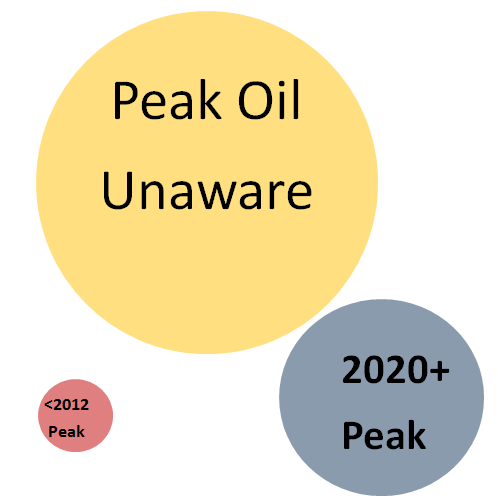
A few short years ago, in 2005 when I started contributing here, it seemed that people could generally be partitioned into 3 main groups regarding their views about Peak Oil. By far the smallest group were those calling for a near term (<2012) peak in global oil production. A larger, and definitively more vocal and deeper pocketed group (including IHS, CERA, most Wall St. firms and energy agencies) were in the "peak oil is not real" or "peak oil is post 2020 at a minimum" camps. But by far the largest % of the population were oblivious to these debates on oils peak, unaware of the possibility and/or importance of a potential peak and decline in our socioeconomic hemoglobin.
As such, those in the smallest camp, irrespective of age, social status, political affiliation, demographics, education, objectives, or sexual preference, united together in a collective effort to raise the analytical alarm bells about the possibility and implications of a near term peak. There were occasional tangential discussions such as renewable energy technologies, relocalization, psychology of consumption, finance and geopolitics, but by and large the focus centered on Peak date (and post peak decline rates), which were topics most of the Peak Oil tribe could agree on within certain parameters. We were all on the same team.
Fast forward to Q4 2009, and the landscape has changed considerably. The % of people acknowledging at least the possibility that we are already passed the peak in global oil production has markedly increased (though is still a minority overall). However, though most of the 'early peakers' (the small pink circle above) remain in that camp, 4+ years of analysis and insights have created a vast disparity of world views, beliefs and objectives within this once homogenous group. Slow collapse, fast collapse, catabolic collapse; renewable energy to the rescue; conservation and efficiency champions; human extinction let me count the days; powerdown, drill baby drill, retreat to steady state economy, World War III, Mad Max, the dawn of space based energy, lets just party and enjoy ourselves, etc. - the list of differing views is a long one.
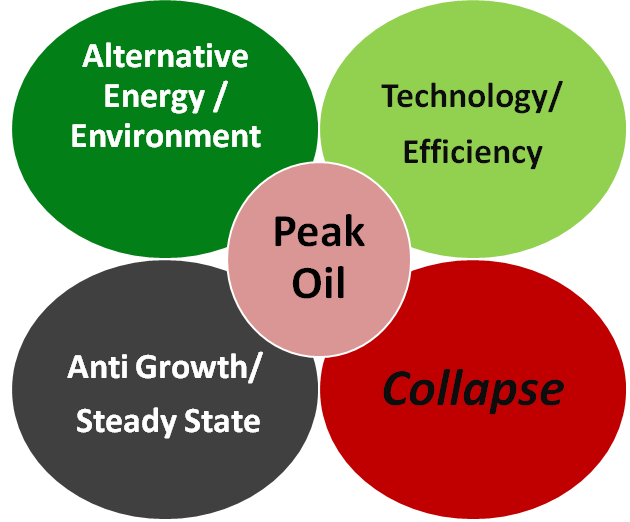
I would argue that within the "Peak Oil is likely past tense" group, there are four main camps with respect to our likely future trajectory. 1) The "renewable energy" contingent, who generally subscribe to the belief that solar based flows will eventually replace fossil fuels in a somewhat seamless transition and that Peak Oil is probably a good thing with respect to the environment, 2) The energy technologists, who believe that even in face of near term peak, that better drilling, seismic, and recovery techniques combined with increases in unconventional fuels will keep us roughly on a business as usual path, 3) The End of Growth group - who think we have overshot resource limits (not just energy) and must generally powerdown to some cocktail of both more sustainable means and aspirations and 4)the human species meets Reindeer Island group (The dieoff crowd) - that some large proportion (possibly all) of humankind will perish due to biological tenets based on fact that we are akin to a plague species, our rapaciousness trumps our ingenuity and ability to plan for future...essentially humans are not smarter than yeast. These world views have some small overlap but are largely mutually exclusive, though the numbers of people in each is vastly different (I suspect the hard collapse/dieoff group is the smallest). There are of course some other viewpoints not represented above.
Nestled within each of these groups are objectives that differ both in timing and in scope. Some of have no objective other than continuing to ride the wave of current dopamine - searching the internet for unexpected reward, reacting daily but having no particular long horizon concern or plan. Others care only about a more comfortable next 5-10 years. Others have a longer term horizon, and care about the world of their children in 10-30 years. Still others (rarer) care about what this planet might look like 100 or 1000 or 100,000 years hence. Too, voicing ones objective and concerns does not always equate to the truth. A great many eloquent writers and speakers might not be eloquent doers. Actions speak louder than words. It takes all kinds, etc.
For myself, I continue to view the future as a probability distribution, which includes a non-zero possibility for each of the above scenarios, and also some % chance of both business as usual continuation and of World War III trajectory, etc. I change my opinion about these things without even realizing it as I incorporate new understanding or new events come to light. My time spent here over the years has significantly improved my understanding of the various emergent properties of different disciplines accompanying global overshoot. I'm quite certain that there are some themes out there that will emerge in next few years that I am oblivious to, however, I have been frustrated that so many of the things we have talked about on this site are coming to pass, yet so little has been accomplished in mitigation.
In the face of this backdrop, I find myself with increasing occasion questioning the role and focus of resource depletion outreach, both via blogging and at conferences, etc. It is my opinion that we have enough knowledge (by far) to be making serious social changes, yet few of any importance seem to be occurring. (In fact, most changes that ARE being made are for the worse, buying us some small short term comforts at cost of greater ultimate declines in standard of living and environmental conditions.) How can this tribe, brought together with a common purpose of educating policymakers about peaking in oil production, continue forward: a)when what we were purporting to educate about has already happened, b) when our constituents now have widely disparate views about the future, c) when for the forseeable future fossil fuel decline rates are likely to be trumped by currency/central bank and financial outcomes and d) and as will be discussed below, when our efforts might only have outsized impact under unlikely scenarios?
WHAT ARE WE DOING AND WHY?
Here is how my mind is coming to terms with these questions.
Ahead of this months ASPO conference and amidst the 4 and 5 year anniversary of this site, I've tried to step back and assess what we've done, what we're doing and where we're going. On the one hand, this has become one of the 'go to websites' for news and information broadly related to energy and resource depletion. Whether by 1% or 30%, TOD was instrumental in accelerating discussion and awareness of depletion issues in international conversations from 2005-2008 - to what extent and to what ends we'll never know. On the other hand, I doubt in 2005 that many of us imagined we would still be writing and hanging out here in 2009-2010. Perhaps we thought that public awareness of the central truths regarding Peak Oil would obviate the need for armchair analysts to share data and perspective for free on the internet. Perhaps we didn't think that far ahead. In any case, I am virtually certain I won't be blogging 4 years hence (if for no other reason than my elbow will be permanently in the shape of a right angle).
As readers here are aware, I don't remotely believe that Peak Oil caused the credit crisis, the seeds of which started a generation ago. Though the financial crisis was largely (but not totally) ignored within the peak oil community until after the fact, its onset was arguably the largest reason that peak oil is cemented in the past due to: lack of price signals bringing on new supply, highlighting the non-viability of low EROI (high cost) projects, and implied smaller differential between natural and observed decline on existing fields in production. However, oil depletion, irrespective of causal chain, will be now be a permanent constraint on global society from here forward. But many other subjects will increasingly become more important: water and other non-energy inputs, social equity, geopolitics, fiat/biophysical relationships, energy technology, human aspirations, complex systems, etc. Put simply, these discussions will never again be just about oil (not that they ever really were). However, those efforting change on these issues will need accurate information on reserves, costs, and depletion more than ever before. As such we face both a dramatically larger tribe, and a smaller one at the same time.
I would hypothesize that each of us participating in the online muckraking/analysis sphere spends time on their websites of choice for some of the following reasons: 1)to increase our own social capital (through either social recognition or through an increase in our own understanding of a complex situation which will then in turn improve ours and our families future), 2) because we are puzzle solvers (meaning it's fun/meaningful to figure all this out, 3) because we want to make a difference to steer society away from making poor long term choices, and 4) being right. I would guess that all of TOD staff and most who hang out have done so for some combination of the above. My fear is that we, the analysts, are neither advocates, nor doers, generally speaking, which means we put stuff up continually in subtle hope that someone at a higher level will incorporate and implement it. To what end, we don't know. My gut feel is that a plurality of TOD staff fall under the number 2) above, and that increases in social status and/or societal transformation due to our work are only externalities of our passion for puzzle solving. I suppose things could be worse...;-)
Putting it all together
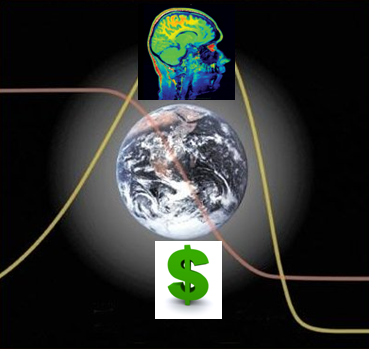
As usual, this essay represents my own musings, and is not reflective of the philosophy or objectives of anyone else on staff, but as one of the senior contributors to this site, I've begun to ask myself the purpose of a peak oil movement, in a post-peak environment where financial issues are likely to dominate for the forseeable future, objectives and beliefs about the future are increasingly disparate, and synthesis of information is only as good as ones understanding of the weakest link (ergo - there is TOO much information for most people if not everyone). Furthermore, our ability to plan and change for the long term diminishes in negative correlation with how badly real time events erode. As such, in my view the highest leverage lies in the integration and subsequent implementation of systems analysis. What is needed is a 2010 version of Limits to Growth that not only improves on the 1970s natural resource type model, but integrates two new layers: knowledge on human demand/neuroscience and the current status of our economic/financial system, into a holistic scientific project that can be used for serious and urgent global policy change. Perhaps a site like this could be a public forum to discuss and hone in on aspects of such a project. I don't know. I must admit I've learned as much from the relatively uneducated on this site than from those with stellar resumes. In the end we're all in this together.
Finally, I think 'Peak Oil' has eponymously outlived its usefulness. Too many now associate doom, gloom and fundamentalism when they hear those 2 words. Though doom and gloom may possibly be the end reality of Peak Oil, such an immediate emotive reaction can't be productive among people of influence. As such, the energy community, and broader natural resource paradigm change movement probably needs to rebrand the whole discussion. Peak Oil may or may not be past, but the term 'Peak Oil' is now passe.
CAMPFIRE QUESTIONS
1. Is it worth it for this website to continue? And if so in what direction? And why?
2. How can those interested in these issues continue to share/compare and synergize when knowledge of an increasing array of topics becomes necessary?
3. How can 'Peak Oil' be reframed?
Any other comments welcomed.
Contact
- campfire at theoildrum dot com
Personnel
Archives
- November 2010 (4)
- October 2010 (4)
- September 2010 (4)
- August 2010 (6)
- July 2010 (6)
- June 2010 (8)
- May 2010 (9)
- April 2010 (9)
- March 2010 (8)
- February 2010 (8)
- January 2010 (9)
- December 2009 (8)
- November 2009 (7)
- October 2009 (7)
- September 2009 (9)
- August 2009 (9)
- July 2009 (9)
- June 2009 (8)
- May 2009 (9)
- April 2009 (9)
- March 2009 (9)
- February 2009 (9)
- January 2009 (9)
- December 2008 (4)
The Oil Drum: Local archives
- November 2008 (1)
- August 2008 (1)
- July 2008 (4)
- June 2008 (4)
- May 2008 (3)
- April 2008 (1)
- March 2008 (1)
- February 2008 (2)
- January 2008 (2)
- December 2007 (4)
- November 2007 (4)
- October 2007 (6)
The Oil Drum: New York City archives
- September 2007 (3)
- August 2007 (2)
- July 2007 (3)
- June 2007 (8)
- May 2007 (1)
- April 2007 (8)
- March 2007 (2)
- February 2007 (3)
- January 2007 (5)
- December 2006 (5)
- November 2006 (12)
- October 2006 (10)
- September 2006 (9)
- August 2006 (14)
- July 2006 (15)
- June 2006 (11)
- May 2006 (18)
- April 2006 (35)
- March 2006 (14)
- February 2006 (13)
- January 2006 (12)
- December 2005 (17)
- November 2005 (13)
- October 2005 (25)
- September 2005 (36)
License

This work is licensed under a Creative Commons Attribution-Share Alike 3.0 United States License.
My answers:
1. It is absolutely essential that this website continue. People need to read up on the opinions of specialists and those who actually know what the hec is going on, especially when the situation worsens and more people are receptive to necessary information.
2. I ask that you write up some content for a non-specialist and innumerate audience. I have a 3-in-1 type of degree in Electrical, Mechanical and Computer Engineering, and even I often have to strain my mind to chew and digest some of the information presented here.
3. "Passe" it might certainly be for those who have been immersed in the problem for years. But I'll guess that over 90% of all people (perhaps even 90% of governments around the world) still don't know what Peak Oil is. They only understand the prices at the pump and the availability of jobs, goods and services.
Re your #2 - We have discussed this on and off for years. I think the problem is that we, TOD staff, are just not well-suited to communicating with a non-specialist innumerate audience. People who have those skills tend to be people who don't understand the article they're supposed to be "translating."
We have tried (notably in some of Gail's posts), but I fear communicating with Main St. is outside our bailiwick.
This goes to show what kind of masochists we are, as we relentlessly try to convey what we understand to a wider audience. I spent the entire Saturday morning crafting a post comparing the popping of popcorn to the Hubbert discovery peak profile, hoping against hope that this would be the ultimate killer analogy, one that would light a bulb over everyone's head.
http://mobjectivist.blogspot.com/2009/10/popcorn-popping-as-discovery.html
Yet even though this is about as basic an idea as one can come up with, I bet instead of lighting a bulb, it will sail over most people's heads. When I was working out the math I came across this quote:
This was written no more than 5 years ago. If it took that long to for people to discover how long it takes a popcorn kernel to pop, we've got a lot of work to do. Of course, I am always game :)
WHT, surely you jest. Everyone's head? If everyone had a EE degree then they just might have a chance of understanding what you wrote. For instance:
Yeah, that lit a bulb over my head all right. And that bulb said "what the hell is this guy talking about? I don't mean to be either sarcastic or mean WHT, but surely you must realize than only a very tiny fraction of everyone has even the slightest clue as to what the hell you are talking about.
Ron P.
IME, that's the biggest barrier in technical writing: often, the tech types are completely unaware of how incomprehensible they are. That is, they don't even know there's a problem, or are unaware of how big the problem is. They often think they are good at communicating with "normal folk," while the normal folk see it quite differently.
And we on TOD staff are not immune.
Thanks to you and Ron both. I appreciate the honesty.
Yet we have to remember that this is a two-way street that we are engaged in. The tiny fraction that includes me also needs to be here to understand other posts coming out of TOD. As a case in point, there was a recent post called "Mind-sized Hubbert" by Ugo Bardi describing a Lotka-Volterra model that motivated my own post. I could understand his equations and what he was getting at. Yet there was a large problem, as his model was completely misguided and ultimately wrong. If people reading TOD actually believe that we understand oil depletion by the contents of that post, we have a serious credibility problem. It is perhaps better to be inscrutable than wrong at this point. A few dedicated people need to cross-check the stuff.
So it looks like the stage of where I am at, I am trying to write for an intuitive non-technical audience through the use of analogies, but I balance that with enough information that the technical types can grasp. Ultimately, a scientific argument has to be reproducible for it to be called science, and unless I place some technical details in the post, no one will be able to reproduce the argument. Since Bardi included enough of the model details in his post, I could reproduce it and call him on the problems with the approach. I also supplied him with some data that he could check his theory with. That is essentially the way that knowledge advances, as the discussion ebbs and flows. If TOD contains just a few people willing to duke the technical details out, that is generally all it takes.
On my own blog, which has been active and dedicated to peak oil for longer than TOD has been around, the content has changed significantly. For the first couple of years I was posting daily with many rehashed arguments from other sources. Then I gradually started to do the more in-depth modeling posts and my productivity dropped way down. It has gotten to the point that I get lucky if I can get one post per month out. It is entirely possible that you can get stymied down some investigative path and bang your head for long periods of time. Perhaps the moral is that what you get out of some argument, is equal to the amount of effort you put into it. I had spent some time on Lotka-Volterra models, so that when Bardi produced his post, I was primed and ready to respond.
It will be interesting if we can get an analogy that will take. Predator-Prey is definitely out. What do people think about the popcorn popping analogy?
I don't like the popcorn popping analogy. I don't see the connection to peak oil at all, really.
I like the popcorn analogy, but I think the qualitative aspects will be more important to most than the quantitative analysis. Right now we're in the middle of the fast-popping zone -- so fast you can hardly discern individual pops, and there is no way to know if the bag is 1/4, 1/2, or 3/4 popped. Keep going much longer though, and the smell will make it obvious that this party is about over.
I have enough math hours to have a math minor on top of an engineering degree, but that was a long time ago. I can follow the math but I couldn't devise it anymore. I appreciate that those who focus on that skill set do so, and that provides a necessary quantitative and theoretical basis for what is happening in the empirical world. It certainly helps with the "prediction" side of the problem.
So, use your nifty algorithms to draw up some nice explanation/prediction graphs and devise cogent relationships between contributing factors and I'll be right there with you. If you want input on which regression method should be used to refine the second decimal point of your exponential decay rate, you're on your own!
Excellent, Thanks for the insight. You gave me a great idea in regards to an explanation graph.
As I said in the post, there are three levels of learning a new concept: the enactive, iconic, and symbolic. Among the reasons for doing analogies is to embrace the tactile intuition that we get from experiencing something (watching popcorn pop is the enactive), and hearing stories like yours about smelling the popcorn evokes emotion and shared experiences (i.e. the iconic portion). The last bit is coming up with symbologies, which represents the true analogy, and graphing the concept is a big part of this.
These are really right/left brain concepts I am exploring here.
WHT, I would suggest that historical analogy can be a simple but powerful argument for a general audience. This is used effectively by some of the TOD "peak oil overview" presentations, in which the production history of the U.S. is shown to graphically illustrate the up-and-down nature of resource extraction. Once that point is made, extrapolating to the notion of a worldwide peak is a relatively minor step.
This is reasonable, unfortunately the quantitative part is not there. This means we lose any depletion management numbers, except for some heuristic extrapolation from the USA. Cornucupians will try to attack this approach as relying too much on rank empiricism.
I think the best historical analogy we've ever used here at TOD for peak anything is the whale oil story...
The whale story ultimately fails as a great analogy solely for the fact that whales reproduce and the population recovered somewhat. If whales actually went extinct, it would work as a "running out of" example, yet even that is not accurate.
It also reinforces the possibility that an economically exchangeable resource for oil exists. Since petroleum replaced whale oil, the argument would stand that something better will replace oil.
fair points both. however, I know that when I use the whale oil story in class with the entire historical context they get the dynamics (and I emphasize that there is no substitutability, etc.)
I emphasize that there is no substitutability
Prof Goose, this is a bit off-topic, but...I can't stand it. Again - why do you think that wind/solar electricity can't replace oil?
They don't lubricate very well.
Cheers
Lubrication is small enough that it can be replaced with oils synthesized from biomass.
Heck, liquid hydrocarbons can be synthesized from electricity and atmospheric CO2 right now - it's expensive ( roughly $10/gallon), but doable.
Here's a discussion of conventional synthetic motor oil - you begin to see how it can be synthesized from almost any hydrocarbon stock,including biomass: http://en.wikipedia.org/wiki/Synthetic_oil
It also reinforces the possibility that an economically exchangeable resource for oil exists. Since petroleum replaced whale oil, the argument would stand that something better will replace oil.
WHT, this is a bit off-topic, but...I can't stand it. Again - why do you think that wind/solar electricity can't replace oil?
It can't fly airplanes, for one.
Unless perhaps everyone travels by hot-air balloons.
That's true.
But in the larger picture, air travel isn't important enough to say that oil can't be replaced, right?
Further:
1) air transport is only about 5M B/day
2) at least 60% of air travel is recreational, so the current 5M B/day could fall to 2M B/day, and not affect "commerce as usual"
3) oil production can maintain a level of 10M B/day for 100 years or more
4) kerosene (jet fuel) could be replaced by existing tech over time, even though it would be annoying and expensive - existing tech includes hydrogen, or synthetic fuel - fuel can be synthesized from electricity and atmospheric CO2 even now - it's expensive ( roughly $10/gallon), but doable
5) in 100 years we're likely to have new energy storage tech
6) even if we don't, the combination of higher efficiency air travel, synthetic fuel and high efficiency PV would work pretty well, albeit at a cost per seat-mile that might be, say, twice what it is now.
2M B/day, and not affect "commerce as usual"...............
What a load of tripe.
And what do you think would have happened to the economy to drop air travel use by 3M B/day?
What would be the cost of business travel if passenger occupation dropped by two thirds?
Do you expect airlines would carry on commerce as usual?
What would happen to the tourism industry along with the myriad of supporting roles by other industries and businesses?
Point 3 is as pointless, useless, meaningless and ridiculous a statement you have ever made, I'll trump it and say it can maintain 20M B/day for 200 years or more......so what.
Points 4,5,6 are as naive as ......edit and deleted too nasty.
And what do you think would have happened to the economy to drop air travel use by 3M B/day?
I agree - such a drop isn't likely any time soon. I was addressing a long-term perspective.
What would be the cost of business travel if passenger occupation dropped by two thirds?
Actually, business travel subsidizes recreational travel, so business costs might fall. Air travel has relatively low overhead (no rail or roads to maintain), so air travel could shrink quite a lot with relatively little impact on economies of scale.
Nick, I suspect many here will not reply seriously to your question because they will think you must be a bit of an etc.
However, here goes from one to another, so to speak.
At present, wind and solar constitute an utterly piddling proportion of energy supply. It could be ~sort-of~ argued that that could be vastly scaled up in future years if people just had the vision. Well, putting aside the fact that they won't have the vision...
Firstly that vast scaling up has not yet happened. Things rarely work out as easy as expected. That vast scaling up would require a huge redeployment and retraining of the people to carry it out. It would require a massive investment/ commitment of lots of money and personnel resources. It would require the conversion/replacement of millions of costly machines that are currently oil-powered, along with establishing the alternative supply infrastructures. Again masses of people would have to be retrained in the new tech.
All that might be fine except that there is an ongoing crisis of credit. People and governments can barely afford just ticking over let alone this major investment to replace a setup that has resulted from decades of prior investment.
Add to that the problem of urgency. It's no good envisioning what might be possible for 20 years' time if meanwhile the system has a cash-flow (energy-flow) failure beforehand. And the issue of now is how to substitute for the decline of several percent p.a. from right now.
I don't see that as remotely possible and I'm rather obviously far from the only one here. I think it therefore rests with yourself, to make a case that there is some credible substitution scenario.
You might want to include in it some consideration of the fact of the USK government/s supporting of manufacture of yet more ff-autos, rather than reduction of dependency.
[PS--ccpo's nit about lubrication was merely a piss-take undeserving of a reply and it might be best if you delete your reply to it.]
At present, wind and solar constitute an utterly piddling proportion of energy supply.
Not really. Wind is 2% of US electricity, and 40% of new generation (8.5GW last year).
that vast scaling up has not yet happened.
It has, actually. Wind is very much a large-scale thing now. Growing to, say, 25GW per year would be no big deal.
That vast scaling up would require a huge redeployment and retraining of the people to carry it out.
Not really. We're talking manufacturing and construction. We have plenty of well-trained unemployed in both areas.
It would require the conversion/replacement of millions of costly machines that are currently oil-powered
Manufacturing is mostly electrically powered. The diesel required for the transportation and installation is pretty trivial.
People and governments can barely afford just ticking over let alone this major investment to replace a setup that has resulted from decades of prior investment.
Utilities have good cash flow, and wind has the advantage of very short lead times. Besides, the original question was: "Is there a good substitute for oil?". Whether we're going to have total financial collapse due to bad social structures is a separate question (not that that's likely).
It's no good envisioning what might be possible for 20 years' time if meanwhile the system has a cash-flow (energy-flow) failure beforehand.
For better or worse, we have plenty of coal and natural gas to get us through an electrical generation transition. As far as oil goes, we can easily reduce non-commercial travel (solo commuting, especially) enough to reduce oil consumption by 25%. Commercial travel (trucks and ships) can reduce their consumption overnight by large percentages, just by slowing down. We really don't have a physical shortage of BTUs.
nd the issue of now is how to substitute for the decline of several percent p.a. from right now.
There's no sign of decline yet. We're on an extended plateau, which may last another 3-5 years. After that..things will get harder. Still, there will be more than enough oil to fuel the really essential things.
I don't see that as remotely possible and I'm rather obviously far from the only one here. I think it therefore rests with yourself, to make a case that there is some credible substitution scenario.
The idea that there is no substitute is very much the non-mainstream idea. Nevertheless, I'm happy to make that case: see http://energyfaq.blogspot.com/2008/09/can-everything-be-electrified.html
You might want to include in it some consideration of the fact of the USK government/s supporting of manufacture of yet more ff-autos, rather than reduction of dependency.
The US is pushing it's car industry towards electrification - see articles on the Chevy Volt, money going to other EVs like the Tesla.
ccpo's nit about lubrication ... undeserving of a reply
Good thought. I edited my reply to be purely informational. Even the silliest of comments is a education opportunity for lurkers...
Thanks Nick for taking this trouble to reply. I think best if I just say I (and obviously some others here) don't find much persuasiveness in those rejoinders, and leave it at that for now. (Hopefully a more suitable page will come up before long.)
Well, please feel free to leave comments on my blog. I'd be delighted to have this conversation there, at as much length as you'd like.
One of the reasons I blog, and comment here, is to fine-tune my understanding of what's going on, and I appreciate your and other's responses very much.
I don't like the popcorn anology, as near as I can understand it, because I don't think it is accurate. Your curve still looks like the standard bell curve. I think this is highly inaccurate. I believe we are well past 50 percent depletion. Take Russia for instance.
19 percent and growing! How can a decline rate that high be growing? Easy, in order to keep production rate high they are just punching a lot more holes in their old reservoirs and sucking the oil out a lot faster. This keeps production up but increases the decline rate from all other wells in the same reservoir. This will mean that when Russian oil does start to decline, it will plunge like a rock in a pond.
And this very same thing is happening in most other old reservoirs, especially OPEC reservoirs. Saudi Arabia has decreased their decline rate from an average of 8 percent to 2 percent simply by sucking harder on their old reservoirs.
And theis is why the peak oil curve will look like a shark fin, not the standard bell curve. This will become apparent to the world by no later than 2012.
Ron P.
I lost you with my argument because you are on the production side of the equation. The popcorn popping is only analogizing the process of discovery. I realize that you know that the two processes are distinct but for some reason this point didn't come across.
The basic analogy is this: all the reservoirs lying beneath the surface of the earth are kernels ready to pop. We supply various rates of effort and the reservoirs supply varying degrees of resistance to be discovered. Those represent the internal variations of the popcorn kernels and the external variations of the shells. I find it amazing that there exists that much variation in popcorn such that you get what amounts to the drawn out Logistic curve of a popping time histogram. And we apparently take this for granted everytime we pop corn.
The key take-home message is the fact that no one recognizes that this variation is even more striking in oil discovery than it is with popcorn popping. You think that popcorn kernels are homogeneous? Well, just think of the varying geology, societal technologies, etc. The only thing consistent that ties it together is an overall accelerating rate of effort. Yet, no one wants to analyze the Hubbert discovery peak this way (except for me, that is, IMHO).
Not to say that production doesn't figure into the discussion. But that is a job for the oil shock model, which has some other more appropriate analogies.
WHT
I think your popcorn analogy is good enough to run with. I guess I have been hanging around TOD long enough to have a least a little bit of a clue about discovery peak issues. Even so, this analogy helps.
Thanks, and the graft on accelerating effort would be of interest
So true Leanan. As you are aware, several days ago I prompted readers to post their stories/metaphors about peak oil. This sort of thing typically brings on the chiding from, as I called them, the "pocket protector" crowd. A few posted thoughtful and enlightening metaphors. It takes time and work to create a story that resonates, to create a compelling vision. I grew up on the mantra that ideas are a dime a dozen, it's the follow through that counts. In 2005, after attending the first ASPO-USA conference, I was inspired to take action and do everything I could think of (including running for U.S. Congress) to raise the awareness of this issue among my elected peers. Leaving Denver in 2005, I believed that others were equally inspired and the word would spread like wild-fire. Since then I have spent a great deal of time trying to understand why this fire is choked of fuel.
TOD is largely an echo-chamber--albeit one I have enjoyed immensely. I hope it continues but I also hope it does so with an audience that wants to share the "doing" rather than just the conversation. Nate has taken us beyond the technical discussions of peak oil, to consider the human element. How can we implement that understanding as we attempt to move more people from the spectator stands to the playing field.
The first snow of the season is falling here in Mammoth Lakes. I'm not ready to hang up my hiking boots just yet because the fall (aptly named) is unpredictable. The TOD team is especially needed during these unpredictable times and those of us who feel a kinship here need to ask ourselves what value WE can add to its continued success. My thanks to everyone who has added value to my understanding and knowledge.
With that I will close with an example of a communication tool that is better suited to reaching the "normal folk." http://vimeo.com/6823943
The problem with science and particularly scientific theories on this level is that you need a controlled experiment to test against. Unfortunately, we are in the middle of the biggest controlled experiment known to mankind, and ultimately the only controlled experiment available to test the hypothesis is the one we are in.
Therefore one way to convince people is to use metaphors and analogies of other controlled experiments and compare the trajectories of those against the observations of our own oil depletion path.
I think the video is good but it doesn't help as a management tool as much as a model would. For example, a model with a good analogy can be used directly as a depletion management tool. It could actually be used for prediction and possible outcomes. This could help shape policy. Since have impressive experience in politics, of course you realize the importance of policy in politics. ;)
Well, maybe, but I dunno..."normal folk" don't go to the Corcoran...never mind whether they even have ready access to something like it...they're too busy shuttling their kids to the endless sports meets, or, if the kids are grown up and gone, they're maybe going to football games or (in summer) the cabin up north, or, if they're really poor, they're staying home...
Worse still, according to the video, the picture show appears to be little more than an artistically self-indulgent exercise in equating large scale with iniquity and doom. One perhaps supposes the desired alternative to be, as usual, some sort of mythological ancient agricultural landscape where everything is done on a small scale, in order that the viewer should see it as "humanized", meaning in part that the dirty bits, rampant disease, starvation, and so on, should fall neatly out of the frame. Alas, it just seems so hopelessly fatuous in the face of a population of seven billion and rising with no end in sight. Wherever and whenever populations become large and dense, we seem to encounter large scale.
Indeed, we encountered large scale millennia before the arrival of 'fossil fuels' in the modern sense. So even a stack of emotionalized photographs tall enough to to use as a space-elevator might be unlikely to make it go away. And we should be careful what we wish for - concepts such as "capping global carbon emissions", for example, will become meaningless should global social structures become severely compromised or break down.
My favorite analogy to explain "why" would be a Slurpee analogy.
The first half of a Slurpee is easy to drink as the juice comes right through your straw. We could even share it with someone else with two straws. Eventually the easy to get juice declines, and the ice starts to pack together. There is still plenty of juice, we just have a harder time drinking it. We have to shake the drink up a bit, or poke the straw in multiple times, or stir it, or blow into the straw to break up the ice, or just wait till it melts. It comes out slower no matter what we do, and the juice we unlock is not as tasty as the first juice when we first got the Slurpee.
Very good analogy for some of the details such as reserve growth and secondary recovery. The next issue is how to extend that from the qualitative to the quantitative.
Sorry, joining the conversation late.
Debbie, your request strikes me as no different than people who are looking for the silver bullet that will solve the energy problem itself.
Isn't it possible that changing a societal conversation is really hard especially when there are so many physical structures that support the current one? (i.e. the gasoline is still coming out of the pumps, 401k statements pull people toward a growth economy, etc.)
We could have a wonderful analogy and the distribution and action problems would still be there: how to get it in front of enough people, how to burst the bubble that protects people from understanding it, then how to motivate them to actually do something when they finally do get it.
Getting peak oil widely known will never happen in time and likely never will happen. Wishing it is some other way is like complaining that the basketball hoop is too high or the football field has too many yards. A football field has 100 yards, not one yard more or less. Since those are the rules of the game, the only fulfilling option is not to fight that but instead to embrace it and have fun playing the game as it is constructed.
Not to mention that the shamans who are the ones who have the power to cast magic spells and foretell the rosy future are using all of their powers to conjure up the everlasting growth is good, growth will continue mantra.
Greenspan predicts economic growth to hit 3 percent or higher
http://www.cnn.com/2009/POLITICS/10/04/u.s.economy/index.html
There is a picture of Alan Greenspan (worth a look) that reminds me of the Wizard Saruman from Tolkein's Trilogy. The one power Saruman does not lose after his fall is his silver tongue.
Too bad Saruman wasn't the US cental banker, at least he would have made sense.
Greenspan was an incomprehensible hack. I don't know who is worse, him or his toady Bernanke.
I am trying to promote the sharing of ideas. I don't care how hard it is. There is too much moaning and groaning here.
obviously, what you guys need is a two-tier system: scientific explanations for the techies and to stay credible with science, and a translation section for the non-techies.
for instance, what are you really trying to say with the popcorn analogy? for an intuitive understanding, for a non-techy, it has to be both simple and intuitive:
I submit that what you are trying to say with the popcorn analogy is two things:
1. The production of oil starts with a few slow "pops", or finds, then speeds up to a peak where there are so many "pops" they run together, then it slows back down to a few "pops" or finds, every once in a while, until there are no more, or if you keep waiting for more, you spoil the batch.
2. Those last few "pops" don't mean that there's a big peak coming again, they're just small pops.
This works because a) most people think in analogies and b) most people are very familiar with popcorn
You just can't get into detail with analogies, because a) that's not what they're for[analogies are to produce insight, insight has to do with overall process, not detail] and b) no analogy holds up when you get into detail.
I hope that explanation helps you geeks.... :-)
I prefer the mound of dirt or haystack full of basketballs, baseballs and marbles. What you gonna find first? Could be any of the three. But which are you gonna finish finding first? Basketballs, by a wide margin. Next? The vast majority of the baseballs, also by a fair margin, though the actual last field or two to be found might be baseballs. Marbles last.
Make it beach balls in a pile of dirt on the beach... whatever. The nice thing is, it's the same action: digging for something buried. Hell, make it buried treasure. Cannons and treasure chests, cannon balls and goblets then ingots.
Whatever.
Cheers
Yes, that is the best analogy for oil finds.
But it doesn't really bear out. Deffeyes did a study of the size ordering in his earlier book and didn't find much variation. It is perhaps a second-order effect.
The obvious thing is that no one ends up searching for the large fields first -- they find what they find. Of course, the cross-section for larger fields is larger but how does it operationally manifest itself?
The population distribution of cities in the USA maps very well to the size distribution of reservoirs.

Now imagine that you were flying overhead in an airplane and you were searching for cities out the window. I dare say that you would spot all cities of size at least 1000 on first glance. Hence, if you look at the correspondence to oil reservoir sizes, you could then presume that you might also find lots of the medium and up size reservoirs. Once you get those, all the smaller reservoirs don't amount to much cumulative volume in the end.
So I contend that the size analogy is not the best approach. It doesn't hurt to push that, but you can safely ignore it and you still get a good conservative estimate just by using the dispersive discovery (popcorn) model.
I read your response about the popcorn and your critique here. In both cases, "Huh?" was the overriding response. The analogies aren't for you, they're for us.
Trust us when we tell you, simple us good. I don't need to know jack poop about Dispersive Discovery to understand Peak Oil. Point out finding fields is like the frequency of popcorn popping or the liklihood of finding various sizes of needles in a haystack and I know all I need to. I know we've probably found all those basketballs and a lot of baseballs and are in deep doo-doo.
Cheers
There is another factor and that is that the analogies are essentially random search while the real world i.e. the cities and the oil fields are going to be searched according to geographic features (rivers and other reasons to expect large populations for cities) and geologic (reasons to expect oil to be there).
So cities and oil fields won't be searched for randomly. I know that people don't search for oil randomly and the city example you gave I am not sure if you based on a random search or not but if so it is not a fair comparison.
The different sized balls in a sand pile is pure random so other than being a good physical analog it also may not be the best process analog.
All math aside the best we can have is a correlation that could in the city example be very coincidental but in the sand pile example at least the physical comparison makes sense.
On another note.
It would be very interesting if anyone could come up with a guess for how much undiscovered oil might be lurking in Iraq.
I understand that it has never really been fully surveyed.
Neither Phoenix or Las Vegas are where one would expect cities to be, much less 5% to 6% of the US population.
Alan
touche but if you followed the aqueducts?
Granted they are man made but still a clue.
How do you come up with 5-6%???
The coasts are where I would expect to find people and low and behold that is where most are including the great lakes so I don't know where you are coming from except the outliers you mention.
Edit: I miss-interpreted your comment. I see now you meant that at least 5-6% of the population is in Phoenix and vegas and not at all where you would expect based on geography.
But my response here is still valid just not a direct answer to you.
Your response is valid, but irrelevant when discussing outreach to the general public. They simply don't need to understand the explicit point you seem to think is important. All the lay person needs to understand is that most, if not all, of the easy oil has been found. From these simple analogies they can also understand receding horizons because it should be obvious that having one operation with many rigs is more cost effective than having many operations and many rigs.
It simply doesn't matter if they understand the dispersive part. To top it off, many lay people would end up just as confused by the full popcorn analogy as the actual technical explanation.
Besides, dispersive is kind of handled by gravity if you stick with the haystack instead of dirt: most b-balls, baseballs and marbles will predictably be on the floor, being much heavier than the straw.
Cheers
If you Google "Finding Needles in a Haystack" you get a nice analogy in the top 5.
http://www.theoildrum.com/node/2712
I have worked on these analogies quite a bit, primarily to verify the math but also to get people to think about the subject.
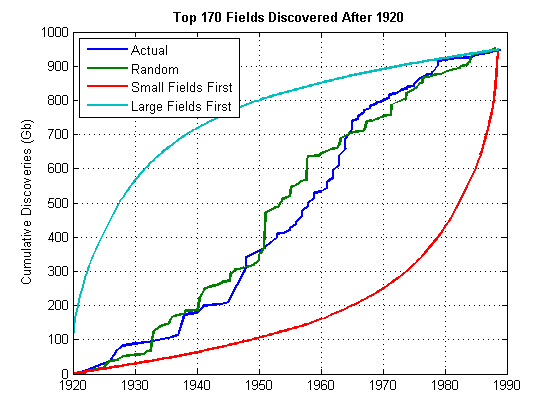
The large vs small field size issue was discussed on a Dispersive Discovery post
http://www.theoildrum.com/node/3287#comment-269887
Note that finding large fields first does not empirically hold, as it is pretty much randomized. Why somebody wants to push what amounts to at best a second-order effect as the principal cause, I don't know why. I guess I am just pointing out the inconvenient truth.
OK. I stand corrected it looks like no matter how the searches are conducted the finds follow the same trend. Interesting.
Kind of like Jed Klampit exploration.
Probably makes sense - even large fields are small in relation to the Earth's land area, and offer few clues to their existence. It appears that in more recent decades the Actual moved a little closer to the Large Fields First line, which might be the influence of newer technologies. Seems like a small movement for all of that - still not much better than poking holes at random.
Deffeyes used the analogy of throwing darts at a dartboard.
I suppose speaking like a caveman works wonders with a segment of the population.
Us no understand what you talk.
I tend not to trust people who turn a typo into a lack of intelligence. It takes a degree of meanness.
Cheers
OK, I am sorry. Typos are hard to detect when you speak in a colloquialism.
Leanan,
I am a loyal member of your "non-specialist innumerate audience". I have read TOD almost daily since the early days. I wanted to become Stuart's first groupie.
I have a masters in biology but sometimes I can't follow the more technical discussions. Peak oil interests me less than "the way forward" -- how a technological society will at least attempt to find replacements for fossil fuels.
I also am kind of a big picture guy and get turned off by the more doom and gloom posts on collapse (I have read Diamond's book.) I like posts about steady state economics.
I also find the Drumbeats less interesting. I use to read every one of them. How about breaking them down by topics: Peak Oil, Alt. Energy, Sustainability, Eco-Economics, The Oil field techie stuff, etc.
I love TOD. Maybe a re-purposing is in order, as Nate suggests. "Post Peak Oil Drum"
I love the forum and the wonderful characters from WesTexas and WebHubbleTelescope and Darwinian and Darwinian and let us not forget totoneila -- No novel has a richer cast of characters, and I mean that in the most positive sense.
If you have a masters in biology, I would say you are definitely not among the non-specialist innumerate audience.
I second this idea...
lilith
Leanan,
I too,am a member of your non-specialist innumerate Main Street audience.I find frequent posts that I can't fully comprehend,but I plow through them anyway.
The impact you and the Oil Drum have had on my family and presumeably others by extension is immeasureable.
At considerable financial risk,we completely re-ordered our lives.Three generations (5 of us) sold two homes,left jobs,moved to a temperate climate,consolidated into one home,shed an automomile,initiated gardening/food production,began walking/biking/busing to about 70% of destinations...initiating a long term process of reducing consumption.
Certainly at times you must feel as though you you are on a thankless mission,well don't.Untold thousands have grown and learned because of your efforts.
I thank you profoundly.
I agree with this... I have some issues with/critiques of TOD, but mostly I have benefited from this site and the work and discussions of everyone here. Many thanks to all.
lilith
Yup.
Not as drastical changes as yours, and not exclusively because of TOD, but, I am now a member of a budding ecovillage and will consider moving there with my family when we start to build houses.
Have you discussed pairing a techie and a non-specialist? The latter could write up what he/she understands; the technie could critique; together they might both learn something and we all could benefit.
lilith
Do we then need a 'Public Oil Drum', staffed by people--ranging from primary school teachers to moonlighting PR professionals--who ARE gifted at coming up with analogies and illustrations that regular folks can understand.
And let's remember, folks, how difficult it is for ANYONE to influence the course of affairs in the USA, let alone the planet. Look at Obama's struggle to introduce the most commonsensical modifications to policies and practices that are doing incalculable harm to the country.
As I clearly stated in my early weeks on TOD, I came here to have an impact (then 2% to 3% probability of success), make connections and use TOD as a whetstone for ideas. So far, better than expected results.
My focus has evolved to creating a "Green Hirsch Report", written with gov't sponsorship and with major groups (Sierra Club. League of American Bicyclists) and major corporations co-authoring selected chapters. All modeled by the Millennium Institute to show the interconnected economic, energy, environmental and national security results of better policies.
There are policies that benefit every macro social goal and this is not well known. it is my hope that the sponsorship and results will raise the profile so that it can serve as a blueprint when our energy and economic policy shifts from complacency to panic.
TOD has served me well so far, and I hope that it will do so in the future.
Best Hopes,
Alan
This is a resource that needs to be nurtured and cultivated.
It is a reference point of sanity in a chaos of story and myth.
Alan's Electric Rail advocacy and the regular appearance of other "BB's" that we can consider employing are the anchor points that keep me interested in TOD.
The fact that it has a fairly mature conversation across a range of people from quite different backgrounds is also a point that I can hang a lot of hope and encouragement on.
I think TOD is the "LOOK BEFORE YOU.." site for me.. and I have to take care of any leaping I do someplace else. But part of that looking involves hearing about the leaps others have been taking.
I can see how it seems to be spinning the same laundry again and again, which must feel futile to many.. I think the repetition might be also seen as 'checking and rechecking', though, a kind of discipline that keeps the drumbeat going, keeps a response available for the opposing drumbeats of MISinformation that must be countered, and keeps at the ready for when 'something gives'.. wax-on, wax-off.. it's almost a training regimen. (or Chop Wood, Carry Charts and Graphs)
That said, there would be value in regularly challenging and reinventing the goals and the means, as Nate has done here. Scientifically Appropriate. But at the moment, I don't have any new suggestions for 'where to take it from here'.
I do have my old suggestion, which is to see if we, the members can assist the Mods in a project to methodically (or randomly..) sift through the mass of old material in order to sort the various types of offerings into a really accessible database/help system/wiki of some sort.. to put in 15-30 minutes at a time searching out valuable nuggets on a given topic and reformat it so that the body of experience is presented in a bit more continuity by subject/theme.
Best to all, and great thanks to Nate, Leanan, PG, HO and SuperG! (and whoever else I missed and dissed)
Bob Fiske
This is a great idea. May I add, how about organizing an introductory page, where people new to the issues can get a quick overview, and links to in-depth material on specific topics?
lilith
There are some links to intro at the top of the front page. Perhaps they could be made more prominent.
As a former website/blog editor, I totally understand your questions.
1. You probably see falling readership numbers (oil prices being down, media focus on energy dissipating)
2. You are probably starting to think that all the issues have already been discussed
3. Costs in terms of time/money are VERY significant, and at one point, the question is valid; is it worth going forward in this direction?
As a long-time reader of this website (even in the first version), and most prominent sites (energybulletin.net, etc), I think that it is very important that this site be kept alive; it serves me as a references on countless subjects, as well as broadening awareness within the peak oil community.
I think in a weird way, some people are disappointed that the "imminent collapse" due to peak oil didn't occur as fast as they predicted. I, on the other hand, believe that very significant changes are on the short and medium-term horizon, on the energy side, as well as the economic side, as both are very tightly connected.
I see the oil drum as a reference for thinkers, managers and deciders that will have to face tough decisions faster than they think. I think that this economic depression is much larger than most of us would like to believe, and that in the future, we will live in a much less globalized world (lower entropy). The oil drum could be a cristallizing spot where local communities could share experiences on rebuilding a lower energy world.
I know that sometimes, as website editors, we get pretty lonely, and just see torrents of anonymous IP addresses and get very little positive reinforcement - no money, no pat on the back, no awards. It is a very humbling experience, but I must say this is my idea of a fantastic site; the way I would have built it if I had the time/skill... Keep up the good work, we support you. If the site is in need of funding or other things, just state the needs, and there will be a wide response, I'm sure.
Just my $0.02, for what it's worth.
-oligarchie
Ok thanks - that is worthwhile feedback. I really don't want this thread to devolve to pats on TOD back, but do want to maintain open eyes about our purpose, potential impact and real world events. There are some who have devoted a large chunk of their personal lives here - I want to remain vigilant against perpetually contemplating our navel, unless we come out and acknowledge we are navel contemplators in which case it's OK....;-)
There are likely going to be some changes ahead here. My inclination, as it has been from the start, is to go with the flow and what feels right. But that is kind of my personality so I don't want to overly influence the sites future with my own cavalier philosophy.
Nate, our job is now to
(1) show statistical evidence that peak oil has happened
(2) have emergency solutions ready in our drawers, which will be adopted when the big surprise comes for those who either don't care, are in denial or otherwise unaware of peak oil.
I am trying to do both on my web site
http://www.crudeoilpeak.com
We have now to consider a scenario in which the financial and economic system continues to depress demand for oil in such a way that we are just staying under the oil-geological curve, resulting in low(er) oil prices UNTIL we hit the minimum operational levels for a global economy.
India and China are wildcards difficult to assess.
Depending on what the "big surprise" is, I question whether there are any such emergency solutions that are going to be much help to those who have not already done some learning and preparing. I think we have to concentrate on that learning and preparing, and the discussions on this site contributes to that by being a tool/resource for that learning task. The site can also be used as a test-paper to assess which of our friends, family and acquaintances aren't going to make it.
The economic crisis has overshadowed the peak oil crisis, and blogs have sprung up focusing exclusively on economic issues. This has no doubt drawn away some of the readership of The Oil Drum. Even I (a member of this blog for over 3 years) find myself spending more time reading economic blogs than this one. I admit that I haven't posted on TOD for quite awhile, though I've continued reading.
The Oil Drum is really a crucial resource, and it would be an enormous pity if it were to disappear. Of all the blogs I read that allow user comments, this is still by far the most intelligent one. Though there are exceptions, the readership here is very well informed, and I am seriously impressed by the quality of the discourse. I certainly hope that it continues. I am not sure how this blog is financed - bandwidth isn't free, but charging readers for access would kill the discussion. Web sites depending on advertising revenues are all hurting as the economic crisis cuts into that source of funding. Just as the peak oil crisis itself, I don't have an answer for that dilemma.
best regards,
Robert
speaking of economics, my spouse is inventing something that will make solar energy much more practical for making electricity. I've searched for financial help to develop it. the government hasn't had budget for anything that's new technology since 2006. They aren't helping small businesses or anything that's actually new. so we are going to start small, making 1000 watt generators from 10 watt solar panels....
Sounds like a nice trick. Feel free to post details if you like.
Sounds like a concentrator. This is a good way to fry a panel from excessive heat. You really need direct sunlight, a good tracking system and special cells with a well-designed cooling system to make this work. It does work, though; the Deep Space One probe powered its systems and its ion drive from a concentrating PV system using gallium arsenide cells.
GaAs = expensive.
Without getting into the physics, the fact that GaAs works great as a laser source means that it can also absorb lots of light and take a beating. A laser can require a lot of power and if it is defect-free, it won't break down.
So it makes sense that the space guys used GaAs. They only had to pay for one after all :)
They get 40% efficiency now, but in space you can radiate the concentrated heat off the dark side of the panel as well. At $10K per launched lb of weight it's easy to afford the best cells!
brilliantly on nate. u'r head, & heart are in this one.
i am a doer. my goal in coming here[besides desiring to 'being smart enough to run w/ u big dogs'] was as u say in no.1.
i feel sad as i start to reflect on;
1.?? TOD has given me the reasoning to seriously change the trajectory of our family's life. no other website had enough credibility for me to 'hang my hat' on the info presented. it has been very very sobering re the future we face.
i was involved 1 yr. locally re PO then came to the conclusion this was wasted time/energy & things were going to be much worse than anyone would talk about.
even moreso recently i think the river de-Nile is wider, & deeper than i accepted[my own denial]; & can't be crossed until people are in crisis.
so yes i think tod should at least refine it's mission to the newly aware PO concerned[not that is not it's primary focus now], but not attempt to affect public policy in direct or indirect ways.
2.this addresses a failure of our specialization society; & i think is one of tod's best traits- how- more staff diversity maybe[oh wait - a hedge fund manager, actuary,....]
3.energy scarcity.
It must feel sometimes as though we're just going round in circles on this site. How many times and ways do we have to say the same thing? But the value for me is in large part the intelligent and far-ranging comments which follow posts. It's one thing to know the problems, but quite another to know what to do about them, and this tends to get thrashed out in the comments.
Responding effectively to Peal Oil is a damn difficult thing to do. But I've been helped by the discussions here to grope my way forward on this, and I can see some progress starting to happen in my remote corner of the world. I helped organise a meeting in our town the other day at which two of our Shire councillors and a former politician now involved in setting up an alternative energy co-op were present. Our main speaker was a high executive officer at our local Shire who is fully versed in the real issues. All these people are now aware of what's at stake and are in a position to do something about it. Without The Oil Drum this meeting would not have happened.
Yes TOD will change, posters will disappear and new voices will come along. But we still need it now!
Hello Nate,
1. Is it worth it for this website to continue? And if so in what direction? And why?
Yep. TOD should blog as long as possible to help push Peak Outreach to any interested. Why? IMO, to help assert some measure of Optimal Overshoot Decline so we can potentially shoot the gap between a Jay Hanson Thermo/Gene fast-crash and Archdruid Greer's Catabolic Grind.
2. How can those interested in these issues continue to share/compare and synergize when knowledge of an increasing array of topics becomes necessary?
IMO, the WWWeb is excellent for broad scale info flows, possible synergisms, and consensus building. Recall back in 2007 when we all contributed to the Ghawar analysis spear-headed by SS, Euan, F_F, etc.
3. How can 'Peak Oil' be reframed?
As Westexas has said before, in regards to Alan's ideas: "Let's work to not make it as bad as it could be." This thinking could be extended to many other Peak Everything concerns. Again, consider reframing towards Optimal Overshoot Decline.
Some other poster said once: "It will take all of us, working together all the time."
Hell, we humans have got nothing better to do than to try and bring this possibility to fruition, at every possible level.
http://upload.wikimedia.org/wikipedia/commons/2/27/Spider_web_with_dew_d...
Yeast never try building webs. Thus, grape juice into wine. Maybe we humans can do a little better IF "We remember When the Music..." --Harry Chapin.
Bob Shaw in Phx,Az Are Humans Smarter than Yeast?
watch that latter optimism bob; messes w/ u'r tagline!!!
Toto;
That line you reference might have been William McDonough's
"It will take ALL of us, and it will take FOREVER. But isn't that the point?"
in
'From Cradle to Cradle, remaking the way we make things'
Bob
I stand with Bob on these questions, particularly on the practical matter of helping us all to shoot the rapids safely between Jay's and John Michael's forebodings, if we can.
Incidentally, I think that that's what John Michael is trying to promote too. He doesn't want his own worst-case vision to happen just because we didn't understand enough, and didn't try hard enough. TOD continues -- vigorously -- to help to forestall those failures, it seems to me.
Well, I've been a TODer for over 3 1/2 years and lurked before that. In fact, I left another forum where I was a mod because of the intelligent, civil discussions here.
I've never had any illusions that TOD would change the world. However, it is a place where I could/can share, either directly or indirectly, with like-minded people. This inspite of the fact that a am a active, doomer. I think the reason we can share, regardless of our differences, is because of the civility; no one tries to put the other person down simply because they have a different perspective.
I like TOD the way it is and, I especially value the efforts of Leanan. I don't know how she does it day after day much less have time to post. We cover a variety of difficult topics. I can't ask any more.
Todd
This site has been invaluable.
As an average bloke (average IQ, father of three, living in mainstream and all the rest), I get the impression more and more of my fellow Joes and Janes are beginning to think a bit more about the years ahead, about what's in store for their kids. But few connect resource depletion and exponential growth.
Further, I would think the numbers of Average Joes and Janes who stumble across sites such as TOD - then be struck by lightening! (for me, it was an Al Bartlett presentation) - would be pretty small. Less than one per cent?
To be honest, I have no idea how much more oil remains to be recovered, whether polar bears will thrive again, whether our city's dam levels will vastly improve. But I do get the basic math of Limits to Growth. How much is enough?
I agree the "doom and gloom" approach is inappropriate. I guess all I can hope for is that our leaders pick up the batten when limits get a little more obvious.
Regards, Matt B
So, go ahead and write your book, Nate. It's probably about time and I would expect it to do quite well.
On the other hand, I stopped writing my blog before the word blog was invented. My reason being that I had said everything I had to say and couldn't stomach repeating myself any longer.
Anyone who thinks TOD has affected, will affect, or can affect public policy I think is sadly mistaken. However, I'm sure the TOD community has made significant impacts on individual policy, mostly good. It's a group of pretty smart people. I read doomer porn mostly for entertainment. I read TOD to learn things.
Excellent point; I've been thinking along those lines as well. Those who really run this country (and I don't mean the Obama administration - they're just executive managers) are pursuing their own agenda to further the interests of their class. TOD is thinking in terms of our collective interests. But, yes, your contribution has been and continues to be invaluable to individuals.
lilith
The value of the Oil Drum is not for the edification of our dysfunctional respective governments but rather as a true clearinghouse of current evolving reality (energy statements,etc.) with commentary. Any solutions that may or may not appear would most likely be from the resolve of individuals influenced or at least sub government entities.
In a world where policy goals, if they could ever be agreed upon, are watered down 90% before being put into place will never do the job of redirecting policy away from BAU. It took nearly forty years of observing government to come to this conclusion. I never said I was a quick study.
With a BS degree in geology I am still illiterate in regards to the more technical aspects discussed.
I understand the concepts but not the proofs. Fortunately, I just drop down to the next comment to see if the more literate bought the argument.
I do have a very functional BS meter built in and this web site turns it on for me. Just don't let them lie to me, that's your job.
"Anyone who thinks TOD has affected, will affect, or can affect public policy I think is sadly mistaken. However, I'm sure the TOD community has made significant impacts on individual policy, mostly good. It's a group of pretty smart people. I read doomer porn mostly for entertainment. I read TOD to learn things."
TOD has affected public policy at EU and UN CBD level by making information about biofuels available and readable that otherwise would have been very difficult to find.
Excellent musing. I've made it no secret that I think Nate's stuff represents the razor edge of understanding these interacting systems - well enough, hopefully, to actually DO activism on them.
If activism is even the word I should use. I'd be called an activist by some due to my results, but only a relatively small part of what I've done over the last 3 or so decades would be recognized as such while I'm doing it. Things can be steered in the real world, and the most leverage is in the grey area between bottom-up approaches and top-down approaches.
Pardon any typos or sentence fragments, and definitely the rambly length, I'm recovering from an odd reaction to a steroid shot. But I can't "not comment" on a topic this close to my own musings.
TOD is a wonderful site, and I'm glad I ran across it. Emotionally, I hope it continues, but I wouldn't presume to give advice. Because nothing of the sort really "continues", it evolves and meanders in the process of becoming what it will be.
An enormous amount of human energy goes into trying to hold volunteer/activist entities/collaborations together. They start with a general enough goal that there is great focused energy; but initial success brings so many contextual changes that the entity changes. A greater and greater percentage of time is spent arguing over just what the heck the focus and methods should be, and this causes heavy attrition among the thinkers who first pulled it together, who tend to increasingly be supplanted by those of a more administrative bent. Those who care passionately are at a competitive disadvantage, because they experience heavy stress over conflicts that the admin types thrive on. At this point the entity either disbands and crumbles, splits into two or a dozen separate groups, or if it has achieved a stable income stream under a given name, simply becomes an administrative organization which funds enough stuff to plausibly be the "same" entitity, though of course it isn't.
This is "old news" to those who have worked in such groups, but it may not be obvious to all.
I'm not talking about TOD specifically, but about a general human dynamic which many others have observed. I lived through it in the growth of Greenpeace from selling t-shirts in '75 to owning fleets (and not on the periphery), and have seen it a lot more often than that. Fer'instance, if you look at David Brower's career, he'd start groups, ride them until he was forced out, and then start another one. The seeming inevitability of this has certainly caused me to structure organizations and programs differently than I formerly did.
With regard to educating the world about peak oil, I have yet to sell myself a rationale for yelling "theater" in a crowded fire. Oh, it "feels" right to me - to tell as many people as possible all I know. It would be odd if it felt otherwise, since I evolved for tribal life as much as anyone else.
Yet thirty+ years on the front lines working to alter real-world situations has given me great respect for planned stepwise strategies based on changing the probabilities of specific large-scale outcomes. And one of the things I came to realize is that control of information is crucial. The timing, sequence, and substance need to be crafted for a specific context.
So for instance, to the question "can Peak Oil be reframed", my answer is "heavens yes". And it probably should be. But an archived public blog is simply not the place for planning it. I take some scorn for statements like this, but anyone who has ever reframed, via stepwise strategy, a concept in world culture would agree. It's a delicate business, not because it's some machiavellian personal bent of mine but for deep reasons having to do with the way ideas propagate and culture changes. (To those familiar with self-organized criticality and the ricepile experiment, I'd draw parallels. The criticality landscape can be known, and the result of a given perturbation predicted, but only if those in the peanut gallery aren't throwing rice at the experiment randomly.)
Moreover, for the "scattering" reasons discussed above, "reframing" of a concept by a large poorly-controlled group is kind of a terrible idea to try. It needs to be done abruptly, properly, with its feet of clay well hidden, and steered to where it needs to go by a core of folks who know exactly what they're doing.
I kinda hope TOD will continue, since I enjoy the group of people it has brought together. But I'll be leaving it pretty soon and only coming back sporadically. There are a number of posters here I'd have gotten in personal touch with if they had contact information in their profiles, but I respect that most prefer not to.
I think the "eclectic cross-discipline real-time peer review" is a wonderful sieve for reality and I hope it continues here. It's habit-forming enough that hopefully it will. And to generally answer the question
The concept of "satisficing" may apply. One doesn't need to know everything about everything; just to have a good science and logic grounding and a sense for how things fit together. I've often felt like Tainter's declining returns on investment in complexity apply to human expertise, and have consciously prevented myself from specializing too much in any area. I'd suggest that being a sophisticated generalist is a good place to be, and reading TOD comments would be a great way to produce more of them. Indeed, producing and honing sophisticated generalists wouldn't be a bad achievement for a website.
cheers
You offer lots of good insights.
With peak oil, we are moving in the direction of what is happening--so there is change, but based on what is happening short and long term. Those that made forecasts based only on the geology of oil are finding that the situation is more complex.
Different ones of us have different views of what is happening going forward. The challenge can be how to accommodate diverse views, especially when each feels fairly strongly about what we see as our own view of the future. I can see how groups might splinter, especially if some with one view feel a need to enforce their view on the rest. How can different views be accommodated, except with someone who has more of an administrative bent in charge, rather than a crusader?
How different views can be accommodated? Putting them together in free discourse as here. In any ideological conflict I try to analyse with the other(s) quite what facts or reasonings or values we agree on and which we disagree on. For instance I was just now at the supermarket queue talking to the woman in front about her having studied the Welsh language which is compulsory in schools (in Wales). I suggested it would be more useful to learn one of the languages of a great culture such as German or Russian. In this case at the end of the day the controversy boiled down to an arbitrary value judgement of whether one held more value in preserving the Welsh culture or in extending ones's horizons via the German/Russian etc. Hilariously I then showed her some rose-hips I had picked on the way there, and she had not a clue what they were. So much for the education system preserving our traditional culture!
Your question seems to be, where do you go once you have arrived at where you were going. It seems almost certain that Peak Oil is now history. The ranks of the nay sayers are thinning, and and increasing number of the deserters are quietly jumping onboard the PO wagon - or at least stepping out of the way. Of course even as they grudgingly acknowledge the peaking or soon to peak production of conventional oil, many are now insisting that PO will be effectively mitigated through the development of non conventional oil, renewable sources of energy and ever improving technology. Perhaps the new role of TOD is threefold; maintain awareness of the post peak process, shine an objective light on proposed substitutes for conventional energy and cover viable options for post peak life.
Yes, I think you are right. I kind of feel that to a large extent, our job here is done. We were all about predicting when the peak would be, and now it's the rear-view mirror.
Though not really because everyone's jumping on the peak oil bandwagon. Rather, because the economic crisis will mean no one cares about peak oil. They'll blame the lack of financing/price signals to support new production, and not geology.
I do think that if we continue, we should consider a new format, and a new name. "The Oil Drum" really isn't a name suited to a site devoted to, say, alternative energy. As it is, a lot of people assume we're an oil industry lobbying group, because of our name.
Another problem is that the staff really isn't suited to covering alternative energy or post-peak living. We are heavy on oil-industry types. Then there's the climate change issue. It's going to be tough to continue to finesse that once we move past oil production.
The staff of TOD was united around the idea of a near-term peak, but outside of that, our diversity makes it hard to cover things like post-peak living.
Leanan --
First, I echo an earlier commenter's thanks for all the time you put in compiling the Drumbeat. It's one of my major sources of news.
Second, while The Oil Drum might not be the best name, I'd have to say that the site is more about oil than alternative energy, and that's not a bad thing. There are a lot of alt-energy sites out there, and most of them don't have any feel for the scale that's needed. It's really about oil, the cubic mile of oil per year, the energy density of oil, how we've gotten into this predicament, and how hard it will be to get out.
It takes oil-industry types to give the right perspective. The timing of the peak, and the fact that the site was set up to deal with a near-term peak, seems irrelevant to me.
I think the site has more diversity for discussions of post-peak living than any other I've seen. It's certainly a place where discussions of subsistance farming, guns'n'ammo, and community can coexist. Mostly with civility. Amazing, really.
The civility takes more work than most people ever realize.
Considering that much of what will transpire in the next twenty years might well be unprecedented in human experience... who would be better suited to covering it? Many of the people here learned what they know while riding the curve to the top... they'll learn on the way down, too, and will remain both knowledgeable and a valuable asset to readers like me.
The real question is...are they interested in covering it? They have to be, because they are doing this for free, taking away time from career and family to do it.
I knew you read this, but I never recall seeing you comment. Put a smile on my face, it did.
Name change The Oil Drum - Past Peak Oil
It seems that most people on the site now feel confident that we are past peak, easy to get oil, if true then adding Post Peak Oil could clarify this change.
the main focus then becomes decline rates, energy return on energy invested, price points...
Maybe "The Terra Preta charcoal retort drum"? Another use for that old oil drum.
Leanan, that is a well thought out post. Probably because you live it. Preaching to the choir can be frustrating, in part because of some of what Nate has said. I have separately posted a similiar question to a sustainability group. "We understand the problem, but what are you doing personally and in the areas of public activism and education to change things?"
Personally, although I do try to view the site daily, I just don't have the time to even read everything. I try to get the jist of most threads and then move on unless it is really of interest to me or something I might be doing.
I do disagree, to some extent, with the first part of your post:
"Yes, I think you are right. I kind of feel that to a large extent, our job here is done. We were all about predicting when the peak would be, and now it's the rear-view mirror.
Though not really because everyone's jumping on the peak oil bandwagon. Rather, because the economic crisis will mean no one cares about peak oil. They'll blame the lack of financing/price signals to support new production, and not geology."
I see things moving along kind of like we are seeing right now, when we, as a species, could be making a transition to another paradigm, but we are not doing it. We have the opportunity to move in a different direction, but that is not going to happen any time soon. The "have-nots" are going to continue to want to be "haves" and right now that is China and India. As we move toward a geologic peak, noting that there will be many more crises which will delay recognition fo the peak oil crisis by the great unwashed masses (and I apologize to Blackie Sherrod fans for stealing his term I read so frequently when growing up, for the few who might recognize his name), but an increasing number of people will gradually recognize what the world is facing. As such, I do think that the TOD effort is worth continuing, with many pats on the various backs to those who keep up the hard work from those of us who wish we had the time to help.
I personally have made a lot of changes, some starting before I ever read my first Drumbeat about 4 years ago, long before my first post. Some originated as a matter of earlier lifestyle changes, but some were in direct response to TOD / DB information, both from the staff and the rest of the people I have seen on here.
I will continue to follow the discussion no matter what the name is. I live the depletion scenario, and have been fooled by geologic interpretation and the dream that we can improve yields draamatically with technology. The most of what we do every single day in the field was developed before 1935, and I am serious. Beam type pumping units, the same rod-connected pumps, mud drilling, cable tools, oil/watr/gas separation methods, well treatment, etc. have been improved with changes in materials, but were in common use before 1935, and still are. Of course, directional drilling, staged fracs, exploration technology,submersible pumps,downhole drill motors, etc. are newer, but production is still close to the same. Everybody knows what is coming in the field. We just try to prevent the inevitable from happening to us.
Please keep up the good work in whatever form.
That may be a good thing. Blogs where learned individuals don't agree on key points are much more useful than blogs where they always do. Forces the readers to think more.
Perhaps, but in our case, it's become somewhat paralyzing. It's hard to bring in new blood when the staff can't agree on what direction we should take.
Your comment:
Perhaps the new role of TOD is threefold; maintain awareness of the post peak process, shine an objective light on proposed substitutes for conventional energy and cover viable options for post peak life.
I believe is an excellent track for this website to head. Now that a sufficient number of people are beginning to consider that PO is real, the critical question becomes... What do we do now to help insure that our kids and their kids will have a reasonable quality of life? What does the path from here to there look like? What is a realistic vision for a sustainable future? These questions and the question that come from them could keep many people engaged for many years.
Zev
Hi Nate,
I think oil drum has a unique role. It provides a platform for intelligent debate with a minimum of noise compared with other websites.
However, it think there are now too many article writers that agree that we are doomed and I think you need to attract more of the mainstream folks, legislative aides, mover/shakers types, etc that don't think peak oil is a top priority.
Why not invite some guest posts from non-peak oil folks that are influential? It might spark some great debates. Would some folks from DOE be up for the challenge? Or local/state govt? How about the backers of the $6.7B natural gas pipeline that goes from Colorado to Ohio. What do they think?
I would also like to hear from a few high school class presidents or undergrads that are movers/shakers. Do young people get it?
I am not a mover/shaker, but most undergrads understand there is a problem with respect to energy. Then again, I am an engineering student and don't come in contact with non-engineering students very often so I don't know about the rest of the undergrads.
CAMPFIRE QUESTIONS
#1: ABSOLUTELY it must continue. More than ever we need to have deep analytic work that the Oil Drum has provided. We need to know the numbers and the reasons behind them. I think there needs to be very little change in direction. There is already a good mix between analysis, opinion, and raw news. We need all three to continue to understand the problem that we are facing.
#2: I think that will happened, has happened, is happening, elsewhere. It need not happen on the Oil Drum, though it does through many articles and comments. If people want an increasing array of topics they will ask for them. If the contributors of the Oil Drum feel they need to bring up other topics, then they should. It will be a benefit, not an impediment to the website and the community as a whole.
#3: How can 'Peak Oil' be reframed?
Well, while many, if not most, think Peak Oil has passed, I don't think it is time to retire it. We will still need confirmation and to ensure continuity we should use the same term. Lets not fall into the "It's the Green House Effect, no it's Global Warming, no it's Climate Change" trap. Peak Oil is peak oil. If you want to reframe it then keep it to its technical roots of when oil production can no longer increase. If you are looking for a new term to describe what happens next, then maybe call it Downslope Economics or something equally esoteric... it doesn't really matter what it is called... we all know what we're talking about.
I think we need a place where we can discuss what is going on, in as fact-based way as possible.
We are going to have a diversity of opinions on these issues. I think over time (and it could move faster or slower as events unfold) there will be more and more clustering toward one or two of these views.
I am not sure there is really a way of reframing the issue that will really be helpful to what we are trying to do. In a way, I expect if we look back in a few years, we will see a very major issue turns out to be peak credit, brought on by resource limits, particularly peak oil. But this is not going to be an issue that is popular with many readers, because it doesn't fit in neatly with geology. It also means that "peak oil" is not likely to get "credit" for the problems it is causing, and oil prices will never go very high. So this will be only one of many ways of thinking about peak oil.
The by-line for TOD is
"Discussions about energy and our future".
This is a wide church; really, the future doesn't exist; it is a result of the present. The present is defined within the constraints and freedoms of (largely) oil and gas, and the technologies caused by/enabled by oil and gas.
As the 'ground' morphs and shifts to constrained oil products, so the daily reality changes, so the psychological 'impingement'on fears, hopes, plans, dreams changes. Thinking takes 'account'. Investment is shifted as a result. Some are ahead of 'a future fore-cast' (Jerome a Paris). France, in general.
Some will be smashed over the head with the speed of change, the lack of preparedness.
This flux compels us to discuss. I look for 'answers' and for insights. The most wide boundary thinkers appear here ('Infinite Possibilities' was one). The best logicians. The best real-life experience.
The function of TOD - post peak - is discussion. Nutting it out, as Nate said.
The blog not only informs: it challenges.
It changes mental sets.
It extends.
It is not a 'seer', altho' there are seer-like aspects. It is a tool for grappling with changing reality.
To that extent - past the shock factor and denial - it is a tool for mental health.
Everything is influence.
Lorenzo
Lurker here for 2-3 years. Finally registered for this post.
1. TOD is invaluable. It's the only site I've found that integrates, energy, environment, and economics. AGW sites don't all understand that FF consumption won't continue for the next 100 years. The economists haven't figured out that FF energy is why everything has been getting better since the 1840s. I don't see any need for change. TOD is unique.
2. Synergy happens. The posters and commenters have knowledge of a hell of a lot of topics: geology (duh), transportation, alternative energy, etc. And I get advice on gardening. What's not to like?
3. Peak Oil is a subset of Limits to Growth, which is the framing no one has wanted to hear since the 70s. I have felt like we're living on borrowed time since I waited in gas lines in 1973. I don't know how to frame the subject so people get it. Among the engineers and environmental scientists where I work, I'd be surprised if even 10% are thinking about limits. Keep pushing, don't worry about framing, it's not a dead topic, it's not even understood by the professionals who should know better.
Hello Waterplanner,
Thxs for un-lurking, then joining the discussion==>Welcome [same for any other new-posters & newbies]. If your TOD-name is an indication of your career, then I hope you can post a lot more expert discussion about water & sewage topics going forward, as I feel this already is/will be a huge global concern. IMO, these are the two most worrisome quotes Ever:
"Whiskey is for drinking, water is for fighting."
"Water flows uphill towards money."
Sitting in the dark is no problem compared to starvation & dehydration. Please add whatever info you can in the future. Thxs!
I liked your diagram showing the 4 types of peak oilers. My guess is that the particular quadrant one falls in is influenced by many factors, mostly not about the actual 'facts' (ie emotional issues, politics, etc). A consequence of this is that a general site such as this can fall prey to becoming an arguing ground between the pessimists and the optimists about who is more right. There have been a couple of posts where I've given up reading the comments because of that...
However, I think that by and large this site has avoided that pitfall and instead offers a broad spread of views, information, and discussions about the energy future. My suggestion for the future direction of the site is to focus on possibilities for bringing about improvements in the probable future scenarios. Many people ask 'what can I do?' and even if the answer is 'not much', this site seems to be better placed than almost any other forum to be able to bring forward and develop possibilities for positive action.
I'm probably in one of the 'hopeful' categories of thinking that when things get really bad that people will bite the bullet and take what action needs to be taken (and I understand the doomer arguments against this being adequate). So I think that it is worthwhile to start thinking about a lower-energy future and how that can be navigated both personally and by society. Even doomers who foresee collapse probably have an interest in saving something good from the mess. How do you ensure that? In all cases, the time to be making preparations - whether personally, on a local level, or at a national / global level - is now.
A website like this obviously has no direct influence, but by providing a resource for both individuals searching for 'what can I do?" and for activists/researchers who are looking for ideas and proposals for action, it can offer some real help as we navigate the coming oil depletion.
There are actually 5 types of peak oilers. The missing one is the one that is still trying to get a handle on the situation and figuring out ways to manage depletion. I certainly do not belong exclusively to any of those groups listed -- at least I don't recall writing or being an advocate for any one of those agendas.
1) The "renewable energy" contingent -- I will criticize this as necessary, RE ethanol and semiconductor technology as that is my advanced degree
2) The energy technologists -- I criticize this as necessary, RE batteries, ultra-water, and see #1
3) The dieoff crowd -- I don't write about this
4) The End of Growth group -- Saying we are ending growth is akin to saying we are "running out of oil" -- and we know how much people on TOD hate that phrase :)
So the fifth category stresses that we are neither running out of oil or running out of growth. This may sound mealy-mouthed and wishy-washy but depletion management will be the key policy mechanism in the near term.
I am perhaps a group of one. Anyone want to join?
Though you did not exactly say it, I take it that your group is the missing one you mention. No, unless you are talking about one's individual efforts to save yourself and your family, I do not care to join your group. Suppose you did figure out how to manage depletion? Fat chance. ;-) However suppose you did what would you do with this information? Would you post it on your blog? Or perhaps you would go downtown and start shouting the good news to everyone? Get my point?
I have been deeply studying the situation for almost ten years WHT, and I think I have a handle on the situation. (See my last reply to your popcorn analogy.) I have tracked oil production from every nation for many years and I think I have as good a handle on the situation as anyone. The collapse of oil production is only a very few years away. Making matters much worse will be the hording by exporting nations once they realize what is happening. They have theirs and no one else is getting it by golly!
Yes, unfortunately I am a member of the dieoff crowd. Not just because of peak oil, but that will be a major part of it. An abundance of fossil energy brought about an abundance of food that enabled the population to explode. It had to collapse sooner or later. Once the population made that hockey stick turn up, the end result was as much as written in stone.
Ron P.
Makes sense. I respect your opinion but I usually do not engage in the same comment threads as you.
My answers (from a "lurker" who reads TOD daily, but hasn't spoken up yet)
1. Would anybody ever argue that if TOD went away, its departure would move us closer to a solution to the PO problem ? I didn't think so. TOD is a rational island in a sea of dogmatic assertions.
2. First of all, "knowledge of an increasing array of topics" is an inevitable part of the problem. Hubbert could summarize all of his all his knowledge of PO in a single graph. We have thought about it more and are much closer to it, so unavoidably, we need to bring in a wider range of expertise. I think I could make a case that we need much more expertise in a much wider range of topics - that we are too narrow on the techy stuff. That being said, I admit I still find myself neglecting some topics that I personally am not skilled in, or just don't care about. But I am becoming more familiar with the "Big Picture" questions. And that, I suspect, is a common pattern - getting the Big Picture and as many pieces of the details as possible.
3. I do not see the need to "reframe" Peak Oil. To what - some warm fuzzy politically correct name ? Yes, we have a scary message - deal with it. We have finally achieved some "market awareness" of our "brand" - why throw that away? If people dismiss us as cranks, etc,, they are not potential "customers" in the first place.
Nate postulated four motives for TODers, and guessed that most of us fall in the second category - "figuring out the puzzle". For me, that is wrong - I have better things to do with my time than solve puzzles. Motives 1) protect my family and 3) maybe find some way to steer our society in general to a better path dominate.
Finally, Nate asked about future directions for TOD and as long as I'm breaking out of "lurking" anyway, a few thoughts. If we believe our own message, then we need to be relocalizing. I'd like to see:
- some discussion of what actions look feasible at the local level. If there were 10 / 100 / 1000 TODer's in the same city / suburb / rural area, what could they reasonably hope to accomplish? Would they work through the political system ? go to the city council / county board of supervisors and say "We're from TOD and we're here to help. ;-) We think you need a {fill in the blanks} and we want to work on it". What could be done outside of the political system - education, growing food locally, installing solar cells on some critical structure, say, a fire station ?
- a way for people to build a TOD local network. This was discussed previously in terms of face-to-face contacts. I'd suggest some anonymous "get acquainted" opportunities first - I'm probably not comfortable walking into a strange home, not knowing who I'll see there. I would like to see the TOD staff (in their copious spare time ;-) ), set up facilities to permit people to chat by area. I envision 50 "chat areas", one for each state. People could post on the chat area for the state they live in their specific area within the state, (e.g. "north suburban Denver"), a little about themselves, and what they'd like to do locally. When a group of people within a state decided that they wanted to be a permanent TOD-subgroup, they could petition the TOD staff to set up a chat area for that group, under the state chat area (e.g., the north-suburban-Denver subgroup to support PO-aware candidates for political office).
This seems to me to be one possible answer to Nate's "whither TOD" questions.
Norman
For me specifically, at this time in my life, TOD has allowed me to get involved in a way that works for me. The DB articles, and other posts, serve to shape my thinking and are often a springboard for the articles I write in my own blog and two others I contribute to - my form of activism, if you will.
I would miss it very much.
I agree with relocalizing, but then the local Transition initiatives come to mind - a lot of the same issues and discussions, but in a solution-oriented way. New initiatives are popping up every week or so these days.
Of course, the discussions online are interesting in a different way - because of the input of regulars with viewpoints you just can't find in a single town - I think we come to a better understanding of reality as it surrounds us. The power of this community is in this solid understanding, that each of us then takes to our lives, where hopefully we have found a way to be activists.
It sounds like the issue at the editors' level is different - perhaps of wanting to start with some "action" oriented posts, except not enough editors agreeing on any one "action" (?).
But is it useful for TOD to chronicle the path of oil production declines? Should TOD continue to take the daily pulse of the media/country's discussion on the topics? - I think yes.
TOD lacks direction; too many different voices many of whom seem
poorly informed.
There is a lack of analysis and people can't prioritize.
Peak oil is first about resource depletion, not the environment or human nature.
Political discussions, economic speculation and science fiction should be discouraged.
JMHO
???, as opposed to which blog? Can you name a standard-bearer?
I was perusing the Wilmott site, and they have ridiculous papers on concepts such as negative probabilities and other insane, impractical theories. Aren't we kind of grounded in reality, a place that people can present the bean-counting and deep data mining.
I disagree, WHT.
There are a lot of summary graphs extrapolating dire predictions but that's about it.
Then there's the rather weird mathematical speculations (guess which ones) which are almost always poorly deduced/explained.
This site should raise basic energy literacy (with regular pop quizzes). TODers should be able to clearly explain the issues to the public.
TOD should be an energy education site first.
Just My Humble Opinion.
I have a thick skin, so if you are referring to me that is OK, but I have a feeling it is someone else. If the latter is the case, you have a point and I will agree that we have no peer-reviewed filter for quality. Yet, even the yearly American Physical Society meeting includes abstracts from the most hare-brained theories around. If you pay your membership dues, you get to submit an abstract.
I wonder if any of those have ever panned out? Even a blind pig will find an acorn.
There are but even more so there are endless refusals by some to accept simple mathematical explanations why their pet technologies aren't a very good idea...
Peak oil is first about resource depletion, not the environment or human nature
Awful hard get those items separated on the threshing floor isn't it?
If the environment didn't limit the resources we humans have been naturally inclined to use up there would be no resource depletion.
JMHO (the H is for honest right, otherwise most here shouldn't be using it)
To the main post: 'The Oil Drum' title may work better as a post peak name than you imagine. I've spent significant time in AK villages where old oil drums have been recycled to about any use they could handle, not the least of which was as burn barrels where worthless or even dangerous clutter were incinerated to make room for something of more use...and of course drums have be proclaiming the news over distance for a long long time, as it seems certain this site's founders were well aware.
I appreciate the oil drum analogy. The other good one is the leaky drum sitting on it side. It appeals to the environmentalists who would quickly disabuse themselves of the notion that TOD is a corporatist site if we used that as a logo.
That is the gravatar icon I have used for years, the discarded oil can.
The leaky drum icon works for me WHT,
the stuff is going away and we aren't doing much or a job husbanding what is left--hard to say that more succintly
(cool old oil can gravatar by the way, brings back youthful memories of wantonly pouring cheap generic oil through worn-out clunkers).
...and though the math generally sails by me (once upon a time I may have mostly followed it) I can often get enough out of the explanations and the hashing out it gets on this forum to make sense of what the modelers are trying to do
majorian
1)If you don't like the campfire post don't read them
2)I feel that ecology, mindset issues and future speculation are a intrinsic part of the issue
3)Somewhat weak main focus, sure, more analysis, better priorization, better informed info, would be an improvement so step forward and help make it happen...
TOD is a unique educational and communication resource.
Peak Oil awareness is by no means widely-enough spread through the population, and the political leadership doesn't seem to 'get it', and therefore, the mission is nowhere near complete.
I am not certain that the year of Peak Oil is in our rear-view mirror. I think it may be, but I am not certain. The delineations between conventional oil. C+C, natural gas liquids, tar sands, heavy oil, deep-water oil, reserves vs. flow rates, demand destruction, above-ground factors, the possibility of grand strategy market manipulations, etc. make the peak determination somewhat challenging. If the Peak of conventional oil was ~2005, then it is very important to continue to build an irrefutable case to document that fact and then to spread this awareness far and wide.
I like the component conversations about alt energy, sustainable living, limits to growth/resource and sinks depletion, global climate change, population overshoot, and the linkage between credit/finance/economies, war, and resource depletion, etc.
Drumbeat is a great compilation of news about these topics.
Keep up the great work.
If you need to bring in some money, you could add some on-site advertising for products and services which may appeal to TOD readership as long as such advertising does not corrupt the editorial freedom of expression...although I anticipate getting some blow-back for this suggestion, given some of the points of view espousing a return to hunter-gatherer living, or at least a simple Amish living...but, web site hosting and people's time are not usually free for a great length of time.
I'm home with the flu looking for things to do, so I might as well have a go at this one, too. I'm a woman, by the way, so you're hearing a feminine perspective here.
Places like TOD will become increasingly important in the years of crisis ahead. We will need places where people can learn about and develop energetic frameworks and mental models to help them make sense out of chaos. The public is remarkably obtuse--my freshmen students don't know what brownouts are, don't know where their heat comes from when they twiddle the thermostat, and wouldn't know a policy if it slapped them in the face. We're in trouble here.
I have not posted here much previously because of the endless fascinationhere at TOD with supply graphs, and also because of the blog format which creates discussions based on the moderators' questions. This is a problem. A wise man once said, It's not the answers that science finds so much as the questions that science asks. And instead of asking questions about how to cope with descent, previously the focus here was generally on supply of oil. I viewed the endless supply graphs posted here over the last five years as a form of bargaining by engineers. I figured that that was about as emotive a picture as I was going to see out of engineering types; endless big sad faces :((((( stretched across the x-axes of graph after graph.
The problem of moderator-driven discussions in a blog format can be illustrated by something in the narrative above. I'm not sure why you stated it here, Nate, but it serves as a good example.
As readers here are aware, I don't remotely believe that Peak Oil caused the credit crisis, the seeds of which started a generation ago. Though the financial crisis was largely (but not totally) ignored within the peak oil community until after the fact, its onset was arguably the largest reason that peak oil is cemented in the past . . . .
We're headed into an unknown future. While it's great that you state your biases up front, Nate (I disagree violently, by the way). every comment made as a directional guide in the narrative takes a supposedly intelligent group of responders down a sometimes narrow focused path that may not be their interest or concern or issue. It also suggests a degree of desire for control that reflects, what? Anxiety? At the heart of descriptive studies and social science lies qualitative investigation. In order to find a path in this grand social experiment we are running here called peak oil, let us not use just the reductionist, deductive, quantitative approach which leads to reductionist science. We need to use a variety of broad, inductive approaches that allow a bottom-up consensus to form, in a similar dynamic to that of community organizing and/or relocalization. Explore some of the techniques described below, and use them here at TOD?
http://en.wikipedia.org/wiki/Qualitative_research
I used to check in here about every 6 months. I'd see more endless frowny face curves and would check back out again. In the last 6 months, I've stuck around to read. What I see in the past 6 months here is people at TOD and in society at large are coming out of their shock and denial of this problem, and starting to try to figure out what to do. Your campfire offerings are particularly helpful. Yes, a lot of us who have seen this come and post here are analytical types, which does not make us the best movers and shakers in the social sciences and policy arenas. You need to attract those types, which will mean a different format, or more attention to which questions you ask. There are massive policy issues and energetic education campaigns to be started, and TOD is just coming into its own with the role it can play there.
You're doing a great job, all of you. Don't forget to honor your own feelings about all of this, and even to role model by stating those biases too. I think that one of the most important problems here at TOD is how to break through the denial, deal with the anger, the depression, and the bargaining in ourselves and in others. Recognize and honor the feelings, so that we can work on accepting the predicament and figuring out how to deal with it, rather than looking for a problem to fix, as Greer so aptly puts it.
Regarding the qualitative research that you mention, it encompasses this:
Isn't that kind of what we do? A big ball of detective work built on top of often bottom-up models. Have you seen some of Joules Burn's posts on Saudi Arabia? This is all social sciences because we are looking at the most opaque and guarded of societies -- that of OPEC and also of the most profitable corporations in the world.
Does anybody else even do this besides lone rangers such as Laherrere and a few others, and even they occasionally post on TOD. It seems like the corner is marketed. We may be quixotic in this quest, but it certainly is interesting and challenging.
So I suppose your point is that we can apply this same technique to somehow motivate policy?
I qualitatively get what you are driving at so I guess that is the end of the discussion :)
We have considered this. But we are engineering and science geeks. We (for the most part) don't really have the skills, aptitude or connections to reach out to "movers and shakers" (nor the desire to acquire them, I suspect).
And it will be a very different format if we choose that route. I think we would have to become more like RealClimate. Only a few articles a month, comments heavily moderated. Movers and shakers aren't going to want to be associated with this site if we're discussing things like dieoff, doomsteads, and the collapse of civilization.
Yup, the "movers and shakers" are losing legitimacy faster than the banks. You're right, we don't need them, in fact they're more likely to have a negative impact and are therefore totally undesirable. They no longer have any importance to our future.
I guess the other point that comes to mind is that as things stand now, this site functions in two different roles. One is essentially represented by the front page articles.
The other is almost more like what other websites call "forums" where users comment and interact with each other. Which in general also require moderators, but in this instance the moderators function like referees to enforce rules about civility and so forth. I guess what I am wondering is whether it would make sense to try and formally split these two roles. The main site would still have the front page articles, and have moderated on-topic comments of one sort or another.
Forums wouldn't need to actually be directly or formally associated with TOD. They could be hosted anywhere by anyone with sufficient bandwidth once someone had a set of rules, and a small group of moderators set up. If the forums were a part of TOD website, then a disclaimer at the top would make sense to say that "the comments posted here do not represent the opinions of the editors...".
Once you had forums set up somewhere, then you could in theory become a lot more strict regarding comments in TOD and restrict them to things like article citations for other things in the news that might be relevant, or to direct comments related to the articles cited. In most cases the discussions that take place in DrumBeat could just as easily be done from within a set of forums. And for that matter a moderator at TOD could just close off discussions that were wandering with the statement "Take it to the forums". I am tempted to say that comment posting would die off a lot once forums became available. You could email a link to a front-page story to a "mover-and-shaker" and not worry about them reading all kinds of kookiness the comments.
I briefly thought about the concept of shutting off comments entirely at TOD, which from a technical standpoint you could do quite easily of course. The problem is that this would shut out some of the other developments that are of interest. Although I suppose if the forums were formally associated with TOD, that the editors could watch for interesting things in the forums, and request a front-pagable article whenever something sufficiently interesting came up.
The major problems with having forums is that moderation would be a pain. Would you have separate sub-forums for doomers and non-doomers? Moderation would involve a lot of trying to keep posts in the appropriate sections so as to avoid flame wars..
This is something that has come up off and on for years. We actually did turn off comments on the DrumBeat for a short while.
I don't think there's much interest in setting up forums or a message board. As you note, that would take a lot of moderation. Plus, there are other peak oil message boards. (PeakOil.com, LATOC, etc.) Why do we need to be a message board, when that need is already being filled?
LATOC is great if you are a doomer. If you aren't, then not so much..
I wasn't aware of forums at PeakOil.com.
If there already are forum(s) that meet the needs of everyone who is interested in the subject, then as you say there isn't much point in re-inventing the wheel.
If you wash your hands of moderating discussions, then ultimately the community building aspect will migrate to forums somewhere or another. The leaner and meaner TOD could focus on occasional scholarly articles..
Shutting off comments entirely has other problems. People may have a relevant question for the author. Perhaps those could be sent by email rather than posting the question.
No perfect solutions...
PeakOil.com's main offering is its forums. That's its reason for existence.
For awhile, they had "Doomers Only," "Moderates Only," and "Cornucopians Only" forums, but I think they have eliminated them.
Hmmm, should the Oil Drum die?
I guess if that's how you view your product, that is what the outcome will be.
Not that long ago the president was complaining about how the bloggers were ... disagreeing with him, basically. (He was trying to defend a shrinking and centralized mainstream news publishing business.) The bottom line is that the president reads some blogs and people on his staff read blogs and administrators read blogs and their families read the blogs. People do read the damned things.
It's the marketplace of ideas. The question is whether the Oil Drum product is now dated. Of course it is. Time marches on, so what? Francis Fukuyama famously predicted "The End of History and the Last Man". He wuz wrong and so it goes here. The Oil Drum? The Energy Drum. Old Coke, 'Classic' Coke. It's all coke, everything, in the end it's all just more and more coke. We all outlive our usefulness. The best thing to do is age gracefully and buy a second Rolls Royce.
The world is in a policy gap. The ideas of the past 100 years have also outlived their usefulness. At the same time, they have long to run before the credibility resource is used up. Policy straddles both sides of this zeitgeist. Does this mean the old ideas don't pretend things don't change? The world has had an energy shortage for a long time. What does that mean? It means if there were four or five more Saudi Arabias right now, there would never have been an 'economic crisis' or economic crises. Unfortunately, there is no 'alternate universe' with plenty of oil to use as a control. We don't - we cannot - know. This is a special kind of ignorance, one that presupposes that all possible outcomes conform to the fundamental posturings of decades past. Since there can only be 'one' outcome that demands 'one' policy trigger, the arguments are sealed before they begin. The 'Peak Oilers' are on the outside of this marketplace of singleness of outcomes.
No wonder the PO'ers question their own relevance.
On the policy side of the gap, the establishment has been repeating itself ever since the end of World War Two! Economic policy of today derives from the causes/effects of the 'Knickerbocker Trust money panic' of 1907!
The bromides and speculations that have propped up policy have yet to be unmasked. Nate sez, "I don't remotely believe that Peak Oil caused the credit crisis, the seeds of which started a generation ago." I disagree, but so what? What if I'm right and Nate is wrong? There is no pot o' gold at the end of that rainbow. In the end, the problem solves itself. As will all the energy and resource problems. What the traders in this particular market place are left with is the ability to discount their own products.
Why should they? Context is everything except when it's not! Offering a version of the truth is not selling out.
Since the current establishment does not understand the problem, they cannot conceive of solutions. Who, then. will provide insights and solutions? Certainly not the current (failed) establishment. The energy shortage unmasked will provide opportunities for those who can reframe the old issues in new ways. This is the way the world works at cycle turning points. Since none are alive who can remember the last major turning the nature of these things is not understood. We are breaking new ground/we are living this turning just like all the other turnings so far. Thousands of them, probably.
The largest task of all lies in the future, to create a new narrative, one that doesn't include destroying nature for a few pieces of silver, wrapped in a banner of 'Progress'. Maybe an Oil Drummers will come up with this or maybe just the ordinary type of drummer or no drummer at all, but it will be done.
We have considered this. But we are engineering and science geeks. We (for the most part) don't really have the skills, aptitude or connections to reach out to "movers and shakers" (nor the desire to acquire them, I suspect). And it will be a very different format if we choose that route.
The center cannot hold; the movers and shakers of today are likely to end up in Paraguay. The movers and shakers of tomorrow (and I'm hoping I mean the short-term tomorrow here) will not have the specialized skills, aptitude, or connections that the ones today have. They will be generalists, with more regional or local connections, with less focus on efficiency, control, and predictability, but more abilities to create systems that are adaptive, flexible, persistent, and sustainable in the face of massive change. So who's to say who the movers and shakers of tomorrow will be? There are currently no specialists for descent. The voices that are evolving are often local, and are of necessity arising out of many different walks of life. These people that arise from the wreckage will certainly be people that I wouldn't mind talking to or shaking hands with, unlike our current crop of "leaders." And it's out of cauldrons of change such as this one that such leaders arise. People are feeling very vulnerable right now, whether they are aware of it or not. And for the first time in 40 years, people are open to listening to the problems of energy desent, and are ready for voices to fill the void.
TOD is suffering from the same problem that is facing the rest of society; too much complexity in the face of energy descent. From a pragmatic perspective, the heavily moderated blog format is energy intensive and requires specialists focused on your specialized goals and topics. You will probably have to adapt the format to some more self-organized format requiring less energy inputs. And I see TOD and other peak oil websites as a metaphor for succession. The internet has been a massively growing system, with urban flight out of old habitats, into newer digs in the suburbs of peak oil, as the system expanded and specialized into subniches for peak oil. So where's TOD in that geography? What are you specialized goals? As we lose urban centers in this metaphor, does TOD remain in the urban center, or move out to the suburbs, or become the trendy New Urban settler or hie off to rural local woodlands? Well, I'm not sure. Perhaps your niche has been to announce peak oil to the main stream media. I'd say that that goal is, at this point, either met for some of the media, and you might as well give up with the rest, who are all carefully corporate-controlled. So what's your new, generalist, relocalized, descent niche? In the short term, what is the internet equivalent of a mature, climax forest, and how do you fit in?
I think we would have to become more like RealClimate. Only a few articles a month, comments heavily moderated. Movers and shakers aren't going to want to be associated with this site if we're discussing things like dieoff, doomsteads, and the collapse of civilization.In a lower energy world we will probably see less freedom, less equality, and less information exchange. So that development may be the type of change we see on the internet in sites like this. It will be interesting to watch. Self-organization works, and you've got to trust it and let it happen.
1.The site is priceless but as some others have commented the rationale may need to change somewhat as peak oil is now in the rear view mirror.Maybe the focus will eventually be on renewable energy or ecology or the intersection of science,engineering,and economics.
My personal pov is that the comments meatgrinder is what makes the site so good-I could find most of the content of the articles easily enough, but as a skeptical reader and sometimes writer, I know how easy it is for an author to subtly shape his reader's views by choice of word, phrase, and emphasis.
Here I don't have to go looking for the other side of the story-the audience participation is the best I have ever seen anywhere in terms of variety and sophistication and I generally come away from reading each piece feeling satisfied that I have at least a good layman's understanding of the topic, right ,left, and center.
No matter how the site evolves,if the quality of the audience as indicated by the comments can be preserved it will always be a leading light.
2.The biggest problem the site has now in terms of attracting a general audience is (my personal opinion)that the typical person who might visit the site is not capable of absorbing the contents-I am probably about as well educated in the basic sciences as the typical regular visitor and at times I get bogged down in some of the more technical arguments,especially if they involve several steps of higher level math-it's been three DECADES plus since I have had any need of math beyond basic algebra.
The new economics such as Nate's specialty are frustrating because I seem to be dropping in on junior and senior level lectures without having learned the freshman and sophomore level basics starting with terms and definitions.Some things make perfect sense, others are????
Maybe it would be possible for the site to create and archive basic lessons in some of the newer fields if volunteers can be found to write them up.A good second choice might be to try to find links leading to elementary or basic level explainations of the subjects under discussion and post them with each article.This might enable a few more curious people to follow the arguments.
I don't think in the end however that the site can remain true to the philosophy of INFORMED discussion and appeal to the general public-it must remain the province of a thinking elite or it might as well shut down.
The staff will just have to keep the content at a level accessible to the current audience-any of the engineers could leave me scrarching my head with thier first sentence if not held throttled back to the basics by the editors, ditto the physicians, the geologists, etc.Maybe there could be another set of threads for them , labelled "for the pros only".They might really enjoy that and it might attract a new audience willing to share thier expertise on a less technical level with the rest of us on occasion.
3.Reframing peak oil brings to mind the old 4H motto, part of which goes "better days thru better ways".
I tend to be rather pessimistic about the near term meaning the next few decades but I believe there is a substantial chance that future generations can enjoy dignified, rich , and satisfying lives, even in an energy and resource constrained world.Furthermore all that is necessary to bring about a new world order enabling these better ways and days is an informed public-of course THAT is a tall order indeed.
Bad news sells but an upbeat out front message attracts followers-if some one can think of a good name and motto it should focus people's attention on the future in terms of decades(-the length of time it takes to raise kids,etc) and a total quality of life experience.
This would lead into the site having a broad mix of environmental,engineering,health , political,and other issues, the goal being to help the visitor see the big picture in all it's complexity.
i think the oil drum is a valuable resource, i would not change anything EXCEPT, like someone mentioned, have some guests, experts, guru's give an interview on their take with peak oil, and have a Q and A with the readership afterwards. other than that, i like to hear other persons perspective. I amy not reply as often as before, but i still follow the oil drum. The best place to discuss oil and gas issues, besides, it has the best and most qualified group of readers and posters. Civil in it's discussion, entertaining, and enlightning.
oil and natgas may have dropped in price, but there is a reason for that, the world's people continues to grow in population, resources are only so big, the oil may be valuable but isn't getting cheaper. i mean do the math. something has to give, but not TOD!
this site has been of immeasurable service to me and others, it has really cracked my coconut.
If there is another site out there that brings together such a diverse group of folk and can have (for the most part) civil discourse about the most important topics facing we monkeys, please point me to it.
that said, everything dies, that's not bad, just sad
I think this sentence does a good job of describing what I have called the "rationale problem" with blunderbuss information dumps and crisis blogging generally. As I noted in my earlier comment, it feels right to get information and spread it out immediately to anyone who will listen. This is a central tenet of most human culture, and for small groups and local issues it's generally a decent default mechanism for assuring that the information is incorporated into the collective and dealt with somehow.
However, it doesn't work well with large numbers of people or complicated information. It's a shame, but it just doesn't. That's not to say it's a bad thing to do, but it's not necessary an unallayed good thing.
Moreover, information can be used for any agenda. In a hypothetical world with 50% forward-thinking altruists and 50% immediate-reward hedonists, one would expect information to be used 50/50 to advance these ends. The real world and real people are more nuanced of course, but it's rather a leap of faith that putting it all out there will necessarily cause more good things to happen than bad.
It reminds me, in the yawning few minutes before I head bedward, of the "underpants gnomes" business plan of the cartoon South Park. These hardworking little folks collect underpants for profit, but have no particular mechanism in mind, just an abiding faith that some mechanism will kick in when they have enough underpants.
This is in NO WAY a dig against TOD, which is a wonderful resource and ongoing creation. It's just my agreement that blogging (even brilliant blogging), in and of itself, may or may not accomplish hoped-for goals. Influencing things toward specific ends is a very different process.
TOD is a superb site, one of the few I look at and the only one I post to. It needs no justification. But if some of us might wish to accomplish specific things, we should put our heads together and get to it.
Greenish, Re your concern about whether the good/bad ratio may be 50/50 or worse. In my experience there tends to be a certain remarkable correlation within the human race, even though it is far from a 100% correlation (or 1.00 in technospeak). On the one hand there are the self-serving, competitive, authoritarians, on the other hand there are the problem-solving, creative, co-operative types (evident here). The authoritarians cannot see the world in terms of true/false but only in terms of powerful/weak, us/them, convenient/inconvenient. The authoritarians are further handicapped by a specific delusion. They major in such "kingly" subjects as politics, economics, and law, whereas the creative people major in "pleb" subjects such as physics, chemistry or the arts. From an early age they are totally stuck with the idea that just as physicists and chemists are ruled by politicians, financiers, and lawyers, so physics and chemistry are subservient to politics and economics.
For these reasons you could ram TOD down the throats of the authoritarians all century and yet they would never understand the reality (cf Galileo etc). The enlightenment available from this site is consequently something from which the unworthily-motivated are strongly filtered out by their own mental characteristics.
1. Is it worth it for this website to continue? And if so in what direction? And why?
2. How can those interested in these issues continue to share/compare and synergize when knowledge of an increasing array of topics becomes necessary?
3. How can 'Peak Oil' be reframed?
Oh dear, what a Totally Wimpy Wet Blog.
DO NOT ASSUME!
DO NOT GIVE UP!!
PEAK OIL IS NOT IN THE REAR VIEW MIRROR OF THE GENERAL PUBLIC, IT MAY NEVER HAVE BEEN IN THEIR LINE OF SITE TO BEGIN WITH!!!
And
ONCE PEAK OIL HITS THE ECONOMY, IT STAYS HIT FOR EVER, LIKE PERMENANTLY, MAN. AND IT HASN’T YET HIT THE GLOBAL ECONOMY.
I apologise for shouting.
1. Yes it is worthwhile to continue this website, and in the same direction.
Why?
Just because the economy is presently in the tank does not mean that sooner or later it will not recover, that demand will not rebound, that prices will not rise again, but that we will be closer to the real breakdown, not in absolute oil production but in oil exports from the swing producers.
And that there will be no magical technological fix.
You cannot immediately and directly affect public policy.
Changing direction is like altering course on a super-tanker.
But because once you let up, the anti-peak oil forces, economists and cornucopians will come back and win – until the next time.
You have to keep hammering away.
This is a hugely useful resource that covers a variety of related energy subjects, including
1. Costs, benefits and technical and environmental risks of CO2 sequestration for EOR and / or,
2. Carbon Credits as a feel-good Ponzi Scheme,
3. Unconventional gas resources, and that gas shales in thee Horn River have knocked the Mackenzie Pipeline Project on the head yet again for another 10 to 25 years,
4. The ongoing debunking of ethanol,
5. The possibility of natural gas as an electricity energy supply plug for a generation,
6. Emphasis on renewables that are scalable and work,
7. Identification and emphasis of renewables that are non-scalable and will not supply the extremely large amounts of petroleum energy that Western and Developing Nations’ economies require,
8. How do deal with lowered economic expectations and the resulting political unrest,
9. The realisation that it will be necessary to be collectively environmentally responsible, not individually green,
10. A discussion of how economies can have their infrastructures reconstructed away from oil products for transportation to … what?
11. The realisation that it will take a minimum of two generations to carry these public works out, and that it will be incomplete,
12. And how to pay for the public works that will be required.
I am an old, old man, old enough to remember food and petrol rationing …. It was no fun. And this time there will be no “bright sunny uplands”.
My answer remains the same as it was before it was even asked for. Since shortly after I first found this place, I have been advocating the discussion turning to solutions and activism. I am sure that the urgings of myself and others helped give birth to this very forum, the Campfire.
The answer to your question lies in the past: You provide a need. That is what happened with TOD from its inception till now, it is what is happening with Campfire and it is the only truly useful thing to be done with it in the future.
The Energy Bulletin, by contrast to TOD, beat you to the punch in first expanding their offerings beyond the energy world and then joining up with the Post Carbon Institute. The problem with the EB is the overall lower level of discussion on that site. Simply put, not intending any offense, and allowing that the following is merely one man's opinion, it is the overall level of scholarship, objectivity, comment and comments from the peanut gallery that have made TOD a tool of real utility to people beyond TOD staff. It is something that is unique to this site among the PO-related spaces on the internet. Thus, there is still a role to play for TOD.
There are, as alluded above, plenty of sites that discuss solutions, but there are few that could successfully tackle vetting the various solutions. While that is somewhat inherently what occurs here as energy sources are vetted, a focused approach to solutions rather than debating the whether and when of PO could transform TOD into a leading website for change.
A site where options are honestly and objectively vetted is needed. There are a million opinions out there, but no one place where they are sussed out. Peer reviewed, if you will. Post Carbon has a view. EB has a view. R. Rapier has a view. Name a PO, Climate Change, "Limits" or "Collapse" author or activist and you find a view. It's all so much noise until someone somewhere starts pinning things down.
A lot of the heavy lifting has been done in terms of technical analysis of energy systems and their viabilities, depletion, decline, resource constraints, etc. What is needed now is analysis of what might reasonably work to get us through the next century or so.
Some questions to be covered:
1. Is there really a difference in the urgency of PO vs. AGW? (Hint: not likely.)
2. What solutions, be they BBs or bombs, work for both?
3. Which are bad for one or the other, but serve as a viable bridge?
4. Given the answers to the above, what outcomes are most likely (remembering your probability distributions)?
5. What is the end-goal, preferred outcome, inevitable outcome or necessary outcome? That is, what do we want the world to look like at the other end of the century/bottleneck/crisis vs. what must it look like to maintain societal coherence vs. what it will look like regardless of what we do? Catabolic, fast collapse, transition or BAU?
The first step in your mission, should you choose to accept it, is to draft a policy position as a staff that states the minimally agreed upon view of PO, AGW, resource limits and growth limits. This statement would, I should think, minimally state something like:
I would suggest a pithier statement should you choose to follow this advice. (I'll not be holding my breath.)
Hell, pithier just popped into my head:
At least, that's the way I see it.
Cheers
superb suggestions
Not gonna happen. As you are no doubt aware, the staff of the TOD do not all agree that global warming is happening, let alone universally accept AGW. This is a big reason I have doubts about how we can continue in a post-peak world. AGW is the elephant in the room; we continue as a site only because we are studiously ignoring it.
Doesn't studiously ignoring it create a major blind spot ?
If the focus of TOD is to move more into the realm of solutions, particularly by applying scientific and systems analysis thinking, can the equation ever be given credibility if one of the largest variables is excluded ?
While I'm sure no-one here wants to see the "great debate" occupy pages and pages of space, at some point, isn't denial the biggest problem we are dealing with, whether it is PO, AGW, resource depletion or population growth ?
I realize I'm asking more than answering, but maybe this is the reason sites don't become main-stream - they become pidgeon-holed into a particular viewpoint, thereby attracting mainly people with the same viewpoint - people with other views move on elsewhere.
As I've said on other posts, survival is about diversity and adaptation.
That is my point. There is undoubtedly need for a site about what comes after peak oil. But we may not be the people to do it.
Then, I would say you have to keep doing what you do best, the best way you know how. Maybe a spin-off could be created in a similar way to Campfire - TOD:Solutions. Maybe some folks here would step up and volunteer to help. I do agree with ccpo, in the above post, that a certain set of governing principles would have to be put in place so as folks could get on with the business of planning and solving, rather than debating the validity.
EDIT: We used to have a term in software consulting called "Analysis Paralysis" - folks purchasing or implementing software would spend so much time trying to analyse down to the nth degree which solution/package was best that they effectively ended up doing nothing (which actually suited some folks).
It seems strangely ironic to me that science geeks who read the evidence for peak oil well before the rest, somehow seem to miss the equally compelling evidence for AGW. This seems to imply that either they are not willing to admit that PO is not the be all and end all or they are poor evaluators of scientific evidence.
Peak oil is seemingly more apparent to reductionist analysis.
This has to be one of the great paradoxes of this site.
I was not aware of this divide. Perhaps the people that do not accept AGW should leave. There is no chance of crafting viable paths without addressng all variables.
What if it's the opposite, and it's those who are skeptical of AGW who stay?
So far as I know, this site, TOD proper, is the core site. So far as I know, the primary anti-AGW folk are at TOD: Europe. Being the pragmatic fellow that I am, I don't see why TOD: Europe can't re-brand itself and go their merry way and leave TOD to do what it has always done best: deal with facts and reality.
As I have pointed out too many times to count, there is literally no scientific support for the idea AGW is not happening now, and quickly. It is a perverse thing to deny it given this simple truth. And, yes, it is a truth. I've yet to have my challenge met: show me one, just ONE, anti-AGW paper published in a real scientific journal that has not only been published and passed peer review, but stood up to subsequent analysis and responses from climate scientists.
Such an animal doesn't exist.
Mearns, et al., have a lot of explaining to do given this simple fact. Again, not opinion, fact.
If this site is to move to solutions assessment, then dead weight will need to be jettisoned. It is the way of things. At any rate, the output of persons who cannot support their positions in any way, yet hold to them in spite of the facts in front of them, is dubious at best.
I would invite them to take TOD: Europe, re-brand and keep on keeping on. I, and I am sure other readers, would have no problem with their energy-related posts linked here, or used as main posts, just so long as their untenable denialism is dismissed with.
But, hey, I'm a simple man. I say, if it needs to be done, it must be done. Egos, ideologies and hurt feelings? Well, too damned bad. These are serious times.
Cheers
It's my impression that TOD:Europe group are the ones who are most enthusiastic about keeping the site going. So whatever happens, I don't expect them to be jettisoned. They're the ones with the energy right now.
Ha-ha-ha!!
Doesn't it figure? Just another sign of the apocalypse: the insightful burn out, the blinded stumble on. The Pied Piper must be having a good laugh.
Cheers
I read an AGW risk analysis scenario somewhere that went something like this :-
There are 2 options with AGW :-
It is happening
It is not happening
There are 2 choices of action :-
We can do something
We can do nothing
Putting these scenarios together in various combinations, what approach is the least risk ?
1. It is happening and we do something - we may save the biosphere from complete collapse
2. It is not happening and we do something - at least we will have cleaned up the environment for future generations
3. It is happening and we do nothing - we are in very deep trouble
4. It is not happening and we do nothing - well, nothing happens
Clearly we need to avoid #3 at all costs.
We only have a one in 4 chance of #4.
#1 and #2 result in something good happening.
Conclusion : Better risk management strategy to do something rather than than nothing.
Then I will follow the leav(d)ers.
It would really be a shame if TOD became a AGW denialist site. But as an American in 2009 I'm used to things I once cared about being corrupted.
ccpo's declaration draft:
My suggested revisions:
I don't think TOD is drowning in hyper-debate about AGW. I think we should cement those other foundations that we do agree on and leave the AGW question to solidify of its own volition and timing.
I further think that it is a most valuable feature of TOD that it does "waste time" on debating the diverging views. In my involvement in political spheres one of the great tragedies has been cliques of people only talking with their fellow cliquists and heavy walls of misunderstanding and ignorance growing up between them. Other fora already exist for those with this or that commitment. If you favour my preferred strategy of lifeboats/energyarks/relocation rather than relocalisation, then perhaps best you build on my primitive efforts at www.energyark.blogspot.com. But meanwhile TOD has its different importance.
[PS--my substituting TOD community for TOD staff is not intended to detract from the credit due to the staff, just the site wouldn't amount to half as much without the other commenters here.
Sure. Go ahead. Commit group suicide.
Cheers
Just for clarification, I didn't mean we should leave the process of AGW to carry on, just we should not explicitly outlaw its discussion here. We aren't dead yet so what's the suicide?
I slightly misunderstood your point, but in the end my response was on target. I was trying to imply that leaving the AGW debate to itself sort of inherently implies there is a debate when there is not. Give the rate of change indicated in the most recent reports from the research, wasting time on a debate that is one in fantasy only is a suicidal action.
If a parent comes to me and tells me to teach language using rote methods, I smile and tell them thanks, but no thanks, and do what is effective and useful.
Denialists are cute, but dangerous. Feeding them by hand is suicidal.
Cheers
It's hard to draw a line, though, if what's intended is outreach. A huge percentage of the world's populace believes the show is being run by invisible supernatural beings, and that their personal deaths won't necessarily impair their social lives. AGW denial in an educated person is silly except as a dissonance-damping mechanism for those who don't like its implications, but it's hardly unique.
1. Is it worth it for this website to continue? And if so in what direction? And why?
That depends on whether running this website is worth it to you, Nate, and those on the TOD staff. As to direction, that is for you to decide but from where I sit, the constant harping at policy makers is a clear failure.
You have known Jay Hanson for some time yet your actions indicate that you disagree with his assessment. You can say what you want but actions speak louder than words and the effort that you have put in here to public policy advocacy is pretty clear. Yet it has not worked, exactly as Jay indicated. Food for thought?
2. How can those interested in these issues continue to share/compare and synergize when knowledge of an increasing array of topics becomes necessary?
Why do they need to share and synergize? There are only two useful reasons for doing that - (1) because you think you can actually have an impact, which has already been shown by the last four years as a vain, false, and wasted hope, or (2) because you intend to actively prepare for the end of civilization regardless of the thinking of those who think otherwise. The third reason people do this, for the simple dopamine rush, does not strike me as "useful" but it may be the strongest. You, and most of those who post here regularly, are addicts, addicted to the positive feedback that TOD gives you on this topic.
3. How can 'Peak Oil' be reframed?
It doesn't need to be reframed. It's been stated. Either the theory is reasonably correct and useful or it is not. Evidence strongly suggests that it is correct and that we are or have already experienced the near term peak. So what else do you want, egg in your beer?
You have a choice. You can continue to play policy outreach games in the hopes of an even bigger dopamine hit that probably will never come or you can refocus your efforts. Refocused efforts can include:
1. Shut down TOD and move on with your (the staff's) life (lives).
2. Refocus TOD to some other objective more consistent with your (the staff's) world view(s).
I don't see any other options, Nate. You know where I sit. Barring some major breakthrough in science, which always remains a possibility, no matter how small, the probability continues to grow, in my opinion, that technological civilization is going to fail catastrophically in this century. You can tilt at windmills trying to stop it or you can act as a focal point for whatever must come afterwards. My bet is that the tilting at windmills will continue in some form.
Thanks for popping in Greyzone.
Have you read Jays writings lately? He says he's more optimistic than he's been in a decade because of reading Thuman Arnold, Avner Offer and some of the social critics of early 20th century. The fact that many of these social/economic disconnects were sussed out generations ago has introduced a sliver of sunshine to his view. He admits it is not a genetic done deal that we off our species into the abyss. (still, I don't gather he is 'very' optimistic)
What do we have other than cultural evolution to offset our nastier tendencies? Nothing - that is our only chance. We have the scientific knowledge to know why we continue to bonk our heads against the same business as usual walls - special interests are profiting from it and so are preventing us from doing anything to switch strategies. It’s special interests overriding the common interest at heart of these issues. I think the genetic bias to “crisis manage” a social pathology (overconsumption, fouling our nests) is equivalent to a genetic bias to “profit from” a social pathology – the only difference being the context.
The bottom line is that some (many) readers and citizens aware of these issues are first and foremost worried about personally making it through the bottleneck - others (fewer) are looking at a longer horizon, whether doing so is genetically maladaptive or not is an open question. In some senses tilting at windmills for these folks is a placeholder until some more focused strategy becomes clear. I agree there is non-zero possibility that such a moment never comes.
Disparate futures and disparate objectives - in many ways the discussions here have been (civil) microcosms of post peak reality. I understand the bigger picture much better than I did a few years ago - in some ways its darker but in others brighter. More colorful for sure.
Your 2 final suggestions are exactly where I (personally) now sit as well, and have for some time.
Nate,
This is sort of OT but since you mentioned genetics, I think you'd find Philip Wylie's 1951 book The Disappearance interesting. It's one I re-read every year or so.
Todd
Never heard of it. but will order. you've had many good recommendations over the years.
That is probably the biggest translation of abstract marker capital to real capital that I've made - I don't have enough to build a fortress but have been building one hell of a library (I now have several thousand books - where to put them is becoming an issue).
Cultures rarely evolve, Nate. Look at what Tainter teaches us. Cultures collapse, leaving the humans behind to forge a new culture. Cultural change occurs. I'm not sure yet that I'd call it evolution. The changes in the United States have been largely simply accommodations to technology but the US today is the same expansionist nation that it was when it was still a set of British colonies.
I see downstream possibilities for homo sapiens but not for the current civilization. If it does find a (temporary) answer to resource depletion, it will simply continue it's growth as usual paradigm until it gets hit again. In my opinion, change will only come when the growth as usual crowd are fatally proven wrong. And the longer this takes, the further down the downslope we end up before something maybe positive can occur. Remember, the change in response to the failure of growth could be as catastrophic as growth so there's not even a guarantee that we'll get a positive result even then.
The odds don't look terribly good.
TOD is unique, excellent, and should continue.
I read a lot of books and monitor about 45 blogs and 20 podcasts. Most of the authors are intelligent and expert in their fields yet it amazes me how few people understand the complete picture. One person understands the financial crisis but does not believe in limits to growth. Another gets peak oil but does not believe in climate change. Another likes renewable energy but has no clue about feasibility or costs. Another worries about food security but is not worried about population growth. Another understands the evils of The Fed but does not worry about government deficits. TOD is the only place I've found with a tribe that understands the big picture.
TOD may not have moved society (yet) but it has helped me a lot. I find solace in knowing that a few members of our species are not stupid or insane. And based on what I've learned from TOD I have drastically cut my consumption and am planning to buy a farm.
Could TOD improve? Yes.
1) More emphasis on constructive actions. As each idea is hashed out and accepted by the TOD tribe it should be moved to a "cooked and ready to eat" list. Then each of us could do our little part to push our leaders and neighbors in a positive direction.
2) Open up a forum organized by broad topics and/or geographic location so that we can help each other protect our families and our communities. Put strict rules in place from the get go to keep out the nuts and fringe topics.
Reframe Peak Oil? Yes. How about "Peak Consumption" or "Peak Growth".
But there seems to be a lack of a mechanism for determining such acceptance. That seems to me one of TOD's greatest needs for improvement, that there can be a huge long discussion but the only way to discern any conclusions is to read through all the comments with an attentive mind.
To fix this, I would suggest a slight change of format. After say five days, the editors post a special comment designated as the "Conclusions Comment", attempting to summarise the main points and conclusions, while noting any non-consensus. Commenters could still follow up with challenges to the reasonableness of that Conclusions Comment. Post authors would rarely be the best person to compose such a conclusion. Sometimes two alternative conclusions might be best. I am sure the editors have the wits to passably judge each circumstance as it comes.
Such a feature could be a very valuable enhancement for those such as myself who struggle to keep up with all the good content here.
1. Is it worth it? Look at it this way: The emergence of so many splinter groups out of that original basic trio, is evidence the subject has and continues to be digested by enough people to reflect the many perspectives represented by the populace. That's a good thing, is definitely a good thing and I'm sure TOD has played an important role in that process.
2. Maybe by having individuals specialize in gaining knowledge of specific aspects, then bringing them all together to share that knowledge.
3. 'Peak Oil' is just that, and if people don't like the term then that means they don't like the message -- Tough. They need to live with the term no matter how hard it is to digest. My two cents is don't change the term or attempt to soften the blow to those that cannot handle the truth. Are these really the questions I was asked here to answer - phone calls and foot lockers? No, actually we're all here on TOD we exchange information and opinions on Peak Oil.
It is my intent to best understand each and -EVERY- aspect of this issue. Even if the "PEAK OIL" its self proves to be a "farce" [I do not believe it will] It is important for "everyone" to understand this MASSIVELY fundamental item, that powers/moves the global economy known as "oil".
I use info here, to attempt to "forecast" Geo-political "events". IE: how each gov/"block" will act, -/+ re-act within their own understanding of their own "Geo-political strategies". How each knew "discovery" of oil, changes the "game" or does not change the "game" depending on the difficulty of extraction.
For example, Eurasia is now a VERY "hot place" in the diplomacy "realm",
because it's one of the last BIG "easy to get" oil/LNG games on Earth... OUTSIDE of Africa. And given the famine/drought and international arms deals effecting African Geo-politics... I think the people IN Eurasia, are going to have a few "bad days". ESP regarding Nagorno-Karabakh so that Nabucco can be built. http://en.wikipedia.org/wiki/Nabucco_pipeline
Could I FIND the same EXACT oil Production #'s some place else? Perhaps... but for SURE I doubt I could gain an understanding of "EVERYTHING" it takes to remove oil out of the places where new "reserves" have been "found". In such RICH detail, in a ONE STOP, place.
In the end: We want to LIMIT the damage to MANKIND and the planet EARTH , when the time of transition comes. ALL OF US have the BEST intentions. We want to SAVE LIFE , be it human life, or plant life, or animal life. We all want to save life. Wile at the same time, understanding, we cant save everything.... and need to plan ahead for what we can save.
Today, 40 MILLION people JUST in East Africa risk STARVATION
www.fews.net Wile El-Niño + drought played the "larger" part, [this year] it can not be denied that the price spike in oil also played a role in food costs rising in 06/07/08/09+.
NO DOUBT, millions of people in east Africa starving to death, will resort in some sort of political violence: "The Coming Food Coups - January 2009" http://www.twq.com/09winter/docs/09jan_NatsiosDoley.pdf
Thus, have Geo-political "fall out", and MASSIVE global economic "fall out".
For example: Is anyone here willing to say Oil and agriculture are NOT related?
If Egypt collapsed cus of "food riots" cus the price of wheat goes too high, cus farmers across the globe could not get loans, to cover the loses in the collapse in the global dairy milk industry... that caused "feed" providers to go under, that caused the farms to go into foreclosure, that then caused the price of Wheat to go up...
Boat Piracy takes over the Suez Canal... What happens to oil prices then?
Regardless of IF these events happen.... Our world, based on Oil consumption is NOT SUSTAINABLE. And it should be noted, that in my [short] time here, I have not yet seen 1 article or post, regarding potential impacts/damage to supply in the event of a "extremist attack". Be it left wing "tree huggers" or right wing "religious nuts".
Surely, people who pay so much attention to oil, must have SOME logistical mitigation plans for such events? Other then to pray/hope for the Arctic to melt faster? A Pandora's box in and of itself!
REGARDLESS of WHEN we peak the GREATEST threat we face, as a globe is "nut cases" attacking the oil sector, in effort to undermine a government, in the world. Or, an attempt to "end mankind to save the planet"
The Info I gather here, helps me to understand ALL that is involved in production and delivery capacity, as well as the what/where "could go wrongs", might happen. So that I might better understand and explain to others, and plan for, geo-political events, and actions, in re-action to such events.
This site, helps save lives, in ALL sorts of ways.
NO ONE HERE, has bad intentions. WE ALL, want to help make things better. The info here, helps us do that. This site, informs us, we inform people, that then influence local, national, and geo-political GRAND-policy and GRAND-strategy.
Today, we may be the smaller voices, warning of potential threats that come.
By default, it then falls upon -ALL- of us to think harder, and never accept failure.
If we are ALL wrong, we are a group of well intentioned "silly people" who got things wrong.
If we are RIGHT... then it falls upon us, to be the better part of humanity.
1. Is it worth it for this website to continue? In my opinion absolutely and unequivocally YES. I come to Peak Oil via an introduction from the most doomer-ish clan (Savinar, Kunstler et al.). It is only here that I find a breadth and depth of knowledge and analysis, combined with civility and an equal amount of sensible suggestions and discussion in the comments section that gives me a realistic view of the many many issues that are now, or will be upcoming. It matters not a jot to me the TOD may be preaching to the converted - the converted still and in the future want to be kept up to date and informed on what we know to be happening and what we can maybe expect for the future. TOD's direction may well need to change as The Peak comes into clearer perspective in the rear view mirror. Change in what direction? I don't know. Minds immeasurably superior to mine may be better able to shine a light on that. As to the why, I can only restate that part of being Peak Oil aware, for me at any rate, is to remain informed, and regardless of whether or not TOD IS preaching to the converted, there is not a better site (that I have found at any rate) anywhere on the web for information and discussion of that information.
2. I think that ways can be found to evolve as time passes. That is pretty well in the nature of things. Maybe as the upcoming crisis starts to show its form a few more experts in the necessary topics will present themselves and hopefully contribute to TOD. The caveat to that is not to let the site become hopelessly subdivided and fragmented. Its present one-ness is part of its strength for me.
3. How can Peak Oil be reframed? Peak Oil is Peak Oil. It is either already here or is coming very close to where you live very soon. Nate talks of the majority of the population still not being Peak Oil aware. I may be callous but let it be so. I personally have chosen to make huge changes to my life in response to my knowledge of Peak Oil. I know not whether those changes will benefit either me or any of my children/grandchildren that may chose to take advantage of that. I have made the change. I cannot and would not presume to dictate to them their course of action. Up to them. I don't even know (how can we?) whether my changes will even put me at an advantage in terms of lifestyle and/or survival should things get real bad real quick. I can only hope they will. My take on the global politics of Peak Oil is that the politicians know it is coming, but that they also know that having to say to their prospective electors "Hey guys and gals, it is going to get really bad really soon" is not going to get them elected. Where I originate from in the UK the official stance of the government is that Peak Oil is not going to be a problem for decades. And yet there is an All Party Group on Peak Oil and Gas. Out of 645 MPs TWENTY FIVE are members. Pretty well backs up Nate's figures!
That's a pretty long post for me - just my tuppence worth.
YES
Why?
Because "Peak Oil" is about as effective a message carrier as is "Public Option" when talking about the Health Care mess.
Nobody but us cultists hears a message when the code words, "Peak Oil" are muttered.
Contrast that with how well the "Climate Change" people have fared with their alliterated moniker.
Changed to what though?
Now there is a tough egg to crack.
How can a complex issue like Population Bomb, Economic Expectations Bomb and Oil Production Bomb be squeezed into 2 or three catchy words?
________________________________
The ERROI of Our Ways (TEOW)
GEE WIGS (Great Economic Expectations Without (perpetually) Increasing Global Supplies)
___________ (your catchy phrase here)
The Energy Pyramid? I think that encapsulates oil's role in driving us to new heights of socioeconomic complexity, if only for a brief time in human history.
Hi TubaPlayer,
If you're in London, you might be interested to come along to the next meeting of the APPGOPO which is open to the public (see here for details)
I plan to go along, and also to write to my own MP in the meantime to encourage her to attend.
Tuba, Re your mentioning the MPs and the APGOPO. My first chink intro to peak oil was five years ago. I was at the local pub with John Hemming the founder of APPGwhatsit and mentioned my hostility to cars. At which he pointed out the idea that the fuel was running out anyway. Before I could have time to do any follow-up of that I was immediately afterwards paralysed by a harassment conspiracy, plus lying judges and homelessness from which I am only just emerging 4 yrs on (www.2020housing.co.uk). Meanwhile John Hemming has become an MP and founded his APPGo which not surprisingly is going nowhere, with himself becoming just another of the clueless timewasters. He's a self-made millionaire and such people tend to develop delusions of having more judgement and understanding than they actually do.
Whereabouts are you in UK?, I'm in Birmingham/Westmids.
www.energyark.blogspot.com
Hi Robin,
As I said above, I was thinking of going along to one of their events with the aim of generally finding out what happens and whether the APPGOPO is just a talking shop or whether they actually do anything. Your opinion seems to be the former (which is pretty much borne out by a reply I received from one of Hemming's researchers when I enquired about it). Do you have any opinions on how it could be made better or do you think there is simply no place for it?
I have also made an appointment to see my own MP to find out how receptive she is to these ideas.
Given my low expectations it will not surprise you to learn that I have also joined the local Transition group... I have read about your EnergyArks and accept many of the criticisms of TT but am still inclined to start there and see how it goes. I certainly don't expect to remain in this area long term.
TOD has certainly stood the test of time in my shifting blog list over the past 2 + years since I joined the internet (slow starter). Yes, there is Too Much Information for me at times, but I don't have to read it all. So,
1 Absolutely worth continuing the website. I like the name Drumbeat. We are all marching to our own beat: oil, gas, renewables, collapse etc
2 Knowledge doesn't seem to bring transformation, but conversation in all it's forms is,to me, one of the most worthwhile and stimulating human activities. It makes the difference between living and surviving. There is of course a fine line between too much information, conversation and chatter....Maybe the site is too big and could be split into smaller specific focus groups?
3 How to get "common sense" problems, like living off finite resource capital, net energy issues, and waste production across when centuries of education still fails to convince millions that the world wasn't created by god 4004 BC. I say it can't be about trying to persuade or convince anyone about anything. Just have the information and let it be found and discussed.
Change is inevitable. People move away, move on, return etc. The contributors to TOD do a great job. If I had something more than a comment to make, this site is where I'd try to say it. That's all.
Keep on Keepin' On.
TOD: Keep on following your intuition for as long as you can stand it, please.
For me you are a great source of information and ideas. You help me determine the 'rightness' of my own thinking among that of the rest of my society.
I do admit to pulling back a little from advocacy of 'the cause' to simply working harder to save my own skin. A kind of growing awareness that Darwin will take the hindmost, and its my duty to make sure my family is not back there when it all hits the fan.
I have become more accepting of the fact that there are many people I cannot change no matter how many 'facts' I hit them with. So I tend to be more inclined to simply put the facts in front of them from time to time, and leave it for them to reflect on. If they don't react that is their loss. Next!
So I continue to register the content of TOD, and to disseminate the juicy bits as opportunity permits. But in the mean time; I'm busy making my own 'other arrangements'.
Keep up the good work. Thank you.
Nigel
I would just like to say that I have absolutely nothing to do with the oil industry, I'm a film director's agent/digital strategist in a well known film director's worldwide production company but I do enjoy dipping into this great blog through my reader. Please keep going but I have one pleading, begging request and that is can you make your posts much, much shorter! I never have the time to read all your long posts. Get your point across, short and punchy please, then your right angled arm can take more of a rest. If you have longer posts, link to them. I would share more of your posts to my 10K odd twitter following and my friendfeed and facebook audiences if they were short, rich paragraphs, with contextual images or video. Otherwise keep up the good work.
We are aware of this issue, and have been trying. Blogs just aren't suited for long posts.
But we're not that good at being pithy, and the ideas we're trying to convey often take a lot of verbiage. File this under "not good at communicating with Main St."
Oh, funny. S/He's in the business of film directing so obviously a child of the movies. Oldfarmermac I'm guessing is not -- IIRC mentioned once that he's read possibly thousands of books. Look at the average length of Oldfarmermac's comments. I recently ditched television and took up book reading and now find myself more inclined to digest longer posts like Oldfarmermac's.
Good topic for down the road. Sometimes I scan DB's just to see what's new; other times I read everything. The depth of discussion on TOD is a huge asset precisely because it isn't boiled down to 5th grade sound bites.
Non technical people tend to rely more on other communication forms, such as tone of voice and body language, etc. Well, we all do that (in fact it is my most natural mode too), but when there is actually something specific to communicate, i.e. there is actual meaning in the words, then these forms are inappropriate. I've run into this time and again at work when dealing with management and marketing types - in reality they do not read the words, they are only scanning for "feeling" and emotion. Long text can actually annoy them. We've got one of those now in my company, and it turns out we have to say the same things over and over, because he is not listening to or reading the words.
Sure, it's important to avoid being verbose, and one should put enough thought into a comment so that it contains the relevant information and not much more. But by this point in my life I could give a crap if people are too lazy to read and comprehend the text of what I write - and that is what it is: lazy. I'm fully capable of all the non-verbal, emotive stuff, but I choose to use written communications, sometimes long, for those times where I am trying to impart information. And if the recipient is not interested in reading the words, well too bad then.
It's the same thing here - there are often long posts on topics that do not interest me that much or that I don't have time for. So I don't read them, but that does not mean the post is too long.
Agree
Edit for concise then precise
Example:
Film director's agent/digital strategist with no oil industry experience who enjoys this blog.
Comment - please be more concise, short to the point, I have a 10K twitter group and would link more if shorter, more images and video
thanks
This conflicts with one of the major contributions of TOD, which is in-depth analysis. We can't please everyone.
I am personally trying to distill the main point of every post I write into an abstract or executive summary. You can stop reading there if you like.
this is the best site of them all, and is the kind of linking that will be needed. Don't let it go ( happy to help) but let it morph. Keep the name, and the site, just let the discussions flow.
This is where I come every day, to reassure myself I'm not a solo nutter in a world of folk who, by and large, don't know, care or think. I appreciate some of the intellects, and enjoy scrolling down to my favourite names with their comments. I've learned heaps, and it's a great resource for spreading the word.
I understand burnout, but every day brings us closer to a major social change and if some of you feel like your expertise is not aimed at the 'afterwards', there are a lot of us pretty comfortable down that road. I rather suspect, though, that you are the kind of folks who don't stop thinking just because the goalposts shift......
Nate,
I find this site exceptional for the quality and depth of information it provides, both from the articles and the detailed discussions that follow. It has certainly helped me understand the implications for Peak Oil and the wider Limits to Growth. I have made a number of changes to my lifestyle and the way I operate at work as a result and I would feel a real sense of loss if it were to disappear
Limits to Growth require a fundamental change in culture. This brings a set of problems that are rarely experienced by people, so people have few references on how it should work. It is very hard to answer the question “Does this feel right?” when you are going through something for the first time.
I am not an expert on Culture Change by a long way, but I was fortunate to work with some people who did this for a living. The key points from what I remember were:
1. You need a burning platform to get people started
2. Leaders need to model the new future before anyone will follow
3. Successful culture change can take up to 10 years (it is also worth having a look at the S-Curves of infections / technology adoption to see just how slow the change is at the start e.g. the charts on Page 5 of this paper http://www.santafe.edu/research/publications/workingpapers/00-01-002.pdf )
Based on a sample size of 1, my guess is that many of the readers have only recently (say last 1-2 years) understood the scale of the problem (i.e. the burning platform). I would also guess that most of the readers are people who are particularly good at seeing the wider picture and the interrelatedness of the problems, so what looks like a major forest fire to us only looks like a tiny smouldering match to the general public. This makes your work at the Oil Drum still hugely relevant to make sure people understand just how big the burning platform is.
My question for you is what would you like from us that will help you keep your motivation and enthusiasm going?
One possibility is to set up a weekly post to allow us to share what we have been doing. You could model it on Sharon Astyk’s Independence Days http://sharonastyk.com/2009/04/28/independence-days-challenge-year-two/ . The idea is that change doesn’t happen overnight, so you need to make small steps every week that slowly make you independent of the current Business as Usual. This could provide a forum to show how much of a difference TOD is making (no matter how small).
Thoughts on the headings would be:
Personal change (seems a bit small for the aspirations of TOD, but it may help with “modelling the way” and allow people to get started on the journey):
Set up a clothes line in the garage so we can use our tumble dryer less. Saving = 5 kWh per day = 500 kWh per year = 7% reduction in electricity usage.
1st Aniversary of cycling to work – 70 miles per week, 3,000+ miles per year = saving of 250 litres of fuel / year.
Finished planting 5 apple trees
Community change
Nothing to report as I find this part very hard
Corporate change (may be difficult to go into details because of confidentiality issues)
Set up forum at work to discuss strategy implications of Limits to Growth (didn’t call it that, but as I do most of the posting I have been able to steer the conversations, and there are many references to articles from TOD)
Completed strategy study that recommends a major shift of our resources towards the rail industry – actually I was only partially involved, but the rationale for the change pulled heavily from the Limits to Growth consequences and I introduced this to the team.
Political change
Again, nothing to report as this another area I find hard
As to the question should the OilDrum continue?
Where an earth else would I direct people to who want to know more about oil supply and the problems we face?
Should TOD continue? I've been a reader for a couple of years and it is the best place on the internet for energy analysis. Please don't stop. It is massively valuable.
I would like to add my voice to those who would hate to see TOD go away. I am not an engineer, and don't always read all of the technical articles, but I do feel that this site gives an excellent summary of the interrelated problems of energy, economics,and the environment.
I infrequently post, and don't even visit the site as much as I used to, partly because I feel like I have a reasonable grasp on the problems now, from following things more closely a while back, and partly because I am busy doing the things I have been inspired to try to do by my reading here. It takes more time to develop a garden, commute by bike, hang out the laundry, cook real food, etc, than to continue living a maximally energy consuming lifestyle.
I believe it was Ghandi who said something like: "First they ignore you, then they laugh at you, then they get angry, and then they join you." I'm not quite sure where the distribution of the general population would fall along a bar graph of these 4 stances, but I think one thing that sites like TOD have contributed to is some shift there. I have been modestly involved locally in attempts to advocate alternative transportation and local foods (currently trying to get small flocks of hens allowed in town), and there really has been a change. A few years ago, a coworker laughed at our bike advocacy, saying "no one uses a bike in this town," but now he tells me of all the places he goes on his bike, and the paper and other local forums are full of complaints about too many bicycles on the road! Similarly, when we started doing a Local Harvest Supper at our UU Church, it was mostly about education, even 4 years ago, with a pretty enlightened audience. Now we feel like there's not much more educating we have to do. The awareness of local food issues is huge, helped in large part by books like The Omnivore's Dilemma and the White House garden.
So, yes, the economic situation has clouded the energy picture, and distracted from Peak Oil, but the problem hasn't gone away, and it is critical to have resources like this site to serve as references for people who are just becoming aware of what a complicated set of interrelated problems we face, and as a resource/discussion site/reality check/support group for those who have accepted the situation, and are struggling with what to do next.
Thanks for the hours and hours editors and contributors put in, and especially for the high quality of the site.
"Should TOD continue?" This is an oasis that people can reach to find out what the real energy issues are (whither the moment or the future). More people learn every day, and the continuing stream of information helps the newly aware put the puzzle pieces together.
"What should TOD evolve to?" IMO, five main thrusts;
A. Oil production forecasting (continue)
B. Energy News (Drumbeat is fantastic, Leanan is a keeper)
C. Psychology of demand (you've started this, but it is necessary for us to understand cognitive motivation, consumer behavior, etc out in the open)
D. Impact scenarios (Risks must be understood in the light of day, though in a thoughtful manner)
C. Mitigations/Transitions (What can be [and is being] done by individuals, communities, provinces/states, and nations? This should be a large new area. "Local" was a start, re-energize it in a wider scope.)
I also don't think TOD needs to publish everyday, or at least not 9 times per week. Reducing the perceived need to get a column out every day should exponentially reduce the stress induced by such a standing policy.
Will makes a good point, as usual. I for one cannot imagine the effort that goes into keeping this site open. It takes a long time just to read through all the comments on any given article. Fewer key posts might not reduce the site's volume much, if any, over time as more who visit would be able to at least read more of the posts. Finding the right balance would, of course, not be any easier if fewer key posts were decided upon.
Then again the content must maintain a certain level of freshness and the editors may have long ago discovered that the current level is the minimum that works. Well I didn't add much but length, sorry.
I accept that "Peak oil is in the past" but society has not noticed yet, and if it has ever occurred to 'them' well, obviously someone in government recognizes the problem and is planning for it.
I know this analogy sucks, but somehow I picture those Japanese soldiers that didn't know WWII had ended. But in this case, there are just a few soldiers that found out and the rest are continuing the good fight.
We may not have educated the general public but I have started on my lifeboat in a small town in a region that may not suffer too much from catastrophic climate chaos or roving packs of zombies. I know I'm too late, but everyone has to have a goal.
I try to be subversive, however; the cycling club in this town has gone from 60 to 130 members in the past two years, and I have no other obvious solution to any of these problems above getting on your bike whenever possible.
Bryan
I totally understand your feelings as I ran a similar blog (just not nearly this good)and have been posting on a similar forum for years, both in Hungary (as far as cyberspace has a location anyway...). Your questions are valid, as understandable is the underlying tone. I had the very same feelings, summarized as follows: "If I can't achieve anything, is it worth it to continue?"
However, asking your readership will give you false feedback, Nate. Your readerships is with you because for some reason they feel it is woth it for them. Asking them whether it makes sense to continue makes no sense. Naturally, they will give you the same answer someone more often tan occasionally drinking a few beers would give you if you asked them if it makes sense to sell beer at all. (And reading this site is free... also not the best of feedbacks in our world.)
You have to decide what you really are doing, e.g.:
1) digesting science
2) doing science
3) teaching science
4) telling a few people about science
5) having a conversation of science
6) other
And what you are doing it for:
a) educating people in general
b) having a good time
c) forming groups
d) working out action plans
e) helping yourself to understand the issues more thoroughly
f) other
Now. Imagine you are about organizing a journey.
If you want to get from point A to point B, you have to answer the following:
1) where point A is
2) where point B is
3) means of transportation, time required, etc.
Without knowing where point A or point B is, it makes no sense talking about a journey.
The peak oil debate was originally about point B. I.e.: it said that we are in A.D. 2003 (point A) and peak oil comes in A.D. 2010 (point B), adn befre getting there we should do this and that. As it seems, we are through pont B now, and in the current situation we can say we had peak oil in 2008 (point A), we have (say) 22 more years to act (timeframe) and we should do this or that. So the question is how you define point B.
Nate, defining point B is essential. In other words: you have to have a goal. It's great that we know we are past peak oil (point A). But if we are to talk about how to transition to a different society (journey), we really have to fix point B. Of course I understand we may be at error while defining a point in the future. But that's what all policies do. Defining a point (however uncertain even though more certain than any other particular point) and designing accordingly.
For the whole discussion to have any real-life relevance, you have to set in stone point A and point B -- then you can talk about means of transport (the journey). Not defining any points... you have nothing.
As for your questions:
1. Is it worth it for this website to continue? Yes.
1.a And if so in what direction? That's up to the editors to decide. Do not ask people knowing less abput possible direnctions than yourself.
1.b And why? Because it is an important discussion. (And fun.)
2. How can those interested in these issues continue to share/compare and synergize when knowledge of an increasing array of topics becomes necessary?
You have long outgrown the blog format. You should have a bulletin board AND the blog, and let the community organize themselves. You can go by region/profession/outreach... give the crowd the tools and see if/how they react.
3. How can 'Peak Oil' be reframed?
That's a tough one. As for myself I've always talked about energy and resource shortages, not peak oil. You can also talk about the shrinking pie and how present mechanisms are unable to distribute in times of scarcity. You can talk about the importance of regional solutions and decentralizing the system. I basically don't know though.
You have a point. The feedback here is definitely skewed by selection bias.
I agree that we should probably be more focused. The problem is that we cannot agree on anything aside from a near-term peak in oil production (possibly already in the rear-view mirror). On our staff there are people who believe the collapse of civilization is imminent and unstoppable, people who believe BAU can more or less continue forever with alternate energy, and everything in between. We have people who support coal and nukes, and people vehemently opposed. We have people who believe global warming is a bigger threat than peak oil, and people who don't think it exists. We have people who want this blog to grow ever bigger and try to influence the movers and shakers, and others who think we should scale back, and let other blogs do the things we're not good at.
Perhaps that's why Nate asked the question. It's true that the people replying are the ones who care, and also that they are unaware of the costs of maintaining this site. But we're not sure where we're going, so why not ask our visitors what they want? It doesn't mean we can accommodate them, but asking doesn't hurt, and might help.
Sure, ask them if you think it makes sense. But AFTER having asked them you still have to decide on your own. Regardless of my answers to any questions, it seems unlikely that I'll get the admin password by tomorrow, right? And when you guys decide, you have to agree on a point B.
Point A is agreed on (more or less anyway): Peak oil is 'now' give or take a few years. Because it is agreed on, we cannot really talk about it in an entertaining manner any more, can we? So for this discussion to continue, we have to have a different question (not about the timing of peak). And that qustion is:
NOW WHAT?
This is the time to fix a point B, and since there are several editors, you have to fix a point B that the vast majority of editors agree on. (I.e.: with the supply of oil dwindling, it makes sense to mitigate the liquid fuel problem.) Agreeing on a point B is essential, but naturally, the more people agree on something, the less differing from public consensus the agreed-on-thing is, hence the less sense it makes to agree on it.
The toughest but most important task is to agree on a point B. Only then can you start discussing how to get there. And when discussing that, I think you'll arrive at my earlier questions, i.e.: why do you do it and who do you do it for.
I know it's tough. I can only hope you'll do better than I have, as the blog I ran is off-line. But you people are greater in number and are better at what you do than I am. And I can assure you that it is actually worse not (even) blogging about it.
On a sidenote: I'd be glad to help you guys, just don't really know how. And you cannot escape the making up your minds part anyway. At any rate, let me know if I can help.
Maybe not, but OTOH, maybe you'll have some ideas that haven't occurred to the staff.
As for agreeing on Point B...I think that is impossible.
Why is that? What are you (we) agree on? We agree that peak oil is an important phenomenon having a great impact on BAU, and that peak oil is in the 2005-2011 timeframe, most likely in 2008. Of course there are differing views like memmel (2000 natural pak) or Lynch, but we mostly agree on the timing of peak.
I can see there is no agreement on what this peak means and how we should mitigate it as a whole. To what extent can/will we use coal (per climate change), whether we should downsize, the role and possible impact of technology , etc.). However, I'm sure there are a few things the editors can agree on. For example:
1) not having enough oil causes a liquid fuel problem
2) changing transportation will be an issue
3) the possible role of nat gas
4) the possible role of electric cars
5) the role of planning (remember the marimekko we saw in a post recently?)
----------
6) how much oil will we lose per year (i.e. the shape of downslope)
7) other components of the all liquids palette (heavy, tar, shale, biofuels, etc.)
8) the eroei discussions
9) any discussions about gas and coal (as there is concensus that oil has reached a peak, what about other FFs)
10) efficiency and the energy intensity of GDP
I think if you fail to agree on a point B, this site is done. You will not be able to talk about any journey (i.e.: now what) without agreeing on the topic you are asking this very quesiotn about. So the question of defining point B is as follows:
Peak oil is here. NOW WHAT?
Others have raised this point (notably Bart of EB). There really is nothing we can all agree on. And you are right. If we can't agree on point B, there's no reason for the site to continue. Perhaps it would be best to put TOD on hiatus, and spawn some spinoff sites where people who do have a shared vision and can agree on various point Bs can continue.
I see.
Well, this being the case, I think you should've asked these questions a lot sooner. I have a growing feeling that the outcome is already decided in your minds (at the very least) and having this coming out - talk it over session is just assuring yourselves that you tried everything. (Which is btw true, only in a defferent sense.)
So I have no more questions or suggestions. I understand. I went down this road myself. I had hopes you guys will be different in this regard (as well). But it's natural to be human.
Thanks a lot for your efforts and use your time and resources the best way YOU think YOU should.
No, nothing has been decided, really. What I said is how I see it, that's all.
When I said that none of us agree on anything, I meant it. That includes the future of the site and whether it should continue as is, continue in different form, or be put on hiatus.
OK.
Now what? ;)
Real life marches on, the internet stuff comes and goes. Internet's a life form, in its own way.
Why is a destination that important? Who will ever have the answers? Isn't that what we are stuck with now? One size (answer) fits all?
One thing you might want to consider is to create a discussion forum, either to supplement (or supplant) the current layout style.
There are lots of discussion fora that have tens of thousands of members, such as the Fender Guitar forum. These are managable and have spaces for different topics. TOD can periodically publish important articles as it does already, leaving out the need to craft pieces every day.
The drumbeat could be rotated to different staff so that it isn't such a burden on Leanan. I suspect Google provides most of the data sets here; maybe posting drumbeats could be auctioned to members, here.
Another way to add 'functionality' is to charge a membership fee. 10 bucks isn't a lot of change and would add some funds for server space, etc.
The way I look at it, there is little public awareness of resource issues outside a relatively small group. Most of the economist profession, design profession, agriculture profession, public policy decision makers, industry and commerce, banking and finance are all around the bend on this. Is it Oil Drum's job to add light? Yes ... and ...
No, circumstances will do the job, the longer it takes, the harder it will be on the managers, their butts are in the sling. When events cause the lightbulbs to illuminate over the heads of individuals, there will be a need for information. TOD is a bit ahead of its time right now, and the time will eventually catch up.
Also, peak oil happened a long time ago. TOD has been effective during that time, now is not the time to exit as things are getting interesting.
The outcome is not decided.
Leanans and your discussion are at heart of the issue.
This was not a 'coming out' post - I wrote it off the cuff yesterday afternoon as more of a catharsis. And of course there is a 'selection bias' with the responders. If I was a beer drinker I certainly would urge the brewmeisters to continue at all costs!
So many of the things we discuss are in the nether region of science and intuition. (the 'falsifiable' aspect won't be 'known' until it would be too late to act). But that is what our society faces - we desperately need science to guide our decisions, but science on many of these issues won't be settled in time.
Underlying it all is my belief that what separates us from other animals is the unproven (at this scale) possibility of cultural evolution. We know that we use far more energy and resources than is necessary, not only for survival but even for an enjoyable, meaningful existence - whether we get to the lower footprint era by choice is an open question. What would be the precursors of paradigm change/cultural evolution? 1) smart people, 2)civically engaged people (as opposed to sociopaths), 3) a medium where they can meet and interact, 4) a catalyst. So SOME place like The Oil Drum will/must exist.
Great. Here are a few suggestios then:
If I were you, I'd break up this site, and let the editors contribute to the sections they don't have problems with. The whole blogring (umbrealla) would act as a holding, with perhaps a shared logo and similar readership, but without the need that the editors agree on everything or should be involved in everything.
Let each subsite evolve and see what you get. Involvement of readers and making them contribute is important, too. Give them (us) the tools first, and let's see what we (can) use them for.
Why don't you do that? You could ask TOD to one of the sites under the umbrella.
I'm not sure you weren't sarcastic here, but I can see where you are coming from either way. It's plenty of work, yes. Easier said than done. Why didn't I do that?
First of all, most of the things I know about these issues I learned here. Secondly, although I'm not afraid of math and statistics in general, I'm not remotely close to the wizzardry WHT, Khebab, Stuart&al do easily. Moreover, English is not my first language... All in all: I felt I simply don't know enough about these issues and I should learn instead of trying to contribute despite the fact that I have read a lot in the last 3 years. I just felt it wasn't right to try organizing something others are a lot more capable of doing in my opinion.
If the existence of the site is in question however... I think I should at least try contributing.
I wasn't being sarcastic. But I do think that we are facing a Tainterian problem here. We need to simplify, not get more complex.
If a solution requires more work - more complexity - it is probably not going to work. Nobody has any more time to give. We could of course bring in more people, but as Tainter points out, that creates as many problems as it solves. The new people must be supervised/coordinated among. If we get paid help, that's another job someone has to do - payroll, taxes, etc. It's the equivalent of a larger bureaucracy.
OTOH, if it's a solution where non-staff memebers take on more control/responsibility...they can do that anyway, without the permission of the staff. Want to set up peak oil forums independent from TOD? Do it. Want a peak oil wiki? Organize it. The staff doesn't have time, and there's no need for the staff to be involved.
You have a point. (More, actually.) I rest my case.
As you all well know, starting up a meaningful site and managing it is a major effort, but you have already succeeded. In business terms, you're past the start-up phase, and you will forever be among the more successful sites in the blogosphere.
A wiki or forum that is associated with The Oil Drum has a good chance of hitting critical mass. A standalone wiki or forum is likely to die during birth. Many esoteric topics get a fair reading and solid critique here that would go unread on the vast barren plains of Googledom.
You have respect. You have influence. You have name recognition. In an odd way you have POWER. It would be a shame to see that shrivel; it would be superb to see it leveraged to greater impact.
Have you tried doing any audience-contribution efforts besides the polls and more directed than the Campfires? A lower bar to participation than a full article might gather some interesting results - there is no shortage of opinion and knowledge here, and boy do people like to hear themselves talk! Is there a way for you to divvy up the onerous part while retaining the creative/control aspects?
Re Eastender's proposed changes, IF IT AIN'T BROKE DON'T FIX IT. There are any number of BBs, forums, position-taking sites, whatever. Not one of which compare with this.
Re Eastender's point about needing to agree the Point B to which we wish to travel: The most important task at the moment is working out what the likely Point Bs are. We need a unified, continuing, TOD to do that.
Eastender, although some of your ideas are very good, I don’t like TOD to become too fragmented and outsourced to more specialized sites. I have tons of such sites bookmarked in my browser, but over the last year or so I come almost exclusively to TOD for my daily ‘medicine’. I anticipate unpredictable theme posts, one day they can be heavily technical, and the other day – a great Campfire blog! Or mix of both. I like them being spontaneous (or at least feel like it) and not being combed, sorted out, marked and tagged until it feels like an automated warehouse system. Sorry if I didn’t express myself clear enough.
Despite my posts further up thread, the simple fact is, the fertility of the site is in no small part due to the disagreements, for they engender debate. There's rarely much debate where all agree, right?
Then perhaps the answer is as simple as officially opening up the discussion to any an all issues related to surviving this mess. Whereas the policy has been to mostly avoid climate issues, maybe now it is time to embrace those, too, for example.
Let the differences work for you by not ignoring them, but letting them fertilize the discussion further.
Cheers
Let the differences work for you by ... letting them fertilize the discussion further.
I strongly agree.
TOD has a good light to heat ratio :-)
Best Hopes fro Good Discussion,
Alan
I agree - the key thing is that a site like this helps to catalyse effects - both with individuals and within communities - that can lead to change. Even if half the population has lower than average intelligence, I think humans are smarter than yeast. But to be sure it requires some individuals and groups to actually be thinking and talking about (and doing) new ways of going about things before there is any hope of long term survival.
Underlying it all is my belief that what separates us from other animals is the unproven (at this scale) possibility of cultural evolution.
I quite agree, Nate, there is that possibility and I wrote on TOD some time ago that a dog has a dog culture and a cat a cat's culture, all very limited. Yet cultural variation in humans seems great and a real ace as far as a survival trait. ... right up there and likely better than the development of the opposable thumb for use with the Blackberry. If we agree on that I do not see that TOD will not adapt and if there is any luck to be had in that adaptation, maybe what will result, in that going down the slope of peak oil, will be the myths that the formation of an evolved culture would require.
I'll just add that I hope the editors do not forget that after the peak there is still going to be something and that something will be likely as scientifically 'interesting' :) as reaching the peak was and, by necessity, more important.
I think this runs counter to the nature of TOD. Fixing a Point B would turn TOD from an analysis group to an advocacy group. There are enormous problems with this, including
TOD needs to pick things apart, exposing the men behind curtains and feet of clay. Let the advocates take it from there and run with it.
EP's right. It's the flexibility that makes this place dynamic. However, that flexibility has a much higher cost than working a single path to death, etc.
==
The problem is that we cannot agree on anything
==
That's been my greatest disappointment as a doomer. I used to think becoming a doomer was one of convergent evolution, that everyone presented with the same information would arrive at the same singular truth and then everyone would work together for a common goal. But there is no common ground even with red-pillers. You find yourself falling into a small subset within doomers having to fight for mindshare even there. The paranoid survivalists vs. the powerdowners vs. the technofixers vs. the anarcho-primitivists. So there is this arrogance that we all have. We presume to represent the entire peaker community when in fact we only represent a subset.
This sense of feeling like a minority within a minority really tempers my expectations that my preferred vision of the future can ever come to pass. Some of the hardest battles to be fought will be with rival groups who present an alternate narrative that is close to your own, but in your mind is flawed, incomplete, or just plain immoral.
The first battle of collapse is over hearts and minds and we're fighting it now.
Maybe we need a doomer credentialing board.
Kidding, although it'd be a hoot to run. No, as much as I like "doomer" as a shorthand descriptor (kinda like hippies adopting the word "freak" and making it their own), the process is about being a bit more educated and/or a bit less delusional. The rest of the complexity of life, the world, and everything is still out there.
These sorts of things don't tend to converge. Indeed, those who are peak oil aware see a lot more looming problems than does the population at large, so if anything may tend to be more divided on average.
I can certainly attest that in many activist situations, more energy is expended arguing with those you have minor disagreements with. Indeed, those are the people a human can get into hating. Those who disagree wildly are abstract opponents, infidels, but don't push our buttons. Sunni's and Shias. Paul Watson opposing "the whalers" but hating "Greenpeace". This may be inevitable; in a reef community there may be a war going on between slightly-different kinds of damselfish, while they ignore what the other species do.
I think it's best to realize that this dynamic exists, and simply avoid it. The best way seems to be for some people to clearly define just what it is they're trying to do, and NOT trying to do, and letting people line up with them on that basis and leave once they disagree. Otherwise, it seems the organizational splits will continue until each human has several blogs and a nonprofit organization.
Of course, the real world during system collapse will cause a lot of people to band together, for practical rather than idealist reasons. Goals will become simpler. If your main worry is a warm place to sleep and enough food to eat, you can get along quite well with people you think are utterly insane. But at this point, excess energy makes it seem unnecessary to compromise, and any point of view can seem equally valid.
They tyranny of choice really messes with organzations.
I think you've hit the nail on the head here - and maybe this is a message the TOD staff need to consider. For better or worse, everyone has slightly different opinions. And the more 'thinking' people are the more individualistic those opinions will be. That's why successful political organisations always tend to strictly enforce the 'authorised view', so they can focus on external foes rather than get tied up in arguing amongst themselves.
At the moment, the real shape of the 'battle' is still unclear, and so there are of course diverse perspectives on where the critical issues will be. At some point - my guess is when the critical issue becomes one of immediate survival - everyone will be much more focussed on that and probably willing to put up with minor disagreements over the correct interpretation of events. Of course as far as the website goes, all bets are off at that point...
Exactly,
the real issues have not even yet begun but when they do there will be a more cohesive push I think.
==
Of course, the real world during system collapse will cause a lot of people to band together, for practical rather than idealist reasons. Goals will become simpler. If your main worry is a warm place to sleep and enough food to eat, you can get along quite well with people you think are utterly insane. But at this point, excess energy makes it seem unnecessary to compromise, and any point of view can seem equally valid.
==
To me it's like having a band of people trying to control the moves on a chess board. Each person thinks they know the right move, and if they let the other guy make the move, they may cause their side to ultimately be checkmated.
Once we are riding full speed down energy descent, it's like trying to win chess with your king and a handful of pawns. Sure, maybe you can move a pawn to the other end of the board and queen it (think fusion EESTOR, etc...) but is it likely?
So the stakes are at its highest now, when the options are largely still available.
So if you accept this analogy, for everyone to put their differences aside and bond out of a desperate need to survive is really too little too late. Sure, people can do all sorts of things in desperate situations, like the Donner Party. People have to force themselves into a sense of urgency and band together now, not later.
Actually, it's a bit off topic here, but I have reason to believe there's a lot which can be done even without the majority of people bonding. And it has something to do with your team-chess analogy: there are ways of steering things which are best done by individuals or very small groups; things which simply wouldn't be possible if a crowd was all trying at once.
If I could hypothesize a bright side to the doomer mindset, generally speaking is that there is less fear, of death, of collapse, of everything mortal. As such, those who have spent years facing these thoughts and ideas might be able to take better risks and make better choices when chips are down, as opposed to those psychologically caught up in sharp delta T of their new T+1 reality.
Just a hypothesis
As a doomer, I pretty much agree with your assessment. But, it also goes deeper than that. I have no delusions as to what I can and can't do/accomplish. For example, I could brain tan hides for clothing but the odds are that all the deer will be killed within a few months if it all does come down.
I'm also willing to accept that I may be wrong. Maybe nothing happens. Are my investments of time and money to prepare worth nothing (and I should add here that I believe that many people are afraid to do anything for fear of looking stupid)? Not in my view because it is all integrated into my everyday life; right now, today. I use the PV system almost every day. In fact, I've been topping the batteries off this afternoon. I grow and can food. I bake our bread, etc. If it hit the fan I'd certainly have to expand some things but it would be an expansion of my usual life.
I believe "usual/every day life" is a real key to successful doomers. In my case I love my life and have given a great deal of thought to priorities as you know. My goal has always been to buy time so that I can make rational decisions as the situation changes. I believe what I have done fulfills that goal.
Todd
Incorporating Doomerism into your daily life is important even if the rest of the family do call your extra food stash the 'Apocalypse Cupboard' as they do in my house.
As usual another great post, thank you Nate!
Instead of answering your three questions individually I'll highlight what I believe needs to be the focus of any group that wants to have some impact with regards peak oil and it's global consequences.
What I think needs to happen is something akin to the creation of the IPCC. Call it the IPLC or the Intergovernmental Panel on Limits to growth. Peak Oil would be one of the issues that such a panel would by definition have to address but it really needs to address first and foremost the consequences of growth and resource depletion on a finite planet.
On the other hand I've been spending way too much time in front of my computer. Yesterday I got out and did some kayaking. Today I'm helping my girlfriend mix soil for a vegetable garden It's now cool enough to start planting here in South Florida.
I happen to have my teenage son with me and will spend some time researching and discussing composting from a scientific and soil science point of view with him he will have to do some science projects in his biology class so maybe I can plant a few seeds that will sprout into food for thought.
As the tsunami of exponential population and economic growth bears down upon the beach of civilization, the TOD members have their feet firmly planted in the sand, looking at, measuring, and forecasting the wave's impact. Some have begun to slowly walk backwards while still watching in horror while others have run for high ground. Most of the people on the beach won't turn around. One TOD member says "Hey Buddy, there's a huge wave coming behind you and it's going to trash that beautiful beach scene you're looking at." The blissfully ignorant replies, "You're crazy, look, everybody's having fun, it's a beautiful day, get lost."
The TOD members continue to measure the wave characteristics and dynamics and even send a message to the lifeguards who ignore them. "What wave, I don't see a wave." Of course the wave is only a foot high and in deep water and can only be detected by those trained to do so. The Limits to Growth people saw it a long time ago.
Now what to do, try to reverse a massive force of nature. Scream "tsunami" on the beach, or continue debating the exact moment of impact. Try to convince others to live a Spartan lifestyle while much of the third world aspires to live like the rich and famous.
I appreciate TOD because I want to read others thoughts on the approaching wave but like diminishing technological returns, once the picture is well-defined, much greater effort changes it very little.
One thing I have discovered is that knowledge and wisdom that has taken a lifetime to build, with considerable expense in time and money, cannot be given away to those who wish to look the other way. I've spent too much time on the beach looking at the wave and the behavior of those that built it. I'll now use what I know to gain a competitive advantage in the post-event landscape. Shouldn't be too hard, most everyone else is busy at the tsunami party even though the tide seems to be getting unusually low.
I like this analogy. I think last year the beachgoers felt the tremors of a distant earthquate, and today the water is rushing out. Soon the first BIG wave will come swelling up the beach.
TOD absolutely needs to stick around for a few cycles of the inevitable "boom/bust/less boom/more bust" trend to (1) ensure that the reality we're facing is indeed the long-predicted peak, and (2) to educate the newly arriving "soggy, bruised, and battered" survivors of the next wave.
I assume, but do not know, that readership was way up about a year ago as prices peaked. It'll be down now, but when the next spike up arrives there will be a host of newly curious readers who would greatly value from the wisdom captured here. Those of us who are regulars will still benefit from some view of when and how hard each new "step down" will hit.
In the meantime, I suggest the following:
1) Keep Drumbeat just as it is - an engaging capture of daily news stories and related commentary.
2) Keep "Campfire" and guest posts more or less as they are, with a mix of posts on personal approaches/testimonials, new silver BB technologies, tutorials of various sorts, and the all-important Megaprojects, ELM, and oil production updates.
3) Add a new section, or reference page, of resources: sound bites (current), primers, tutorials, and latest projections for easy access. You can find a TON of stuff by searching TOD, but for most people's purposes an indexed collection of articles, presentations, and quotes would be a lot handier for browsing through. Let's make it easier for the "influencers" to approach the "movers and shakers".
4) Consider adding a Silver BB section split (along the lines of another post above) into individual, local, corporate/industry, and political sections. This would be the place where "doers" and "influencers" can have their say. Flux would be low on any given such page, and most of the work would be low-key and tedious, like working on a standards-body or any other collective effort, but over time some high-quality work products could emerge for main-stream consumption.
For the "individual" section above, people could post what they're doing and what "works" -- an in-the-trenches "consumer reports" of residential/personal products and approaches. Links to other blogs/resources would be encouraged, too. If I want to buy a generator, a solar panel, a fruit tree, or a farm, this is where I would look for info and links.
For the corporate/industry we could encourage work-groups where like-minded specialists could flesh out ideas and survey approaches. We've all seen Alan's electric rail and transit-oriented dev'p posts -- these would each have an area.Probably ELM and Megaprojects could have a section here too, as could a host of other arenas. When a new topic needed a good EROEI or feasibility thrashing a topic could make a guest appearance on the main thread, and when vetted (for good or ill) would reside in the appropriate reference area. Maybe a set of wikis with volunteer moderators would work?
For "local" efforts sub-threads for interested localities could help organize and foster involvement, for existing and hopefully new activities. This was suggested before, but few want their personal contact info posted on the web for trawling. Instead, this would point people to local groups (and maybe a few brave local evangelists as contact centers) and perhaps point out topics of local interest without congesting the primary groups.
For "politics" someone might track energy-related legislation and cultivate pro-peak legislators, again streamlining the path from analysts to influencers to movers/shakers.
It is really hard to coordinate activities of large numbers of people for non-profit purposes, but the Open Source community succeeds. We need to somehow capture the intellect and energy of the TOD readership to do something similar. It's not time to stop analyzing, but it is high time to commence more directly "doing". Think globally, act individually, coordinate locally, influence nationally -- something like this should be our goal.
1. Yes.
Direction: Start pointing out what can be done, not locally, but for our whole civilization. (Based on the energy that is left and how to use it)
Why: This is a global problem. So we must have a global solution as a starting point.
2.
3. It can't and isn't the problem. It's Peak Energy; which means we don't have enough energy to grow our civlization and soon there isn't enough to maintain it.
I concur. If there's a direction in which I would like to see The Oil Drum move, it's in the direction of moving beyond being a "peak oil" site to become a "peak energy" site. There's already a lot of stuff related to peak energy posted here, so it's not like it would entail an enormous change. If Nate, Leanan, & co. think that would require a broadening of the expertise of the personnel who run the site, would that be a bad thing? Bringing additional warm bodies on board could make it possible to distribute the workload more broadly.
A catchy new name to go along with the wider focus would be helpful. I can't think of a good one off the top of my head, however.
The Emergy Exit
"Peak Energy"--while that is important (especially in the longer term), the more immediate issue is the heavy dependency on oil. No way is there going to be more than marginal conversion of the infrastructure (millions of machines) to be powered somehow by Ngas or coal. So Peak Oil it should remain.
I've been reading TOD for about a year and a half. I came here in search of info on peak oil etc after Charlie Hall recommended you site to me. I think TOD is playing a crucial role right now in educating people who what to learn about our energy predicament. I have to admit, I delayed visiting your site for 6 months after Charlie told me about it. I figured it would be depressing and, as an ecologist, I already know too much about how we are degrading our resouce base and I didn't really want more bad news.
Now I send many people to your site. A certain percentage of them do come to TOD and I've watched a number of people transition from PO denial to acceptance that PO is soon or may have already occurred. Changing the paradigm of a society is a slow process and I think TOD is playing a key role. The site comes across as credible because of the heavy presence of people who work and know about oil. Skeptics who would be turned off by other sites that have more discussion of politics, the environment and social change can come to TOD and read for awhile, learn about PO without being bombarded by sensationalist junk.
You may think this stuff is old hat, but many people in my neighborhood (an ecovillage) still think PO is coming in 2050 or not at all. Of course, we live in the Marcelus shale are about to get a rude awakening of what it is like to live in an industrial zone.
As for moving forward, I think a logical next step is to expand your ranks to include experts from other areas related to energy (reducing energy use and alternative energy sources). The future is hard to predict and I agree there are a range of possible trajectories we could follow. It is possible that we will experience collapse. There is a chance we will experience some nasty resouce wars and signficant decline in human population. There is a remote chance that some game changing technology will emerge.
One thing I am certain of: We are in for a massive change in terms of how human societies function and consumption will need to be reduced drastically. But to bring more people to this conclusion requires the kind of information provided by this site. TOD is the go-to site for those seeking information on PO. The mainstream media is NOT telling the truth. Expanding your discussion to PO and energy after PO would be a huge service. This site also serves as a gateway to many sites that address specific solutions as well as those that address the big picture.
Lastly, reframing PO. There is no way to avoid the fact that PO is bad news. It is depressing and scary, particularly because no actions are being taken at the larger scale to respond proactively. We have to come to grips with our predicament. The PO concept is crucial to our times because it applies to all other finite resources. Humans have to grasp this concept to take action. The the dynamics of resource extraction can be illustrated by all the documentation and analysis this site has brought together on PO. So, yes, it is useful to discuss energy scarcity in conjuction with PO to help people grasp the concept, but you can't change the fact that is bad news. Reading a debate about bad news gives people a chance to assimilate the bottom line slowly.
Thanks for your efforts...
Yes, "Peak oil is bad news", and we need to accept that many, perhaps even most, are not going to make it over even the first hurdle to the future, namely spotting the Mother of All Tsunamis before it hits them. Nate is also right in despairing of educating the powers that be. I could have told him decades ago (e.g. http://www.energyark.net/decadenc.htm). And yet TOD does have a grand purpose in the scheme of things, which is as a resource for the minority, however small and useless they may appear now, who do have a clue (or will have a clue) and thereby can come to lay the foundations of the post-corporate society.
3. How can 'Peak Oil' be reframed?
as cash flow in business models for the atlas shrugged crowd.. who are the main source of high profile cornucopian/ deniers.. the notion of a buisness running on early profits while new income does not match expenditure... we use 3 for 1 found stuff... etc etc
OTOH I think we are close to breaking into the mainstream..... why all the front page rebuttal stuff.
why has all this cornucopian stuff appeared all of a sudden?
keep plugging away you are doing better than you think
The Oil Drum is essential for disseminating and debating ideas related to peak oil. I know of no other forum of its type. I have found the articles and discussions very thought provoking and I have learned a lot from reading them, but more importantly TOD has caused me to do a lot of investigation on my own.
There is a lot of criticism about the articles being too technical and there is a lot of off topic discussion. Perhaps we could improve the site for everyone by categorizing the posts such as:
Production and discovery
Depletion
Energy production technology
EROEI
Alternate energy
Transportation
Energy use and efficiency, including thermodynamics
Social implications of peak oil(Power down and survival strategies, Population, Politics, National defense)
Climate change
Peak minerals
These topics would be links on the home page, with a summary of all newly posted articles and the number of comments. Everyone should be encouraged to comment in the appropriate section.
A lot of good ideas and discussion takes place here, but unless it gets grouped in a better manner (data management) it is difficult to retrieve for educational and research purposes.
Posts of dozens of unrelated news articles turn into a free for all for comments. Perhaps these should be "read only".
I'm not going to respond to the questions, but rather to the comments. Clearly TOD has provided many readers with invaluable information, lively intelligent discussion, and a daily fix so to speak. Those who are adament that TOD continue don't seem to realize what happens behind the scenes and the hours spent by these volunteers who 'are' TOD. It takes an enormous amount of energy and time to pull this off day after day at a great expense to the individual. Having said that, I am grateful that TOD was available when I needed it for my education, and if TOD 'live' disappears, then I'll assume that the synergy and focus of the group has splintered. It's not my place to tell the volunteers of this site that they must continue to keep the site going. I would rather see it archived and available than have it decline in quality.
On the other hand, they could pull a Brett Favre...
You get it. Producing so much content and keeping the discussion civil and readable takes a lot of time and energy. Some of the staff are burning out. It's resulted in our posting some articles we later regretted posting.
Going in hiatus is a possibility...perhaps to return if circumstances change.
If you close up the site, best wishes to all of you. Thanks for all the info. Life is short-do what makes you happy.
Now that's absolutely understandable but rather diferent from finding a point B (see my comments upthread). Yes, having run a blog about energy scarcity myself, I 100% know what this kind of intellectual fatigue means. Combined with less than desired public response... it can be a momentum killer (and it certainly was in may case).
However, this being the case, the proper question is: How can editors at TOD regain their 'mojo and street hunger' when it comes to peak oil /energy scarcity / allocation of resources / etc.
To this question I know the answer not. :(
I don't think they are really different things. Part of the reason for the burnout is the feeling that with peak oil in the rear-view mirror, we no longer have a shared purpose.
Post peak oil is at the beginning. Love the Drumbeats and oil analyses. Tricky thoughts here, don't know myself what to do.
Hitting PO is certainly just the beginning, just like an underwater earthquake starts the tsunami process. There is still much to come, and TOD has a major roll to play in the proactive or reactive transition elements. That is, unless it only wanted to be a PO warning site.
OK, if the question is what should we do post-peak, there are lots of different directions we could go. But if the editors cannot agree on AGW, then discussions of solutions and actions will begin to develop a schizophrenic quality to them. At least until people change their minds :-).
In a sense this split mirrors what is going on in the world around us, and it isn't a unique feature of this site.
I guess the first thought that comes to my mind is that the pressure to keep fresh content on the front page is one that comes from within. There isn't some outside person breathing down your necks hounding you for more material. If you have something, then publish it. If not then relax.
I have said before that this subject is very slow moving, and in general on a specific day there isn't always something new that it worth discussing. There are little developments here and there that get aggregated into DrumBeat. But there just isn't enough going on every day that just *has* to be discussed.
If there were only 2-3 new non-Drumbeat articles per week (or maybe only one), I don't see that creates a huge problem..
RealClimate only posts updates a few times a month. That could be one way we go, especially if we decide to keep our focus on analysis of oil depletion.
I'm not sure keeping the DrumBeat would make sense in that case, though. With only one new key post a week, most of the site would be DrumBeats. And, fond of the DrumBeat as I am, I don't think it should be the focus of the site. Especially if the keyposts were careful, academic-type analysis. It just wouldn't be a good fit.
OK, DrumBeat could become a once-a-week feature that comes out on whatever day happens to suit your fancy, and you could maintain some sense of balance. It would let you be more selective about which articles get included..
I don't think I would be interested in doing that. There's nothing staler than old news, especially on the Internet.
So have fewer non-Drumbeats and add a new index-page(-sequence) for daily Drumbeats only. The latter would be as substantial as is compatible with Leanan's burnout threshold, while the former would be as frequent as the others can cope with. I guess that would leave the question of editorial workload depending in part on how many article drafts get sent in (as one was from myself)...?
Leanan,
I have very little money but if it becomes necessary I could and would pay a modest subscription fee to help maintain the site.
You in particular must be devoting a LOT of hours to the site every week, and the other staffers can't be but so far behind.A salary would be more than justified.
I really can't see any of you putting in so much time indefinitely unless you are men and women of independent means,which does not seem to be the case reading between the lines.
I think the site could attract some advertisers that would not compromise the integrity of the site- lots of the visitors seem to be "comfortable" and might buy things ranging from premium quality hand tools to hiking boots to books to hierloom seed for thier gardens,etc.
I agree with all the other posters on how good TOD is and that of course it should continue. However I must admit to becoming frustrated that TOD has become stuck in a circular rut with much discussion and to do about things we already know.
PO by all indications is behind us, financial collapse is upon us and the climate looks set to warm by 4°c by 2060. What is important is what we personally do given the knowledge we now have. Telling some jerk, government or population who cannot or will not do anything is a waste of time, the only real recourse we have is to act in our own interests. And that is the point where my frustration arises.
In 2003 through informed reading, general analysis, WAGs and likely assumptions I came to the conclusion that the future threat of climate change, financial collapse and energy depletion posed a grave problem to myself and family. Since then I've been working away at trying to improve our prospects with that future in mind (I've changed practically everything). Roll forward to 2009 and untold number of reading hours later I'm still working on essentially the same set of conclusions as I started from in 2003. That's my frustration, both TOD and myself have failed to push thinking forward into living through the crisis and beyond in any meaningful way.
As I've said before, I think that John Rob and Jeff Vail have a skeleton of an idea concerning our future and one which I will be incorporating into my own thinking. If TOD wants to continue to get the message out, then it needs to be the message of what to expect, how to circumvent the problems and how to organise ourselves as individuals and communities.
Well, I have been reading TOD since before Hurricane Katrina, alerted, as many others, by JH Kuntsler's book. I have learned an enormous amount and always come here for a solid critique of any energy related news in the MSM (such as a big oil strike or the latest in alternative fuels.)
I credit an enormous amount of work by Leanan for the comprehensive selection of news articles on each day's Drumbeat and for solving early troll problems and for keeping the discussion on an extremely high level compared to other blogs. Also for keeping the focus on energy issues.
I note that the staff is now down to a skeleton crew, who have day jobs and other commitments and must find it hard to pour so much time and energy into TOD.
All that said, I hope the site will continue. The Drumbeat, in particular, provides the most comprehensive roundup of energy news to be found anywhere complemented by a high level discussion of the issues behind the news. This is not duplicated anywhere else to my knowledge.
1. So, with a hat tip to Leanan who cannot continue to do it all, I hope that Drumbeat will continue in some venue.
2. I hope that the invaluable archived research articles, with their related peer-review discussions, will continue to be made available and accessible somewhere.
3. Some suggestions made above about an organizing arm, a "let's get together and do something about it" site, have merit. It would, I think, take some people to step forward and put up specific proposals there, and invite others to join the effort. Alan Drake comes to mind as such a person (although I am not volunteering him . He seems to have already moved to the next step on this.) "Greenish" may already be contemplating something like this.
Best wishes to all, and thanks for all the great times.
We need places where we are not alone in this journey. Too many of us are alone in a world that doesn't know what is happening. I don't know if anything can change enough to even soften the crash. But we who know are often so very alone with that knowledge. The oildrum and various discussions sites around the web allow us to have a sort of (very contentious) community as long as the web and the grid last. That is truly something.....
I suggest you join the local Transition-US ning site for your state (assuming you're in the US). Then you can try to find members there within driving distance and at least have some sort of localized support network of people you can hang out with every now and then in the meatspace--even if the transition initiatives stall. That's what I did and it's been helpful.
Hi Nate,
I've been reading TOD for about 10 months - this particular topic has pushed me into registering and posting my first comment.
The information available here is *amazing*. Not only are (the) relevant topics posted here, but the subject matter is throughly debated by an unusually intelligent readership. I haven't found anything else that approaches the quality of this site. The comments by many are so insightful that this site acts as a value sieve for those of us who aren't energy experts. Ideas are very throughly vetted here.
Note that before I started reading TOD, I had inklings about energy scarcity - but being a technologist, I thought humanity would always find a solution to the problem. TOD has opened my eyes, and probably the eyes of many others, to the wider range of problems that lie ahead. PO is a scary subject - I usually find myself reading TOD on the edge of my seat.
Change the site if you feel you must, but please keep the conversation going. You and the rest of the TOD editors and contributors have done a spectacular job.
Thanks,
Ray
Yes TOD should continue, in a form that integrates as many aspects as possible of our multi-faceted crisis. This may mean reaching out to people from other fields, so long as they are also systems people who understand energy. People from different fields can learn from each other to make everyone's big picture bigger.
IMO finance is critical, as it is rewriting the energy debate. Hard science people often seem 'allergic' to finance as a topic. They either ignore it or mentally model markets/economies as machines, where knowing which lever to push can bring about a correction. Unfortunately this model is totally wrong. Markets are irrational, emotionally-driven examples of human herding behaviour, and thoroughly grounded in positive feedback. They are also inherently predatory, acting as wealth concentration mechanisms at the expense of the masses.
Under our globalized market paradigm of the last three decades we have seen a tremendous hollowing out, or catabolism, of our socioeconomic structure. This is the context in which peak oil is playing out, and the effects of that will be enormous - demand collapse followed by supply collapse. Exploring this to a greater extent would make good food-for-thought for the readership.
C'mon back!
;-)
I wish there were more hours in a day - if there were I would write a lot more. Unfortunately now that I work full-time it's difficult to do more than answer a few reader questions at TAE. I have a lot I'd like to say, but not working isn't an option at this point. My employer still owes me a week off on top of the time I'm taking to visit ASPO, so maybe I can put something together to post here and TAE. There's nothing I enjoy more than weaving a tapestry out of many different threads :)
That would be a start.
Another thing to try would be to limit your effort. Instead of publishing every day... perhaps 3 times a week would work. You'd get a rest, a chance to re-energize, and to develop deeper perspective on direction.
But don't leave. PLEASE do not bail.
We cannot depend on the sources like the NYT. NYT and their ilk have morphed into Pravda-like organs. It beggars belief that our energy and economic situation could be so fragile and MSM reporting continues to be so worthless. Reading the WSJ and NYT is a lot like reading Kafka... or Orwell. Watching TV is beyond Orwellian.
I thought many of the whiz-kid Wall St quants had advanced physics degrees. So they were both allergic to it and mentally modeled the markets/economics incorrectly?
I said that either they were 'allergic' to markets or they modeled them incorrectly. In the case of the notorious quants it was clearly the latter. They seemed to think they could eliminate risk by endlessly selling it on through the derivatives market, but all they ended up doing was making it systemic.
I don't think they had anything else in mind but selling junk down stream to unsuspecting dupes.
All the derivatives swindle was was another version of the old "Putting lipstick on a pig".
I have been in this game for 20 years and every bubble I have witnessed has been a variation of the same old nonsense.
I can't prove my hunch but I believe the whiz-kids new better yet deliberately sold out to the seduction of economic power. They willfully put on the blinkers and pocketed their paychecks betraying their scientific training.
Sort of like the Mentat Wellington Yueh in Dune who breaks his conditioning.
From what I've read the quants did the math, and stated the "simplifying assumptions" used to make the equations workable in read-life. These assumptions included the very basic (mistaken) presumption that default risk for every loan was statistically independent -- basically that the chance that I'd lose my job and not pay or that the probability your home would go underwater and you'd walk was uncorrelated with each other and all other loans. In the aggregate, the models required that real restate values must not fall in concert, else the system would fracture.
Of course such assumptions can be readily shown to be false, but the sensitivity to the result was not well communicated, and when the quants passed warning up the chain they were studiously ignored by execs who did not understand the math but did understand the massive profits and bonuses. You can move risk, and you can spread risk, but you cannot eliminate it.
It's like the space shuttle o-rings, only worse. Those who control fail to listen to those who know. And as you say, those who knew liked the paychecks they were getting I'm sure.
One article among many:
http://www.artisanmg.com/millares/pdf/millares_659196.pdf
Talk about a fallacious assumption! Real Estate and loan performance not correlated with each other and themselves ?????
Like I said upthread this was a designed swindle and that is all it was.
Everyone on Wall Street is out to grab as much money as they can as fast as they can and that has always been and will always be.
Ok so they were quants and knew how to do the math. They were working on models that were more akin to plotting the positions of the planets so the financial wizards could do their astrological charts. The quants very precisely and correctly plotted the planets positions. Though it was not part of their job description to go out on a limb to tell the public that their bosses astrological predictions were deviating from reality in the world at large. That would have been the job of their handlers, the guys wearing the wizard's cloaks and obviously it was not in their interest. (pun not intended)
It wouldn't have mattered much if they had told the bosses - I've been in the position of having unequivocal proof that a product about to launch was unreasonably dangerous and the management response boiled down to shut up sonny we have a deadline to meet.
A few years ago I was contemplating peak oil and what I as an individual should do. There are all kinds of options - so many as to leave people with a caught in the headlight look on their face. As examples, I *could* have put solar on the roof, invested in more efficient appliances, or any one of a number of things.
As it turns out, the decision I made was to reduce and eliminate debt instead. The reasoning was that many of the options essentially would tie me to that one specific house. Being without debt is freeing - I can choose to live where I want to, and other options become easier.
It is just as well I went down this road - I no longer live at that house, so any improvements I might have made would have been non-portable and hard to take with me.
I guess one that that is still clear to me is that the future is quite unclear. A general trend towards using less will eventually pay off, but as individuals we need to be prepared to quickly adapt as things start to come into focus.
Anyways, that's a long-winded way of saying "thank you" for writing about finance :-).
I'm with you, Stoneleigh - these days I spend far more time learning what I can about the financial side of things, and Automatic Earth is usually my starting point, thank you. I do wish I saw more postings by you at AE - they are excellent!
Meanwhile I search high and low for indications in the blogosphere that the crisis of surplus labor has begun to sunk in, but find little or no comprehension. Here is the problem.
We-the-consumers demand the lowest (internalized) costs; we-the-investors demand the highest (internalized) rates of return; any business which ignores these demands is quickly rendered extinct in the Market. Thus we mechanize and automate and outsource everything possible; we replace human labor with coal and oil and every other fossil fuel we can rip out of the Earth; we throw power tools and robotic machines at every job we can…and then we are astonished that unemployment is a problem! Jesus help us, really; we're too dumb to help ourselves. Almost no one can imagine there could be such things as too much Progress and too much Productivity. We cannot see – cannot admit – that one of the main "outputs" of the Growth Economy is Manufactured Uselessness.
This is the mother of all third rails in American political and social discourse: no one will admit publicly that Productivity has made tens of millions of American workers TOTALLY UNNECESSARY, not only for the production and delivery of essential goods and services, but increasingly for the production and delivery of luxuries, extravagances, indulgences. Drink more bottled water! Fly to Disneyland! Buy a vacation home, a bigger riding lawnmower – we need JOBS! But every year it takes fewer and fewer people to provide that bottle of water, that vacation trip, that vinyl-clad McMansion, that gas-guzzling go-cart which happens to cut grass.
God knows most of us don't need more stuff any more than we need the cynical manipulations which marketers use to foist more stuff upon us. Such things as greed and gluttony, lust and pride and envy are – as they have always been – vices, moral hazards, threats to family and community. Meanwhile we are reaching and exceeding the biophysical limits of Earth to support Growth Capitalism. But mainstream economists and businessmen and politicians live in holy terror of thrift and frugality – if the consumer isn't spending "enough" on credit, then by God the government had better do so. Libertarians and Austrian-school types fervently believe that balanced budgets, minimal government, and a truly free Free Market will solve everything; they don't seem to worry about the fact that half the working population in America would be jobless if our nation REALLY got serious about living within our ecological means. At least liberals and progressives give a damn about working people, but they focus so much of their energy on demonizing super-rich elites that they also fail to recognize Productivity as a double-edged sword.
http://www.wired.com/wired/archive/8.04/joy.html
It feels like most of us are so entrenched in our various Balkanized political groups/ways of thinking that nothing less than a catastrophe will open our minds to real Change. I am beginning to see why so many wise ancestors deemed the human condition tragic.
Hans Noeldner
www.entropicjournal.blogspot.com
Well said.
Long winded, but well said.
Shorter version: Elites to the unemployed masses: We will let you eat cake --but all in good time because jobs are a lagging indicator.
Thank you :)
I agree with your assessment of employment. My take on it can be found here War in the Labour Markets. Basically it's going to get a whole lot worse from here. My guess is that we'll see upwards of 50% unemployment within less than 5 years.
I remember the day I read that Bill Joy article and agreed 100%.
Technological unemployment is going to become buzz phrase in the near future.
I hope TOD continues. I want to say thank you to all of the staff for all their efforts. Obviously each have a passion concerning PO and concern for their community and planet to sustain their effort over the years, same goes for all the regular posters that I am getting to know thru their comments.
For me, having become a regular reader only in the past 6 months, the articles and discussions have provided an invaluable education. It has helped me begin to synthesize various observations, from Jared Diamond to Strauss and Howe, from Simmons to Mandelbrot, from Charlie Munger to Ray Kurzweil. Today I learned a new acronym AGW Anthropological Global Warming - what I think the GP - (General Public) assumes global warming to mean. As someone who works in the software/IT field, I can appreciate acronyms. :)
I was at a football (American style) stadium a couple of weeks ago with some friends who work in the P/C Insurance industry. After the game we went to a watering hole to celebrate a last minute loss avoidance for our team and eventually our discussions got around to economic issues. So I asked them do think there are limits - resources, human organizational-behavioral, etc, and how do you think that will affect our decisions about the problems we face today? Both of them sat there for a few moments and we a bit surprised to have the question framed this way. They replied, sure there are limits but .... and then they both seemed unconvinced of their own arguments about BAU.
I think many people are still working through the denial stage as my friends are, but each day the progression unfolds.
This site provides an arena for that progression. Since the staff and people who have been here for years are classic early adopters - here of a worldview(s) of a future unlike the immediate past,
one where where they will be a historical discontinuity, maybe they are getting the feeling of "Are we there yet?" when the rest of the family are just beginning to realize the journey is the destination.
Finally to end this post, for me this site helps me see connections. However TOD evolves, I think and hope it will continue to do so.
Hi Nate,
As a four year member, I like the content of this site the way it was, and is. I especially enjoy the conventional oil depletion articles and discussions: e.g. when is the peak?, are we past it yet?, is Gahwar peaked yet? what are the megaprojects' status?, what are the costs and prospects for Arctic/deep offshore wells?, etc.
The Oil Drum is the daily chronicle of the unfolding events of Peak Oil. Please don't change what works for me, at the expense of trying to educate and persuade the so-far ignorant masses.
[I'm a technological cornucopian, expecting that Peak Oil will compel a beneficial switch to electric transportation, with new generating capacity provided by domestic renewable resources.]
It's the old adage, 'are we preaching to the choir', conundrum. It may be that preaching to choir creates necessary community. It's important not to feel alone when it comes to that loaded term, "peak oil", which desperately needs a makeover. I think the writers need to write about it, the speakers publicly discuss this issue and the dancers keep making their interpretive energy descent dances. Me, I've had to turn a corner myself - the girl with the peak oil webisodes - to be a bit more proactive; looking at peak oil not as an end, but as the beginning of a whole new way to approach life. I've been hitting the pavement (and dirt) finding those souls (and there are a ton of them out there!) who embody and manifest positive change in the face of peak oil, peak air, peak water, peak soil and possibly, peak toast. My latest video is the beginning of a series exploring all the ways citizens are engaging themselves: http://www.youtube.com/watch?v=hd_VDfNeqpc&feature=channel_page
Hi everyone - longtime listener, first-time caller. Love what you're doing. The Oil Drum and the Energy Bulletin are two of my daily stops for the latest news on resource depletion and sustainability.
There's no doubt that we are at a critical point. I'm glad we have a resource like the Oil Drum to gain critical knowledge about how we tackle our biggest challenges.
Thank you for this site.
Please post the conclusions/summary of your plan of action that result from all of these good comments.
Doing a paraphrasing of the points raised would not add anything.
I will add ... RESET ... it's happening now!
The word is being used more and more in MSM ... add it into your blog name/section ... in any format that will be useful for the newbies or the regulars.
I cruise the web for info ... most of my posting are at TAE and the Market ticker and a blog at physicsforums.
I try to find info and eliminate the garbage before arriving at a decision.
Everything is a moving target.
-----
Since I am learning --- I reserve the right to change my mind.
jal
Well said. To me at least, your statement best embodies the spirit of what TOD has meant to me. And whether we acknowledge it or not, all of us are still learning.
This site probably has the biggest learning bang for the hour invested of any site on the net.
Sure does. Its broad, and deep. I've learned more about gardening here than on forums dedicated to the topic.
I read your great introspective, as I see it, Nate. Then I read part of the posts, and replied to one before reading the rest of the responses.
I want to separately reply to your three questions, as best I can.
1. It is worth it for ME for the website to continue. I don't run the risk of an elbow at right angles, so that is therefor a question for the staff of TOD to contemplate. Plus, I have not read a single reply of "No, do not continue it", but I may not have fully read every single one based on who posted it. The direction should still be along the same lines it has evolved to.
2. I think those posting should be reminded, collectively, that the general discussion should be kept to resource depletion and directly related topics. CC, GW, AGW, etc are of great interest to me, but depletion / pricing / exports are the real motivation for me viewing the site. In short, limit the scope, and if time is short, gracefully is not necessary.
3. Peak oil is still peak oil. Subsalt formations, constrained sources of potential production, political factors, and even (as little as I accept it) technological changes are all going to move the bar, and alternative sources like keragen and shale gas will cause confusion. And, peak oil, once society accepts higher costs, will possible be determined by how well the world economy hold up once a new cost structure is finally accepted by the world.
I know how everybody can become exhausted, and once anyone's "purpose" in life has been reached, how tough it can be to continue, but I also hope that the existing "crew" will be able to become rejuvenated and continue. If not, please know that you have positively impacted my life. And, at a particular point I find myself in right now, that has been important to me.
Thanks, and, again, I hope you will continue with TOD. I'll continue to read it until the cows come home.
TOD was invaluable to me in coming to an understanding of what is happening and why, and I continue to learn things here - but mostly in the side paths that this collection of interesting people provide. My own understanding has moved beyond PO itself and to the larger picture of what the results of using all that fossil fuel are - massive population overshoot, climate change, ecological damage, and the social consequences of political and economic turmoil.
I think TOD is still invaluable as a place for those who are interested to go and learn, but I do not see the point of trying to convince the larger masses of what is happening. The vast majority have neither the skills or the interest, and will be actively hostile to these ideas that go against their entire belief system. And honestly, what if everyone understood PO and what it means? Could we, would we do anything constructive with that knowledge, or would it result in a fight to get the best position?
Those that are putting in the effort to run this place will have to decide if supplying information to a small group is worth the time they spend. It's got to be a lot of work. Change is inevitable, and TOD will inevitably change too. I'm kind of surprised it's stayed as it has for this long, and glad to have been able to participate. It is possible that the group of people who have been part of TOD will be able to make some useful contribution to their communities, and that this will have been enhanced because of TOD. That would be a heck of an achievement and make TOD a rousing success in my book.
As a long time TOD viewer, this is my first entry. I came to this site on accident in 2005 while following a story and facinating photo of the Thunder Horse platform listing in the gulf. I didnt know anything about Peak Oil. Since that time I feel I have develped good understanding of this issue. Over the years I have tried to reach people about this issue, but for the most part it is a real difficult concept for people to get their heads around. And equally tough to approach someone about. I live in Alaska. When the news story headlined this past week in the Anchorage Daily News about preparing for local natural gas shortages this winter because of our own gasfield depletion problems, people were very upset. But in the ADN online comment section of the some 250 entries after the story it was very apparant that vast majority of ADN commenters really have no idea. So I tried to direct them here. Maybe one or two will find what I have found to be the best resource for this and other related topics. Keep it up in whatever way you can.
Thanks.
Larry Turner
Big Lake AK
Is there anything to be learned about the "site culture" of places like ZeroHedge that could be applied here?
I am NOT suggesting that on a absolute or relative scale that ZH is "better" than TOD - heck their readership may even be less than TOD for all I know - or I know how to determine.
I often find the more technical-detailed top posts at ZH well over my head, but like at TOD the commentary often boils it down to something more understandable. There is a different signal-to-noise (more noise) ratio at ZH too.
Does the subject matter make that much of a difference? Financially oriented subject matter is perhaps more topical but that does not mean more important than the effects of ignoring PO or more generally today's energy challenges?
Perhaps TOD needs to reframe even more on the very real perils of ignoring not just PO but ignoring action on the very real energy challenges facing the USA - no the World. I just caught a brief exchange between Barbara Boxer and Carl Levin on CNN about clean energy funding/programs and it seems clear to me that the dialogue suffers from a dose of reality and immediacy. And by that I mean, as their likes joust over the energy topics the clock continues clicking.
I have no doubt (but no personal proof) that the level of corruption and hypocrisy that is so pervasive surrounding the financial space or health care space is at least equaled by that in the energy space.
Can or should TOD post (attack) more on this front with more of the irreverence that, for example, ZH does?
Pete
1. Is it worth it for this website to continue? And if so in what direction? And why?
It is worth continuing because it wasnt reaching peak that was important but what happens on the downslope will. There were many more people reading this site with the price rises last year and there will be again when it happens in the future
2. How can those interested in these issues continue to share/compare and synergize when knowledge of an increasing array of topics becomes necessary?
I think TOD has covered a far more diverse set of topics than any other PO website. Resource depletion, environmental problems, technical analysis, economics, human nature etc. What other PO website can claim all this and more?
3. How can 'Peak Oil' be reframed?
Anything that happens from now will happen naturaly. We dont need to force the square peg through the round hole.
Grant me the serenity to accept the things I cannot change; the courage to change the things I can, and the intelligence to tell the difference.
For some reason my brain started to read that as "Grant me the senility...".
When my blood pressure gets too high, the man on the tape tells me to say, 'Serenity now!'
Late to the party as usual. And I haven't had an opportunity to read all of the comments, but the many I did read seem to share a sentiment that TOD does and will continue to fill a vital need, for the readers, and for those yet to become readers.
However I completely understand Nate and Leanan's consternation. TOD has morphed over the time that I have been reading. It has gotten beyond the calling attention to a future event to a variety of purposes that, getting mixed together, leave something of a blur in the head.
With that in mind, I wish to humbly offer a suggestion for a future direction that I think will provide some needed organization and help serve useful purposes for different audiences. There is one hitch here, however. It will require the formation of a non-profit (like ASPO, I think) fund to which all of us who have expressed our support for TOD contribute. This is needed for the technical issues involved in this suggestion.
As a matter of principle, when a system (TOD in this case) is becoming overly complex (with ideas) it is a good time to modularize and federalize. That is, break up the various themes and centers of attention into functional subsystems, each of which has a certain autonomy, but which cooperate in a way that fulfills the evolved "mission" of the original system.
In other words, I suggest that a new entity be created which forms something of an umbrella organization and maintains a portal website with a brief overview of all the various sub-topical areas that are incorporated in the federation. Here is a diagram of just a quick view of what such a modularization and federation might look like:
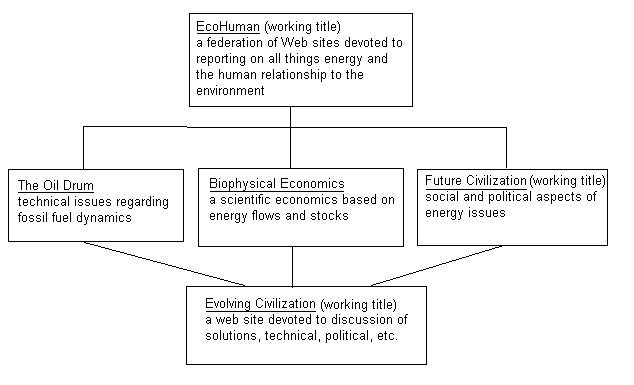
Other categories and better names could surely serve. All of these semi-autonomous sites would have cross links that would allow people to go from, say a technical peak oil review on TOD, to a proposed solution on the lower web site. This would require a sophisticated technical support and moderators for all of the sites (I'll be the first to volunteer for the Biophysical Econ site, which is already going but not very developed).
If this sounds at all like a feasible idea, I'd recommend that the current TOD editors and some of the contributors might put together a steering committee (with a necessary finance subcommittee of course) and ask for volunteers from the readership to help make it happen.
It all depends on what peoples motives boil down to. Maybe TOD has generally been, and would always be just a place for a few experts to share their thoughts and lots of other people vent their beliefs, etc. Maybe that is its only purpose (as I infer somewhat from Nate's and Leanan's comments). But maybe there is a contingent of readers who want to push the envelop of organizing knowledge and communicating with the rest of the world. Maybe some of us are just enough 'activists' to want this rich body of knowledge to count for something more than just a collection of rants interspersed with the thoughtful ideas. If so, there is nothing that prevents action.
It's just a thought.
George
We are already a non-profit.
This is an intelligent comment, and certainly one possible way to go. I've seen it done many times and done it many more. And I don't disagree exactly.
I'd just note that this sort of modularizing has tradeoffs. Increased time/resource overhead, cutting back on the cross-disciplinary fertilization, and increasing detachment of people and constituents from one another.
This feels like an "investment in complexity" in a Tainter sense. That's not a bad thing, but it's something to think about.
The reality of entities at this scale is that they're largely person-and-personality driven - a few key people tie it together, and the magic lasts as long as their bone marrow does. It's easy to lose sight of this fragility when splitting things up conceptually.
How and if to reorganize an entity is a big discussion, which I won't get into here; but the mission statement and governing structure are biggies. As is the question, "what are we trying to do?"
I hope TOD continues, but it's not surprising I say that. A survey printed in the Hermaphrodite Basketweavers Quarterly would likewise get overwhelming support to continue from its readers.
"cutting back on the cross-disciplinary fertilization"
Bad, really bad...
What I most value about TOD is that it is not all split up into small pieces.
Yes, George, this is similar to one of the models we've been tossing around for a while now.
Most of the problem with any sort of modularization is the financing issue that we face--and we have been doing this for so long without a large budget (save the budget for the servers and site stuff). If we had a lot of money, this would be a lot less of an issue...(*cough* note the "donate" button in the top left hand corner *cough*).
Our first shot at bridging the complexity was to break things up by country/region (hence the old TOD, TOD:E, etc., distinctions). We also hoped the tagging system (which has been tough to get right) would help with the segmenting.
Since then, there are cleavages that have developed naturally...as people get more in depth in a topic, it is inevitable that this happens. We have tried many different approaches over the years...and I think this temperature taking of the readers is a good thing.
Nate, you guys should go on with the oil drum as long as you can maintain your motivation. Why? egoistically spoken: The discussions here shape my way of thinking to a significant extent.
Aside from this, I believe that the campfire questions you have raised are very important since every avantgarde needs to reinvent itself periodically the more their viewpoints become commonly accepted mainstream knowldedge. However, concerning peak oil this is not the case yet, as opposed to climate change after the Stern-Report.
Two more thoughts derived from my experiences from being one of the leaders of a german think tank on sustainability:
1. Forward thinking must stay forward thinking. If we here believe that we are past or quite close to peak, then we need to keep thinking forward - what will happen on the decline side, what will the decline look like scenario-wise? Expertise and ideas will be desperately needed in the future - this site is a valuable source of insights and ideas.
2. As long as the actual core idea (in this case the peaking of oil production) has not made it to broad, common acceptance, one might focus some attention on how to get it there where it belongs. I know there wasw a Hirsch Report, but no one except a few know it. Would it be wise to bring on the next Stern-Report focused on peak oil, in an arena and with an authorship that is certainly being listened to? Stern-Report has altered global perception of climate change. Adding another really, really prominent report might do the same - some ideas may by the community may be spent on this.
Please keep up the good work - we need all the voices of your four camps here for a valuable discussion.
This sums up something I've been saying for a while: if people don't start looking at options, the doomer scenario becomes a self-fulfilling prophecy. Even if none of our ideas will work, we should be happy about it: we have nothing to lose by trying!
That kind of sums up where I am as well. The reality is that humanity will scramble and try lots of different things. Some will be productive and will help, others will be unproductive and be a waste of time/energy/money. Our role is to do the best we can to advocate the ideas that we believe to be productive, and to argue against those things that we believe to be unproductive.
"The American love affair with cars is a lot like Stockholm Syndrome."
(source unknown)
As noted up the thread, I guess my bottom line opinion is that the most that we can realistically do (other than individual ELP type actions) is to have a credible plan ready "To make things not as bad as they would otherwise have been," when and if a sufficient number of people and policy makers conclude that we can't have an infinite rate of increase in our consumption of finite fossil fuel resource base. Along those lines, I posted a note a couple of weeks ago about a planning conference in which I participated--I was quite surprised when the mayor of Fort Worth asserted that "Business as Usual is DEAD!," and he insisted that the audience shout it out with him, a couple of times. He added that the only viable future transportation option for the Dallas/Fort Worth area is rail. So times are, to some extent, a'changin. I don't know where the captioned quote came from, but it's quite possible that the mayor of Fort Worth agrees with it. Of course, Alan Drake, IMO, is the "Man with the Plan," what I have called "A Desire Named Streetcars."
On the other hand, I wonder how many millions of college graduates are trying to ride out the recession in law schools and graduate business schools--incurring more student loan debt in the process--thinking that things will shortly "return to normal," and they will be able to afford the three car suburban way of life when they get their law degrees and MBA's.
Incidentally, Sam and my son-in-law are putting the finishing touches on our updated export presentation for ASPO, and there is a heavy emphasis on actual case histories, and in accordance with multiple requests (by JHK among others) we have tried to simplify the presentation and make it more graphical. We will try to get the actual paper out some time this month. In putting the slides together, two things surprised me: (1) How strong the case histories are and (2) The huge increase in non-OECD consumption, as oil prices rose at 20%/year from 1998 to 2008, while OECD consumption stagnated and fell.
My take on the Influence of Oil Supplies on the Financial Firestorm is that constrained oil supplies acted as a trigger, kicking off the firestorm, and are now acting as an accelerant, feeding the fire. When we consider the fact that the US is a highly indebted high consumption country, with an energy intensive lifestyle, in the early stages of experiencing what we believe will be a long term accelerating rate of decline in net oil exports, with a recent track record of being effectively outbid for oil supplies by many non-OECD countries (our reduced consumption of oil supplies basically went to non-OECD countries), the future does look "somewhat" challenging.
In any case, regarding burnout, I'm surprised that it hasn't been an issue earlier. I tried to write monthly posts for Graphoilogy and quickly got tired of it. Another solution for TOD might be some fresh blood, i.e., some new volunteers, to replace the people that want a break.
a)
WHT - is there any way to quantify how much of non-OECD consumption increase eventually made it into goods and services that were consumed by OECD nations? Ergo, USA consumption of oil has been flat, but perhaps it was still increasing if we looked at total emergy consumption (which would include indirect energy inputs for salad shooters and televisions not made in US, etc.
b)re fresh blood, email the editors..
Mail has been sent.
Bullshit. I tried to get involved in contributing to this site once and I was totally ignored. Apparently I did not rate even the minuscule courtesy of a reply to my two requests for a guest post. Even when I take the time to post what I consider to be thoughtful comments here more often than not I get little more than a sneer from the staff, especially you Nate, for a reply.
God only knows how many other potential contributions you have blown off with similar arrogance and ineptitude.
I for one would heartily encourage the staff of TOD to find better things to do if it pains them so to keep up their oh so terribly precious heroics.
Cheers,
Jerry
Not many.
I pulled up the email thread for your post by the way (from two years ago), apparently it did fall through the cracks, as it was a guest post that quite a few who had read it were keen on, but it needed some other things. You can blame me for that mistake.
Well, as a general principle I blame you for everything, including global warming, especially since your "role" as head of the secret global oil price conspiracy was exposed by a former blogger.
Incidentally, I suggested a few weeks ago, in connection with a series of planned nationwide naked bike rides, that ASPO, as a money raising effort, pledge not to do mass naked bike rides (given the fact that the bulk of Peak Oilers are middle aged and older white guys--think of several hundred clones of Kenneth Deffeyes, in the buff, riding through your town).
The Oil Drum could carry this a step further, and actually do a mass naked bike ride, and then demand extortion payments from other towns and cities--if they wished to avoid a similar spectacle in their fair cities. Just trying to think outside the box here. . .
It's a good thing I have broad shoulders, WT...of course, it's my broad ass that would raise money on the bike ride extortion ring you're positing... :)
This is probably a good example of the problem. There are plenty of people who want to contribute. But evaluating the submissions, communicating with the authors, working with them on their submissions, editing and formatting, scheduling and posting, etc. takes a lot of time. Things do fall through the cracks.
Ineptitude I could agree with but arrogance not so much. I'm sorry your effort went unanswered - I've always thought we needed more Odum concepts expressed here. And yes, I imagine a huge amount of stuff has fallen through the cracks. I get over 100 oildrum related emails per day and just can't keep things straight anymore.
How about Odum as a lead post to generate interest and awareness.
I had never heard of Odum or his concepts until another poster pointed out that my ideas were a rehash of his work from 40 years ago.
Not to mention that I believe that type of thinking is the direction of the future.
As far as replies to e-mails I never received a reply either but I assumed it was due to you guys being overwhelmed and not because I was being blown off.
I have never felt any condescension from the staff here on TOD.
Some of my emails to TOD have gotten lost, too. I've always assumed it was due to the reasons Nate and Prof. Goose have mentioned and never took any offense.
Jerry, they meant help with running the site, rather than having your things published here. I sent in
a brilliant article myself (better than some of the others that've got through recently) but it wasn't what the site required and we just move on.
Meanwhile we hope for replies from the staff, but we don't have justification to complain if we don't get them, from these volunteers who owe us nothing.
I'll toss in my simplistic view of TOD. This site, like all others, is primarially beneficial only to those who participate. The only benefit to those outside our little world is the little gems our players carry from here to them. Is that a monumental gain? Probably not but it beats a poke in the eye with a sharp stick.
Subject matter? A self-correcting issue on TOD I beleive. Someone wants to chat about the possibility of harvesting methane from some distant moon...have at it. Other then mining such an idea for humor the conversation will end quick enough. Alan, our resident train nut, is another good example. No direct impact of hydrocarbon extraction but I always enjoy (and am occasionally educated) by his chatter. And so, apparently, are quit a few others. Hang in the Nawlins Boy.
Name change? Maybe so. From my personal experience if you're associated with oil then you'll likely be associated with oil companies and that means you're evil and should be destroyed. Or at least ignored. That's been my personal experience anyway. In the past when I offered assitance to different environmental/conservation groups all was well until they learned I worked with oil companies. I had analyzed a study presented by Dow Chemical which actually showed, if you knew how to read the numbers, they were contaminating shallow water aquifers with heavy metals. The local environmental group refused to listen to me or even read a report I sent them. I was told by the secretary of the lawyer who was representing the group that I should stop calling. Once he found out I worked for Mobil Oil he was never going to take a call from me. I can foresee a time when the PO SHTF in a big way the public will search high and low for the guilty. Any group with "oil" in their title will be likely suspects IMO.
Burn out? Heck yeah...these folks should get all the help/substitutes the group can muster. Easy for me to say, of course. I have neither the time nor talent to offer much assitance. Perhaps some sort of mentoring program to indoctrinate the interested.
TOD is the only such site I review on a regular basis. It would be greatly missed.
RM,
Formal or not, your participation on TOD is highly valued. Good to keep us petro geology hacks honest.
JB.
Just as the world at large (or at least the USA) ignores 'peak oil' they also ignore 'birth control'.
I think we should not only continue but should step up ours efforts to inform. Lock in our efforts to tie peak oil to The Club of Rome and explain that hoping for the best while planning for the worst is really the only sensible way for one to conduct one's life.
Remember no one wanted to hear about the dikes breaking in NOLA, but they still did. Hell we could just concentrate our efforts in cleaning up this one entry on wikipedia....
http://en.wikipedia.org/wiki/The_Limits_to_Growth
I think the Oil Drum should be talking about down sizing as a solution. Massive Birth Control *can actually* get us out of this mess, and it's actually cheap enough to work.
I suppose that puts me in the Anti-Growth Circle but I am not for steady state until the world gets back to 4 billion people. Because alernate energy could probably support the world with only that many people.
To not talk about 'Peak Oil' because many people might get an emotional charge out of it is really stupid. You cannot change anyone's mind until you hook up with their emotions.
No matter what they tell you.
The world has been here before when it stopped talking about The Limits to Growth, and we saw how that turned out.
I didn't mean that emotive responses themselves are bad - indeed we need some sort of trigger - perhaps guilt about our children etc. in order for people to change behavior. I just meant that whenever "Peak Oil" is voiced in most venues, everything that comes after is handicapped by factor of 1/2 or more - kind of like when Jehovahs Witnesses show up at your door - as soon as that escapes their mouths the common ground has shrunk considerably.
The term "peak oil" now has a default meaning in the culture. It's "a fringe belief that oil will run out". Doesn't matter what we think or wish it means.
If someone comes up with a great alternative term, for heavens sake don't put it out in blogspace and expect it to grow organically, or it too will be lost. Rather, it needs to be clear, simple, and fill a perceived gap in the minds of people who hear it. And it needs to achieve a fair level of penetration quickly with its intended meaning intact, in order to not drift.
For instance, if the perfect term were thought of, it might be a good idea to wait for a special context - either created or accurately predicted - to spring it on the world.
Peak Oil Exports
Linked, but different. Not how much oil is produced, but how much is available for US !
53% of all oil produced is exported, so this is a "subset" problem.
I submitted an article to TOD, and it is "under review".
Best Hopes,
Alan
Okay let me see if I follow this correctly. 'Peak Oil' Needs another term so it won't turn people off? Okay let's say we call it The Magic Drum and we will have a Magic Peak, after which time we can get less and less magic out of the ground. How long before the average person figures out 'Magic' is oil?
Then what about all the other people in other countries who say something like "it's those crazy Americans again I'm not calling oil magic no matter what. So then where we did have one camp we now have 2 or more, kind of like gobal warming & climate change or cliimate crisis if you prefer Mr. Gore's reframing.
To my way of thinking we don't need another term we need more FUSION, we need common members in ZPG (err now the reframed 'People Connection'), the Sierra Club, GreenPeace, the NRDC, the Land Trust Alliance, the Unitarian Universalists, and MENSA to see what this means to them.
Making a whole new organization, is what usually happens when people see only one problem that they want to solve, it's what got these other organizations started. The only Organization that I know of that has been smart enough to co-op other organizations at least in print has been the Union of Concerned Scientists. Why aren't we talking to them about peak magic?
http://www.actionbioscience.org/environment/worldscientists.html
1a. Is it worth it for this website to continue?
As a reader who spends 2-5 hours a week at TOD, -- well that answers the question, at least from a reader's point of view.
As an early refugee from the flyingtalkingdonkey era of peak oil awareness, TOD has made significant changes to my worldview, I've learned to be far more analytical of the claims that make the corporate media, and that has served me well as a person.
1b. And if so in what direction? And why?
I think TOD, in its present form, is a great resource, I read nearly every TOD sourced article and comments, and about 10% of the Drumbeat links, but about 90% of the drumbeat comments. Over the last few years I believe I've received a world class education in energy by just paying attention here.
However, since you've asked the question, It's clearly on your mind that TOD is somehow not the right thing (for you) to be doing now. (I get that way sometimes myself...)
I've mentioned it before, but I think that TOD, because it is organized as a website, does not appear as authoritative as a many other organizations, for example the think-tanks and consultancies who are so frequently debunked here.
Many of those kinds of organizations were formed prior to the web, and since have added a web presence. Perhaps TOD could grow in the other direction, using the web site as a base, and forming an institute or such that is a better impedance match to the savvy media engine.
As a thought experiment, Imagine two nearly identical press release mailings, one From "The Oil Drum website" and one from "The Energy Futures Institute" (I just made that up) - which do you suppose has a better chance of being read, and which is destined, unread, for the recycle bin at your local newspaper, newsroom, or magazine?
2. How can those interested in these issues continue to share/compare and synergize when knowledge of an increasing array of topics becomes necessary?
A brief glance at Brookings, Cato, and other 'institutes' gives a clue. TOD-plus could branch out with sub-categories one click away from the splash page. The hard part would be a way to promote the best of each sub-category into a digest that a person might digest in reasonable amount of time.
3. How can 'Peak Oil' be reframed?
For myself I have internalized it as one of the three greatest threats to civilization, along with population overshoot and AGW. For the uninformed, it's not so much that it needs re-framing, it needs exposure in the main stream media.
Say, maybe Michael Moore needs an idea for his next movie....
I figure I've been here for about 3 years. I hope you can continue the site as much as possible but I also understand how folks might need to move along at times, find a way to make a living, etc.
I found TOD right after Katrina and at about the same time ran across a dedicated group of folks in neighboring towns who started a community group focused on energy and relocalization. The group spread virally to other towns, but over time, most of its core members have burned out. Perhaps with the economic downturn and the falling oil prices, attention has been diverted elsewhere. Within these groups, a few themes emerged -
Each of these fits cleanly into a Transition Town plan (though we started before hearing of Rob Hopkins' work) but these are local 'boots on the ground' activities, community driven.
I view TOD is something entirely different. TOD is a community of a different sort but still a community. I don't think you could find a high enough density of knowledgable folks to hold such meaningful interchange in a physical community; it is very hard to hold the focus, and oil & gas is quite a small niche compared to other aspects of relocalization, in daily life. Yet it is a helpful niche.
Similarly the ability to maintain focus, and to an extent, control, allows TOD to remain true to its mission. Leanan, I believe most of the credit for this is yours, though I realize others have some moderation duties over time. I realize the discussion gets quite technical, especially for those lacking a background in science or engineering, but the virtual organization has a hidden benefit: you've maintained editorial control. In each of our small town groups we've had to deal with non-technical controlling people (usually with a political agenda) who try to take over the organization and alter its agenda to suit their needs. Everyone in each town knows who these people are. A virtual community is different. Most of us are anonymous here; our political orientation isn't so important. There is great value in having an open forum.
Back to the mission. I really think PO as a concept hasn't met the mainstream yet. The media won't touch it, and politicians won't use the term, though they will talk about energy now. I don't think TOD's mission is complete. There will be a lot more help needed as others realize we are at or near peak, to help understand the severity and timing of decline and what happens then. I truly hope you will keep the site open. But how to organize, with whom to affiliate? I agree with the poster up-thread - EB is another great resource, but I come to TOD first; I find the most up-to-date discussion, and quickest feedback on ideas at TOD. Would it help to become part of PostCarbon? Hmm.
Chris
"Most of us are anonymous here; our political orientation isn't so important. There is great value in having an open forum."
Unfortunately, particularly in the US, certain opinions can be pretty strongly correlated with political party. This sometimes makes it extremely difficult to discuss topics from a foundation of the facts alone.
I think it is interesting to note that many people in what would be labeled "the conspiracy theory crowd" have a completely inexplicable blindspot when it comes to Peak Oil and AGW. Their theory is that peak oil and AGW are not real; and are just excuses for a cabal of international bankers to take over the world, impose a high-tech fascist world government, and reduce the human population to 500 million. This particular group of people tends to have a fairly good idea of how things "really work", although of course it is a diverse group that tends to go off the deep end. A lot of them are convinced that free energy is possible through bizzare devices involving magnets or electrolyzers for cars.
It's an interesting world on the internet, that's for sure. I know conspiracy theories (except the one about the MSM lying about peak oil) are not allowed here so I will not go into depth about which conspiracy theories I believe are plausible or likely and which ones I think are impossible/unrealistic.
However, it is important to note some of the very real conspiracies that have put us in this position with respect to energy. For example, the coalition of Standard Oil and some auto/tire companies which conspired to destroy light rail (and succeeded).
Ed Tennyson is the last living member of the GM prosecution team (he was technical staff support). GM lost and was fined $5,000.
I have had the honor to co-author a paper with Ed T and Hans Herren.
Best Hopes,
Alan
A small irony. The regional North Texas electric Interurban system was shut down in 1948--the same year that the US became a net oil importer.
I've been reading The Oil Drum for about a year and am delurking to post this comment. Yes, The Oildrum is important! Where else would I have learned about tar sands, Texas and North Sea oil depletion curves,the production fall-off of the Cantarell Field, or even the possibility of Thorium reactors? I am an avid daily reader of Drumbeat. I really enjoy reading comments about what strategies people are taking to reduce their fossil fuel consumption as well as just the general intelligence and healthy skepticism on this site. I like The Oil Drum better than the Energy Bulletin largely because it has more content, is updated more frequently, and has comments that have valuable perspective.
Preach to the choir, by all means. Your choir will grow. Of the people I interact with in person on a daily basis, I find their knowledge of peak oil to be approximately zero. This is in San Francisco, where 72% of the waste stream is being recycled or composted, where carbon emissions are already below 1990 levels, and the number of people bicycling has almost doubled in the last few years. Heck, our city just put out a Peak Oil report which basically no one knows about and no one read. If a population that is literate, open to change and would probably be happy to foresee the end of Big Oil doesn't know about Peak Oil, you can be sure that the ignorance of the subject is frighteningly profound.
Peak Credit does not make Peak Oil meaningless. It means it's time to face reality on any number of levels. Peak Oil may indeed be behind us, but its impact is ahead of us. I am much less a doomer than many posters here, but my sense is we have about five years to turn humanity around in terms of finite resource use. We need to reorganize and rethink our energy and mineral consumption, but I don't see it as hopeless. Americans currently waste so much we could probably drop both our energy usage and resource consumption in half over the next three years without even feeling it. With some effort, we could drop it in half again. It would be nice if we had government leadership in these efforts, but since government seems designed to follow rather than lead, we'll just have to do it without.
In the past year, my family has cut our electrical and natural gas consumption in half. We've dropped our gasoline usage by 20%. We've recently downsized one car (got rid of our incredibly low mileage van) and have added two electric bicycles to our transportation stable. We've put solar panels on our roof, blown insulation into our walls, put 1.5 gal per min showerheads in our showers. We're currently looking to terrace our hillside with retaining walls to grow vegetables. Did The Oil Drum influence our decisions to do this? You bet.
We all like to think if we'd lived in the antebellum South or in Nazi Germany we wouldn't have cooperated, we would have taken the moral action and sold the slaves/resisted the fascism/somehow prevented the suffering. We face the possible deaths in the next several decades of 4 billion people and the extinction of half the species on earth. This kind of catastrophe makes the Third Reich look like a cozy tea party. I am terrified of and appalled at this future, and these days I push on whatever lever I can find to avoid it. I try to get the kids at my daughter's school to take the city bus rather than have their parents drive them in 6000lb SUVs. I advocate for bike lanes. For waste-free school lunches. For more funding for public transit. The saddest part of the whole business is that the people who will suffer the most are the people least to blame for the mess. This truly is our Nazi Germany/American slavery moment. Do we ignore our complicity, save only our own skins, or do everything in our power to prevent it? Even if it's hopeless, I believe endeavoring to prevent it is the only moral choice.
I understand about burn-out, and for me, that's the only reason not to continue The Oil Drum. I'd personally be grateful if you could continue at least for the next five years. (After that, it very well may not matter.) Please be sure that what you are doing is a service to humanity that will stand out over time. And there are signs of hope. When I look out my front window I can see about 100 rooftops. A year ago there were 2 solar PV or solar hot water systems on these rooftops. Now I can count 12. Sorry for the length of my post. Thank you so much, all the contributors of The Oil Drum, for the time and energy you put into this site.
Taomom,
It is not as hopeless as you fear. There are some decent shots at change (quite possibly not enough or fast enough, but they would make things "not quite as bad as they would otherwise be").
One inspiration of mine is Hans Herren. He almost single handedly saved about as many lives as the SS murdered during WW II (10 to 20 million).
He now wants to help resolve the world's energy and environmental problems. And he approached me about working with him in an adjunct way.
Great things can be done, major obstacles moved, with luck and many different skills.
Best Hopes,
Alan
The suggestion of splitting the book into chapters - sectional headings - is a no-brainer.
Iv'e got one idea to float, though, and apologies if it's been covered, but I haven't seen it:
Has anyone contemplated us all pitching-in to support a paid Editor?
I know, I know,the net is free blah blah, and we've all got things to do with our money. Some - I'm one of them - think that fiscal systems may crash post-peak-energy, but until then, I don't mind contributing to my favourite site...
I'd rather put a few dollars into that, than waste it on a dollop of cream and a straw....
Peak Caffeine - now theres a topic....
I would absolutely pay for TOD.
That's one of the first things we have talked about doing were we ever to secure a large amount of funding of course. Believe me, we would appreciate that kind of funding, if anyone is out there willing to do so. :)
The problem would be that a) such a paid editorship would cost quite a bit of money from what footwork we have done on the prospect and b) it would need to be more than a one shot fundraiser if we are going to do it long term. We're talking about 35k a year at the very least, which would as of right now, be outside the scope of what we can do.
It seems as though money would solve the problems, but it's rarely true. It would change a number of things. It's hard to have some people paid and some working as hard or harder as volunteers. It chafes against our capuchin fairness sensibilities and is seldom stable.
TOD has a high enough profile, and good enough demographics, that it could be bringing in a consistent 7 figure annual income now if it was organized to do so. However, that wouldn't necessarily produce a "better" organization than what TOD has been and quite likely wouldn't. The all-volunteer dynamic has a certain magic to it which sidesteps a lot of bullshit.
The size of the active governing body is often inversely related to the half-life of such a group; I'm impressed at how long TOD has lasted.
I'll take some responsibility for the lack of funds. Back when we started TOD, the last thing on my mind was designing it to be a for-profit entity, or even a non-profit charity. It was much more (and remains so I think) about education and community. So, you're right, it never was designed to do so.
However, as you say Greenish, to continue to pull that off, we have had to rely on volunteers...and they've done amazing things in the interim. That egalitarian volunteer dynamic has led to stability and a constancy that I have never seen in another community.
And I think it's likely that we will continue...we just need to figure out how to best do so.
I find The Oil Drum to be THE authoritative voice on energy depletion. I visit several sites, but this one is where I turn to for the best information. I find the monthly graphs and charts invaluable.
I don't see why you would feel that your work is done here. Is Peak Oil in the rear view mirror? If so, the effects are not what I expected, and I am interested in exploring why that is. Have most people recognized the problem? No - and that is why this site needs to continue on. Imagine if another spike in prices hits, and this site wasn't online ....
It's fascinating to see how Peak Oil develops. Since most of us believe it has happened, or is imminent, let's explore how it develops. IS this financial crisis related? How? Are nation-states busy locking in resources? How? What is going to happen with Mexican exports?
Lots of questions for the Oil Drum to answer. I don't see how the site could go on hiatus now, with Peak Oil behind us, yet gasoline still cheap in the US. The crisis is unfolding in unexpected ways, and let's stay with it.
I don't think we feel that the work is done at all--it's just a change in era and/or perspective we are talking about, and the means that best fits the future.
In better words, we're just trying to figure out, each of us, whether this is the most efficacious way for us to continue and have an impact on the future.
I tend to think it's healthy.
Doing what we have done and continue to do here--it is not easy. I am fortunate to be surrounded by competent, smart people who make it look easy, but believe me: it ain't.
I look at TOD and Peak Oil as a gateway portal to a lot of bigger picture issues.
We've discussed the big picture issues many times here.
Examples:
1. Financial system meltdown
2. Population explosion and the exponential function
3. The unsustainable Green Revolution and Biofuels
4. etc.
So yes, Peak Oil (PO) is one Black Swan topic. But there are so many more and any one can pop out of nowhere to dwarf all the other worries.
How about a bigger picture site name like:
"The Black Swan's Drinking Hole"
or
"The Black Swan's Drum Song"
Well I have found this site to be useful, after the initial insomnia. I saw my local (English) MP and not long after that she joined the All Parliamentary Group on Peak oil, although I haven't ever seen any reference to Peak oil from her after that. The Conservative party are against the Third runway at Heathrow at least - which is at least one white elephant saved (as there is now way Brown's labour party will get back in). I got some complacent correspondence from the Government concerning near term peaking. I went to see the head master of my local son's primary school - they were already planting a vegetable garden. I sent a document to some of my friends regarding Orlov's five stages of collapse which is always good for a laugh when we are down the pub.
I find some of the campfire topics - things to do to prepare for peak oil useful. Still not decided whether to try and move somewhere more rural (in a town of 120,000 , which is reasonably close to London), or whether to stay here.
I'm one of those persons who do sometimes talk to movers and shakers. I am active in advocacy work / mobilising both in the Climate (AGW is too much associated with Autonomous Guided Weapons for me sorry) and PeakOil fields. I really appreciate TOD and the fact that I do not comment that often is a combination of appreciation of the high quality of the site and the discussions (not much to grumble about) and the fact that PeakOil Netherlands only has one serviceable time machine which is in use by Rembrandt Koppelaar ...-:)
TOD is a very good source of information if one is interested and willing to take the time and effort to get it. And TOD info is being used on a regular basis by me and others doing advocacy work. So on the questions
1.Is it worth it for this website to continue? And if so in what direction? And why?
Yes, keep it in this direction for a few years and start moving to a more general resource depletion blog after that.
2.How can those interested in these issues continue to share/compare and synergize when knowledge of an increasing array of topics becomes necessary?
Carry a good (Ockham' s) razor. EROI and its equivalents in other depletion issues may be the equivalent for TOD. If an issue can't be related to this, drop it.
3.How can 'Peak Oil' be reframed?
PO does not need reframing in the context of TOD I think.
Energy and Society.
This is how I would rename TOD.
The tentative name right now is "Energy and Our Future," (TOD is funded by the 501C3 called the Institute for the Study of Energy and Our Future...) but we're open to ideas.
Don't forget the past. Most history books ignore the central role of energy (ag food, slaves, wood, wind, coal, etc.) in shaping all that we are and have done. Sometimes I think the best path to educating people about PO future is to re-tell our past in terms of energy.
Just tuned into this discussion after a relaxing Sunday afternoon (watching football). What a great initial post by Nate and what answers.
My cut on this is that the editors need to do what they have to do. I can't tell you what to do but boy would I miss reading TOD every day.
A few thoughts.
1. On no other site on the internet would I be able to read a set of comments like I just read. Don't agree with every one of them but the quality of the thinking is the best.
2. Peak oil may have happened (maybe), and you may have convinced most of us - but the general public and officialdom is clueless. It will take years to convince them, and probably well after the fact.
3. I still do not know exactly how I should be preparing my family for the energy decline - so I want to keep reading TOD to learn more.
So I hope you continue - and there have been some good suggestions as to how. But if you need our help - please ask.
How about "Energy and/or Future"?
Kidding. Mostly.
I'd be happy to be consulted to offer general sage advice on the process of naming/renaming, structuring, etc.
I nominate Greenish for the framing committee. Do I hear a second?
Yes, you have great long posts but its the one-liners that crack me up. Like, "yelling "theater" in a crowded fire."
You could hit the "nail of a head" blindfolded.
I second the nomination.
This might get him to hang around a bit longer.
Yeah, I'd add motion to the second frame in the zoetrope while the crowded fire burns down the screaming theater. Sure why not?
Joule: Energy and Our Future
(and isn't our blue marble a beautiful jewel?)
We should increase female readership.
Nutrition,health,organic gardening ,education and lifestyle are all related to energy and interest women more than technical and statistical topics.
This would also benefit male readers who often neglect how to take care of themselves.
Knowledge is power.
It is also intangible wealth.
YES YOU CAN should replace YES WE CAN.
I completely agree. This place is a relative sausage farm. Back in the day, I think the gender balance was better...and we still have more women proportionally on staff compared to the larger websites. But, I still agree.
It would be interesting (impossible, I guess) to know whether women are over-represented among lurkers vs. comment posters. True, the staff ratio is pretty good.
Post a survey.
Maybe even add a few more questions like age brackets and geographic location and educational background, occupation field etc.
It may be useful/telling to have a sense of demographics.
Anonymous of course.
It might also be cool to have a correlation graphic of eyeball hits here verse oil prices. i am sure it would be positively correlated but still interesting.
Much of this information is already available on the web-monitoring sites. I have no idea how accurate the stats are, or how they clean the demographic information, but it seems precise if not accurate. :)
http://www.alexa.com/siteinfo/theoildrum.com
If at all accurate, it shows that TOD has way more than average male readers and way fewer female. It tends to have fewer working-age readers and more young and old. It has slightly more college-educated participants than average.
Thanks but how do they go about collecting the non trackable data such as education level and age?
"Some people have been asking where we get our demographics data... more to come in a post later this week. For now, I can tell you that it starts with the Alexa Toolbar and Sparky, which ask our customers to volunteer demographic data. There are some more smarts involved, but that is the core dataset that we use."
So it's a sampled representation from a somewhat skewed base.
Better than nothing I guess.
Inconclusive.
As a female lurker I have to completely agree. With an economics and law background, I "get" much of the technical analysis on TOD. When it's over my head, that prods me to dig deeper and learn more, which I appreciate. That said, my strengths are in nutrition, health, organic gardening, lifestyle, etc. Major topics for a post-peak era... Not sure where that fits into TOD in it's present state. It would be wonderful if this forum grew to include more of the YES WE CAN mentality.
That said, what I've learned from TOD has motivated me to become much more tangibly involved on the local level through the Transition Movement in my area as well as our local organic gardening non-profit that offers courses in permaculture. I've met tons of like-minded folks who know nothing of TOD but are already implementing post-peak ideas in their own lives. This gives me hope...(especially as I'm in Houston, TX).
I love the idea of taking a subset of TOD to edit a website on Transition, that would have the features of intelligent ("comment-type" or other) debate by a diversity of people, a rundown of relevant news articles, and a monthly update of depletion issues.
I guess the question is not simply whether TOD as it is, is valuable, but whether editors' enormous effort would be better used creating/debating Point B, where we are going from here, how to get there, than fighting essentially with each other, on issues that are game-changers (whether AGW matters/exists, whether technology is poised to "save us" - whatever else you disagree on).
Here's Sharon Astyk, and I wholeheartedly agree:
On the contrary I consider that to be a seriously dangerous mentality. What is required instead is a "WHAT we can" mentality. Huge amounts of time and energy have been wasted in pursuit of projects that were doomed from the start due to insufficient application of due criticalness to discern their impracticality.
Such halfbaked solutions distract attention and energy away from more realistic options and poison the water for them.
I discuss this more (esp with ref to the Transition (Transition Towns) movement) at www.energyark.blogspot.com
I cannot agree with this enough. Not checking the details before expending lots of effort is a way to almost guarantee EPIC FAIL. New energy concepts need testing and checking on the order of the design and testing of a new automobile... including crash testing.
There is an entire series of "tests" required to lead a new breakthrough into a mature technology.
Long term, real world use will find flaws unsuspected during initial tests, ways have to be found to incorporate new technology with all else that we already have, mass production has to be ramped up (often a difficult challenge), delivery and support provided and much more.
A lab breakthrough is many years from a real world solution.
Alan
Agreed, while theory and lab experiments is very good at ruling things out they are hopeless at demonstrating that things work. My favorite aspect of this site is the diversity of response - some apparently sensible ideas have been shot down on here by those with direct experience and that saves much reinventing the wheel. And I too like the 'Energy and Future' tag.
CAMPFIRE QUESTIONS
1. Is it worth it for this website to continue? And if so in what direction? And why?
2. How can those interested in these issues continue to share/compare and synergize when knowledge of an increasing array of topics becomes necessary?
3. How can 'Peak Oil' be reframed?
Any other comments welcomed.
---------------------------------------------------------------------
1. IMO, TOD should change direction. It's too much of a "doomer" site. More space should be given to the theory that oil production hasn't peaked yet, and also the rapid growth and immense potential of renewable energy.
2. This is one area where the TOD site can help. But perhaps it would be better with a BB type format like Jelsoft's vBulletin. Reference articles could be more easily organized under different topics. Commentors could stay out of topics they're not interested in.
3. The question is, why does "peak oil" need to be reframed?
Unfortunately for the movement, some of the more outspoken advocates have been making rather outlandish predictions that have now been proved false. This is one of the reasons why a large percentage of the public doesn't believe peak oil is real.
Bring it on. I would be very curious to see the theory. If it provides some insight, it will help us all.
In the case that the admins don't allow it, go ahead and make a TheOilDrumAudit.com and you can knock yourself out.
This interview would be a good example:
http://www.ibtimes.com/articles/20091001/oil-natural-gas-geothermal-hydr...
And a, there's already an anti-doomer site on the net:
http://peakoildebunked.blogspot.com/
I'm sure you can set them straight in the comments section. lol
For some reason JD of peakoildebunked has never attempted to debunk any of my models and he doesn't seem to go after the notion of peak oil that much. He is more into the anti-doomer aspects as you state. So the name of his blog is a bit of a misnomer.
Yet you just said that you wanted to see a "theory that oil production hasn't peaked yet" I am afraid that JD is not much of an adversary on these matters.
So too, does Byron King have a "theory"?
Oh he's an adversary alright e.g.
http://peakoildebunked.blogspot.com/2009/07/411-reality-check-for-ace.html
And from the King interview:
"Maybe we've bought five years. Maybe a decade. We'll still have to deal with the decline eventually."
Hmm, doesn't sound like he thinks the peak is here quite yet.
Idle musings does not really constitute a theory.
More on the possibility that oil hasn't peaked? Sure but if it hasn't happened yet it's not far off and I personally don't see the value in hashing out the exact date any more. + or - half a decade is fine in my books, the direction we must head is already crystal clear to me (i.e. prepare and do it quickly).
1. The oil industry has been growing for 150 years, so if world production follows a symmetrical Hubbert curve, there will be an oil industry to blog about for another 150 years to come.
2. The world may have reached Peak Oil, but it has not reached Peak Gas (2020 perhaps?) nor Peak Coal either. So Peak Fossil Fuels is still a live issue, and TOD has as much expertise on gas production as it does on oil.
3. Mankind will continue using energy even after all fossil fuels are gone. We can make a reasonable estimate of the maximum feasible contribution from firewood, biodiesel and hydroelectric, and of course it's not enough. But there's also wind power, OTEC, solar power, wave power, tidal power, uranium fission, thorium fission, and thermonuclear fusion, and at the moment there are tremendous uncertainties with all of these. Far too much of what's written on the Energy Technologies of the Future is deplorably biased, either pro or anti. TOD's contributions in this field make a welcome effort to be relatively impartial. No-one in the world has expertise at running OTEC or thermonuclear fusion on a commercial basis, nor a proven track record of keeping nuclear waste safe for a hundred thousand years (the design life of the new Swedish waste repository). So you guys at TOD don't need to feel embarrassed about a lack of relevant expertise.
4. I suggest TOD eases off on non-energy issues as far as possible, and let's include climate change, politics and economics in that. But keep the occasional article on parallel resource issues - e.g. Peak Phosphate.
Should you keep going?
Hell yes!!!
Of course I say that as someone receiving all the benefits of the site, without having to do any of the work.
True, I don't post very often anymore, but then, I don't post much anywhere anymore.
After wading through the morass that comprises the majority of the internet, where the worst of humanity pours out self-centered lies and delusions, the oildrum is like a breath of fresh air after a summer shower. In a world of mud-slinging digital ink, the contributors of the oildrum are actually giving thoughtful well informed comment, as to what mankind should do to ensure civilization continues. I haven't seen that many other places.
Don't let the lower readership (that accompanies lower gas prices) put you off, you still got it baby!!!
My feedback:
I like TOD. I especially like the Drumbeat; like someone else said, it's a terrific concentration of the relevant news.
Does TOD now have a kind of brand? I wouldn't rename it, but then I'm not a marketing guy.
I also feel a debt to those commenters who have explained things well, like Darwinian and Westexas (I'm not not thanking others, if you follow me) - the prediction that oil production will be a shark-fin and not a bell-curve and why this prediction is so, is to my mind one of the most valuable insights I've had from TOD. I can't remember who (all) posted the shark-fin graphic but my thanks to them equally.
I first learned about peak oil in August 2007, and it has certainly been on my mind since. Firstly I wanted to verify it, then I wanted to know if there are solutions.
I would like to see TOD (and everyone) concentrate on solutions. I've stated I think fission breeders are the necessary energy solution, as nucleargreen.blogspot and bravenewclimate advocate. If we're very lucky perhaps IEC fusion will work as they hope over at talk-polywell.
If TODers would want to post on other subjects relating to possible solutions for sustainability that would also be good (you know, food, water, biodiversity and just everything).
I really struggle with knowing there is something I can't figure out about humans. Western democracy is not working properly, and I believe it's because it is corrupt, but I can't figure out how polls can show most people want peace and prosperity and yet it's not happening (or at least not in a particularly fair and equal manner).
I guess I can't expect TOD to answer everything!
I hope my comments don't seem too absent-of-merit.
And not to too obviously be a James Lovelock acolyte (the solution is nuclear + biochar), a good example to my mind of posts on sustainability that are not absolutely directly about oil and only oil is E-P's post on the possible sustainability of biofuels from biomass, and all the good comments it got.
"Energetics of cultivation: draft animals vs. combustion engines and the Haber process"
http://www.theoildrum.com/node/5796
The Oil Drum: keep the name - it is a recognized brand. Leanan, Gail, Nate keep the faith - we love you.
I'm not a marketing guy, but I had the "brand" thought as well. In fact, I was Googling traffic stats for theoildrum.com when this comment posted. While not a household name, The Oil Drum has a significant readership in many countries, and on high weeks they've had visits from .01% of the Internet population. That sounds small, but over time it's a LOT of visits.
I'd hate to see the brand value be wasted, or overly watered down. Maybe keep The Oil Drum and Drumbeat, but go for the more basic name for an umbrella org?
As an offhand remark, it's slightly reminiscent of another branded entity which wanted to get "oil" out of its name, so to speak.
I seem to recall that Kentucky Fried Chicken found, when doing research, that it was a marketing problem that their brand-meme contained the word "fried". They spent a bunch of money to re-brand it KFC, so people didn't have to deal with mental dissonance when buying oily food by the bucketful.
For most of the first year after I heard of TOD I didn't read it because I assumed it was exclusively oil-industry focused. That wasn't my interest, though I had been an oil industry geophysicist in a former life. It was a delight and a surprise to realize how broad its boundaries actually were, and the existence of its unique community.
Likewise, although it was less than a year. I've been reading this site for months and I am amazed at the quality of debate but I would have come much sooner if the title was different.
1. Is it worth it for this website to continue? And if so in what direction? And why?
Nate, I think Greyzone was onto something. TOD is such a big volunteer effort, I'm amazed some of the main contributors haven't burnt out yet. I think the majority of those involved here for the past several years are convinced peak is close or we're past it. So the debate over "is PO real, coming or close" is kind of over for most of us here. A lot of the emotional energy is gone once that argument is stomped into the ground.
So once convinced of PO and a very slow to non-existent world effort to prepare post PO world, there's a deep melancholy feeling of being a Cassandra but watching the train wreck occur VERRY VERY slowly. At least that is what it looks like now to me. Give us another big spike in oil prices, and most of us will feel better in a weird way, and pat our selves on the back for being right. But the long bumpy plateau I expect will be mainly that, long and bumpy. Very brief periods of feeling we had it predicted right, and longer periods of waiting, wondering what the hell is going on, or both.
Does TOD have a purpose? Sure. Look how many replies you stirred up with your post. There will always be newbies who need to learn what this is all about, and there are those of us convinced of PO who might go crazy if there isn't a place where others agree with us and share our terror/anger/fear/urgency over a post peak oil world.
2. How can those interested in these issues continue to share/compare and synergize when knowledge of an increasing array of topics becomes necessary?
The hardest part for me now on TOD, is how long all the replies get. There's not enough time in the day to read it all. The volume of information here is staggering. Part of the value is the archival of this site for future reference and research purposes. I think it was in a past Campfire discussion, but some better ways of accessing all this info would be great. There were several ideas proposed and I liked the wiki idea for TOD core subjects and ideas.
3. How can 'Peak Oil' be reframed?
Inherent in this question seems to be "how do we tell everyone about the coming tsunami?" this idea that more people who know, then perhaps we can save more lives or preserve more of the economy or of civilization. Part of TOD is out reach to those who do not know of PO, but I don't see that as it's main function. Like Leanan said in a few posts above, to paraphrase: highly technical people aren't the best at sales, marketing, or evangelizing of new ideas. So what? This is part of Cassandra's dilemma. I don't think we'll resolve it in a campfire discussion. It's always worth fighting the good fight though. No shame in that, and you you can die without regrets.
How to tell people about the energy decline?
I discussed it here:
http://energyark.blogspot.com/2009/07/getting-people-involved.html
I'm a non-expert grateful for this blog. I accidentally posted a comment that was still in progress. Sorry, I'm new at this. I'll come back and edit this later.
I am financial analyst in the oil & gas space and find TOD to be the only legitimate and honest conversation online regarding the massive macro problems my industry is facing. The problem is so huge it does seem almost futile at times. But without TOD where would we go? I do feel the conversation must go on.
I have a feeling that more than a few financial analysts than one may think are reading TOD. I was asked to participate in a podcast for the ZapataGeorge web site last week. Listen here:
http://www.zapatageorge.com/zapatag/web_radio
Fun stuff because I enjoy well done talk radio and George really knows how to carry on a two-way conversation..
Well, if burnout is the main issue then I guess you could recruit more volunteers or reduce the intensity of postings...although I really appreciate the drumbeat. Great way to keep up to date.
Alternatively, I suppose you could start by soliciting donations. I'd be happy to donate a monthly subscription if you decide to go that route. I would hate to see it become manditory...I think it is important to keep free access for the greatest impact. Hopefully the "regulars" would provide enough financial support.
We probably haven't asked for donations enough...but there is a donate button up in the top left corner on the front page. :)
Ya, I donated some coin fairly recently.
I would suggest not changing the name of The Oil Drum blog site. Lots of books coming out are referencing the TOD URL, and if that changes you essentially screw up all the print references. Never forget the law of unintended consequences.
But webforwarding is cheap and easy.
I just tipped $50. If you could share a budget, and some notion of "donation rates", that might prod regulars to chip in. I'd never noticed the button before, and kinda figured somebody with deep pockets was bankrolling the basics for the project.
As I write this, there are 227 replies. Once more, we have been around and around the same circle...those who have recently become aware of this issue (and my definition of recent is approx. the year 2005, when once more the issue of oil prices brought many in the population at large in the developed countries into some awareness), and those who go back to the old 1970's days when many in the population were certain the end of the growth in oil consumption had arrived, and the transition to a new cleaner energy base would have to begin. A generation even older, going back to the 1950's and even the 1930's, including Buckminster Fuller, Admiral Hyman Rickover, and Marion King Hubbert himself were aware, but are now long dead and gone. Even Thomas Edison himself, as he helped design the devices which would consume so much, spoke of the day oil and coal would run out.
Those of us who can remember the old 1970's crisis are old folks now. We may not like to admit it, but we are. We now have to worry about things like healthcare, retirement planning, what we want to do and are able to do with our remaining years to get the most possible value out of them. We have spent three plus decades with the weight of impending oil decline somewhere in the back of our mind, and for some, something that we always factored into our planning.
This is now a young persons issue in many ways. The older crowd, including me, for the most part missed our chance to make the transition a third of a century ago. Yes, there were (and are) some "campaigners" who tried, and in rare cases, gave their careers to this cause right through a third of a century and sacrificed for careers of wealth for their cause, their belief, but this was more a labor of love and belief than a path chosen to change the world. The world had (and may still have) very little interest in changing. Much as the guy who stands on the street corner with the sign "The world is coming to an end", they did their part, and played Cassandra.
But the transition is coming. Despite the Cassandra screams, there are those who have no interest in doomsday scenarios who have been making the advances, the little steps, the big breakthroughs. The first step in rebranding if we want to stay relevent at all is to get out of the crisis mode. This is a TRANSITION. We all knew from the start it would come, it would have to come, if we hoped for anything other than a return to a world lit only by fire, a return to a dark age we left gladly several centuries ago.
And it is coming. Like the birth of industrialism, it will create both winners and loses, victims and victors. There is no perfect system. There is no way to assure the benefits will outweigh the costs. Industrialism brought us a range of experience including the democratization of speed, travel and experience, arts and sciences, instant telecommunication, but also a world of Hiroshima and Dresden, napalm and attack by airliner. Depending on how you wish to view it and when and where you were,or are, industrialism is the golden age, an age of earthly pleasure and experience my grandfather could not even imagine, or an age of horror, of the hell we would bring upon ourselves if we accepted its Faustian bargain.
The age coming will almost certainly likewise be more different than we can possibly know, but it will be the same in that one core truth of human existance: It will be both heaven and hell, depending on where you are and what your exact circumstances are. As always, everything will matter...Hemmingway once said "It's all important." Race, education, location, wealth, health, planning, and just plain luck, it will all matter.
All the worry, all the "planning", all the thinking, all the communications and friendships and allegiences matter. The germ that can change a culture, a world, is smaller than the eye can see. It may wreck a culture or it may save it, and it will be followed by other germs, more varied, more unpredictable than we can even imagine. The germs of ideas, of social causes, of books and poems and theories are being born with each passing moment, and organizations, companies, individuals in their garage or shop, school kids working on thier first playful experiments are unwittingly birthing the germs that can alter the whole culture, the structure of daily life, either for better or for worse, usually for both. It is all important. Thus, The Oil Drum is important. In what way, and how big the effect of thus virtual "culture" can be we cannot now know. Great change has been birthed from far more humble beginnings...Lenin with his converts on the original boxcar, one electrician climbing a fence in Poland...a small group of Virginia property owners who tired of paying their taxes and being told wha to do...
Even the old folks who remember the 1970's can still play a role, Perhaps a small one, and in some rare cases perhaps a great one, but we will not be doing it because we can "guide" humanity to salvation, not if we are self aware, not if we want to resist those illusions that have always led the alert mind astray, the Cassandra complex, the Messiah complex.
We will be doing what we do for the experience, for the chance to play the game one more time. We will do it as Don Quixote did, for one last chance to feel alive and involved and relevent. We do it because that is what humans do. And at the end of the day, that is what matters. We make our choices and live with them, we carry the guilt for our consumption, our useless desires, we carry the memories of our "victories" and the scars of our failures, knowing that both victory and defeat are illusions.
The culture, the whole human culture will be built from our combined choices and actions and our obsessions, from the one thing we almost never talk about here, from the kind of world we WANT. But don't wear the burden too heavily. The choices of any one of us alone will have more impact on us as individuals than it will on the world in most cases. The hour is late, whether your 18 or 80, so make your choice and then do the best you can with the choices you and your fellow humans have made. The storm, whatever storm, will be over soon enough for all of us, and others will go forward for awhile from whatever they are given, and make their best choices with it. It will not be a perfect world they are given, and despite their idealistic hopes, it will be far from a perfect world when they leave it. And it will be over soon enough for them too.
"The whole thing drops from my shoulders now, like a jeweled coat, and I lay it aside, feeling I’ve never worn it at all.” (Margaret Gerkhe, 1948, used as the closing line of episode 4 of "The National Parks, America's best idea, a film by Ken Burns)
Should The Oil Drum continue? Why not? There are websites devoted to cufflink collecting, polo and kinky sex. Surely oil consumption and energy use mattter as much as these. "Half of life is just showing up." Woody Allen
RC
TOD absolutely must live on in some fashion.
But 90% (or whatever) of the core issues regarding depletion have been gone over inside and out.
Make it a two part searchable database;
1- Feature Posts
2- Comments
Then have a Campfire like Question or Comment of the day, could be breaking development or whatever, and allow the TODer responders to do what they do best.
Link to relevant stories
Site studies
Argue
Post experiences
Give advice and solutions
TROLL
Existing staff could trade off on moderating.
I’m in for $50 bucks.
I just want to echo those who have said that this site is one of the few with sufficient creditability to have forced me to rethink my life.
Well, this site and the largest post-war recession. ;-)
I enjoy the heck out of the daily Drumbeat, but then I am a news junkie.
I've learned tons from the technical posts.
I appreciate the interaction of an obviously better educated than average set of posters.
I'm interested in various 'adaptive' lifestyle pieces posted.
The only thing you are missing is the comic section. ;-)
I second the idea that you could expand your 'charter' to include more than just oil. I'd like to see more guests posts about individual energy technologies - not that you've overly confined yourself to just that. But embrace it. Talk more about individual techs: different flavors of biofuels, nuclear, wind, wave, even space based solar mw sats (although I'm dismayed and embarrassed at how testy and rude some responses are to that subject).
It's the 'mix' has that made this spot so special over the last few years. Its inevitable that mix will change over time. But I've enjoyed the ride thusfar!
PS. I depend on the Drum Beat to keep up on international energy news. I have no good alternative. I would be sad to see it go, although I can guess at how much work it is to keep up.
THE OILDRUM:ENERGY AND SOCIETY.
You keep the well known brand and rejuvenates the name.
Energy and Society means that everyone is involved now and does not exclude any discussion about Energy and the Future.
This is my first comment on The Oil Drum. Just signed for an account today. I wanted to respond to Nate's Campfire questions.
The answer to 1.) is YES
To 2.) I think the editors are all great. It is obvious from all of the work that they produce for this site that they not only have a personal interest in the subject, but they are also concerned for how best our world can go ahead in the future. And there seems to be minimal spin.
To 3.) The way PO is framed works fine with for me. Obviously, the article are all written with a various degree of technical expertise. However, I can understand the points made in the large majority of articles. I have also worked with writers and editors for many decades, and I think, that it is unrealistic to expect that those who contribute their efforts to The Oil Drum should have their work checked by some kind of a communications or public relations specialist. In my mind, this would not only slow up the final publications of articles, but would also lead to less value for most readers.
Other Çomment: I have been surfing this site on a regular basis for a couple years. As a mutual fund investor in energy specific funds the Oil Drum is a help. Also, as someone with children and grandchildren, I find the information available here is also of importance for their future.
If The Oil Drum were written in a way that would be completely comprehensible to all possible readers, It would have to be written at such a low level that it would loose much of its value.
Many thanks to the entire staff, and also many thanks to those who make the very perceptive and intelligent comments, that add yet more value to the original articles.
Re: Is it worth it for this website to continue? And if so in what direction? And why?
Yes, I was watching "The World Debate" today on the BBC:
http://www.bbcworldnews.com/Pages/ProgrammeMultiFeature.aspx?id=196
Lots of discussion about the future of the world economy by very smart people but not one time was mentioned the term "peak oil" or even the possibility that we have entered a permanent energy crisis. There is still a lot of denial and a lot of BS around, the more people we can convinced that our energy predicament is the number 1 problem facing humanity the better we are.
Ah, a little behind the scenes moding going on. Years ago my boss and I had a meeting with the director of research. He rambled on about stuff which came down to the reality that they were going to cut 30 of my staff and that the decision had been made. I called him a hypocrite for beating around the bush pretending that my input mattered rather then just telling me tough shit and that my justification to maintain the people didn't mean squat.
That's the way I feel this thread was going. After the delete that's what I feel for sure now.
And, of course, delete this too.
Todd
So Todd, let me see if I understand what your saying...are you saying that the founders/editors/core contributers to TOD are prepping to disband/call it quits/stop the work?
We know that some of the core contributors have already essentially stopped or greatly reduced their efforts here...Robert Rapier still contributes on an infrequent basis, and I always look forward to his posts, and he has given his reasons why (work, relocation, etc.). Stuart Staniford left quietly, and I am sure others who founded the board are facing burdens of their own.
Would they be interested in "delegating" some of the effort out, or if they stopped, would it just end and become a "404, Sorry this site is no longer available"?
I don't know how the site is constructed as far as ownership/control goes, so I don't know what would happen. What are the thoughts of the editors/founders?
RC
Roger, as I said, we're not going anywhere yet. We're just in the "thinking it out" stage, and trying to be wise and efficacious with our scant resources and efforts. That's all.
Promise.
It looked like it got flagged. I can pop it back up if you'd like.
(I am guessing it was because there's really a few people (those who are responsible for the site each day...) who are going to make the decision about how to continue and what to do...so the staff airing its thoughts out here in public probably wouldn't be all that helpful.)
I can assure you that we're not going anywhere and that no decisions have been made. Honestly. I promise you that on my honor.
Now, we may reduce the amount of original content, we may take a break for a little while to rebrand, we may refocus, I honestly have NO IDEA.
All Nate is doing here is trying to push us to figure out "what's next" and to see if we could get some ideas from the readership...see what they think about all of this.
Promise.
It wasn't flagged. A staff member hid it. Possibly for the foul language.
Todd--I've had the occasional misunderstanding myself from a momentary bit of paranoia as seems to have happened to you here. As Leanan explains, your thing was hidden due to language usage. The TOD staff really do have better things to do with their time than engaging in sham consultations or other trickery. Hopefully you've cooled off by now. Cheers!
I admit that the Peak Oil topic has lost some relevance for me since the banking collapse began. Originally I was prepped for PO induced inflation but as it turned out, the financial crisis is beating the oil depletion crisis across the finish line.
However. Peal Oil is still relevant because it is THE reason that we can't get out of this deepening financial crisis. TOD has spent years debunking Cornicopians. Guess what, they are still at it with the drill baby drill squealing, the hi tech yet low EROI shale busting, the scale-blind [and credit-blind] alt.energy hallucinations, the [ever more] 'wars for oil' schemes, and more recently, the Keynesian Cornicopian stimulus spending plans to kickstart 'Growth'.
Peak Oil insures that all these roads out of financial hell are blocked. Somebody's got to 'splain it to them with the calm logic and the detailed expertise of a classroom lecturer. If the Oil Drum administrators can't do that, then they could just invite guest lecturers who can.
As for smaller scale solutions to help individuals, the TOD Campfire has been extremely valuable. Can we read more small scale community solutions [a la Rob Hopkins] guest posts here too? I think Richard Heinberg's emergency planning suggestions for how to adapt the Transition movement for American use would be a great campfire addition.
In keeping with Heinberg's Peak Everything, TOD could branch out too. Invite more lengthy contributions explaining peak water, peak phosphorus and other necessary mined materials, peak infrastructure, etc.
TOD's claim to fame is that it is like post graduate school on line.
Still lots of PO relevant topics to write and discuss in a scholarly way.
urbangardener aka gylangirl
www.gylangirl.blogspot.com
We all want this website to continue but i think that it is important to move away from the cullprit "peak oil = global collapse".
First of all to scare people with a collapse idea is certainly not the right way to get their attention on peak oil. When you are informed of an eventual coming danger that there is nothing you can do about it you just ignore it and continue your life.
2nd a collapse is never for sure, never, what ever happen. The book of Diamond Jaren is pretty clear on this, he compared the nordic colonies of groenland that totally collapsed when the climate became colder in the 14th century, when in the same period the colonies of Iceland shrunked but didn't collapse despite the complete loss of topsoil in iceland after they had deforested the island. The main difference between the 2 cases is that the colonies of Groenland tried to maintain their farming life-style despite climate change, growing cows and sheeps that were no longer a reasonable option in colder goenland. Iceland dropped sheeps and cows and turned to fishing and discovered a new wealth. The farmer of groeland never ate a fish despite the fact that this resource is plentyful in Groeland.
Well you get the idea, when peak oil happen we have to be creative to adapt, including reducing population by active birth controle or whatever if it happens to be a necessary solution.
So I think TOD sould focus on pondering about sustainable solutions to mitigate peak oil and try to see how we can manage a "soft landing" in a world where energy would be scarcier and more expensive.
My advise
Nate,
As I suggested previously, what I believe The Oil Drum needs is a topical Table of Contents page. Right now the archives are likely to be seldom accessed, and that good info is essentially "lost," except when someone does a good keyword search.
Second suggestion -- a good one since I proposed it ;-), is an Oil Drum wiki. Here information could be incrementally condensed from each new article, and continually updated. This would require the participation of several good writers/editors, as well as many volunteers, to get get past the tipping point and get it off the ground.
My own effort at this failed to reach its viability tipping point:
http://drmills.wiki-site.com/index.php/Peak_Oil_Preparation
This will never get off the ground without a dedicated group of writers / editors, and maybe some financial backing to pay for some quality writers.
Conclusion:
Whereas: all of the above, yada, yada...
Therefore: I hereby cede all rights (and responsibilities ;-) to this wiki over to The Oil Drum staff, and readers.
Cheers,
-- Mike
:)
Mike, I can't tell you how many times over the last three years I have mentioned the idea of a wiki. It resulted in the megaprojects, erm, project (wiki Oil Megaprojects), but we've never been able to harness the power of the rabbit hole.
That's money, that's time, that's skill set...name it. I can't even imagine...
The Oil Drum is an exceedingly important resource and voice. It is, of course, a combination of a number of things -- Drumbeat, original posts, commentary -- which have different values to different readers.
Drumbeat is an efficient way to keep up with important news in the energy/environment space. Sure, there are plenty of other sources for this, but Drumbeat happens to do it better than others. If this feature went away at TOD, someone would surely re-invent it because it is a much needed service. For some fraction of TOD users, especially those who rely on this information for business or investment purposes, this function alone is well worth paying for.
The original source posts and commentary are also quite valuable, albeit in different ways. Some of the original posts provide critical information. Examples I can remember include Stuart Staniford's and Euan Mearns' May 2007 posts on Ghawar depletion estimates and some of Prof. Goose's August 2005 posts on Katrina tracking and impacts. Finally, the reader commentary is the most interesting, and at the highest intelligence level, of any I've found on the web on these issues.
None of this may matter if the editors and staff are burnt out. If the issue is pay for the editors, that should be solvable. With a 501-c-3 parent, it's hard for me to believe that sufficient funds couldn't be raised through a combination of donations from TOD readers and foundation grants to provide for salaries for the editors. I've recently sent a donation and I urge other regular readers to consider this as well. The current soul-searching clearly transcends any monetary issues though -- as Nate's questions make clear -- but rather revolves more around questions of a new mission and purpose. For those questions, it's unclear that the readers will ultimately be of much help. We all no doubt have ideas of what we'd like, but I doubt there would be much consensus on it.
If you soldier on, we will be thankful and supportive. If you call it quits, you can be proud of the educational public service you have provided. Good luck with your decisions!
Just want to reinforce a few comments made above.
TOD would still be great with less frequently posted and more finely prioritized material. In a strange way maybe even better because you currently post so much stuff it is really hard to keep up, let alone digest and reflect.
If you need money, you should ask.
If you need volunteers, you should ask.
Overiding everything, you should do what is in your hearts. If that means stopping, do not feel guilty. You all have already contributed more than enough for a lifetime, and much more than I or many others ever will.
Hi there, please keep going, this issue is still very much an ongoing controvertial topic, I constantly have to refer back to here for info. A bit like watching paint dry, when waiting for statitics. Much like Global Warming, I don't think most people are going to believe it until they see it, and in both cases, by then it is too late. However, that is how it will pan out.
TOD has substantial positive brand recognition, that is not easy to come by, tread carefully here, if you decide to keep treading. Finding the size that is sustainable may be more important than agreeing on Eastender's 'Point B' at this juncture. I truly hope The Oil Drum finds it, and that it still has the cross disciplinary inputs it has now. NGM, PBS, TOD--good day to pay dues to sources I value highly.
Maybe not. Though TOD has earned my trust, ISEOF is almost a dead end Google. Branding may be far more important than you imagine.
The issue of peak oil has been trumped by the following question:
Can democracy survive the economic destruction of the working class?
A couple of suggestions:
Address the speculation on commodities and companies which has disrupted our economies.
All "securities" can be divided into two classes -- those which have tangible assets as a basis and those that do not (synthetic securities).
Require that all synthetic securities have 1/3 of their exposed liability escrowed in treasuries.
Once this is accomplished, then the economic whipsaw of financial instability will be dampened, the real world supply/cost relationship for commodities will emerge and peak oil production will become evident.
Control US health care costs to restore worker purchasing power -- start with regulation of health care insurers with regard to retained premium percentage, eliminate ratings, preexisting conditions, caps etc. Over the longer term, improve health care delivery quality, wellness and freedom of choice for end of life.
Lacking this, the US will not have the financial resources to transition their energy systems -- it will only be a matter of when US democracy falls.
1. Is it worth it for this website to continue? And if so in what direction? And why?
Absolutely!
I think there is still a lot to be discussed about how the depletion of oil/energy will affect our future. And it is oil on which we most depend, still, and will continue to for a while. (How will anything ever equal the value of a Drum of Oil?! :)
Maybe a redesign of the front page is in order?
Just something like redesigning the sidebars and top-bar, to both modernize and simplify the look (it's 'busy'), and to re-organize the information. (Though it would have to be a great design, layout and re-organization or it wouldn't be of any use.)
Anyway, I shouldn't go on with that here...
2. How can those interested in these issues continue to share/compare and synergize when knowledge of an increasing array of topics becomes necessary?
I think there is probably an advanced solution for this, but I'll not try to figure it out right here (a 'simple' but complicated new web interface/site kind of idea, a little like the above suggestion but massive and different).
3. How can 'Peak Oil' be reframed?
I think it has been, to some extent.
It's called "Energy Independence" now. Though some who use this term don't know it's full implications, I think that some people do understand it's really the end of cheap oil we're talking about.
I've seen this very specifically, even on CNBC, though very infrequently, you can tell when someone is hinting at something much bigger.
- Ron L:
I think the page design is very good as it is.
Peak Oil should be renamed into Lack of Oil. Peak sounds just too optimistic, people don't get the idea behind ;)
I wrote a bunch of nonsense about how to increase the number of followers which might not be the most important thing right now. Now I am sorry I did so I deleted it.
Dear Nate and other staff,
The sheer amount of comments in this thread should be overwhelming evidence that it is worth to continue this website. There may be some valid considerations to feel TOD needs a new direction, but what's wrong with going all the way? There may be little effect on the "movers and shakers", but is that really the purpose of TOD? (Any one heard from Vinod Kozhla recently?)Maybe that used to be TOD's initial idea, but what about the (hundreds of?) thousands of people who altered their behaviour because of TOD? TOD has been of incredible influence to many, many aware indivuduals and I for one am quite sure sooner or later this will trickle down into broader society and maybe even public policy. This campfire post more or less suggest that TOD has reached its' zenith (Peak TOD?), just like oil production. Does it mean this well needs to be abandoned just because the production will not increase any further? I think not. So my suggestion is go on as it is now. If staff feels less inclined to contribute, just at least you can keep open the daily drumbeat for "some wise words from the readers of TOD". 1)
Why? well exactly for exchanging thougths with like minded people. I can hardly think of topics that cannot be covered by TOD readers. Like myself, I think there are many visitors here that have learned so much from eachother on such a varying array of topics that our understanding of the world around us is constantly evolving and improving. Increased complexity is therefor a given but not necessarily a disadvantage for understanding the time and place we find ourselves in. 2)
Your arguments to rebrand the whole discussion has not convinced me, and neither do I agree the terminology is passe. An oilfield comes online, peaks and declines, hence the term Peak Oil. All mathematical illiterates that cannot implement a 2-dimensional graph, be it a human- or an oilfield life-cycle do not need to be part of the story. TOD should be here so ordinairy people just like myself understand why some things are what they are, not what populists tell us to believe they are. 3)
If Peak Oil is to be reframed call it ELP: Energy, Liberty and Peace. We'll lack all of those 3 in the years ahead.
I first became a light-green doomer in the early seventies, child of the Whole Earth Catalog, Mother Earth News, and I don't remember what else. My business card in the late 70's, full 80's actually said 'Renewable Energy Designs' on it. In the 90's, discouraged by the increasing lack of interest that others showed towards my metier, I left the US to live in France, do other things, or live happily ever after.
It became obvious to me a few years ago that the subjects of AGW, ressource depletion, et al, were still vitally important to us all (me, all alone in my secret garden had never stopped caring). It actually took me a few months online before I discovered TOD, but it has become my mandatory morning read, even as I remain a lurker.
What has changed since the 70's is that being a true believer is no longer enough, not intellectually, not spiritually. Meaningful discourse has changed, and for me, that change has been forged on TOD and hardly anywhere else on the internet that I've been able to discover. The Form of the conversations here has helped me evolve my thinking as much as the Content. This is saying a lot and I hope I am not letting my enthusiasm for this site cloud my judgement as I delurk.
I would like to see TOD continue, evolve as it will, which will almost certainly be a consequence of the persons attracted here. An impressive capital, a shame to squander it.
Denny Adelman
Dear Nate and other staff,
The sheer amount of comments in this thread should be overwhelming evidence that it is worth to continue this website. There may be some valid considerations to feel TOD needs a new direction, but what's wrong with going all the way? There may be little effect on the "movers and shakers", but is that really the purpose of TOD? (Any one heard from Vinod Kozhla recently?)Maybe that used to be TOD's initial idea, but what about the (hundreds of?) thousands of people who altered their behaviour because of TOD? TOD has been of incredible influence to many, many aware indivuduals and I for one am quite sure sooner or later this will trickle down into broader society and maybe even public policy. This campfire post more or less suggest that TOD has reached its' zenith (Peak TOD?), just like oil production. Does it mean this well needs to be abandoned just because the production will not increase any further? I think not. So my suggestion is go on as it is now. If staff feels less inclined to contribute, just at least you can keep open the daily drumbeat for "some wise words from the readers of TOD". 1)
Why? well exactly for exchanging thougths with like minded people. I can hardly think of topics that cannot be covered by TOD readers. Like myself, I think there are many visitors here that have learned so much from eachother on such a varying array of topics that our understanding of the world around us is constantly evolving and improving. Increased complexity is therefor a given but not necessarily a disadvantage for understanding the time and place we find ourselves in. 2)
Your arguments to rebrand the whole discussion has not convinced me, and neither do I agree the terminology is passe. An oilfield comes online, peaks and declines, hence the term Peak Oil. All mathematical illiterates that cannot implement a 2-dimensional graph, be it a human- or an oilfield life-cycle do not need to be part of the story. TOD should be here so ordinairy people just like myself understand why some things are what they are, not what populists tell us to believe they are. 3)
If Peak Oil is to be reframed call it ELP: Energy, Liberty and Peace. We'll lack all of those 3 in the years ahead.
Edit | Reply | Reply in new window | Start new thread | Flag as inappropriate (?)
I am in complete agreement with Nate and others that a Wiki of some sort is a great idea. Given the acknowledgment that human behavior, social psychology, and culture/civilization are all key components of any "solution" or outcome, this should be core to any such Wiki. I would love to participate or contribute in any way small way that I can.
Chris R.
The Localizer Blog &
Relocalizations.com
1. yes it should continue
2.
* forums with conversations that stick,
* live chat (java or twitter),
* frontpage flowing flash graphs with prices, reserves, demand. with little points of interest that you can click on and read notes/articles about an event that caused it.
* feels like we loose too much information in aged articles. needs to be easier to search and find articles with huge amounts of embodied knowledge. some articles need to be filed into a library that you find by graphical index (tree and timeline).
* take heavier views into oil replacement (biogas etc) and its effects on nature.
3. this site isnt called peak oil, its called 'the oil drum'. so your free to take every frame that angles around oil and the world.
1. extended.
dont assume the future will be overrun with financial gloom and focus. the world hasnt fallen into terminal full blown decline yet. we have whaffled just a little and seen the sub prime of the financial system fail. there is much much more to come and they will soon notice that the problem isnt credit, but energy. this isnt a popularity contest, so hang in there.
this site will remain as home for all readers that have acknowledged that facts and have concern that man has parlously pinned a global empire on a finite fuel source and has ignored the science and the history that shows us an end.
i hope TOD remains and actually advances its site to let us interact more.
Your hope for higher level implementation is an excellent aspiration. I posit that there are many that are incorporating ideas and knowledge found here at a "lower," grass roots level. Because government and the higher ups are more reactive than proactive (IMO), your hit-count is probably a very good metric of your influence. Make sure your SEO is tuned up.
1. Is it worth it for this website to continue?
absoulutely!
And if so in what direction?
Follow the energy developments honestly and empirically. We need to have the best data, and links to data sources!!, free and on line.
And why?
Because TOD is the best available. When you're not, move on...
2. How can those interested in these issues continue to share/compare and synergize when knowledge of an increasing array of topics becomes necessary?
Do not try and over reach and be all things to all people. It is a recipe for disaster. Do what you're doing well. Follow your mission statement and revise minimally as needed. Add editors if you need to but understand your core vision and don't "overshoot" core competencies. When "evolving" keep in mind that TOD's role has been to raise awareness about looming energy challenges. Keep you're eye's peeled.
3. How can 'Peak Oil' be reframed? Peak Oil as the gateway to the future. Opportunity for discovering how to live within our means. Hopefully it is not too late.
Thank you all...
To put in my 2 cents,
I think the way rigorous thinking about complex real world issues have been done here around "peak oil" is a marvelous work in progress. All are to be congratulated. The logical step is to continue that, but also add discussion of other resources experiencing the same kinds of problems, and explore limits of development with rigorous thinking in all its aspects. I'd say that means expanding on the EROI work and model, studying diminishing returns and embodied resource content for other fuels and for resources in addition to fuels. They're all part of the "mind sized problem" of how to understand the "precautionary principle" in relation to the "bell shaped" or "other shaped" development curves in the general family of "bumps on a cure" ¸¸.•´ ¯ `•.¸¸ in the big story of things beginning and ending.
From a general natural system view what a "resource" is physically an opportunity for development. They invariably start slowly and get easier and then harder, because they're explorations of an environment. Understanding how systems find and exploit their opportunities is the general subject. You'd expand from the good work begun in manageable ways for the available people and funds.
For example,...1AmazingMistake.pdf asks how it the world did we come to having all the world's popular sustainability and climate mitigation plans centered on the use of efficiencies to accelerate growth and multiply our impacts and energy use forever... Oops!
From local politics I have learned that it is hard to get anything done about an issue until there are enough people concerned enough about the problem to do something about it. I think a lot of us are waiting for that time and in the meantime TOD provides a support group for those of us who feel like the seeing in the land of the blind.
As a PT web marketer, I understand the costs of running such a blog so maybe some sort of payment structure would not be a bad idea.
Perhaps the fact that energy is only of the inputs in the economic process, and that it is pretty clear that other inputs, like capital and labor are important is starting to become more clear. And to complicate matters the "energy/capital/labor" interdependency muddles things. Just think about the boundary issues in EROEI related questions.
What is so great about TOD is the iterative rather than linear nature of topics/replies. Yes, it makes discussions more muddled, but often a whole lot more insightful then more narrow discussions.
90% of the people are clueless about finite resources, extraction rates and growth. Just because most regulars are at least familiar with those concepts doesn't mean that the message has been spread to an extend that it seems to have an impact. Think of what it took to get other shifts in society, like the King/ civil rights movement done.
Nate, don't underestimate the latency present in society, and don't let a drop in unique hits let get in the way of an extremely important venue.
It has to be frustrating as editors to keep having to essentialy post the same messages again and again, and act like civility police in the process, and after a couple of years the novelty has worn off. That makes sense, but the message is bigger than any individual weariness.
Rgds
WeekendPeak
I think it's important that such a unique valued site does not allow itself to become too dependent on key people. Having deputies in the wing. On the other hand those who have given so much of their time and effort need to be respected and not having their shoulders cramped at the desk so to speak.
Nate is clearly bothered that the world's powerbrokers are unmoved by our messages. I've understood for more than 30 years that those with the sense lack the power and those with the power lack the sense. Oh well, better to learn late than never! Some here will continue to be determined to hope for governments to become enlightened. I have explained the reasons why there is zilch chance of that.
Obviously this comes as a disheartening "learning experience" to some at TOD. But TOD still has an important role in being the "university" for those who do have a clue or are getting a clue. It can make progress on the question of where is the Place B that we are trying to travel to, as well as the route. I personally favour the relocation lifeboats idea I call energyarks: www.energyark.blogspot.com. In some locations such as perhaps Portugal, the relocalisation concepts of the Transition Towners might have a hope (which they don't in the uk).
I'd also like to see some discussion and research fed back here on how to get the message across. My discussion here but due to serious mercury poisoning etc I've not done much actual testing out on people yet.
The leaders who catalyse radically new futures rarely if ever come from the ranks of the powers that be. I suggest that they are not to be recognised from the honours that have been bestowed upon them, but rather by the insights they bestow on others. And by critical concrete contributions of analysis and synthesis rather than level of publicity noise and seeming success enthusing numerous followers.
"Specialists for descent"?
For obvious reasons, it's rare for persons with any intellect and judgement to have lived through decades of poverty and chronic crisis personal adversity as I have. And at the Hinge of History, many bads become goods and goods become bads!
OK, so we've past peak, at least that's settled, now you can concentrate on investigating what's next.
You here have earned deserved respect and I hope you'll continue in the same manner but with more focus on planning for the future.
To put in my 2 cents,
I think the way rigorous thinking about complex real world issues have been done here around "peak oil" is a marvelous work in progress. All are to be congratulated. The logical step is to continue that, but also add discussion of other resources experiencing the same kinds of problems, and explore limits of development with rigorous thinking in all its aspects. I'd say that means expanding on the EROI work and model, studying diminishing returns and embodied resource content for resources in addition to fuels. They're all part of the "mind sized problem" of how to understand the "precautionary principle" in relation to either the "bell shaped" or other development curves in the general family of "a bump on a cure" ¸¸.•´ ¯ `•.¸¸ in the story of beginnings and endings.
From a general natural system view what a "resource" is physically is an opportunity for development, and understanding how systems find and exploit their opportunities is the subject.
For example,...1AmazingMistake.pdf asks how it the world did we come to having all the world's popular sustainability and climate mitigation plans centered on the use of efficiencies to accelerate growth and multiply our impacts and energy use forever... Oops!
The best with the Oil drum is the analysis and the good signal/noise ratio.
I would be quite happy with an Oil drum with half the nuber of posts, or a third
or one per week as long as it has good quality. When new things happen it will
attract new posts and the readership will pick up again. ToD has a very god
potential as long as it has is credability and stuff will happen in the oil and
fossil fuel fields for a very long time.
That the repetition is starting to be boring is a clear sign that it would be a
good idea to sort and recycle the old material on TOD. TOD is probably already
one of the most valuble post prak oil era collections of ideas and it can become
better. One thay it likely that it will turn into or spawn TND or TCD.
Abd some things are repetitive, You seem to have down prioritized the hurricane
coveragere in the Gulf of Mexico or has it been an usual calm year? Some topics
comes and goes and might return in full force any ear.
Btw, Contingent 1 one should be renewable plus nuclear energy. They belong in the
same cathegory if you zoom out to the peak oil scale of problems, peak oil makes
pro or con wind or nuclear power etc into minor issues.
hurricane coveragere in the Gulf of Mexico or has it been an usual calm year?
An exceptionally calm year. The wind patterns simply did not allow the development of Gulf hurricanes and steered those few from the Atlantic away.
Best Hopes for 2011 (when the US Army has promised to deliver what they first promised in 1968),
Alan
Nate,
It seems to me that the most useful direction would be a “Cheap Oil” rather than a “Peak Oil” web site. How do we avoid harming society with the low EROEI stuff that is coming on line? How can the world be disciplined enough to use only easy oil and leave the economically harmful stuff in the ground?
That is a problem that requires the sort of creativity that can drive a dynamic site. It also has populist appeal (Gasoline Will Be Free). But, you need to avoid censorship in the comments to have a good site.
Chris
As someone who is familiar with nonprofit work – I offer this list of personal suggestions
1) Take some time off – not everyone at the same time but take it
2) Envision what you want for your life and how TOD fits within that frame
3) Come back with defined limits on how much you will put into the site upkeep
4) Pound on the table for more volunteers for editing – for example let one week out of the month the Drumbeat be kept by someone else
5) Focus on keeping a natural, civil site
Finally – I think everyone can agree that adaptation – meaning what we can do with what we have – will be the new focus on TOD. Ideas that will work, won’t work and all sorts of in-between results should be the focus.
1. Is it worth it for this website to continue? And if so in what direction? And why?
The flavour of the site has changed since I started reading a few years ago. I find it difficult to read the comments lately: the debate seems to have become less constructive and more personal and confrontational. I want the site to continue, but it needs more focus in my opinion.
2. How can those interested in these issues continue to share/compare and synergize when knowledge of an increasing array of topics becomes necessary?
Would it be possible to redefine the categories on the website? We already have "Campfire", "Europe", "Canada", etc. What if these were dismantled and reassembled based on technology, sociology, politics, modelling, or others? This would help narrow the debate, and though synergy might suffer, I do believe it would be positive overall.
3. How can 'Peak Oil' be reframed?
Some commonality has to be reached. There are certainly some things that every position and interest can agree upon. I think if we can define these and work towards understanding and solutions within that narrow scope, it may rebuild some goodwill on the site and allow us direct our public information beyond "this is what peak oil means". Just my thoughts.
Chickens. Campfire needs to get back to the topic of chickens. That was fun. :)
Hello All ... TOD is an incredibly valuable site & forum ... there has been a tremendous increase in 'Peak' awareness over the last few years, and you folks have contributed significantly to that process ... however, let's remember that it is not 'Peak', it is process; specifically:
>we are in a relatively rare, and significantly large energy transition ... historically, these things don't happen all that often ... certainly not at a point where a few billion people are becoming middle class in a relatively short period of time
>oil is our current transportation fuel, and unfortunately there is no ready and viable alternative right now ... thus demand destruction, and some measure of social pain or discomfort
>so we need to buy ourselves some time and we need to explore fuel alternatives
>natural gas and/or powdered coal will help provide a bridge ... ditto increased mileage ... just a brief note of reality here: increasing automobile mileage from 20-ish to 40-ish cuts N.American consumption in half, and there are a lot of cars currently available which get 40-ish mileage ... price can be a great spur to action ... there will be a lot of complaining, but the world is hardly ending, and our lifestyle is hardly endangered
>if concentrating solar power (heliostats) are as efficient as their promise (cf: ESolar), then the fox is in the utility hencoop ... the coal boys would need a new game, and Rand Corp. shows that CTL is viable in the $80-ish range ... so that fixes our liquid fuel needs for a good long time
>of course we need to move from having most of our energy eggs in too few baskets to a much more diversified position ... more solar, more oil, more natural gas, more nuclear, more wind, more conservation, more efficiency, more coal
... it seems to me that TOD has been incredibly valuable in creating and shaping the 'Peak' discussion, with one notable exception: politicians ... we are in an energy transition and much could go right, as well as much could go wrong ... I would argue that TOD should continue until we start to see our political leaders having somewhat intelligent and coherent discussions about such an important subject
... keep up the good work, and best rgds.
What Nate wrote resonated with my own evolution as an active poster, moderator, and past conference attendee at both ASPO and all the way back to the first PO meeting from Community Solutions at Antioch College somewhere back in 2003? was it.
As much as I don't want to lose the insights of folks like Nate and others (like Stuart who moved on at one point) I think you reach a point where your work is done here on the blogosphere. The 4 reasons Nate mentioned for being here all have had staying power for years with different degrees of importance for each person but there is a point you can analyze this topic to death especially when you see that it really isn't gaining traction in the society at large. There are however perhaps thousands or tens of thousands of folks here who are at an early stage of grasping this topic and are hungry to analyze all the facets as well as feeling part of a community that understands them. It is a lonely world when you are awake and aware of the consequences but you are in a sea of sleepwalking fellow humans. So I think TOD should just maintain its current format but perhaps the senior administrators have to move on when that time comes.
I know longer find myself possessed with this topic. I have moved on to another stage. Accepting the imperfection of the human condition, accepting that the momentum of overshoot is beyond any mitigation except the one that occurs with consequences that will act as catalysts. We turn these topics over and over and over like stirring a chemical solution that has all the ingredients to get a reaction going except some catalyst, some spark that is still needed. That missing ingredient are consequences that will more severely put a dent into what remains a very resilient complex modern global civilization hell bent on continuing on the path of a dying paradigm. Also Nate's point that he expects events and information to come on the horizon that have been off the radar, unanticipated and not analyzed. No degree of dissection and analysis can anticipate the future direction.
I have also made a major life decision and went ahead and purchased 400 acres of pastures and forest in a remote mountain valley bordering a national park in Central America where there are no telephones, internet or televisions. When I am there the lack of digital communication links paradoxically allows me greater commune with the friends, neighbors and wilderness at my doorstep. I don't predict doom or this place was not purchased only as a life boat. Frankly I don't believe there are any real threats in my lifetime to the status quo. I made the decision I made because in spite of the community I found on these forums and conferences at the end of it all it it cannot replace the quality of human contact and interaction I prefer which is of a more organic direct nature. The problem is with the obsession of this topic is that it does cut into the real organic human contact sphere. How many times my wife and daughters have accurately accused me of neglecting the organic human community in my immediate presence for the obsession of this topic? Many.
Too much cerebral analysis at the end is a dead end street.
395 comments! What can I add?
(This is my third try. My posts keep getting eaten.)
Congratulations on reading this far! Also, thank you.
I believe I was reading TOD for over a year before I joined, and I rarely post comments, even now. I read for information, first, and ideas second. I am essentially a doomer, but I believe there is a wide dispersion in the available scenerios, so although they are all bad, it matters very much WHICH bad scenerio we end up in.
I believe very much in mitigation.
I work on mitigation with anyone who will listen. This is a very small group indeed, but it is not zero.
TOD has posted several essays that have been key to my understanding. For example, When I combined Saniford's analysis of Ghawar with what I knew of Matt Simmons work on Saudi Arabia, I was able to understand the physical basis of politics both in the US and world wide. Historical studies of peak whale oil and the deforestation of Ireland before the potato famine helped me understand interactions of resources and finance, and why they are SEEMINGLY decoupled right now (as was complained about up-thread).
These were just three analyses of many, and the TOD has been very good at looking at the energy resource de jour--including the debunking of outright scams.
I am sorry that you write that your hope was to change public policy, for that hope is impossible. The powers that be already know about peak oil, and indeed have known since shortly after US production in the lower 48 peaked in the 1970s. The problem is that their goals are not ours. Mitigation is not profitable, and that has determined the course of US politics ever since Jimmy Carter was voted out of office and his policies scrapped in 1980.
What is profitable is keeping people deceived as long as possible. It is not just the Saudis who lie about reserves, production, and intentions--though they do make a fine case study. Everyone who is tied into the system benefits from lying.
So as a source of real information TOD has been very valuable.
I hope you have the heart to keep writing post peak. Do not believe oil and finance are decoupled. This will not happen until depletion or de-industrialization--and who knows which will come first?--eliminates oil as a key energy resource, and that is not for several years yet.
Not so simple. Just because you have some data available to you it does not follow that you therefore understand its significance. History is rich in examples of people who had the all the latest data but still failed to understand its message. Opposition to Copernicus and Galileo is a famous example. My antiinnatia theory of autism is another.
In this case these people are faced with the Mother of All Paradigm Shifts, the most daunting of brain-manglers. Hard enough for an individual but you have to further understand that all these individuals are mentally lock-stepped together and with all the other institutions of the establishment. They constantly repeat and re-hear their sacred fictions (need more growth, we have the power to restart it in due course) and are unable to see outside them, indeed would go mad if they could because it would be a bit like the "total perspective vortex", revealing themselves as powerless mere emperors in the face of the laws of physics and chemistry.
Thank you for your thought.
The process of looting out the US infrastructure began in 1980.
Although I have no way to prove it, it is my belief that it was intentional, and was the result of understanding that growth in profits could no longer come mainly from expanding industrial capacity, but had to come from taking what already existed--from infrastructure.
They seem small now, but the banking scandals of the 1980s--in which billions of dollars were stolen--were the largest in US history to that point, and had the disturbing feature that the perpetrators were rarely investigated, and even more rarely brought to face justice. Shocking at the time, it proved only the beginning of a trend.
The trend was mitigated by the ability to play games with the currency (utilizing its reserve status) and thus continue to extract resources from abroad (eg. Saudi oil). We did not move to a totally scam-based economy until the housing bubble blow-out of the early '00s.
Now, a case can be made that the powers that be were not conscious of what they were doing, but under the need to keep profits up under increasingly difficult circustances responded with actions that had heretofore been understood as lawless automatically.
Structurally, the outcome is the same as conscious inntention.
Total agreement.
The progression is as follows.
Capitalism=>Financialism=>Swindlism=>Collapsism
Game Over
1. Certainly the website should continue. One of my best friend's uses theoildrum material for his teaching lessons-that can't be a bad thing. The direction it should take is focusing on overpopulation and 'Peak everything'. Why?? Because population is our most pressing issue and is the root of all other issues. And, it is politically unpalatable! We need to dance around this baby (no pun intended) and sing loudly.
2. I am not too sure about this. Certainly there needs to be someone in Asia keeping an eye on things and broadcasting. I have mentioned this before. Most of the elephant in the room lives in Asia or thereabouts. We need 'theoildrum Asia'. Or maybe 'thepeakeverything Asia.' The latter being, in part, my answer to No. 3.
3. Re-branded and relaunched as 'peakeverything.' Perhaps we should talk to Sir. Richard Branson. Loves low impact balloon flying and he can sell anything.
Ta
i know this is of great debate. and i do agree that over population is a problem, but i dont think its the root.
imagine if the population stayed at 2billion (magically, dont reason out why) but if we did things the same way then we'd come to the same end but just slower.
but now imagine that way back the world listened to hubert, and said 'omg, lets change direction now' and world lived sustainable. population would have controlled itself as to the the energy we use the crops we use. its likely it wouldnt reach what it is now - but the population would be an effect and thus not the root.
i think the root issue is the blind attitude that business takes to making money in bed with the public ability to ignore and continue to buy.
this has trapped the world into economics that can only work with growth.
and the biggest elephant in the room is oil. that the world found this cheap energy that supports everything we want - and because of the above priorities we still today steam towards its natural limitations.
mothernature will win.
The root is our discovery of fossil fuels and how to use them. Everything else comes from that, including the population explosion. Sure, population would have grown after NA was colonized by the Europeans, but it would have happened much more slowly and could not have reached the present level. We may be an invasive species, but we would have been far less dangerous without FF.
TOD is a great and important website. It has informed me and stimulated many conversations I've had with others. I have shown my local member of parliament it and argued for Australia to rapidly move away from our almost total dependence on petrol. Keep up the good work!!
I've posted this a few times without it turning up on the site... never happened before, so may be some bug somewhere.
To put in my 2 cents,
I think the way rigorous thinking about complex real world issues have been done here around "peak oil" is a marvelous work in progress. All are to be congratulated. The logical step is to continue that, but also add discussion of other resources experiencing the same kinds of problems, and explore limits of development with rigorous thinking in all its aspects.
I'd say that means expanding on the EROI work and model, studying diminishing returns and embodied resource content for resources in addition to fuels. They're all part of the "mind sized problem" of how to understand the "precautionary principle" in relation to either the "bell shaped" or other development curves in the general family of "a bump on a cure" ¸¸.•´ ¯ `•.¸¸ in the story of beginnings and endings.
From a general natural system view what a "resource" is physically is an opportunity for development, and understanding how systems find and exploit their opportunities is the subject.
For example,...1AmazingMistake.pdf asks how in the world did we come to having all the world's popular sustainability and climate mitigation plans centered on the use of efficiencies to accelerate growth and multiply our impacts and energy use forever... Oops!
It’s probably too late to post, but I’ll try anyway. As a relatively new reader of this site (few months as a subscriber and some time before that as a lurker) I was not aware of any problems with TOD. To me it looks as fresh and dynamic as the first time I came across it. Perhaps, you just started to burn out and feel tired. Maybe you should step aside for a while, let some new blood in and experiment with one idea (not many) at a time. Become an outside reader and see for yourself what can be changed/improved. Perhaps, all of you TOD staff should take turn with mandatory sabbatical just to re-focus and realign your perspectives and visions.
But the site as a whole must go on. For most of us your internal struggles are not transparent, but we rely on trustworthy and scientifically backed facts that TOD provides us. Thank you and keep up the great work!
This website is invaluable. It is like a weather bouy way out in the Atlantic quietly sending back what is happening day by day where it is located. Many days the info is routine, but at some point it may pick up that a hurricane is forming and headed our way. Then we can look back at the data it transmitted in the days before and say it was sending us the warning signs. This website is transmitting the warning signs every day. As for the term "peak oil", I heartily agree it has gone past its usefulness. I published an article on Peak Oil Blues last month that not only covers peak oil, but the economy, resources, and possibly climate change, "The Point of No Return". Here is a link to the article: http://www.peakoilblues.com/blog/?p=1720
Chuck
Of course I would be devasted if TOD disappeared.
It has been a guiding force for me and the wealth of input here has helped clarify some of what is good and feasable from what is non-workable. Thank you all!!!
It is an invaluable resource, and we would all be poorer without it.
In that vein, please, someone, give me an address so that I can send a $50 check to...I seldom do electronic, and will gladly write and send a check, and will contribute on a monthly basis also -- as long as I am employed.
I will pay to help keep this site functional, and certainly many of you will also?
As far as changes, I especially enjoy the campfire series and the creative ways we can do practical things to help the change. I love all of this site, of course, even the heavy math parts which I muddle through fruitlessly, but am encouraged to be able to read.
I think we need a practical/solution area, where we can go to learn how folks are doing with their solar air heaters, what mods work best, what difficulties were overcome, etc. It is hard for me to sift through the volumes of input here to find those nuggets which most interest me.
Since many of us agree we are now post-peak, how can we develop a list of things to do?
Last Sunday (4th) TransitionReno and our local co-op gave a teach-in at the co-op. I gave a demonstration on how to build an improved (waterproof) winebox solar rice cooker, and also another talk on how to build/use/stock the BugOut Tubes I have been building and promoting. A few hundred people throughout the day attended, and now we have a few more doublejar cookers being used here, and some folks are making their bugout tubes.
Not a big impact considering the scale of our predicament, but one has to start locally, and work small.
We just have to keep plugging away until we cannot anymore.
So, the next projects in the works for our next teach-in are going to be building a 1 meter waterproof parabolic cooker/furnace, pushing for participation in building solar grain grinders for community uses, and the plans on building a cheapo beer can solar air heater. And whatever else we can come up with.
We hope to soon get these plans up on our TranstionReno website, and then hopefully out to Transition Towns at large for them to use and improve.
I would love to see a little small area buried in the Campfire area where peoples projects can be posted, and regularly contributed to. The lack of this is probably the most frustrating part of this great website, and while I will continue to regularly read TOD, it would be so nice to have a place for ongoing projects, and the things we learn from building them.
Again, please drop an address where I can send a small check, and I will shortly post my contact information under my profile.
Until then my email is renofreepress at charter dot net.
Thank you all you wonderful and smart folks....
Craig
Question 1: Continue? Absolutely. What direction? I like TOD just the way it is. "Just the facts, ma'am." It's really beyond your scope to advise people how and what to do about the facts, because those answers will differ greatly from city to city and region to region based on what natural resources they have available, for example, or how independent or dependent they are on the status quo. There are no "one size fits all" answers here.
Question 2: People with interests will spin-off their own blogs and webpages for related topics. I don't think you need to try and be the end-all and do-all for every topic. Stick to a "core curriculum" and maybe provide links to good sites on related topics.
Question 3: Oh, boy. I wish I knew. I have tried to frame it every way I can think of to my particular audience - philosophically, religiously, environmentally, economically, as security or self-defense (so to speak)... None of these seems to be able to capture a wide attention. People are simply too heavily invested mentally and physically in the current system.
But, by using all of these techniques, you hit a chord with somebody, who passes the word to somebody else... Really, this entire movement has been based on word of mouth and convincing person to person not with lofty arguments. People don't believe what they hear from leaders (any leaders, government, religious, social, media or otherwise) anymore. Therefore a "just the facts" platform is a good one. The public is too jaded and cynical now to take anything they perceive as "propagandizing" very well.
And regrettably, in the face of such fiascoes as AIG, etc. where fat cats were clearly putting their own greed and self interest far above their employees, the common people, and even the nation - there are too many people who think the whole "peak oil" thing is just a way for them to have privileges they intend to deny to the "little people." That perception is going to be very, very hard to shake. After all, nobody is going to take cars away from the Rockefellers or from Congress. Only the ordinary Joes will be priced out of the market, and they aren't going to be too keen on "conserving" when Rich people obviously aren't.
That's all I can think of off the top of my head.
I think the issue of perceived equity is a big one.
One way to deal with this is to have a tax and rebate for petroleum and carbon. Everyone pays the same per gallon or per ton, but the rebate is based on something like Social Security taxes paid. Rich people use a lot more and pay a lot more, but don't get back anything like what they pay. Thrifty people get back more than they pay, people who use a lot pay those who don't.
That is, I think it's a way to deal with it. I haven't found any takers among the PO skeptics, even when their politics are firmly opposed to the shenanigans of the oil states.
When you say "I've begun to ask myself the purpose of a peak oil movement", I believe some of your disilusionment comes from your use of the word "movement."
To me, the refreshing thing about TOD, is that it's a debate (and a mostly intelligent and respectful one!) and NOT a movement. In other words, we are drawn together on this site because we've come to notice a certain ugly fact about our civilization (i.e. Peak Oil.) While we are mostly united in our understanding for the geophysics, we have differences of opinion about the timeline, the social and economic ramifications, and most importantly what actions we take to prepare.
TOD members range from bazillionaires will look at the impending peak and rebalance their portfolios to favor commodities, to redneck survivalists who will stock up on shotgun shells, to hippies who will organize community gardens, to techno-utopian geeks who will install photovoltaic panels.
Since we don't know which approach will work (if any), I would humbly assert that a scattershot approach actually makes the most sense...
I posted a (hopefully) humorous comment on the believer/nonbeliever groups you illustrate with the Venn diagrams above:
http://sv-macha.blogspot.com/2009/08/anthropological-field-guide-to-comm...
Spectrum is from total denial to extreme paranoia)
Abiotic Oilers: Related to creation scientists, these folks believe that oil is not a "fossil fuel" but is generated deep in the earth by mysterious geological processes. No really. There's plenty of oil, we just have to put on our tin foil hats, drill deep down into our Flat Earth, past the underground cities of reptile aliens who control our secret Zionist world government, down into the petroleum-rich "Creamy Nougat Center" of the planet.
FUD Peddlers: Snazzy professional deniers on the payroll of the PR/consulting firms in the high-stakes "denial racket". Given enough money, a good haircut and well tailored suit, these guys can wedge a crowbar of doubt between the links of even the most obvious chain of causality: cancer and cigarettes, processed food and obesity, carbon emissions and climate change, finite oil reserves and oil depletion, gravity and falling down, etc.
BAUers: Peak oil? Never heard of it. Go away, I'm watching American Idol and microwaving a Hot Pocket, in the back seat of my Hummer. Unfortunately, this group is also known as "Nearly Everyone You've Ever Met in Your Life."
Drill Baby Drillers: These folks get that our dependence on foreign oil is a problem, but haven't yet gotten that we depend on oil because... um, we don't have that much NON-foreign oil. (The U.S. only has 3% the world's proven oil reserves, and it's sure not for lack of looking.) Like the old aphorism says "Wish in one well, and piss in the other. See which one fills up first."
Not Yetters: Of course the world will reach peak oil... decades from now. Plus, we have 400 years of coal. Often Oil Company CEOs or OPEC oil ministers. (For example Shell CEO recently reassured the world press that we have 40 years of oil left -- when did 40 years become the foreseeable future!!!)
Government Softpedalers: It is vital for our national security that we strive for energy independence. But not THAT vital. Certainly not important enough to switch party affiliations or anything. Please go back to worrying about your job and health insurance.
Free-Market Cornucopians: If the world demands energy, the free market will find a way to supply it. Likewise, if three hungry economists are locked in a bank vault, the free market will provide them a sandwich. (Of course, this turns out to be true if the first two economists decide the third would look good between a couple slices of bread -- see "Doomers, Cannibalism" below.)
Techno-Utopians: The world's oil production will peak (or has peaked) but it's no big deal because we'll just run our "hyper cars" on organic bat spit or cold fusion or nanotechnology or hemp seed oil...
Peak Oil Liters: Of course I don't believe in that lunatic Peak Oil theory (because then I'd be ostracized as a weirdo). I just believe that over time, oil will get more and more difficult to extract... so we won't be able to pump quite as much as we used to... and therefore energy will be really expensive... and it will have far reaching economic effects on our society. (Dude, that's Peak Oil in a nutshell!) Like the many "postfeminists" women I have met who vehemently shirk the feminist label because they don't want to seem extreme or strident, but certainly want to be treated as equals, and can't really name any substantive disagreements they have with the central tenets of feminism.
Just the Facts Ma'am'ers: In this camp I would include the originals like King Hubbert, Colin Campbell, and Matthew Simmons. They noticed and spoke up about the geological facts, without drawing a lot of far-out sociological inferences. (And really, I think that's the strongest critique I have of "peak oil theory". The geological science seems rock solid (groan, sorry), but does that mean that X, Y, or Z will happen in N decades from an economic/political/historical perspective?)
Mainstream Gentle Nudgers: Well spoken, reasonable sounding guys like Jeff Rubin, who has done a lot to promulgate the view that due to peak oil, everything in your life will change without standing wild eyed on a soapbox screaming "OH MY GOD, EVERYTHING IN YOUR LIFE WILL CHANGE!!!!"
Locavore Mafia
(a.k.a. Bike-Lane Fundamentalists): Peak oil is here, and will fundamentally shift our civilization. But that's good, because our civilization sucks and the SUV-driving earth rapers out there deserve to suffer for their eco-sins! Once the global economy collapses, finally we'll be able to get a decent salad!
Long Emergency Preppers
(a.k.a. Kunstlerians/Orlovians): Things are going to get crazy!!! We could see the collapse of nation states, and certainly things will be different and harder than we've ever seen in our lifetimes. Time to start stocking up on canned food and learning to scavenge wild foods.
Neo-Malthusians: Ditto. Oh yeah, we've also massively overshot the non-petroleum carrying capacity of the Earth, and are headed for a massive die-off. Time to get your swine-flu vaccine.
Doomers: We are so completely screwed that it’s not even worth planting a community garden. We are headed for the neo-neolithic ages, so better get ready to fight tooth and nail for a good cave. Complete collapse of the grid will be followed shortly by roving hordes of cannibal former-suburbanites.
I would pay to have functional search access to TOD.
Gregor
----------------------------
I like the idea of a new systems analysis project, something on par with Limits to Growth, but especially one that factors in social and biological dimensions: human behavior.
What really stands out to me in the debate around our energy and economic future is not just updating or consolidating social knowledge, but the human problem of acting according to one's current knowledge once in place, whether it goes against one's established behavioral patterns or even against basic instinct. If one looks at the recent history of scientific research and knowledge, it's amazing and frustrating to realize that the majority of seemingly wonderful ideas are never implemented or applied in any practical way, so the information and energy used in the process of discovery ends up being essentially wasted.
Once we have apparently crucial information, how does one act on it if it appears contrary to social norms or internal motivations?
"Where's my override switch?"
----------------------
Standard of living = Human Capital x Natural Capital / Population being supported
When you understand that there are limits to both human capital and natural capital, e.g.
limits to intelligence, limits to control over one's behavior, technological limits, social cooperation, individual work output, recovery rates of water tables, forests, finite amounts of coal, oil, minerals, etc. Then... it is not difficult to see how a reduction of any of the factors in the numerator and/or an increase in the denominator will result in some people experiencing a lowered standard of living.
Now how do you get people to believe that there are limits to some of these things without experiencing them first hand, or even recognizing it when they do?
I've heard it said that "Action comes from desire."
But where does desire come from?
I don't think it emerges on the basis of knowledge alone.
Solutions toward mitigating potential human ecological disasters definitely need to address more than just the information side of things.
---------------------------------------------------
At 437 comments, you have your answer Nate. I've never seen anything like it, and neither have you.
The name has to stay - it's part of the folklore.
Spread the load,by all means.
Spread the subjects discussed, by all means.
You will be lucky indeed if you ever do something in your lives, which stirs as much goodwill as is demonstrated above, or touches as many. Don't ball the drop now........
My money's on it's way too.
1. Is it worth it for this website to continue? And if so in what direction? And why?
Absolutely. You do offer great research and updated information that helps us try to motivate our peers to action.
2. How can those interested in these issues continue to share/compare and synergize when knowledge of an increasing array of topics becomes necessary?
I would really like to find a local meeting of the Peak Oil aware, and tried to start such a group without success. Perhaps this could be launch pad for more local involvement. As it is, the blog responses are getting a bit long, as in way too many to read.
3. How can 'Peak Oil' be reframed?
I once wrote a letter to the editor of our local mid-sized city paper which was published, where I compared the US to a drunk at a party. While others at the party advised moderation and planning for the next morning, we continued to try and drink up the last of the liquor (oil), encouraged by our fellow drunken Aussies and Englishmen. Surprisingly, I received fewer negative replies to that than any other LTE I have written over the years. As George Bush said: “We are addicted to oil.” Sadly, he was just another dealer with no intention of getting us off of our addiction. I like the analogy, because it covers the issues of destroying the kidneys (climate), brain cells (environment), while acknowledging that we are in denial and need to wean ourselves off the sauce, especially since it is going to run out.
Out here on the lithosphere we are struggling with resource-allocation questions like: which is better, foam under the slab or PV on the roof? Solar thermal or PV+heat pump for DHW and space heating? Where does solar air fit into the panoply of options for dealing with this problem? We need you to keep an eye on those decline rates and help us understand the economics of energy descent. Keep working on that EROEI and biophysical economics stuff. We need to understand how to modify planning tools like life cycle cost effectiveness, correct faulty underlying assumptions about growth. Even good ideas like Architecture 2030 have built-in assumptions that are based on extrapolating past trends on building stock turnover rates etc. Peak oil has just broken the assumptions underlying any trend since about 1920, and peak coal will soon invalidate any analysis based on trends since about 1820. Under the new normal of whatever % decline rate I need a logical forecasting tool to motivate investment in conservation and renewables. Right now I am stuck with EIA tables showing fuel prices in dollars for the next 20 years. I need an alternative grounded in reality. It doesn't have to be in that exact form. The supply of dollars is a political crapshoot so give it me in gold if you like, or the price of other things denominated in oil. You can use a fossil fuel decline rate based either on physical limits or one based on what is necessary to avoid climate catastrophe, whichever is easier. Do you see what I'm getting at?
1. Is it worth it for this website to continue? And if so in what direction? And why?
As someone outside your four camps, I have a bunch of different takes on what this website is about. First, I'm in the Hirsch camp. That means that I think oil peaking will lead to a 20-year or so transition away from oil. If we prepare beforehand and are serious about the effort, that 20 year transition can be relatively painless. If we wait until oil production has peaked or is in decline, and are serious about the effort, it will be more painful but it doesn't have to be a difficult transition. Unfortunately, we have waited until production has peaked, and we are not taking the problem seriously, so the transition could be quite nasty.
From my perspective, the purposes of The Oil Drum have been three fold. First, TOD attempts to analyze oil production to help us understand the likely peak date, the likely decline rate, the likely impact on exports, and the other effects on societies based on the decline in oil production and decline in EROEI. Second, TOD attempts to provide an arena and mechanism for predicting the future based on our analysis of the effects of peak oil on societies. Third, TOD tries to educate anyone who will listen about the real problem that peak oil constitutes and the potential effects on societies. So TOD attempts to analyze, predict, and educate.
I don't see any reason for those roles to change. While it probably isn't really necessary to analyze oil production in order to predict the peak date anymore, we still have to consider the decline rate, decline in export rate, and the effects on societies around the world. TOD can still look at energy transitions through history to try and find models that worked smoothly and compare our model to see what's likely to happen.
More importantly, the prediction and education functions are more relevent now than they were before. Since the world superpower hasn't bothered to attempt a move away from oil yet, we may be in for a very tumultuous 20-year transition. TOD provides a fairly unique forum for looking at this transition and helping to steer the English-speaking world in a positive direction.
It certainly is important. I think that while oil production had only a small role in the creation of the stockmarket and housing bubbles, it had a large role in the collapse of the housing bubble. Certainly those bubbles have deep roots in decisions taken decades ago. Certainly people predicted the housing bubble would eventually burst and the results would be ugly. However, no one I'm aware of got the timing right for that. All of the Cassandras looked like fools until something came along that actually popped that bubble. The spike that utterly destroyed that bubble was high oil prices. The Fed certainly didn't have anything to do with it. I think it's severely understating the importance of energy prices to claim that this second Great Depression is only about credit. Likewise, if we fail to appreciate the role energy had to play in this crash, we may end up with serial crashes and no good explanation. We could quickly enter a very dangerous situation if we keep misunderstanding the real problem and applying poor or counterproductive "solutions."
And please stop the self-flagellation about TOD's impact. It was always delusional to think that one website was going to change the direction of our oil-sodden society. The best possible influence TOD could have is to influence people who then influence decision makers. The peak oil movement, and TOD in particular, has been very successful at that. The policy makers have begun to hear the message, even if they choose to refer to it as "energy security" instead of "peak oil."
2. How can those interested in these issues continue to share/compare and synergize when knowledge of an increasing array of topics becomes necessary?
I have a few ideas about this, but not a really good answer to your question. I think I would start by saying that TOD has done a great job of bringing in an appropriately wide range of discussion in the past. I'm not really convinced that a wider range of topics would be necessary or all that valuable.
- Repost previous essays and open them to new discussion. TOD has a really tremendous archive. Almost all of those old essays are just as relevent today as they were when they were written. We can also provide new analysis and discussion to those older pieces based on new developments. I'm reminded of an essay Stuart wrote a few years ago pointing out that we could deal with declining production by increasing our fleet mpg average by 4% a year. I think I wrote at the time that 1) people would be more likely to keep their cars in a time of economic distress becausey can't afford new ones, and 2) they might simply drive their better fuel economy vehicles in a household more. I think we're in a much better position to discuss that topic again, now that we have another good set of data to consider.
- Try a debate. The Economist has started doing this recently, and it's a really nice format. They have one expert taking a position on a topic, and they've found another expert to argue against that proposition. Then they have a fairly neutral third party as "moderator". They ask along the way for people to vote for or against the proposition, and allow people to comment freely on the on-going debate. Over the course of two weeks or so, they have the experts make initial statements, rebuttals, and closing remarks, and sometimes bring in other experts with additional essays. In the end, you have a nice package of discussion between experts, with informed commentary, and poll results for your archive.
- I really think ranking of comments is valuable. The NYTimes does this some of the time. Readers/commenters rank other comments, and the comments receiving the highest rank are displayed in an additional column or sidebar. If editors think particular comments are important or especially insightful, they put those comments in the sidebar as well. Combining ratings from registered users and a sidebar is something that can be handled programmatically, so once it's written, you don't need to use staff time to maintain it. It would also help people cut through fairly pointless comments to those that are the most useful.
3. How can 'Peak Oil' be reframed?
Well, we could always adopt the "energy security" frame that the politicians have latched onto. I think you'd find it easier to draw in outside experts under this umbrella as well. If oil production really has peaked, we're down to energy security and transition anyway.
There are the various permutations on "transition". Maybe "energy transition" or "oil transition" would work.
You could always play on the Hubbert's peak theme and discuss the down slope of oil production ("thedownslope.org" is available, but people may think the site is about skiing.) Depending on your relative pessimism about this transition, the down slope may refer to the downslope of societies or civilization as well.
I really hope you folks keep it up, since I have to get my two kids through college and hopefully keep them out of any energy wars with China. It's been really helpful knowing where things have been headed, and since I think this topic will dictate our future for the next 20 years or so, it would be nice to know where we may be headed next. I can't think of any other site remotely as valuable for answering that question.
TOD needs to stick around.
It has taken me & my family some four years to be persuaded and then to buy a smallholding.
Without the contributions of high integrity websites such as TOD and the UK based Powerswitch, the word won't get out in a sane form. (Other PO sites verge on the racist and/or insane).
The eco & climate change wed sites are NOT an alternative.
So please keep TOD going in some form or other - it performs a valuable educational service.